
Yes, you can get useful insurance estimates without a single phone call. Start with an anonymous estimate calculator or a privacy-first instant-quote platform, both of which only need basic vehicle and location details upfront. Keep in mind that a binding quote, the one you actually pay for, still requires your full contact information before an insurer will lock in a rate.
TL;DR:
- Using ZIP code and basic vehicle details yields a trustworthy estimate range without sharing personal information, but full contact details are needed for a binding quote.
- Trustworthy comparison platforms clearly state they do not sell data, offer transparent reviews, and allow you to test anonymous estimates before revealing your identity.
- An anonymous quote relies on regional and vehicle data, but full quotes depend on personal info like driver’s record and credit, which can change the final price significantly.
- To avoid spam calls, use secondary contact numbers, set communication preferences to email-only, and scrutinize privacy policies for data sharing language.
- Fleet managers benefit most from platforms that centralize multiple quotes, allowing quick comparison and privacy-preserving estimates without multiple phone calls.
Table of Contents
- How Do You Get Insurance Quotes Without Phone Calls?
- Where Can You Find Reputable Calculators That Won’t Trigger Spam?
- What Do Anonymous Quotes Actually Cover, and Where Are the Limits?
- Your Privacy-and-Form-Fill Checklist
- How Do You Buy a Policy Without Inviting a Flood of Calls?
- Why Diamondbackins Fits Shoppers Who Want Quotes Without Calls
- Legal and Regulatory Considerations for Anonymous Insurance Quotes
- Why Privacy-First Quoting Actually Changes the Outcome
- How Diamondbackins Gets You a Quote Without the Call Center
- Sources
How Do You Get Insurance Quotes Without Phone Calls?
The trick isn’t finding a secret loophole. It’s knowing which fields insurers actually require at each stage of the process, and refusing to hand over more than that stage needs.
Anonymous estimate calculators are your first stop. These tools ask for your ZIP code, vehicle year and model, a rough driving record, and sometimes an age range. That’s it. MoneyGeek’s guidance on anonymous quotes confirms you don’t need to submit a name, phone number, or Social Security number to get a workable rate range. You’re not buying anything at this stage. You’re narrowing a list.
Here’s a practical sequence to follow:
- Start with a ZIP-only calculator. Test the form before filling in anything else. If it returns a rate range from just your location and vehicle type, you’ve found a tool worth trusting.
- Move to a privacy-first comparison platform. Look for language that explicitly states it won’t sell your data to third parties, then run the same vehicle details through it to cross-check the first estimate.
- Use a secondary number if the phone field is required. A Google Voice number or another temporary line keeps your primary phone free of unsolicited calls while satisfying the form’s validation.
- Try the insurer’s own calculator directly. Many carriers let you skip optional fields entirely. If a field isn’t marked required, leave it blank and see if the form still submits.
- Reveal your real contact details only when you’re ready to buy. Save that step for your top one or two finalists, not every site you test.
Google Voice numbers work well here because they ring on your phone through an app, but you control whether to answer, block, or simply let them go to voicemail without ever giving up your actual cell number. Direct insurer calculators tend to be the least aggressive about phone fields, since the insurer already has brand trust and isn’t relying on a callback to close the sale. Comparison marketplaces are the ones to watch, since some of them exist purely to collect leads and resell them to a network of agents.
Pro Tip: Before you type anything into a quote form, open the site’s privacy policy in a new tab and search for the word “partners.” If that word shows up next to “share” or “marketing,” assume your information is headed to a call center the moment you hit submit.
Where Can You Find Reputable Calculators That Won’t Trigger Spam?
Not every “instant quote” tool actually protects your inbox and phone from what comes next. Some are built by insurers or established comparison sites with real underwriting behind them. Others exist solely to harvest your contact information and auction it to a dozen agents who’ll call you within the hour.
Look for these signals before you type in a single digit:
- Explicit “we do not sell your information” language in the privacy policy, not vague statements about “trusted partners.”
- Clear opt-out controls for marketing emails and calls, visible before you submit the form, not buried three settings-menus deep.
- BBB accreditation or a documented profile, which gives you a paper trail of complaints and resolutions if something goes wrong. The BBB’s profile system is a common way consumers vet insurance marketplaces before entering personal data.
- Transparent, moderated reviews. Trustpilot documents exactly how it collects and verifies reviews, which is worth checking if a site’s five-star rating seems suspiciously uniform.
- A working anonymous mode. If a calculator refuses to return any number without a phone field filled in, that’s a red flag, not a technical limitation.
There are several types of tools that exist in this space. Anonymous calculators sit at one end, asking for the bare minimum and giving you a range. Direct-writer tools sit at the other, built by a single insurer to quote its own policies quickly. Privacy-respecting marketplaces sit in the middle, aggregating multiple carriers while still honoring a no-sell policy.
Test each one the same way: submit ZIP-only or minimal data first, see what comes back, then compare that number against a second tool. If two independent calculators land within a similar range, you’re looking at a believable estimate rather than a bait-and-switch lowball designed to get you on the phone.
What Do Anonymous Quotes Actually Cover, and Where Are the Limits?
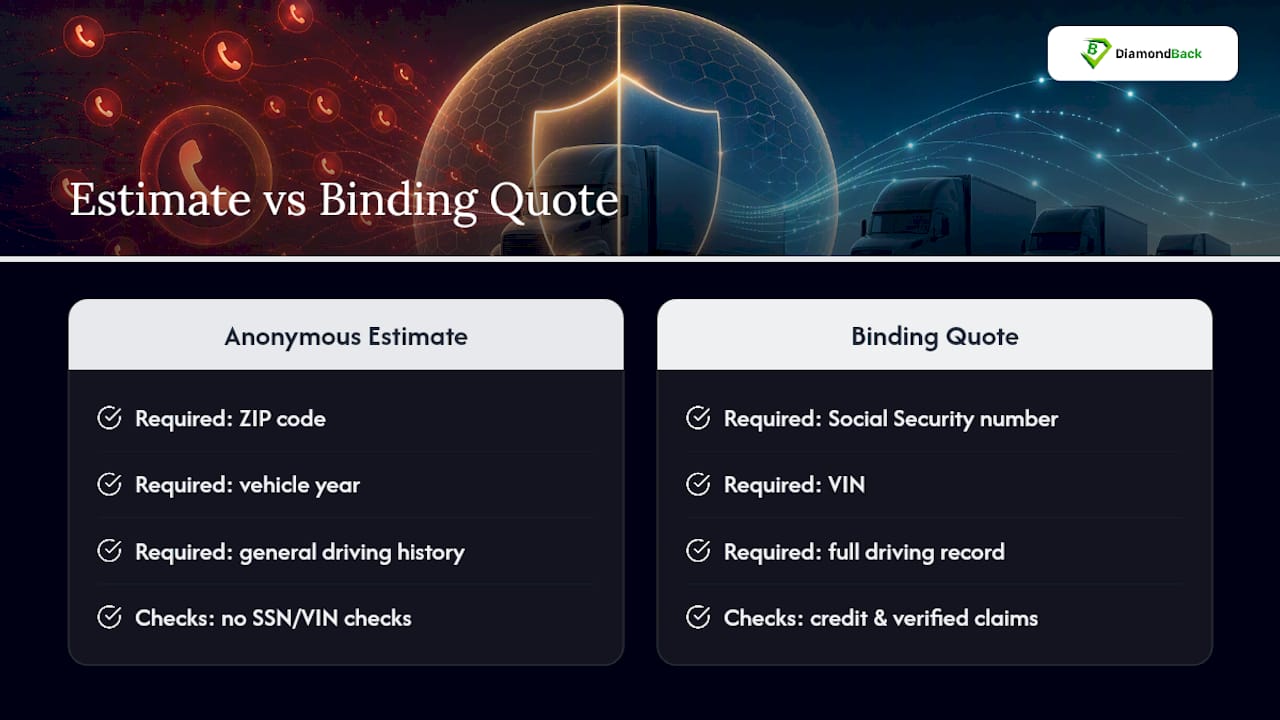
An anonymous estimate and a binding quote answer two different questions. The estimate tells you roughly what you’d pay. The binding quote tells you exactly what you will pay, and it needs a lot more from you to get there.
Fields like your ZIP code, vehicle year, and general driving history refine an estimate but don’t fundamentally change it. Fields like your Social Security number, VIN, and full driving record do change it, sometimes by hundreds of dollars, because they let the insurer pull credit-based scoring and verified claims history. MoneyGeek notes that anonymous calculators skip these deeper checks entirely, which is exactly why they’re faster and safer to use early in the process, but also why the number they return is a range, not a promise.
Insurers require more information at the binding stage because pricing accuracy depends on risk factors an estimate simply can’t see. A ZIP code tells them regional accident rates. A credit-based score and verified driving record tell them your individual risk. That gap is the entire reason estimates and binding quotes exist as separate steps instead of one form.
Use the anonymous stage to build a shortlist of two or three carriers whose estimates land in a similar range. Save your full personal details for those finalists only, rather than distributing sensitive information widely.
Your Privacy-and-Form-Fill Checklist
Getting through a quote form without triggering a wave of calls comes down to a handful of habits, repeated every time.
- Select email-only communication preferences wherever the form offers a choice, and uncheck any box that defaults to marketing consent.
- Use a secondary or temporary number in any mandatory phone field. This keeps your primary line clean if the form’s validation forces a submission.
- Read the privacy policy for “sharing with partners” language before you submit anything. If it’s there, treat the form as a lead-generation funnel rather than a direct quote tool.
- Screenshot every anonymous estimate you receive, with the date and the inputs you used, so you can compare them later without resubmitting the same form.
- Give your full details to only your top one or two picks, once you’ve narrowed the field using estimates alone.
This process protects more than your inbox. It preserves your negotiating position, since you’re comparing real numbers side by side instead of reacting to whichever agent calls first.
Pro Tip: Keep a simple spreadsheet with columns for the platform name, the estimate, the inputs you used, and whether the privacy policy mentioned sharing data with partners. Five minutes of tracking saves you from repeating the same form twice.
How Do You Buy a Policy Without Inviting a Flood of Calls?
Compare first, commit second. Use anonymous estimates to narrow your list to two or three carriers, then research each one’s privacy stance and review history before sharing anything more. This is also the stage where a resource like DiamondBackins’s guide to comparing fleet insurance quotes becomes useful, since it walks through narrowing options without oversharing contact details.
Once you’ve picked a finalist, consider opening a direct account or customer portal with that insurer alone. Set your communication preference to email where possible. From there:
- Document every opt-out you select, including a screenshot or confirmation email, so you have proof if a call comes through anyway.
- Use the insurer’s own customer portal for policy changes and renewals instead of calling in, which also avoids getting re-added to a call list.
- If unwanted calls persist, you have real recourse. The FCC’s consumer complaint process and the national Do Not Call registry both accept reports against companies that call after you’ve opted out.
Fleet operators managing multiple vehicles benefit the most from this workflow, since the volume of quote requests multiplies fast. Locking down preferences once, at account setup, saves a lot of cleanup later.
Why Diamondbackins Fits Shoppers Who Want Quotes Without Calls
Diamondbackins built its quote process around speed and transparency, which happen to be the same qualities that keep unsolicited calls out of the picture. The platform aggregates offers from multiple top insurers for commercial auto, trucking, and fleet coverage, so you’re comparing several real quotes in one place instead of filling out five separate forms across five separate sites.
Expect to move from initial inputs to a usable estimate in minutes, not days. The fields required for that first estimate are limited to vehicle and business details. Full contact and underwriting information only comes into play once you’ve decided to move toward a binding quote with a specific carrier, which mirrors the same estimate-then-bind structure described earlier in this guide.
Because Diamondbackins centralizes the comparison step, you’re not re-entering your information across a dozen lead-generation sites, each one a potential source of a spam call. If you manage a fleet or run a trucking business, a tool like DiamondBackins’s truck insurance calculator can show you what inputs actually move the estimate versus what’s cosmetic. For a deeper look at what’s required once you’re ready to finalize coverage, DiamondBackins’s explainer on trucking insurance essentials breaks down the binding-stage requirements clearly.
Legal and Regulatory Considerations for Anonymous Insurance Quotes
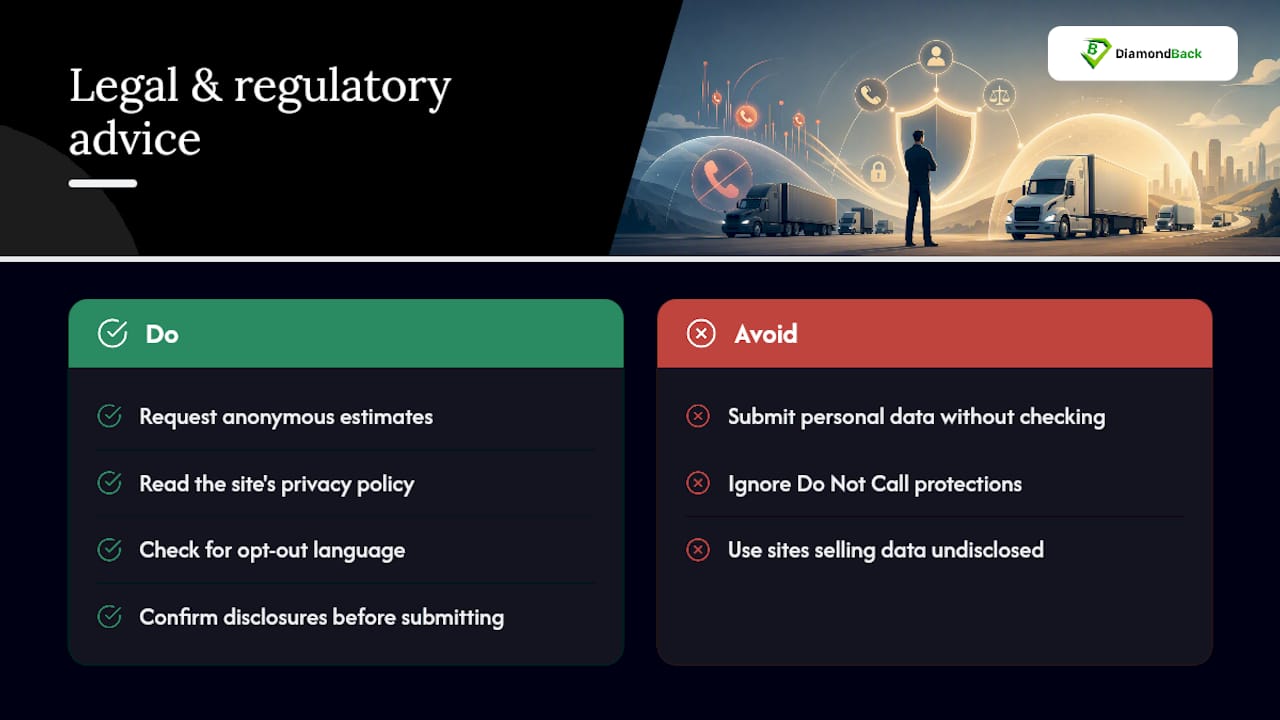
Requesting an anonymous estimate is legal everywhere in the United States, since no law requires you to identify yourself just to see a rate range. The regulatory questions show up later, at the binding and communication stage, not the estimate stage.
Insurers are required to verify identity and gather accurate risk information before issuing a binding policy, largely because state insurance departments regulate how rates get calculated and require insurers to price based on verified data, not guesswork. That’s a consumer protection, not a bureaucratic hurdle. It keeps two drivers with identical anonymous inputs from ending up with wildly different real prices based on incomplete information.
On the communication side, federal rules give you leverage. The Telephone Consumer Protection Act restricts unsolicited marketing calls to numbers on the national Do Not Call registry, and most state insurance departments require clear opt-out language in any privacy policy that collects your data. If a site sells your information to a third party without disclosing that in its privacy policy, that’s the kind of practice consumer protection agencies investigate. Reading the privacy policy before you submit a form isn’t just a smart habit. It’s how you confirm the site is operating within those disclosure rules in the first place.
Why Privacy-First Quoting Actually Changes the Outcome
Most guides treat privacy as a nice-to-have, something you protect after you’ve already gotten your numbers. That’s backwards. The order matters. Shoppers who compare anonymously first, then reveal details only to a finalist, end up with better leverage, not just a quieter phone.
Handing your contact information to five sites at once doesn’t get you five honest quotes. It gets you into five separate follow-up queues, each competing for the same sale, which pressures you toward whichever agent calls fastest rather than whichever policy fits best. Working through estimates first keeps the decision in your hands.
A phone call still has its place once you’re negotiating final terms on a commercial fleet policy with unusual risk factors. That’s a reasonable, informed call. A cold call the day after you typed your ZIP code into a random site is not.
— Vladimir
How Diamondbackins Gets You a Quote Without the Call Center
Diamondbackins builds its process around a simple idea: you should be able to compare real quotes from multiple insurers without triggering a chain of follow-up calls. Enter your vehicle and business details once, and the platform pulls offers from several top carriers so you can compare coverage and pricing side by side.
Fleet managers and trucking business owners tend to get the most value here, since a single request replaces what would otherwise be a string of separate calculator visits and phone conversations—see why tint commercial vehicles is a fleet manager’s guide to protecting assets and lowering risk with better coverage options from NJ Vinyl Wrapz. Before you submit anything, set your communication preference to email only, the same habit this guide has walked through in every section, and you’ll get the comparison without the noise. Ready to see real numbers for your fleet? Start with DiamondBackins’s instant commercial truck insurance quotes and get a range in minutes, not days.
Sources
- How to Get an Anonymous Car Insurance Quote | MoneyGeek
- How do reviews get on Trustpilot? | Trustpilot Help Center
- Insurify profile | BBB