
If your vehicle is owned by your business, used to deliver goods, transport clients, or driven by employees, you most likely need commercial auto insurance instead of a personal policy. A personal policy generally excludes business use, so mixed-use drivers should also look at hired and non-owned auto (HNOA) coverage. Get this wrong and you risk a denied claim right when you need protection most.
TL;DR:
- Commercial auto insurance is required if the vehicle is titled to a business or used for transporting goods, passengers, or paid services more than occasionally.
- Liability limits for commercial policies can start at $750,000 and often exceed $1 million, reflecting higher legal and third-party exposure.
- Commercial coverage includes protections like hired and non-owned auto, cargo, trailer interchange, and higher liability caps, which are absent in personal policies.
- Costs for commercial auto insurance vary widely depending on vehicle class, operating scope, and risk factors, often being significantly higher than personal coverage.
- To determine the right policy, carefully map vehicle use, list all drivers, identify exposures, and ask specific questions about coverage scope before obtaining quotes.
Table of Contents
- Commercial Auto vs Personal Auto: The Core Differences
- What Personal Auto Covers, and What Commercial Adds
- When Do You Actually Need Commercial Auto Insurance?
- How Much More Does Commercial Auto Insurance Cost?
- How to Choose Between Commercial and Personal Coverage
- A Publisher’s View on Choosing Between Policies
- Get a Commercial Auto Quote Built Around How You Actually Drive
- Sources
Commercial Auto vs Personal Auto: The Core Differences
The line between personal and commercial coverage comes down to four questions: who owns the vehicle, who drives it, how it’s used, and what class of vehicle it is. Answer those honestly and the right policy usually becomes obvious.
Ownership matters first. A vehicle titled to an LLC, corporation, or sole proprietorship almost always needs a commercial auto insurance policy, regardless of how often it’s actually driven for work. A vehicle titled to you personally can sometimes stay on a personal policy, even with occasional business use, but only if that use is light and disclosed.
Driver behavior is the second factor. Personal policies assume you’re the primary driver, maybe with a spouse or teen listed. Commercial policies are built to cover multiple employees, rotating drivers, and higher combined mileage across a fleet.
Use pushes plenty of otherwise “personal” vehicles into commercial territory:
- Delivering food, packages, or products for pay
- Transporting passengers or clients for a fee
- Hauling tools, equipment, or inventory between job sites
- Driving between multiple work locations during the business day
- Regular commuting alone typically stays personal, but anything resembling paid transport or cargo work does not.
Vehicle class also drives classification. A commuter sedan is easy to insure personally. A cargo van, box truck, or tractor-trailer is a different animal entirely, and most personal insurers won’t touch them once business use enters the picture.
Liability limits are where the real financial exposure lives. Personal auto policies commonly have liability limits in a typical range per person and per accident. Commercial policies, especially for trucking, often start at $750,000 and can climb well past $1 million depending on cargo and DOT filing requirements. Business driving carries more third-party exposure, more miles, and more legal targets in a lawsuit, so insurers price and structure limits accordingly.
What Personal Auto Covers, and What Commercial Adds
Both policy types share a common foundation: liability, collision, comprehensive, and uninsured motorist coverage. If you total your car, someone else’s insurer or yours pays out under largely the same principles whether the policy is personal or commercial.
Commercial auto insurance builds on that base with protections a personal policy simply doesn’t offer:
- Hired and non-owned auto (HNOA): covers liability when employees drive their own cars or a rental for business errands, though it typically doesn’t cover physical damage to that vehicle
- Motor truck cargo: protects freight you’re hauling for others
- Trailer interchange: covers trailers you’re pulling under interchange agreements with other carriers
- On-hook towing: protects vehicles you’re towing as part of your business
- Higher liability caps: built to match real-world lawsuit exposure in commercial accidents
Sometimes an endorsement on an existing policy is enough, particularly for a solo contractor who occasionally hauls a trailer. Other times, especially once you’re hiring drivers or crossing state lines regularly, a standalone commercial policy becomes necessary. Interstate trucking operations also face federal filing requirements, including MCS-90 endorsements that guarantee minimum financial responsibility regardless of what the underlying policy actually excludes. If you’re running heavier equipment, a service truck coverage guide walks through which classes typically trigger these requirements.
When Do You Actually Need Commercial Auto Insurance?
Run through these four triggers. If any one applies, a personal policy is probably leaving you exposed.
- The business owns or titles the vehicle. Ownership alone is usually enough to require commercial coverage, even for light, occasional use.
- You transport goods, passengers, or charge fees for driving. Delivery drivers, rideshare-adjacent operations, and courier work all fall outside standard personal auto terms.
- Employees drive the vehicle for work purposes. A personal policy is written around you and your household. It generally won’t extend meaningful protection to an employee driving a business vehicle, and it certainly won’t cover the business itself if that employee causes a serious accident.
- The vehicle is heavy, modified, or central to daily operations. Box trucks, service vehicles loaded with tools, and anything requiring a commercial driver’s license almost always need dedicated coverage.
Everyday examples make this concrete. A landscaping contractor hauling mowers and trimmers between job sites, a caterer running food deliveries, and a small logistics operator using a business van for airport shuttle runs all sit squarely in commercial territory. So does a moving company handling furniture and equipment transport for clients, where cargo exposure alone makes personal coverage inadequate. Regularly delivering products or moving employees between sites is one of the clearest signals that commercial coverage is overdue.
How Much More Does Commercial Auto Insurance Cost?
Commercial premiums run higher than personal ones for a straightforward reason: more drivers, more miles, more cargo exposure, and higher liability limits all add up to more risk on paper. Insurers price accordingly.
Experian reports an average full-coverage personal auto premium near $2,304 annually. Commercial coverage varies far more widely, since it has to price everything from a single pickup truck to a forty-vehicle fleet.
Industry classification moves the needle too. A contractor’s truck insures differently than a delivery van, which insures differently than a long-haul tractor-trailer, largely because driving radius and claims history shift the risk profile so much between those categories.
A few levers actually bring the cost down:
- Choosing HNOA instead of a full fleet policy when business use is occasional
- Installing telematics to document safe driving habits
- Building a documented safety program for multi-driver operations
- Raising deductibles where cash flow allows it
Occupation, DOT filing status, and operating radius all factor into your specific quote, which is why generic online estimates rarely match what you’ll actually pay. A closer look at what actually moves commercial rates helps explain why two similar-looking businesses can get very different numbers.
How to Choose Between Commercial and Personal Coverage
Work through this sequence before you call an agent or request a quote:
- Map exactly how the vehicle is used. Separate personal errands from business driving, and be honest about the split.
- List every driver. Include employees, contractors, and anyone else who might get behind the wheel for work.
- Identify the vehicle class. A sedan, van, box truck, and tractor-trailer all sit in different risk tiers.
- Identify your exposures. Cargo value, passenger transport, and driving radius all shape which endorsements you need.
- Choose limits that match your real liability risk, not just the state minimum.
When you’re on the phone with an insurer or agent, ask direct questions: Does this policy cover employees driving the vehicle? Does it cover personal errands run in a business vehicle? What endorsements are included versus optional? Does HNOA apply to my situation, and what does it exclude?
Watch for red flags. If an insurer hesitates to quote business use clearly, offers vague endorsement language, or pushes you toward liability limits that look thin for your industry, treat that as a warning sign rather than a minor detail.
Pro Tip: Keep a written log of how each vehicle is actually used for thirty days before you shop for coverage. Insurers ask specific questions about mileage split and cargo type, and a real log beats a guess every time.
A Publisher’s View on Choosing Between Policies
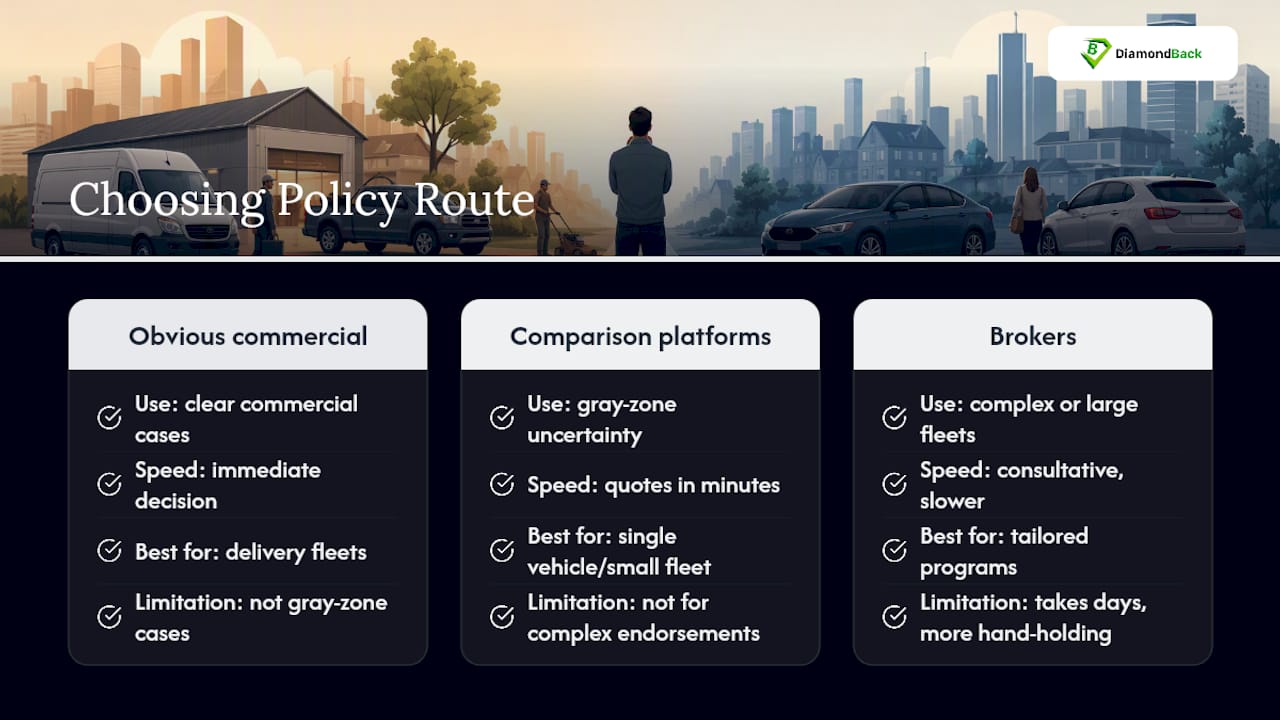
Most business owners don’t get tripped up by the big, obvious cases. Nobody’s confused about whether a delivery fleet needs commercial coverage. The trouble sits in the gray zone: the contractor who mostly commutes but hauls tools twice a week, the small retailer whose delivery van also runs weekend personal errands. That gray zone is exactly where a personal policy quietly stops applying, often without the owner realizing it until a claim gets denied.
Online comparison platforms exist for exactly that gray zone. Instant, tailored quotes across multiple carriers let you see real pricing for a single vehicle or a full fleet in minutes rather than days, which matters most for standard commercial needs where speed beats hand-holding. Complex cargo operations, large fleets, or specialized endorsement stacking still benefit from a broker who can structure a tailored program. For everything in between, comparing carrier responses side by side is often the fastest way to find out whether your instinct about “personal or commercial” was actually right.
— Vladimir
Get a Commercial Auto Quote Built Around How You Actually Drive
Shopping commercial coverage the old way means multiple phone calls, repeated paperwork, and waiting days for quotes to trickle in. This platform cuts that down to minutes by pulling tailored quotes from multiple carriers at once, so you can compare real numbers side by side instead of guessing which agent will call back first.
Whether you’re insuring a single pickup for occasional deliveries or managing a growing fleet, there’s a direct path to a quote built for your situation. Solo operators can start with a quick online quote, delivery and light commercial operators can head straight to box truck coverage, and businesses running multiple vehicles can compare fleet insurance quotes in one pass.
Before you start, gather your vehicle titles, driver list, and a rough estimate of business mileage. Having that ready turns a fifteen-minute quote session into a five-minute one, and gets you a real number instead of a placeholder estimate.
Sources
For deeper detail on specific figures cited above, see Experian’s cost comparison, Forbes Advisor’s commercial auto overview, and Insureon’s coverage comparison.
This article is general information, not a substitute for advice from a qualified financial advisor. Consult a qualified financial professional about your own circumstances before acting on anything here.