

If you’re evaluating diamond-agency.com alternatives for your insurance agency or carrier operation, the strongest options are: Guidewire PolicyCenter, Vertafore Agency Platform, Applied Epic, Sapiens IDIT, BriteCore, Origami Risk, NowCerts, AgencyBloc, FormFire, and Nexsure — plus Diamondbackins as a recommended option when instant commercial quoting is the priority over full policy administration.
Before you read further, one clarification worth making: searching for “diamond-agency.com alternatives” surfaces results from at least three unrelated “Diamond” brands — Diamond Suite (the enterprise policy administration system this article covers), The Diamond Agency (a talent and modeling firm in Orlando), and Diamond-branded consumer car insurance products. This article focuses exclusively on Diamond Suite software alternatives for U.S. insurance agencies and carriers.
Here is your at-a-glance shortlist with one-line verdicts:
- Guidewire PolicyCenter — Best for large carriers needing enterprise-grade policy lifecycle management
- Vertafore Agency Platform — Best for mid-to-large independent agencies wanting deep AMS integrations
- Applied Epic — Best for multi-location agencies that need robust CRM and document management alongside policy admin
- Sapiens IDIT — Best for carriers requiring highly configurable product modeling across complex lines
- BriteCore — Best for regional carriers and mutuals moving to a cloud-native policy admin system
- Origami Risk — Best for risk management professionals and self-insured entities with complex claims needs
- NowCerts — Best for small-to-mid agencies seeking an affordable, cloud-based AMS with solid automation
- AgencyBloc — Best for life and health agencies that need a purpose-built management platform
- FormFire — Best for agencies focused on employee benefits quoting and enrollment workflows
- Nexsure — Best for independent agencies wanting an integrated AMS with built-in accounting
- Diamondbackins — Best for trucking and commercial fleet operators who need instant comparative quotes without a full AMS rollout
Pro Tip: Before you schedule a single demo, confirm whether you need a full AMS or policy administration system (policy lifecycle, billing, claims) or primarily faster access to carrier pricing. That one decision narrows your shortlist from ten to two or three.
Table of Contents
- Which Diamond Suite alternatives actually fit your operation?
- How do these platforms compare side by side?
- How do you choose the right replacement?
- What do pricing and implementation timelines actually look like?
- When is a quoting platform the right alternative to AMS software?
- Key Takeaways
- Why the AMS vs. quoting platform distinction matters more than the vendor name
- Get instant commercial quotes through Diamondbackins
- Useful sources and vendor pages for your evaluation
Which Diamond Suite alternatives actually fit your operation?
Industry resources consistently surface the same ten vendors when buyers evaluate Diamond Suite replacements. What those lists rarely tell you is which buyer profile each one actually serves. Here is what you need to know about each.
Guidewire PolicyCenter is the benchmark enterprise policy administration system for large P&C carriers. It handles the full policy lifecycle — quoting, binding, endorsements, renewals, and cancellations — with deep configurability for complex commercial and specialty lines. Implementation is a major undertaking, typically requiring a dedicated professional services engagement. If you run a regional or national carrier with high transaction volumes and complex product rules, PolicyCenter is worth the investment. For a 10-person independent agency, it is not the right fit.

Vertafore Agency Platform (which includes products like AMS360 and Sagitta) targets mid-to-large independent agencies. Its strength is the breadth of integrations with carrier systems and its established position in the U.S. independent agency market. Agencies already using other Vertafore products benefit from a connected ecosystem. The platform’s depth can feel heavy for smaller shops, but for agencies managing hundreds of commercial accounts, that depth pays off.
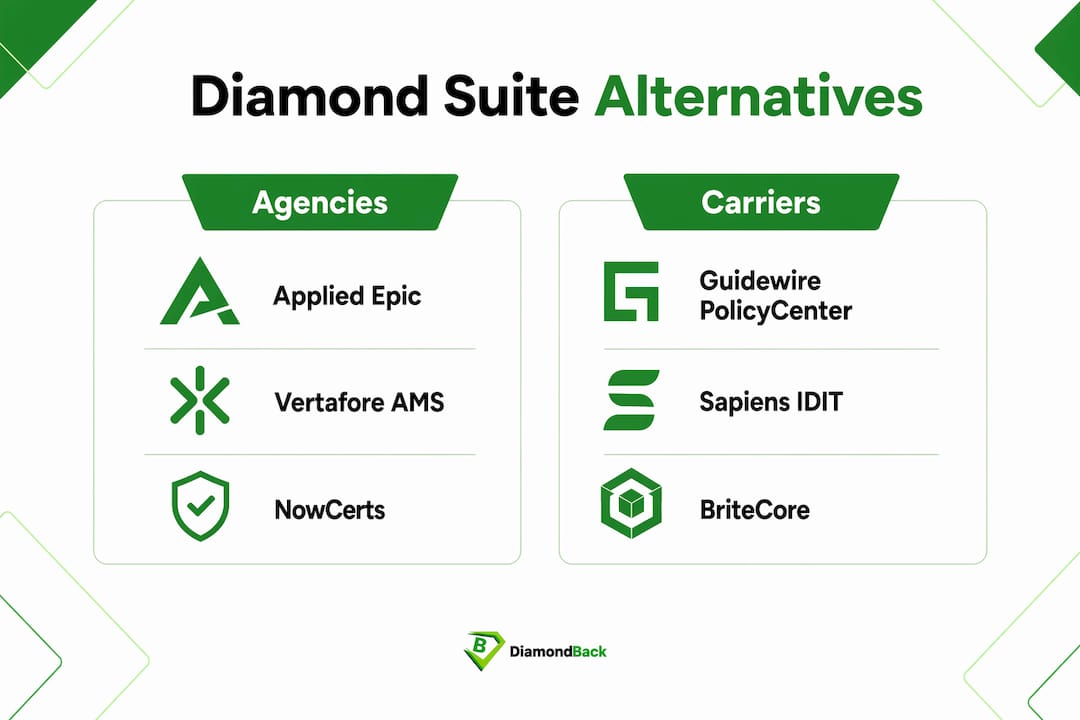
Applied Epic from Applied Systems is the most widely deployed agency management system in North America. It combines policy management, CRM, document management, and real-time carrier connectivity in one platform. Multi-location agencies particularly benefit from its centralized data model. Third-party reviews on G2 and Capterra consistently highlight its reporting capabilities and carrier connectivity as standout features, though users also note a steeper learning curve during onboarding.
Sapiens IDIT (part of the Sapiens core platform suite) is built for carriers that need highly configurable product modeling. It supports property and casualty, life, and specialty lines, and its rules engine allows product teams to launch new coverage options without heavy IT involvement. Sapiens carries SOC 2 attestations and supports both cloud and on-premises deployment. Carriers with complex rate structures or frequent product launches tend to get the most value here.
BriteCore is a cloud-native policy administration system designed specifically for regional carriers, mutuals, and specialty insurers. Its SaaS architecture means no on-premises infrastructure, and its open API framework makes integrations with third-party rating, billing, and claims tools straightforward. BriteCore publishes reference customer case studies and offers sandbox access during evaluation — both positive signals when you are vetting a vendor. It is a strong choice if your carrier is modernizing from a legacy system and wants a faster path to cloud.

Origami Risk focuses on risk management, claims administration, and safety management for self-insured entities, captives, and risk pools. It is not a traditional AMS or carrier PAS, but for risk managers and TPAs dealing with complex claims workflows, it fills a gap that most agency management systems do not. SOC 2 Type II certified, with strong professional services support.
NowCerts is a cloud-based AMS built for small-to-mid-size independent agencies. It covers policy management, certificate issuance, client communication, and basic accounting integrations at a price point that makes sense for agencies that cannot justify enterprise AMS costs. G2 reviewers frequently cite its ease of use and responsive customer support. If your agency has fewer than 20 producers and you want to get live quickly, NowCerts is worth a close look.
AgencyBloc is purpose-built for life and health insurance agencies and general agencies (GAs). It combines AMS functionality with a built-in CRM, commission tracking, and compliance tools tailored to the benefits market. If you are running a P&C shop, AgencyBloc is not the right tool. For a benefits-focused agency managing group and individual health accounts, it is one of the most focused options available.
FormFire specializes in employee benefits quoting and enrollment. It digitizes the data collection process for small group health insurance, reducing paper-based workflows between agencies, employers, and carriers. It is a narrow tool with a specific job: if benefits quoting and enrollment efficiency is your bottleneck, FormFire addresses it directly. It is not a replacement for a full AMS.
Nexsure from XDimensional Technologies is an integrated agency management system that combines policy management, CRM, accounting, and reporting in a single platform. It targets independent agencies that want to consolidate multiple systems. Its built-in general ledger and agency accounting module is a differentiator for agencies that currently manage financials in a separate system. Implementation timelines are moderate, and the vendor offers professional services for data migration.
How do these platforms compare side by side?
Pricing and implementation details vary significantly by agency size, lines of business, and integration complexity. Use qualitative values below as directional guidance, not fixed commitments — always confirm specifics with each vendor during your RFP process.
| Platform | Best for | Core modules | Deployment | Pricing model | API availability | Typical timeline | SOC 2 / Security |
|---|---|---|---|---|---|---|---|
| Guidewire PolicyCenter | Large P&C carriers | Policy admin, billing, claims | Cloud / hybrid | Custom license + services | Yes, extensive | 12–24 months | SOC 2, ISO |
| Vertafore Agency Platform | Mid-to-large agencies | AMS, policy mgmt, carrier connectivity | Cloud / hybrid | Subscription | Yes | 3–6 months | SOC 2 |
| Applied Epic | Multi-location agencies | AMS, CRM, doc mgmt, policy | Cloud | Subscription | Yes | 3–6 months | SOC 2 |
| Sapiens IDIT | Carriers, complex lines | Policy admin, billing, claims, product config | Cloud / on-prem | Custom license | Yes | 12–24 months | SOC 2, ISO |
| BriteCore | Regional carriers, mutuals | Policy admin, billing, claims | Cloud-native | SaaS subscription | Yes, open API | 6–12 months | SOC 2 |
| Origami Risk | Self-insured, captives, TPAs | Risk mgmt, claims, safety | Cloud-native | Subscription | Yes | 3–6 months | SOC 2 Type II |
| NowCerts | Small-to-mid agencies | AMS, certificates, client mgmt | Cloud-native | Per-user subscription | Yes | 2–6 weeks | Documented |
| AgencyBloc | Life & health agencies | AMS, CRM, commissions, compliance | Cloud-native | Per-user subscription | Yes | 2–6 weeks | SOC 2 |
| FormFire | Benefits agencies | Benefits quoting, enrollment | Cloud-native | Subscription | Limited | 2–4 weeks | Documented |
| Nexsure | Independent agencies | AMS, accounting, CRM, policy | Cloud / hybrid | Subscription | Yes | 2–5 months | Documented |
| Diamondbackins | Trucking & commercial fleets | Instant quoting, carrier aggregation | Cloud-native | No implementation fee | API-connected | Minutes | Secure platform |
How do you choose the right replacement?
Start with your operational requirements, not vendor marketing. The single most common selection mistake is evaluating platforms before defining what you actually need them to do.
Prioritized selection checklist:
- Define your scale: number of producers, policy volume, and lines of business
- Identify required modules: policy admin, billing, claims, agent management, or quoting only
- Map your integration dependencies: carrier connections, rating engines, accounting systems, telematics
- Assess migration risk: volume of historical policy data and complexity of data structures
- Confirm data residency requirements: U.S.-only hosting, state-specific compliance obligations
- Evaluate vendor financial stability: public company, private equity-backed, or founder-led — each carries different long-term risk
- Review security attestations: SOC 2 Type II is the baseline; ISO 27001 is a plus for carriers
Questions to ask every vendor during demos or RFPs:
- Do you support bulk policy imports, and what formats do you accept?
- What APIs exist for real-time rating and carrier connectivity?
- What is your average implementation length for an agency our size?
- Can you provide three reference customers in our line of business?
- What does your data migration process look like, and who owns that work?
- Is sandbox or demo environment access available before contract signing?
- How are security attestations (SOC 2, ISO) maintained and renewed?
- What is included in your standard professional services scope?
- How do you handle data ownership and portability at contract end?
- What is your published SLA for system uptime and support response?
- Do you offer a phased rollout option for agencies migrating from a legacy system?
- What training resources are available for producers during go-live?
Red flags to watch for: A vendor that cannot provide a sandbox or demo environment before contract signing is a concern. Vague professional services scopes — where the statement of work lacks defined deliverables and timelines — frequently lead to cost overruns. Any vendor that cannot produce current SOC 2 documentation on request should be pressed hard on security practices. Unclear data ownership language in the contract is a risk you should resolve before signing, not after.
Pro Tip: Run a 30-day Proof of Concept (POC) with your top two finalists. Measure three KPIs: time-to-quote for a standard commercial account, error rate on policy data entry, and producer adoption rate at day 30. Those three numbers will tell you more than any demo.
What do pricing and implementation timelines actually look like?
Understanding cost structure before you enter vendor negotiations protects your budget and your timeline. Most AMS and PAS platforms use one of four pricing models.
Common pricing structures:
- Perpetual license plus annual maintenance: Typically used by on-premises or hybrid platforms; high upfront cost, lower ongoing fees
- SaaS subscription (per-user or per-policy): The most common model for cloud-native platforms; predictable monthly or annual cost that scales with your team
- Per-policy transaction fees: Used by some quoting and aggregation platforms; cost scales directly with volume
- One-time implementation and professional services fees: Separate from the software license; often the largest single cost for enterprise platforms
Typical implementation timelines by buyer size:
- Small agency (1–10 producers), cloud AMS: 2–6 weeks to go-live
- Mid-market agency (10–50 producers), full AMS with integrations: 3–6 months
- Regional carrier, cloud-native PAS: 6–12 months
- Enterprise carrier, full PAS with custom integrations: 12–24 months
Data migration, custom integrations, and staff training are the three cost buckets that most buyers underestimate. Budget for each separately. A mid-market agency migrating core policy admin and billing to a cloud AMS should plan for a 90-day project: roughly 30 days for data mapping and migration, 30 days for configuration and integration testing, and 30 days for user training and parallel running before full cutover. That timeline assumes clean historical data — messy legacy data adds weeks.
For fleet-specific insurance workflows, the integration between your AMS and telematics or fleet management systems is often the longest-lead item. Confirm API availability and integration support with your vendor before you finalize the project plan. Fleet operators managing vehicles across multiple states may also want to review fleet management service options that connect to insurance and maintenance workflows.
When is a quoting platform the right alternative to AMS software?
The answer depends on what problem you are actually trying to solve. An online quoting and aggregation platform is the right choice when your priority is speed-to-quote, lower upfront cost, and immediate access to multiple carriers. A full AMS or PAS is required when you need deep policy administration, claims workflow automation, billing management, or carrier-grade system integrations.
Here is a simple decision flow. If your primary need is to get comparative quotes in front of commercial clients quickly, reduce the time your producers spend on manual carrier submissions, or give trucking and fleet customers a self-service quoting experience — an aggregation platform addresses that directly, without a six-month implementation. If you need to manage the full policy lifecycle from bind through renewal, automate claims intake, or consolidate agency accounting, you need an AMS or PAS.
A practical example: A small trucking fleet operator with five to fifteen trucks needs commercial auto liability, physical damage, and cargo coverage. They do not need a policy administration system. What they need is fast access to competitive quotes from multiple carriers, the ability to compare options side by side, and the ability to bind coverage the same day. Diamondbackins is built for exactly that scenario — instant, tailored quotes for trucking and commercial vehicle risks, aggregated from multiple insurers, with direct purchase available online. For a buyer in that position, a full AMS rollout would be the wrong tool for the job.
Diamondbackins aggregates quotes from multiple top insurers, covers trucking, commercial auto, fleet, freight, and related risks, and lets buyers compare and purchase coverage entirely online. For agencies or fleet operators whose bottleneck is quote speed and carrier access rather than back-office policy administration, that is a materially different value proposition than a six-month AMS implementation.
One clarification worth stating plainly: Diamondbackins is not a substitute for a full AMS when complex claims automation, deep policy admin, or carrier-grade integrations are required. The platform is purpose-built for fast commercial quoting and direct purchase, not for managing the full policy lifecycle of a large agency book of business.
Key Takeaways
The right Diamond Suite alternative depends on your buyer type, required modules, and whether you need full policy administration or primarily faster quoting access.
| Point | Details |
|---|---|
| Match platform to buyer type | Large carriers need Guidewire or Sapiens; mid-market agencies fit Applied Epic or Vertafore; small agencies should evaluate NowCerts or Nexsure. |
| Confirm modules before shortlisting | Define whether you need policy admin, claims, billing, and AMS — or only quoting and carrier access — before contacting vendors. |
| Budget for hidden costs | Data migration, integrations, and training are separate from software fees and often the largest cost items in an AMS project. |
| Run a 30-day POC | Measure time-to-quote, error rate, and producer adoption before signing — these three KPIs reveal fit better than any demo. |
| Diamondbackins for fast quoting | For trucking and commercial fleet operators who need instant comparative quotes without a full AMS rollout, Diamondbackins is the practical alternative. |
Why the AMS vs. quoting platform distinction matters more than the vendor name
Most buyers searching for similar agencies to diamond-agency.com or best alternatives to diamond-agency.com spend too much time comparing vendor feature lists and not enough time asking whether they need a full AMS at all. The vendor selection process in insurance software tends to be driven by the loudest voices in the room — usually IT and operations — who default to the most feature-complete option. That bias toward complexity is expensive.
The real question is not “which AMS has the most modules?” It is “what is the actual bottleneck in my current operation?” For a large carrier, the bottleneck is usually policy lifecycle management and claims automation. For a small trucking agency or fleet operator, the bottleneck is almost always quote speed and carrier access. Those are fundamentally different problems, and they require fundamentally different tools.
Buyers who conflate the two categories end up either over-investing in enterprise software they cannot fully use, or under-investing in a lightweight quoting tool that cannot support their back-office needs. The checklist and decision flow in this article are designed to prevent both mistakes. Define the problem first, then select the tool.
Get instant commercial quotes through Diamondbackins
If your priority is fast, competitive quotes for trucking, commercial auto, or fleet coverage, Diamondbackins gives you direct access to multiple top insurers in one place, with no lengthy implementation and no per-seat software fees.
You can compare tailored quotes for commercial trucking, fleet, freight, and related risks, then bind coverage online in minutes. For fleet managers and trucking business owners who need coverage secured quickly, the fleet manager’s coverage guide walks through the specific coverage types relevant to your operation. When you are ready to see real numbers, get an instant commercial truck quote and compare your options today.
Useful sources and vendor pages for your evaluation
Use these resources to start demos, review documentation, and validate security attestations during your vendor selection process.
- Alternative.me — Diamond Suite alternatives: A starting point for discovering commonly evaluated vendors; useful for initial shortlisting, but follow up with vendor docs and case studies for depth.
- Insuresoft: A U.S.-based insurance software provider; review their platform documentation and request a demo to assess fit for your lines of business.
- Similar.Agency: A directory for discovering specialist agencies and vendors; useful for initial discovery, not a substitute for a structured demo or POC.
- Diamondbackins — instant trucking quotes: For trucking and commercial fleet operators who need immediate carrier access and comparative pricing without a software implementation.
- Trucking insurance explained: A practical primer on coverage scope for commercial trucking risks — useful context before you evaluate any quoting or AMS platform.
When you contact any vendor on this list, request current SOC 2 documentation and ask for sandbox access before you sign anything. A vendor confident in their platform will provide both without hesitation.