

Inland marine insurance is a specialized property coverage that protects your business assets while they’re in transit over land or temporarily stored away from your main location. If your company regularly moves equipment, tools, or high-value goods to job sites, customer locations, or third-party warehouses, your standard commercial property policy likely leaves those assets unprotected the moment they leave your address. Start by inventorying every piece of mobile or high-value property your business owns, then request an inland marine quote. Diamondbackins makes that process straightforward with instant quotes from multiple carriers.
Table of Contents
- What is inland marine insurance and how does it differ from other coverage?
- Why is it called “inland marine” if there’s no water involved?
- What does inland marine insurance typically cover?
- What inland marine policies usually don’t cover
- Who needs inland marine coverage?
- How inland marine policies are structured
- Common causes of inland marine losses and how to prevent them
- What affects the cost of inland marine coverage?
- How to buy inland marine coverage: a practical checklist
- Key Takeaways
- Why inland marine deserves more attention than most business owners give it
- Get instant inland marine quotes through Diamondbackins
- Useful sources and further reading
What is inland marine insurance and how does it differ from other coverage?
Inland marine insurance is a U.S. property insurance category that covers business property, including tools, construction equipment, inventory, and specialty assets, while in transit over land or temporarily stored off-site. It fills the gap that standard commercial property policies leave open.
A Business Owner’s Policy (BOP) or Commercial Property Policy covers items at your listed business address. The moment a contractor loads tools onto a truck and drives to a job site, that coverage stops. Inland marine picks up exactly where commercial property leaves off, following your assets to wherever work takes them.
The contrast with ocean marine is simpler: ocean marine covers water transit, while inland marine covers land-based transportation by truck or train, plus certain stationary assets tied to transportation infrastructure. The two lines are distinct products with separate policy forms.
Here is where inland marine fits in a typical insurance program:
- Commercial property / BOP: Covers fixed assets at your listed location.
- Inland marine: Covers movable property in transit or off-site.
- Ocean marine: Covers cargo and vessels on water.
- Commercial auto: Covers the vehicle itself, not the cargo or equipment inside it.
Why is it called “inland marine” if there’s no water involved?
The name is a historical artifact, not a description of what the coverage does today. When U.S. insurance markets developed in the 19th century, ocean marine underwriters already had established expertise in covering goods in transit. As commerce moved inland by rail and road, insurers extended those same underwriting principles to land-based transit, retaining the “marine” label.
The practical takeaway: ignore the word “marine.” This coverage is entirely land-based, applying to trucks, trains, and temporary storage locations across the country. Inland marine covers land-based transportation and certain stationary items instrumental to transport or communication, such as bridges and radio towers, but water transit is not part of it.
What does inland marine insurance typically cover?
Coverage categories vary by insurer and policy form, but most inland marine policies address the following asset types. Many forms are customizable, and endorsements can expand or restrict coverage depending on your specific operations.
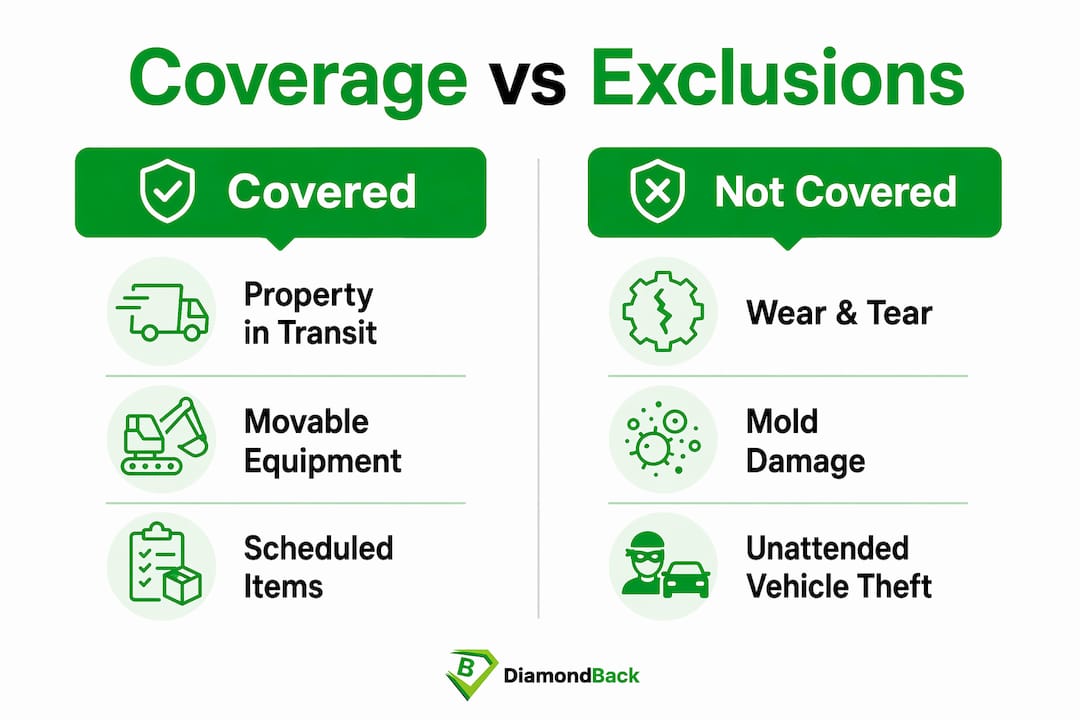
- Property in transit: Goods moving by truck or train. Example: a manufacturer shipping finished products to a distributor; if the truck is involved in a collision, the cargo claim falls under inland marine.
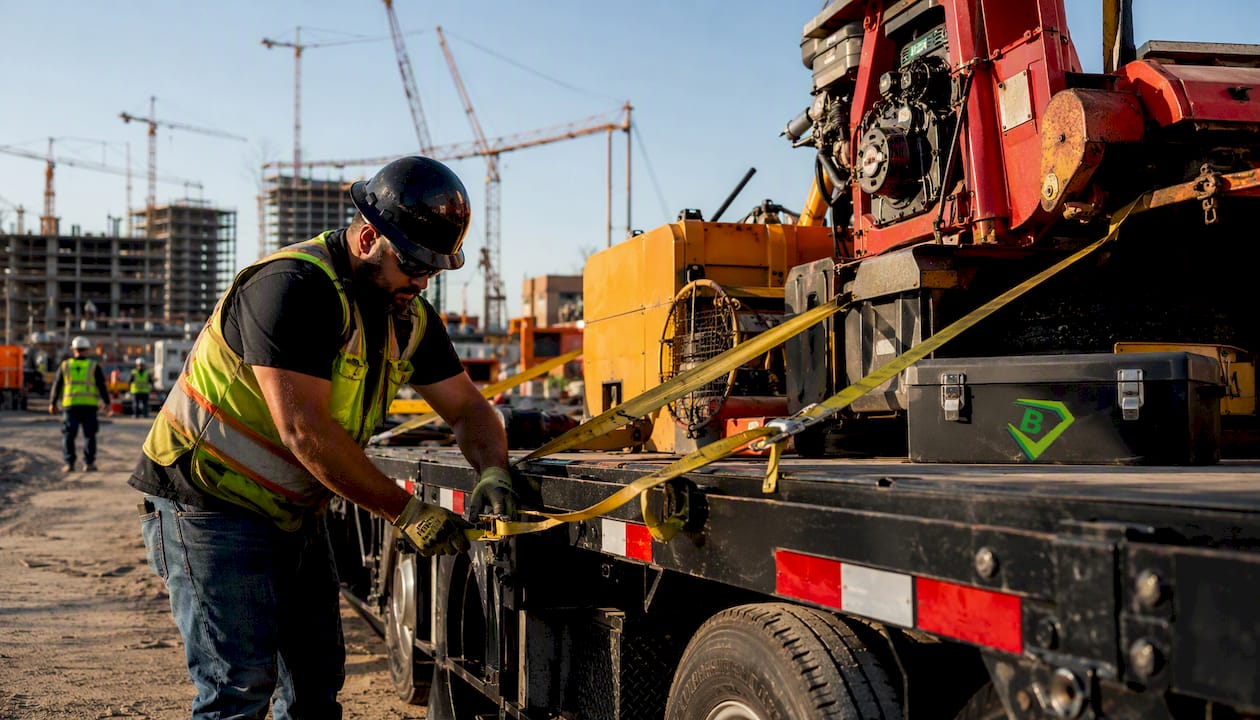
- Contractors’ equipment: Heavy machinery and tools used at job sites. Example: a bulldozer parked overnight at a construction site is covered even though it’s miles from the contractor’s office.
- Scheduled valuable items: Fine art, cameras, jewelry, or other high-value assets listed individually on the policy. Example: a gallery loans a painting to a museum exhibit; the piece is covered during transport and display.
- Mobile medical and computer equipment: Diagnostic devices, laptops, and portable medical units that move between clinics or client sites.
- Bailee’s customer property: Coverage for goods belonging to your customers that are in your care, custody, or control. Example: a dry cleaner holding customers’ garments, or a repair shop storing a client’s equipment.
- Builders’ risk and installation floaters: Materials and equipment during construction or installation projects, from the time they leave the supplier until the project is complete.
- Motor truck cargo: Goods being transported by a for-hire trucker. For deeper detail on cargo-specific protections, the coverage terms and pricing factors differ from general inland marine floaters.
IRMI defines inland marine coverage to include property in transit over land, movable property that frequently changes locations, instrumentalities of transportation or communication, and bailees’ legal liability exposures.
What inland marine policies usually don’t cover
Knowing the exclusions is as important as knowing what’s covered. Most inland marine policies share a common set of gaps.
Typical exclusions include wear and tear, gradual deterioration, damage from insects or mold, and, unless endorsed, losses from flood or earthquake. Property that was already damaged before a shipment began is also excluded, as is the vehicle itself (covered under your commercial auto policy, not inland marine).
A frequent claims trap worth knowing: theft from an unattended vehicle. Standard commercial property policies commonly exclude this exposure. An inland marine floater can be written to cover it, but only if you declare that exposure clearly when you apply.
Pro Tip: Ask your broker specifically whether flood, earthquake, and theft-from-vehicle are included or excluded on any inland marine form you’re reviewing. Each of these can often be added by endorsement, but only if you ask before a loss occurs.
Who needs inland marine coverage?
Industry guidance treats inland marine not as an optional add-on but as a necessary risk-management tool for any business that regularly moves high-value or customer property that standard property policies don’t fully cover.
The industries most commonly exposed include:
- Construction and specialty contractors: Equipment leaves the yard daily.
- Art handlers and exhibitors: High-value pieces move between galleries, auction houses, and museums.
- Medical equipment lessors: Portable diagnostic units travel between facilities.
- Repair shops and service businesses: Customer property sits in your shop under a bailee exposure.
- Freight haulers and delivery services: Motor truck cargo coverage is a core inland marine product.
- Event companies: Audio-visual gear, staging, and production equipment move constantly.
Consider these red flags for your own business. If any of these apply, you likely need inland marine coverage:
- You regularly work off-site and take tools or equipment with you.
- You ship goods by truck or train on a recurring basis.
- You hold customer property at your location or in transit.
- You own high-value portable equipment (cameras, medical devices, specialized tools).
- You store materials or inventory at third-party warehouses.
Each red flag carries real financial exposure. A contractor whose $80,000 equipment trailer is stolen from a job site overnight has no commercial property recourse because the property wasn’t at the listed address. A repair shop whose customer’s machine is damaged in a fire faces liability that a standard BOP may not cover.
How inland marine policies are structured
Inland marine policies are commonly called “floaters” because coverage follows the insured property rather than being tied to a fixed location. Understanding the key structural terms helps you compare quotes accurately.

| Term | What it means | Practical impact |
|---|---|---|
| Floater | Policy that travels with the property | Covers assets at any location, not just your address |
| Scheduled coverage | Each item listed with its own value and limit | Faster claims, less valuation dispute, required for high-value items |
| Unscheduled (blanket) coverage | A single limit covers a group of items | Simpler to manage, but limits may be inadequate for any one item |
| Named perils | Only losses from listed causes are covered | Lower premium, but gaps if an unlisted cause damages property |
| All-risk (open perils) | All causes covered except listed exclusions | Broader protection, typically higher premium |
| Bailee’s coverage | Covers customer property in your care | Critical for repair shops, dry cleaners, storage facilities |
| Transit coverage | Covers property specifically while moving | Applies from loading to delivery; check territorial limits |
A scheduled item has its proven value and limit listed on the policy, which reduces valuation disputes and often simplifies claims for high-value items. If you carry a blanket limit of $50,000 across ten pieces of equipment and one item worth $40,000 is destroyed, the blanket limit may leave you underinsured after the deductible. Scheduling that item separately eliminates the ambiguity.
Most inland marine policies have deductibles and distinguish between named perils and all-risk wording. Confirm the wording before you bind.
Common causes of inland marine losses and how to prevent them
Collision and cargo theft are the two most frequent causes of inland marine losses, according to the Insurance Information Institute. Both are largely operational risks, meaning your procedures directly affect your exposure.
| Inland marine at a glance | Detail |
|---|---|
| Share of U.S. property/casualty premiums | ~2%, but often a higher share of underwriting profit |
| Top loss causes | Collision, cargo theft |
| Coverage trigger | Property leaves fixed location or is in transit |
Common operational risk drivers include improper loading that shifts cargo during transit, vehicles left unsecured overnight at job sites or truck stops, and unvetted third-party warehouses with inadequate security controls.
Practical prevention steps you can take now:
- Use cargo locks and sealed containers for high-value shipments.
- Document loading procedures and train drivers on proper securing techniques.
- Plan routes to avoid high-theft corridors when possible.
- Tag and photograph all scheduled equipment before it leaves your facility.
- Vet warehouse partners for security certifications and loss history.
For a broader view of how insurance in transportation connects to operational risk controls, the regulatory and procedural context is worth reviewing alongside your inland marine program.
What affects the cost of inland marine coverage?
Inland marine premiums vary widely because the coverage is highly tailored. Insurers price based on the specific risk profile of your property and operations, not a flat rate.
Key cost drivers include:
- Value and type of property: A $500,000 piece of medical imaging equipment costs more to insure than a $10,000 tool set.
- Transit frequency and distance: A business shipping goods daily across multiple states pays more than one making occasional local deliveries.
- Mode of transport: Truck and rail carry different risk profiles; open flatbeds differ from sealed containers.
- Security controls: Cargo locks, GPS tracking, and secure storage reduce premiums.
- Claims history: Prior losses signal higher risk to underwriters.
- Scheduled vs. unscheduled: Scheduling high-value items can actually reduce premium disputes and sometimes lower the rate by giving the insurer precise data.
- Deductible selection: Higher deductibles reduce premiums but increase your out-of-pocket exposure per claim.
- Geographic exposure: Operating in high-theft metro areas or regions prone to severe weather affects pricing.
Consider two scenarios: a small contractor with a $30,000 tool trailer making local trips will pay a modest annual premium for a blanket floater. A single fine-art shipment of a $2 million painting from New York to Los Angeles, by contrast, may require a scheduled policy with specific transit conditions, security requirements, and a premium reflecting the concentrated value and transit risk.
Pro Tip: Schedule high-value items individually rather than grouping them under a blanket limit. It reduces valuation disputes at claim time and gives underwriters the data they need to price the risk accurately, which can work in your favor.
How to buy inland marine coverage: a practical checklist
Preparation makes the quoting process faster and the resulting policy more accurate. Here is what to gather before you contact an insurer or use Diamondbackins’s instant quote platform.
- Complete property inventory: List every item you want covered, including make, model, serial number, and current replacement value. Items left off the inventory may not be covered.
- Proof of values: Appraisals, purchase receipts, or recent valuations for high-value items. Scheduled coverage requires documented values.
- Transit details: Typical routes, modes of transport (truck, rail, intermodal), frequency of shipments, and average shipment value.
- Storage locations: Addresses of any off-site storage, third-party warehouses, or job sites where property regularly stays overnight.
- Security controls documentation: Cargo lock types, GPS tracking systems, warehouse security certifications, and driver vetting procedures.
- Prior claims history: Five years of inland marine or commercial property claims, including amounts paid and cause of loss.
- Bailee exposure details: If you hold customer property, describe the type of goods, typical value, and how long you hold them.
Questions to ask your insurer or broker before binding:
- Does the policy cover all transit territories where I operate, including cross-state shipments?
- Is theft from an unattended vehicle included or excluded?
- Are flood and earthquake covered, or must I endorse them separately?
- How does the claims process work for a scheduled item versus a blanket item?
- What documentation will you require at claim time?
Preparing this information before your quote conversation means underwriters can price your risk accurately and you avoid surprises at claim time. Diamondbackins lets you enter this information online and receive instant quotes from multiple carriers, so you can compare options without scheduling multiple broker appointments. For freight insurance online, the same instant-quote workflow applies.
Key Takeaways
Inland marine insurance is the coverage your business needs the moment your property leaves its home address, and the most common losses, collision and cargo theft, are both preventable with the right operational controls.
| Point | Details |
|---|---|
| Core definition | Inland marine covers movable business property in transit over land or temporarily stored off-site. |
| Red flags for needing coverage | Regular off-site work, frequent shipments, holding customer property, or high-value portable equipment all signal a gap in standard commercial property coverage. |
| Top loss causes | Collision and cargo theft are the leading inland marine loss drivers; secure loading and cargo locks reduce both exposures. |
| Scheduled vs. unscheduled | Scheduling high-value items individually prevents valuation disputes and often simplifies the claims process. |
| Diamondbackins next step | Use Diamondbackins to inventory your mobile assets and get instant inland marine quotes from multiple carriers online. |
Why inland marine deserves more attention than most business owners give it
Most business owners I speak with assume their BOP or commercial property policy covers everything they own. That assumption holds until a $60,000 piece of equipment is stolen from a job site overnight or a shipment is destroyed in a highway collision, and the claim is denied because the property wasn’t at the listed address.
What the conventional wisdom misses is that inland marine isn’t a niche product for art galleries and museums. It’s the coverage gap that affects contractors, repair shops, medical equipment managers, and freight operators every day. The “marine” label throws people off, and insurers haven’t done a great job of marketing it plainly. But the exposure is real, and the fix is straightforward once you know what to look for.
The scheduled-versus-unscheduled distinction is where most buyers leave money and protection on the table. A blanket limit feels simpler, but it creates ambiguity at claim time that benefits the insurer, not you. Scheduling your highest-value items takes an extra ten minutes at application and can save weeks of negotiation after a loss.
Get instant inland marine quotes through Diamondbackins
If your business moves equipment, ships goods, or holds customer property, you have an inland marine exposure. The question is whether you have coverage that matches it.
Diamondbackins is an online quote and comparison platform that aggregates inland marine and commercial transportation coverage from multiple top-rated carriers. Fleet operators, contractors, shippers, and repair shops can enter their property details once and receive tailored quotes in minutes, without the back-and-forth of traditional broker appointments. The platform is built for business owners who need accurate coverage quickly, with full transparency on limits, deductibles, and policy terms before they buy. Get your instant truck insurance quote today, or explore trucking insurance options to see how inland marine fits into a complete commercial transportation program.
Useful sources and further reading
The following authoritative sources informed this article and offer deeper study on inland marine insurance and related coverage lines.
- Insurance Information Institute (Triple-I): The primary industry authority on inland marine definitions, coverage scope, and loss causes. Start here for foundational guidance.
- IRMI — Inland Marine Coverage Definition: The Insurance Risk Management Institute’s precise technical definition, including bailee exposures and instrumentalities of transportation.
- Investopedia — Inland Marine Insurance Explained: Accessible overview of floaters, scheduled vs. unscheduled coverage, deductibles, and the buyer checklist.
- NerdWallet — What Is Inland Marine Insurance?: Practical guide to exclusions, endorsements, and how to compare policies.
- Wikipedia — Inland Marine Insurance: Historical origin of the term, scope of land-based transit coverage, and the distinction from ocean marine.
- Travelers Insurance — Inland Marine: Carrier-level guidance on covered property categories including construction, fine art, and renewable energy equipment.
- The Institutes: Professional education and credentialing body for the U.S. insurance industry; authoritative on policy form standards and underwriting principles.
- RideScouts — The Role of Insurance in Transit: Practical buyer perspective on transit insurance, regulatory considerations, and operational controls for transportation businesses.
Recommended
- Marine Insurance and Insurable Interest What You Need to Know – Diamondback Insurance – Solutions with Instant Online Quotes
- Trucking Insurance Explained: What You Need to Know
- Understanding Trucking Insurance Rates: What You Need to Know
- Marine Insurance in Simple Words What You Need to Know – Diamondback Insurance – Solutions with Instant Online Quotes