

Commercial auto symbols are the numeric codes on your declarations page that tell your insurer which vehicles are actually covered under each part of your policy. Get the wrong symbol, and you can own a truck, pay your premium on time, and still have no coverage the day you file a claim. Your first move: open your policy to Item Two, find the symbols listed next to each coverage, and confirm you have Symbols 8 and 9 (Hired and Non-Owned Auto coverage) if anyone ever drives a rental or their own car for business.
TL;DR:
- Ensuring symbols 8 and 9 are listed next to each coverage is crucial for protecting rental cars and employee vehicles used for business purposes.
- Physical damage coverage usually relies on Symbols 2 or 7, with symbol 2 covering all owned autos and symbol 7 covering scheduled vehicles by VIN.
- Common mistakes include missing hired and non-owned auto coverage, failing to report new vehicles within 30 days, and assuming symbol consistency when switching insurers.
- Custom symbols created through the CA 99 54 endorsement address unique ownership or leasing arrangements but require careful review of endorsement details.
- Regularly reviewing and updating symbols before renewals, especially after fleet changes, prevents silent coverage gaps and ensures claim eligibility.
Table of Contents
- Where Commercial Auto Symbols Live on Your Policy
- Symbols 1 Through 9: A Quick Reference Chart
- Matching Symbols to Liability, Physical Damage, and State Coverages
- Custom Symbols and the CA 99 54 Endorsement
- Common Symbol Mistakes That Create Silent Coverage Gaps
- A Practical Checklist for Verifying Your Symbols
- Diamondback Insurance Resources for Fleet Owners
- Why This Deserves More Attention Than It Gets
- How Diamondback Insurance Helps You Get the Right Symbols
- Sources
Where Commercial Auto Symbols Live on Your Policy
Every Business Auto Policy built on the ISO CA 00 01 form uses covered-auto designation symbols to spell out which vehicles qualify for protection. You will find them on the declarations page under a section usually labeled Item Two: Covered Autos.
That section is not decorative. The symbols listed there are the actual boundary of your coverage, and different coverage parts can carry different symbols entirely. A single policy might show:
- Symbol 1 for Liability
- Symbol 7 for Physical Damage
- Symbols 8 and 9 for Hired and Non-Owned Autos
Each row on that page functions independently. Your liability coverage might protect any vehicle your business operates, while your physical damage coverage only protects the specific trucks scheduled by VIN. Read each coverage line on its own terms, not as one blanket promise.
Symbols 1 Through 9: A Quick Reference Chart
The nine standard symbols cover nearly every ownership and usage scenario a commercial fleet runs into. InsureTutor’s breakdown of Symbols 1 through 9 remains one of the clearest plain-language references available, and the categories below reflect that same structure.
| Symbol | Covers | Typical Use |
|---|---|---|
| 1 | Any “Auto” | Broadest option, usually restricted to liability only |
| 2 | Owned Autos | Vehicles titled to the business, including ones acquired mid-term |
| 3 | Owned Private Passenger Autos | Cars and light vehicles the business owns |
| — | Owned Autos Other Than Private Passenger | Trucks and commercial vehicles the business owns |
| 5 | Owned Autos Subject to No-Fault | Triggered in states with no-fault insurance laws |
| 6 | Owned Autos Subject to Compulsory UM | Triggered in states requiring uninsured motorist coverage |
| 7 | Specifically Described Autos | Scheduled vehicles listed by VIN, the narrowest option |
| 8 | Hired Autos | Vehicles you rent, lease, or borrow for business use |
| 9 | Non-Owned Autos | Employee or third-party vehicles used for business purposes |
Symbol 1 gives you the widest net, but carriers frequently restrict it to liability coverage alone because of the open-ended exposure it creates. Symbol 7 sits at the opposite extreme. It only covers the vehicles specifically named on the schedule, which makes it cheap but risky for any fleet that changes often.
Symbols 5 and 6 do not show up on every policy. They activate based on your state’s no-fault or compulsory uninsured motorist rules, which is one reason state UM requirements vary so widely across the country. Symbols 8 and 9 together form what the industry calls HNOA, Hired and Non-Owned Auto coverage, and it is the single most overlooked piece of a small fleet’s policy.
Matching Symbols to Liability, Physical Damage, and State Coverages
Liability and physical damage almost never share the same symbol, and assuming they do is where a lot of business owners get burned. Symbol 1 typically applies to liability because carriers are willing to extend broad third-party protection more freely than they are willing to insure the physical value of every vehicle you might ever drive.
Physical damage coverage, by contrast, usually runs on Symbol 2 or Symbol 7:
- Symbol 2 covers all owned autos, including ones you buy mid-term, and fits fleets with steady turnover.
- Symbol 7 covers only the vehicles scheduled by VIN, and fits fleets with stable, unchanging equipment.
- Combo example one: Liability on Symbol 1, Physical Damage on Symbol 7, common for owner-operators with one or two trucks.
- Combo example two: Liability on Symbol 2, Physical Damage on Symbol 2, common for growing fleets that add vehicles regularly.
UM and PIP coverage follow a different logic entirely. Symbols 5 and 6 exist because your state, not your carrier, decides whether no-fault or compulsory uninsured motorist coverage applies. Confirm which of those symbols shows up on your policy and whether your state law requires them before you assume you are covered.
Custom Symbols and the CA 99 54 Endorsement
Standard symbols cover most fleets, but some ownership structures need something more specific. The CA 99 54 endorsement lets carriers create custom covered-auto symbols, often numbered 10, 32, 51, 52, 72, or 73, to address leases, third-party ownership, or specialized equipment.
Symbol 10, for example, sometimes appears for mobile equipment that does not fit neatly into the standard nine categories. These custom definitions live inside the endorsement text itself, not in the symbol chart you already know. Never guess at what a nonstandard number means. Pull the endorsement, read its exact wording, and if anything is unclear, ask your broker to confirm the definition in writing before you rely on it.
Common Symbol Mistakes That Create Silent Coverage Gaps
Practitioner guides consistently point to the same handful of symbol errors causing denied claims. Here are the three that surface most often, along with the fix for each:
- Missing HNOA coverage. Without Symbols 8 and 9, a rental truck or an employee’s personal car used for a delivery run has zero protection under your commercial policy. Add both symbols if anyone besides your scheduled fleet ever drives for business.
- Symbol 7 reporting failures. Scheduled-auto policies often require you to report a newly acquired vehicle within 30 days for automatic coverage to apply. Miss that window and the new truck may not be covered at all.
- Carried-over assumptions from a prior carrier. Switching insurers does not guarantee your new policy uses the same symbols as your old one. Recheck Item Two every time you change carriers.
Pro Tip: Request Symbols 2, 8, and 9 together if your carrier won’t offer Symbol 1 for liability. That combination approximates the same breadth without the moral-hazard flag that makes some underwriters decline Symbol 1 outright.
A Practical Checklist for Verifying Your Symbols
Run through this before renewal, after any fleet change, or the next time you talk to your broker:
- Pull your declarations page and locate Item Two. Confirm which symbols apply to liability, physical damage, and UM/PIP separately.
- List every actual use case for your vehicles. Rentals, employee cars, leased equipment, and owned trucks all need their own symbol match.
- Confirm your new-auto reporting deadline. If you carry Symbol 7, know the exact timeframe for adding a newly acquired vehicle.
Ask your broker directly about HNOA, any custom endorsements attached to your policy, and how your state’s UM or PIP rules affect Symbols 5 and 6. Bring your fleet schedule, rental agreements, and a current driver list to that conversation.
Pro Tip: Keep a running log of every vehicle added or removed from your fleet throughout the year. It turns a stressful renewal scramble into a five-minute cross-check against your existing symbols.
Diamondback Insurance Resources for Fleet Owners
Diamondbackins built a short guide on trucking insurance symbols and a deeper breakdown of service truck coverage types to help fleet owners connect symbol definitions to real coverage decisions. Diamondbackins’s instant-quote flow also surfaces mismatches between what you actually operate and what a quoted policy would cover, so you can compare symbol options side by side before you buy.
Why This Deserves More Attention Than It Gets
Most business owners treat their declarations page as paperwork to file away, not a document to actually read. That is backwards. The symbols on that page are doing more work than your liability limits or your deductible in determining whether a claim gets paid, because a high limit on a vehicle that is not covered at all is worth nothing.
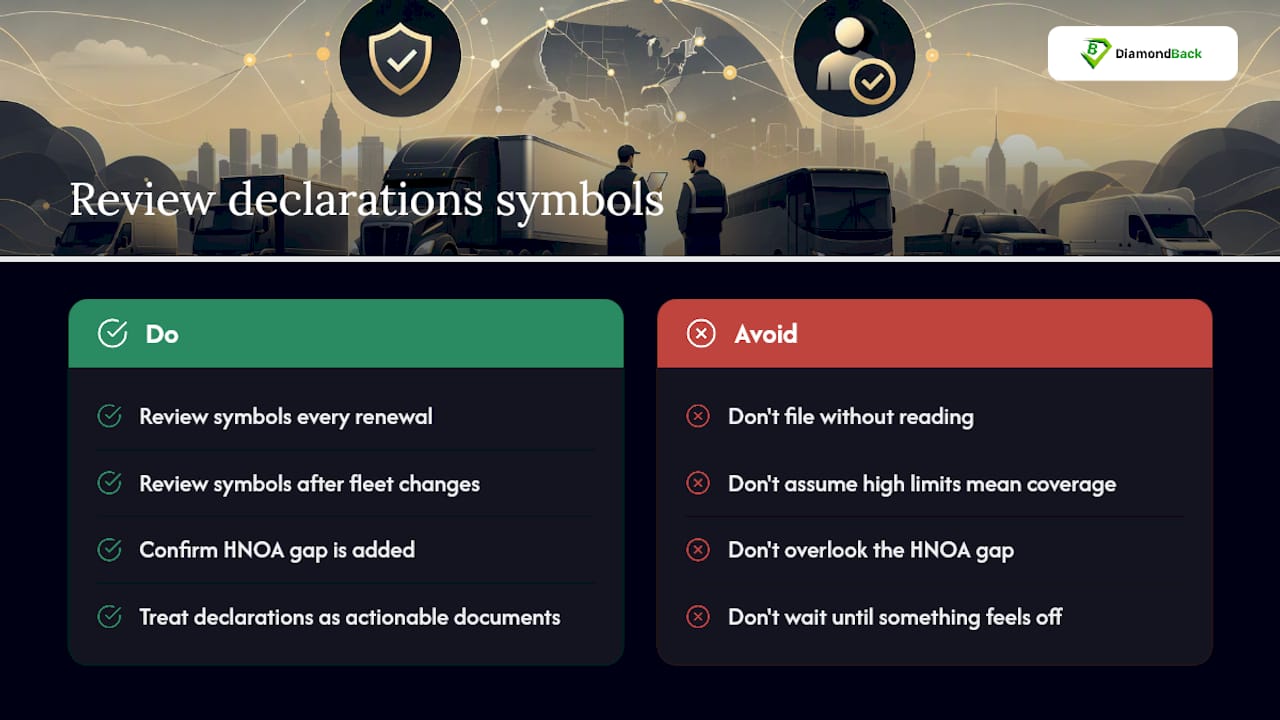
I think the HNOA gap specifically deserves more attention than it gets. It is cheap to add, it is easy to overlook, and it is the single most common reason a routine claim, a borrowed truck, a rental during a breakdown, an employee’s car on a supply run, turns into a denied one. If you take one thing from a symbol review, take that.
Review your symbols every renewal and every time your fleet changes, not just when something feels off.
— Vladimir
How Diamondback Insurance Helps You Get the Right Symbols
Some platforms give you a faster way to fix a symbol mismatch than calling around to individual carriers one by one. Instead of waiting on quotes from separate agents, you run one request through a comparison platform and compare multiple insurers’ terms, including how each one structures covered-auto symbols, side by side.
Start with the trucking insurance questionnaire to list out your actual vehicle uses, rentals, employee drivers, owned trucks, before you request quotes. That list makes it far easier to spot whether a quoted policy actually matches your operation or leaves a gap like the ones covered above. From there, you can get an instant online quote and see how your symbol needs translate into real premium numbers, without a phone call or a week of waiting.
This article is general information, not a substitute for advice from a qualified financial advisor. Consult a qualified financial professional about your own circumstances before acting on anything here.
Sources
- Auto coverage symbols — IRMI
- Commercial Auto Coverage Symbols 1-9 | InsureTutor
- Business Auto Policy (BAP): ISO 9-Symbol Guide (2026)
- Facts & statistics: uninsured motorists — Insurance Information Institute (III)