

An insurance loss run is a formal claims history report issued by your insurance carrier, documenting every claim filed under a specific commercial policy during a defined period. For business owners and fleet managers, this document is not optional reading. Underwriters at carriers like Travelers, Progressive Commercial, and Nationwide use loss runs to price your next policy, set coverage terms, and decide whether to renew your account at all. Understanding what is insurance loss run data and how to use it gives you a direct advantage when negotiating renewals and managing your total cost of risk.
What does an insurance loss run report contain?
An insurance loss run report is structured around individual claims, with each row representing a separate incident. Knowing what each field means lets you catch errors before they cost you money.

The core data fields in every loss run include the following:
Date of loss is the date the incident occurred, not the date it was reported or paid. This field determines which policy year the claim belongs to. A misdated claim can distort your loss history for an entire policy year.
Claim status tells you whether a claim is open, closed, or reserved. Open claims still have active reserves, meaning the carrier expects to pay more. Closed claims are settled. Underwriters watch the ratio of open to closed claims closely.
Paid loss is the amount the carrier has already paid out on the claim. Reserve is the carrier’s estimate of future payments still owed on open claims. Total incurred combines both figures. Paid loss, reserve, and total incurred are the three numbers underwriters use to judge claim severity and your overall exposure.
Cause codes and claim descriptions add narrative context. A cause code of “rear-end collision” tells a different story than “cargo theft,” even if the dollar amounts are identical. These codes help underwriters classify the type of risk your fleet presents.
The valuation date is the cutoff timestamp for all data in the report. A currently valued loss run reflects claim statuses and dollar figures as of the report generation date. Underwriters prefer reports valued within the last 90 days because reserves and claim statuses change as cases develop. An outdated report can misrepresent your true exposure.
Pro Tip: Always request a loss run that is currently valued, not one pulled from a prior renewal cycle. A report that is six months old may show open reserves that have since closed, making your history look worse than it actually is.
How to read loss runs for fleet risk management
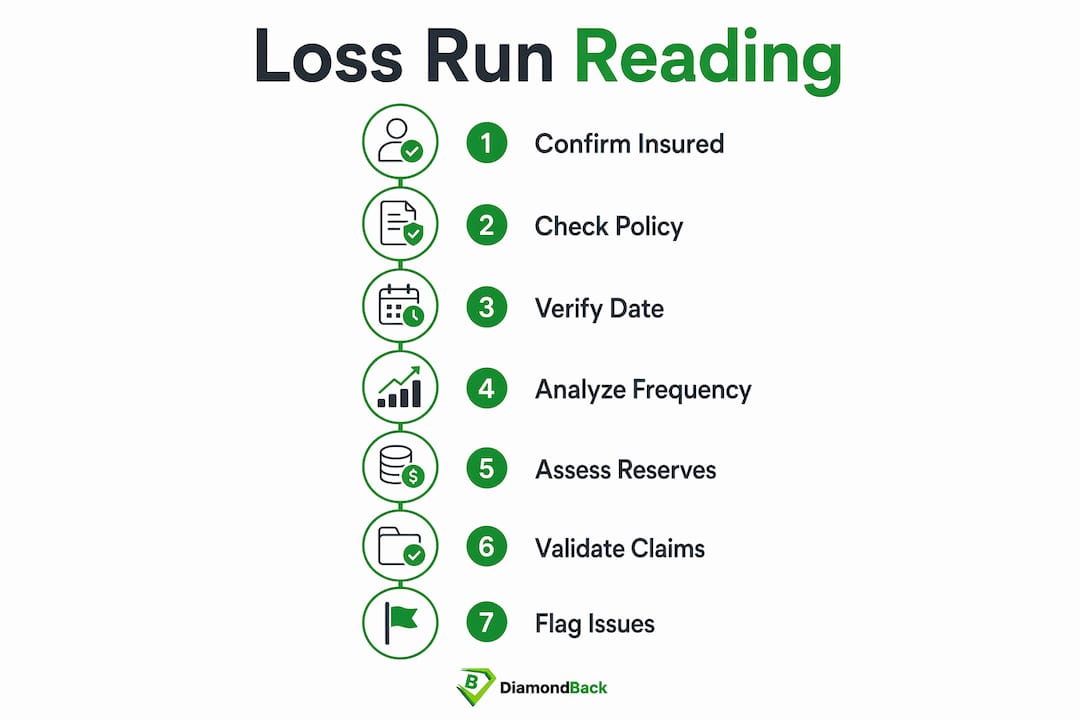
Reading a loss run correctly requires treating it as a structured dataset, not a summary document. The goal is to validate accuracy before the report reaches an underwriter.
Step 1: Confirm the named insured. Verify that the business name on the report matches your legal entity exactly. A mismatch between your operating name and the insured name on the loss run can cause underwriters to question whether the history belongs to your account.
Step 2: Check the policy periods. Each loss run covers a specific policy year. Confirm that all years in your lookback window are represented. Most underwriters request three to five years of history. Missing a year creates a gap that raises questions.
Step 3: Verify the valuation date. Confirming the valuation date and exact policy years included is the most important first step when interpreting loss runs. A report valued more than 90 days ago may not reflect current reserve levels or closed claims.
Step 4: Analyze claim frequency patterns. Look for clustering. Three claims in a single quarter suggest a systemic problem, whether that is a specific driver, a route, or a loading procedure. Underwriters notice clusters and price for them. Checking claim frequency clusters and policy term coverage helps you avoid submitting flawed data.
Step 5: Assess open claims and reserve adequacy. Open claims carry reserves that inflate your total incurred figure. If a claim is nearly resolved but still shows a large reserve, contact your carrier to request a reserve review before submitting the loss run to a new underwriter.
Step 6: Validate claim-to-policy-period attribution. Treat loss run data as a structured dataset and validate correct claim attribution using loss dates, not payment dates. A claim paid in 2025 for a 2023 incident belongs in the 2023 policy year. Misattribution skews your year-over-year comparisons.
Step 7: Flag missing or misattributed claims. If you know a claim occurred but it does not appear in the report, contact your carrier immediately. Missing claims discovered after submission create credibility problems with underwriters.
Pro Tip: For fleet operations running data analytics, tools like those described in small trucking company analytics can help you build your own loss tracking spreadsheet to cross-reference against carrier-issued reports before every renewal.
How loss runs affect your premiums and coverage terms
Underwriters treat loss runs like a scorecard. Clean histories lead to better pricing while patterns of claims drive higher premiums or coverage restrictions. The relationship is direct and quantifiable.
A fleet with five years of clean loss history qualifies for preferred pricing tiers at most carriers. A fleet with three or more liability claims in a single year may face a surcharge, a coverage sublimit, or a declination entirely. The loss run is the document that determines which category you fall into.
Inaccurate or outdated loss runs can lead to higher quotes or outright declinations, even when the underlying risk does not justify the penalty. Submitting a currently valued, error-free loss run is one of the most direct ways to protect your pricing.
The total incurred figure across all policy years is the number underwriters weight most heavily. A single large claim can move your five-year average significantly. This is why disputing inflated reserves on open claims matters. If a reserve is set at $150,000 but the claim is likely to close at $40,000, that $110,000 difference is artificially inflating your loss history.
Underwriters integrate loss run data into pricing models and risk evaluations as a primary input. Your loss run also affects your experience modification factor, which is the multiplier applied to your base premium. A favorable modification can reduce your premium by a meaningful percentage. An unfavorable one compounds costs year over year.
For fleet managers, the impact on trucking insurance rates varies by state and carrier, but the loss run’s role in pricing is consistent across all markets. Reviewing your loss run before every renewal cycle is not optional. It is the foundation of any productive conversation with your underwriter.
How to obtain and manage your loss run reports
Requesting loss runs requires direct contact with each carrier that has covered your business. No centralized database exists for commercial policies. Loss runs are generated by individual carriers and cover only claims filed under each specific policy, which means fleet programs with multiple carriers must request multiple reports.
Start early. Most states require insurers to provide loss runs within about 10 business days after a written request. That turnaround time is the legal minimum, not a guarantee. Building in 30 days before your renewal submission date gives you time to review, dispute errors, and request corrections.
Submit written requests. Verbal requests are not sufficient. Send a written request by email or certified mail to your carrier’s loss control or underwriting department. Reference your policy number, the policy years you need, and specify that you want a currently valued report.
Know your legal rights. Policyholders have the right to request loss runs even after coverage ends. If a former carrier delays beyond the statutory window, you can file a complaint with your state’s Department of Insurance. This right is particularly relevant when switching carriers and needing history from a prior insurer.
Consolidate reports before submission. When you have multiple carriers covering different parts of your fleet, compile all reports into a single organized package for your underwriter. Presenting a complete, organized loss history signals professionalism and reduces back-and-forth delays.
For fleet managers overseeing commercial vehicle insurance renewals, building a calendar reminder 60 days before each renewal date to initiate loss run requests is a practical habit that prevents last-minute scrambles.
Key takeaways
An insurance loss run is the single most important document in your commercial insurance renewal process. Accuracy, timeliness, and proactive review determine whether it works for you or against you.
| Point | Details |
|---|---|
| Loss run definition | A formal claims history report issued by your carrier, covering paid losses, reserves, and claim status per policy year. |
| Valuation date matters | Request currently valued reports within 90 days to reflect accurate reserves and closed claim statuses. |
| Read before submitting | Validate named insured, policy periods, claim dates, and open reserves before any underwriter sees the report. |
| Direct premium impact | Clean loss histories qualify for preferred pricing; inflated reserves or frequent claims drive surcharges and restrictions. |
| Request early and in writing | Most states require a 10-business-day turnaround; start 30 days before renewal to allow time for corrections. |
Why loss runs deserve more attention than they get
I have reviewed hundreds of loss run reports for commercial fleet accounts, and the pattern I see most often is not fraud or catastrophic claims. It is neglect. Business owners receive their renewal quote, accept it as a given, and never look at the underlying loss run that generated it.
The most expensive mistake I see is submitting a loss run with open reserves that should have been closed months earlier. A claim that settled for $25,000 but still carries a $90,000 reserve is costing that business real money at renewal. Carriers will not automatically update reserves on your behalf before you submit. You have to ask.
The second mistake is treating loss runs as paperwork rather than as a negotiation tool. Underwriters use loss run data as a major factor in pricing and coverage eligibility. That means early error correction is a direct negotiation advantage. A corrected, currently valued loss run submitted 45 days before renewal gives your underwriter time to re-evaluate your risk profile. That time translates into better pricing.
Fleet managers who use data-driven decisions in their operations already understand that claims data is operational data. Your loss run is the insurance industry’s version of your fleet’s performance record. Treat it with the same rigor you apply to maintenance logs and driver safety scores.
— Vladimir
Get accurate coverage based on your real claims history
Your loss run tells your insurance story. Make sure it tells the right one.

Diamondbackins works with business owners and fleet managers who want coverage priced on accurate, current claims data, not outdated reports or inflated reserves. The platform aggregates quotes from multiple top-rated commercial carriers, so you can compare options in minutes without the back-and-forth of traditional brokers. Whether you need trucking company insurance quotes for a growing fleet or want to see how your loss history affects your current rate, Diamondbackins gives you the transparency to make informed decisions. Get your instant quote today and see what your real risk profile qualifies for.
FAQ
What is a loss run in insurance?
A loss run is a claims history report issued by your insurance carrier that lists every claim filed under a specific policy, including paid amounts, reserves, and claim status. Underwriters use this document to evaluate risk and set premiums at renewal.
How far back do loss runs typically go?
Most underwriters request three to five years of loss run history when evaluating a commercial insurance account. Fleet programs switching carriers should gather reports from every insurer covering that full lookback window.
Can i dispute errors on my loss run?
Yes. If you identify a misattributed claim, an inflated reserve, or a missing incident, you can contact your carrier’s claims department directly to request a correction. Submitting corrected reports before renewal can materially improve your pricing.
How do i request a loss run from my carrier?
Submit a written request to your carrier referencing your policy number and the specific policy years you need. Most states require carriers to respond within about 10 business days, and you retain this right even after your policy ends.
Why does the valuation date on a loss run matter?
The valuation date is the cutoff for all data in the report. Outdated reports may miss recent claims or show reserves that have since changed, which can lead underwriters to price your policy based on inaccurate exposure figures.