
Most couriers need four coverages: commercial auto liability, cargo insurance, general liability, and workers’ compensation once you hire drivers. Federal rules through the Federal Motor Carrier Safety Administration (FMCSA) kick in when your vehicle’s gross vehicle weight rating exceeds 10,001 pounds and you haul freight across state lines. Below that threshold, state law and client contracts do the heavy lifting, and those contracts often demand higher limits than any regulator requires.
TL;DR:
- Most courier businesses need commercial auto liability, cargo, general liability, and workers’ compensation coverage, with higher limits required by clients and contracts.
- Federal FMCSA rules apply only to vehicles over 10,001 pounds hauling freight across state lines, with minimum financial responsibility starting at $750,000 for general freight.
- A certificate of insurance and specific endorsements are necessary to meet client requirements, and timely updates are crucial for ongoing compliance.
- Premium costs vary based on vehicle type, cargo value, operating location, and claims history, often exceeding the minimum legal requirements.
- Using an online platform speeds up the quote process, helps compare limits and costs, and ensures faster proof of coverage before onboarding clients.
Table of Contents
- Courier Insurance Requirements: What Each Policy Covers
- When Federal FMCSA Rules Apply to Your Courier Business
- Meeting Client and Platform Insurance Requirements
- Recommended Coverage Limits and What Couriers Actually Pay
- How to Get Insured: A Quote Preparation Checklist
- Staying Compliant: Renewals and Recordkeeping That Prevent Gaps
- How Diamondbackins Speeds Up Courier Insurance Compliance
- Steps to Update Coverage as Your Courier Business Grows
- Independent Contractors vs. Employed Drivers: Who Insures What
- A Straight Answer on the Mistakes That Cost Couriers Money
- Get a Compliant Courier Insurance Quote in Minutes
- Where to Verify Federal and State Courier Insurance Rules
- Sources
- FAQ
Courier Insurance Requirements: What Each Policy Covers
Meeting courier insurance requirements starts with understanding that “insurance” is not one policy. It’s a stack, and each layer protects a different exposure.
Commercial auto insurance covers liability (damage or injury you cause to others) and, optionally, physical damage to your own vehicle. This is the coverage most new courier owners get wrong: a personal auto policy almost always excludes business use, meaning if you’re delivering food or packages when you crash, your personal insurer can deny the claim entirely. That gap is why commercial auto sits at the top of every courier insurance checklist.
Cargo insurance protects the goods you’re transporting, not your vehicle or your liability to others. Clients demand it because they want assurance that if their shipment is lost, stolen, or damaged in your van, someone will pay to make it right. Without cargo coverage, that bill lands on you.
General liability insurance handles third-party bodily injury or property damage that happens outside the vehicle, like a slip-and-fall at a pickup location or accidental damage to a client’s loading dock. Most commercial contracts won’t let you bid without it.
Workers’ compensation becomes mandatory in nearly every state the moment you have employees, covering medical costs and lost wages after an on-the-job injury. Independent contractors typically carry their own coverage instead.
Beyond the core four, several add-ons matter depending on your setup:
- Hired and non-owned auto (HNOA): covers vehicles you rent or that drivers own personally but use for deliveries.
- Umbrella liability: extends limits above your primary auto and general liability policies.
- Professional liability: relevant if you handle scheduling, inventory, or fulfillment services beyond simple delivery.
- Cyber liability: worth considering if you store customer payment data or run delivery software in-house.
When Federal FMCSA Rules Apply to Your Courier Business
Not every courier operation answers to Washington. The test is mechanical: does your vehicle’s gross vehicle weight rating exceed 10,001 pounds, and are you hauling freight for hire across state lines? If both are true, you’re operating under federal jurisdiction and need a USDOT number, and likely an MC number, before you touch the road.
Stay under that weight threshold or operate strictly within one state, and federal rules generally don’t apply. State-level requirements and your own client contracts govern instead, which is why two courier businesses in neighboring states can face very different insurance obligations.
For carriers who do fall under FMCSA authority, 49 CFR Part 387 sets the minimum levels of financial responsibility. The figures vary by vehicle class and cargo type, and Section 387.9 breaks down the specific minimums for different carrier categories, generally starting at $750,000 for general freight and climbing toward $1,000,000 or higher for hazardous materials.
Meeting the minimum isn’t the finish line. Regulated carriers must also prove it:
- File a BMC-91 or BMC-91X (surety bond alternative) to certify insurance coverage with FMCSA.
- Some carrier categories file a BMC-34 for cargo insurance certification.
- FMCSA’s insurance filing requirements page walks through exactly which form applies to your operating authority.
Filings typically process within days once your insurer submits them electronically, but gaps between quote and filing can delay your operating authority activation, so build in a buffer before you plan to start hauling.
Meeting Client and Platform Insurance Requirements
Federal minimums are a floor. Clients and delivery platforms almost always ask for more, and they’ll want proof before you make a single run.
That proof comes in the form of a certificate of insurance (COI), a one-page document your insurer issues showing your policy numbers, coverage types, limits, and effective dates. Clients check this document line by line against their own contract requirements, so a mismatch, even a small one, can delay or kill an onboarding.
Here’s the practical sequence for getting compliant fast:
- Read the contract’s insurance clause first. It will spell out required limits and any specific endorsements before you ever request a quote.
- Request the standard endorsements clients ask for: additional insured, waiver of subrogation, and primary and noncontributory wording. These tell the client’s own insurer that your policy pays first.
- Confirm your limits match or exceed what’s requested. Common asks run $1,000,000 or higher for commercial auto liability, $1,000,000 to $3,000,000 for general liability, and cargo limits set by the value of goods under contract.
- Have your insurer issue the endorsement and updated COI. Endorsements typically cost $25 to $50 each and process within one to three business days.
- Submit the COI directly to the client’s risk or procurement contact, not just a general inbox, to avoid it getting lost before a delivery deadline.
Keep a running file of every COI you’ve issued. Clients audit these periodically, and a courier who can produce updated proof in minutes looks far more reliable than one scrambling to call their agent.
Recommended Coverage Limits and What Couriers Actually Pay
Federal minimums under 49 CFR Part 387 apply only to regulated carriers, and even then, they’re the legal floor, not a realistic operating target. Most contract work asks for more than the law does.
For a solo courier running a sedan or light van under 10,001 pounds, realistic limits look like $500,000 to $1,000,000 in commercial auto liability, $25,000 to $50,000 in cargo coverage, and $1,000,000 in general liability. Box truck and multi-vehicle operations should budget higher across the board, especially if contracts involve higher-value freight.
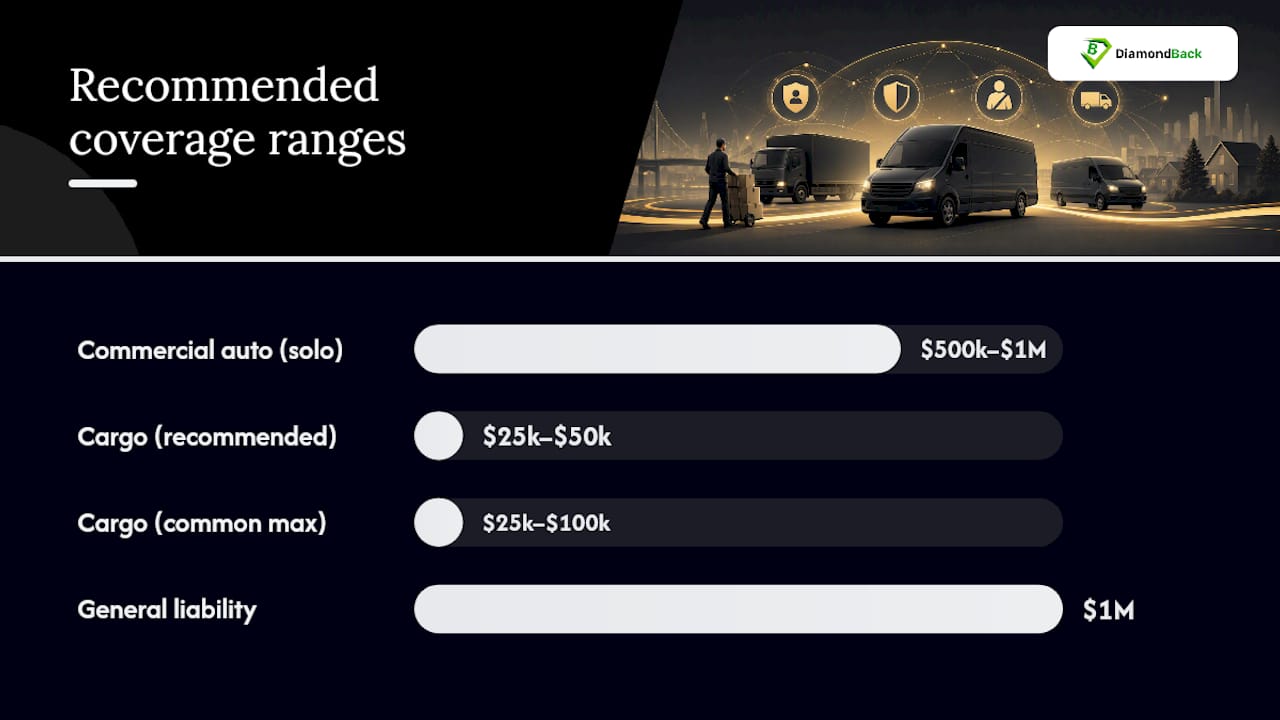
Cargo limits for small couriers commonly range from $25,000 to $100,000, while commercial auto liability is frequently set at $1,000,000 for contract work, well above the regulatory minimum for many operations. If you regularly haul electronics, pharmaceuticals, or other high-value goods, pushing cargo limits toward the top of that range, or adding excess cargo coverage, is worth the added premium.
Pro Tip: Don’t buy insurance based only on what the law requires. Buy based on what your biggest client’s contract demands, because that number is almost always higher.
Premiums vary widely based on a handful of factors:
- Vehicle type and value: box trucks and refrigerated vans cost more to insure than sedans.
- Operating territory: dense urban delivery routes carry higher accident frequency than suburban or rural ones.
- Cargo value: higher-value freight raises cargo premiums proportionally.
- Loss history: a clean claims record over the past three years is one of the strongest levers you have to lower renewal premiums.
Commercial auto for a single delivery vehicle often runs from a few hundred to over a thousand dollars monthly depending on these factors, with cargo, general liability, and workers’ comp adding additional premium on top.
How to Get Insured: A Quote Preparation Checklist
Underwriters move faster when you hand them a complete file instead of making them chase details. Gather these before you request quotes:
- A full vehicle list with VINs, including weight class for each unit.
- Driver motor vehicle records (MVRs) for every driver who will operate under the policy.
- A payroll and 1099 breakdown, separating employees from independent contractors, since this determines your workers’ comp exposure.
- A commodities list describing what you typically haul and its approximate value.
- Your current policy declarations page, if you’re switching carriers, so the new insurer can match or improve on existing limits.
Decide upfront whether you need hired and non-owned auto coverage. If drivers ever use their own vehicles for deliveries, HNOA fills the gap that standard commercial auto leaves open.
Once bound, request your COI and any required endorsements immediately, then upload proof directly to each client or delivery platform’s portal to confirm acceptance before your first scheduled run.
Staying Compliant: Renewals and Recordkeeping That Prevent Gaps
A lapsed policy doesn’t just expose you to liability. It can trigger an automatic contract suspension with any client who requires continuous proof of coverage. Set renewal reminders 45 to 60 days before expiration, giving you time to shop rates and reissue COIs before deadlines hit.
Build these habits into your operation:
- Cross-check every COI against the client’s specific contract language each time you renew, since requirements occasionally change mid-term.
- Notify your insurer immediately when adding a temporary or seasonal driver, since an unlisted driver in an accident can jeopardize a claim.
- Keep signed COIs, endorsement confirmations, and policy declarations pages on file for at least three years in case a client or state regulator requests verification.
- If a policy lapses accidentally, contact your insurer the same day. Many carriers can reinstate coverage without a gap if you catch it within 24 to 48 hours.
How Diamondbackins Speeds Up Courier Insurance Compliance
Diamondback Insurance built its platform around the exact bottleneck couriers hit most: waiting on quotes and COIs while a contract deadline closes in. The platform pulls quotes from multiple insurers for commercial auto, cargo, general liability, and workers’ compensation, letting you compare limits and pricing side by side instead of calling agents one at a time.
That speed matters directly for compliance:
- Faster quote turnaround means faster COI issuance when a client needs proof before onboarding.
- Comparing several insurers at once helps you find limits that match contract requirements without overpaying for coverage you don’t need.
- A streamlined online process reduces the back-and-forth that typically delays endorsement requests.
Steps to Update Coverage as Your Courier Business Grows
Your insurance needs the day you start rarely match your needs a year later. Adding a second van, hiring your first employee, or landing a client that demands higher limits all require a policy update, not a wait-until-renewal approach.
Start by reviewing your policy every time your fleet size, driver roster, or cargo type changes. Adding a vehicle mid-term is straightforward: most insurers can endorse a new unit onto an existing commercial auto policy within a day or two, prorating the additional premium for the remainder of the policy term.
Hiring your first W-2 employee is a bigger trigger. That single change typically activates state workers’ compensation requirements, so notify your insurer before the employee’s first shift, not after. Independent contractors don’t require workers’ comp from you, but confirm they carry their own coverage or you may face gaps if a client asks for proof covering everyone on a job site.
Winning a larger contract often means raising limits across the board. Rather than waiting for renewal, ask your insurer for a mid-term endorsement that bumps your general liability or cargo limits to match the new contract’s terms. This costs an adjusted premium for the remaining term but avoids the risk of bidding on work you’re not actually covered to perform.
Finally, revisit your umbrella policy anytime your primary limits rise. An umbrella that made sense at $1,000,000 in underlying coverage may need adjusting once your auto and general liability limits climb to $2,000,000 or more.
Independent Contractors vs. Employed Drivers: Who Insures What
The insurance obligations for a courier business shift substantially depending on how your drivers are classified, and getting this wrong is one of the costliest mistakes owners make.
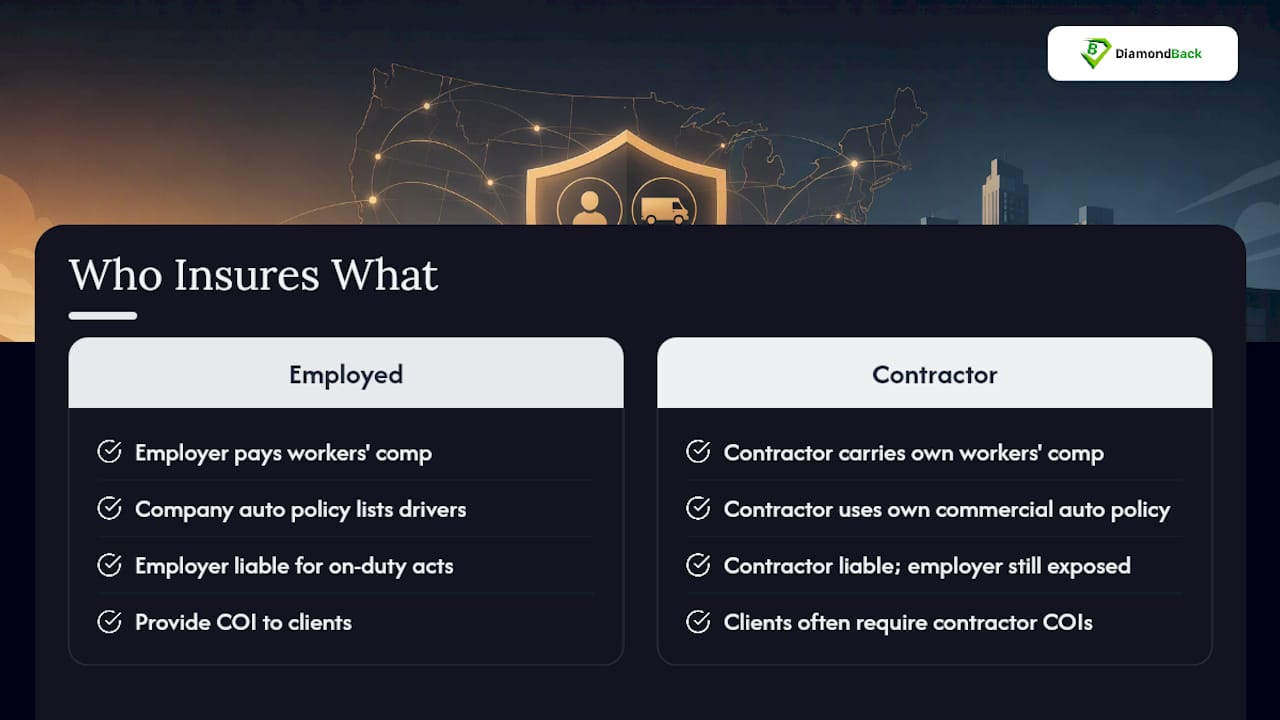
If you employ drivers as W-2 workers, you’re on the hook for workers’ compensation in nearly every state, and your commercial auto policy needs to list each employee as a covered driver. You also carry the general liability exposure for their actions on the job, since courts generally treat an employee’s on-duty conduct as the employer’s responsibility.
Independent contractors work differently, at least on paper. Many operate under their own commercial auto policies and are expected to carry their own liability coverage. But don’t assume that shifts all risk away from you. Courts and state labor agencies scrutinize contractor classifications closely, and misclassifying an employee as a contractor to dodge workers’ comp obligations can result in penalties that dwarf the premium you were trying to avoid.
Platforms and larger clients often require proof of coverage from contractors directly, meaning you may need to verify their COIs the same way a client verifies yours. If a contractor’s coverage lapses mid-contract and they cause an accident, your business can still face liability exposure if your own contract or hiring practices didn’t clearly establish their independent status.
The safest approach: document contractor relationships carefully, request their COIs before their first run, and never assume “they’re a 1099” eliminates your exposure entirely.
A Straight Answer on the Mistakes That Cost Couriers Money
The single most expensive mistake in this business is assuming a personal auto policy will cover a business delivery. It won’t, and the denial usually comes at the worst possible moment, right after a serious accident. The second most common error is underinsuring cargo because “nothing’s ever gone wrong before.” Cargo losses happen in batches, not one at a time, and a single bad month can wipe out a year of savings on premium. The third is skipping endorsements a client explicitly requested because the courier assumed their base policy was “close enough.”
None of these mistakes require a lawyer to avoid. They require running an actual commercial quote, comparing it against your contracts’ language, and requesting the endorsements clients ask for before you need them. That’s the one move that fixes most of what goes wrong in this industry.
— Vladimir
Get a Compliant Courier Insurance Quote in Minutes
An online insurance platform provides courier owners a faster path to compliant coverage than the traditional broker route the sections above just walked through. Instead of calling multiple agents and waiting days for quotes, you compare commercial auto, cargo, general liability, and workers’ compensation options from multiple insurers in one place, online.
That speed translates directly into fewer stalled onboardings. When a client’s contract requires a specific limit or endorsement, you need a quote and COI fast, not next week. Start with an instant online quote for your commercial auto and cargo coverage, compare the limits against your current contracts, and request the endorsements your clients require before your next scheduled pickup.
Where to Verify Federal and State Courier Insurance Rules
- FMCSA registration and insurance filing requirements
- 49 CFR Part 387 federal financial responsibility minimums
- Your state’s labor or insurance department for workers’ compensation rules specific to your state
This article is general information, not a substitute for advice from a qualified financial advisor. Consult a qualified financial professional about your own circumstances before acting on anything here.
Sources
- FMCSA — Insurance filing requirements
- 49 CFR Part 387 — Financial responsibility
- Courier Business Insurance Requirements (MoneyGeek)
FAQ
What kind of insurance do couriers need?
Most couriers need commercial auto liability, cargo insurance, general liability, and workers’ compensation once they employ drivers. Recommended cargo limits often run $25,000 to $100,000, while commercial auto liability is commonly set at $1,000,000 for contract work.
What insurance is needed for a courier parcel?
Cargo insurance specifically covers the parcel itself against loss, theft, or damage while in transit, separate from any liability coverage on the vehicle. Clients typically require proof of cargo coverage before handing over shipments of meaningful value.
What insurance do you need to be a delivery driver?
If you’re an independent contractor, you generally need your own commercial auto policy since personal auto insurance excludes business use. If you’re an employed driver, your employer’s commercial auto and workers’ compensation policies should cover you, though it’s worth confirming you’re listed on both.
What insurance do I need for courier exchange work?
Courier exchange and freelance delivery platforms typically require proof of commercial auto liability and sometimes cargo coverage before you can accept jobs. Check the specific platform’s contract for exact limits, since these vary and often exceed federal minimums even when FMCSA rules don’t technically apply to your vehicle weight class.
How much does courier insurance cost through Diamondbackins?
Pricing depends on your vehicle type, coverage limits, territory, and driving history, so current rates are available directly through Diamondback Insurance’s instant quote tool. Comparing multiple insurers at once typically gives a clearer picture of fair pricing than requesting one quote at a time.