

Managing a fleet means making dozens of decisions before most people finish their morning coffee. The last thing you need is an insurance process that pulls you away from dispatch, driver management, and route optimization for hours at a time. Yet that’s exactly what traditional commercial vehicle quoting demands. Instant insurance quotes are changing that reality, giving fleet managers and small business owners a faster, more transparent path to coverage comparison and purchase. This guide walks you through why the old method fails, how instant tools work, and how to use them strategically to protect your fleet without losing a full day to paperwork.
Table of Contents
- The old way: How traditional insurance quotes slow you down
- How instant insurance quotes work—and why they’re faster
- Bottom-line impacts: Costs, discounts, and smarter fleet protection
- When are instant insurance quotes best—and what are their limits?
- Our take: Instant insurance quotes aren’t just faster—they shift fleet strategy
- Take the next step: Try instant quotes for your fleet
- Frequently asked questions
Key Takeaways
| Point | Details |
|---|---|
| Save hours, not days | Instant quotes reduce fleet insurance shopping from hours to minutes, freeing you to focus on business. |
| Unlock better rates | Comparing multiple carriers instantly puts competitive premium options at your fingertips. |
| Boost discounts with telematics | Safe driving fleets can earn 15-30% premium savings by sharing telematics data with insurers. |
| Know when to go hybrid | Use instant quotes for standard fleets and hybrid approaches for high-risk or specialized needs. |
The old way: How traditional insurance quotes slow you down
If you’ve renewed commercial vehicle coverage even once through a traditional broker or carrier, you know the process feels like it was designed to test your patience. It starts with gathering data: vehicle identification numbers (VINs), driver histories, cargo classifications, current policy documents, and proof of regulatory compliance filings. That alone can take an hour for a mid-size fleet. Then come the phone calls, the emails, and the waiting.
Each carrier has its own forms, its own questions, and its own timeline for getting back to you. You might submit a request on Monday and hear back Thursday, only to find the quote is missing information and you need to start over. Multiply that by three or four carriers, and you’re looking at a significant chunk of your week gone. According to insurance quoting automation data, each manual commercial insurance quote takes between 25 and 90 minutes, and that’s per carrier, not per renewal cycle. For a fleet comparing multiple options, the total time investment is staggering.
The disruption goes beyond the clock. Every hour you spend on insurance paperwork is an hour you’re not reviewing driver safety scores, managing load assignments, or handling customer relationships. For small business owners managing tight margins, this kind of operational drag directly affects profitability. The bottlenecks tend to pile up right when you can least afford them, during contract renewals, after an incident, or when you’re onboarding new vehicles mid-season. Most experienced fleet managers agree: the renewal season is where hours simply vanish.
Now that we’ve seen why the old method is such a bottleneck, let’s look at how instant insurance quotes change the process.
How instant insurance quotes work—and why they’re faster
The core mechanic is straightforward. Instead of contacting carriers one by one, you enter your fleet data once into a digital platform. That platform queries multiple insurers simultaneously using a standardized data format, which means no re-entering information, no reformatting documents, and no waiting for a human intermediary to pass your paperwork along. The result is quotes in 5 to 10 minutes compared to the 25 to 90 minutes that each single manual quote requires.
Here’s how the process typically flows on a modern instant quote platform:
First, you create a profile with your business information, including DOT number, years in operation, and primary cargo type. Second, you input your vehicle inventory, using VIN auto-fill where available to reduce manual entry errors. Third, you upload your key documents once, including driver license records and any existing policy declarations. Fourth, the platform queries its carrier network and returns ranked quotes, usually within minutes. Fifth, you review coverage details side by side and select the policy that fits your needs. Sixth, you purchase directly through the platform, often with immediate proof of insurance available for download.
Comparing this to the manual process reveals how dramatic the efficiency difference really is:
| Factor | Manual quoting | Instant quote platform |
|---|---|---|
| Time per carrier | 25 to 90 minutes | Under 2 minutes |
| Carriers contacted | 1 to 3 typically | 5 or more simultaneously |
| Document submission | Repeated per carrier | Uploaded once |
| Quote turnaround | 1 to 5 business days | 5 to 10 minutes |
| Comparison format | Phone notes, emails | Side-by-side dashboard |
| Purchase process | Separate callback or visit | Completed online immediately |
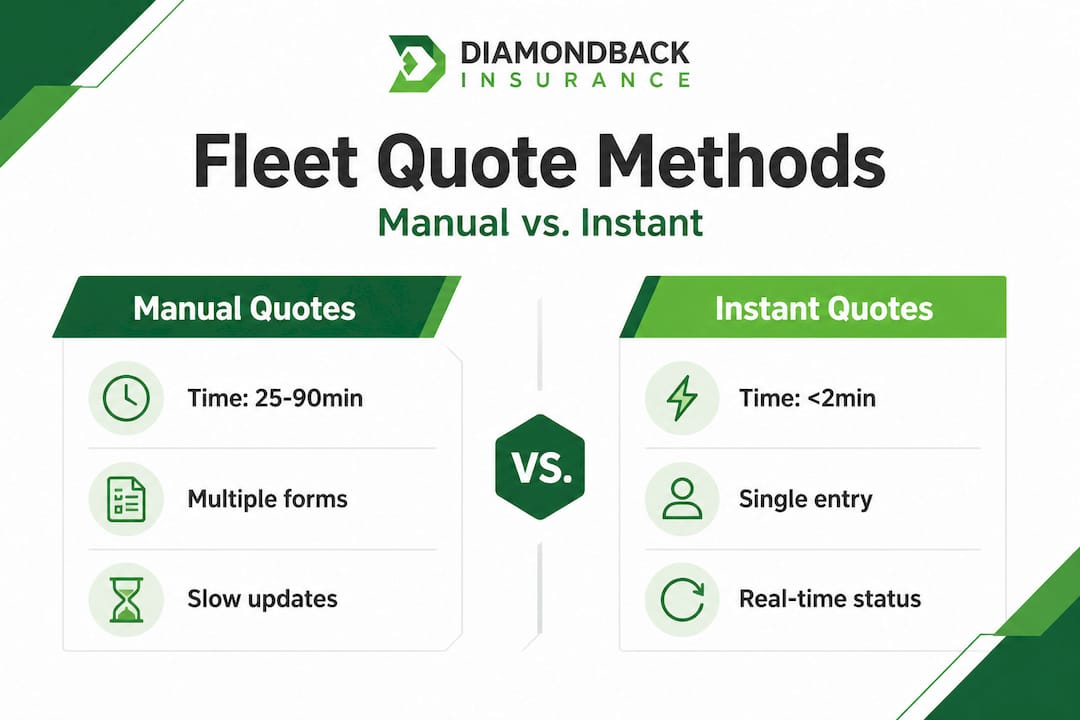
The features that make this possible include VIN auto-fill, single-upload document management, real-time status tracking, and saved fleet profiles. That last feature is especially valuable at renewal time.
Pro Tip: Save your complete fleet profile on your instant quote platform after your first submission. When renewal season arrives, you can update changed vehicles or drivers and re-run quotes in under two minutes rather than starting from scratch.
When you get quick online quotes through a platform built for commercial transportation, you’re not just saving time. You’re creating a repeatable, auditable process that holds up during audits, contract bids, and regulatory reviews.
But speed isn’t everything. What real benefits does this new process unlock for your bottom line?
Bottom-line impacts: Costs, discounts, and smarter fleet protection
Speed matters, but cost reduction is what gets leadership’s attention. Instant quote platforms generate savings in two distinct ways: through carrier competition and through data-driven pricing models, particularly telematics integration.
When multiple carriers bid for your business simultaneously, they compete on price. That’s a fundamental market dynamic that manual quoting often obscures, because most fleet managers don’t have the time to contact six carriers individually. A digital platform does that in the background. The result is that you see the actual market range for your coverage, not just the rate from the carrier your broker prefers or the one that responded first.

The bigger opportunity comes from telematics, which refers to GPS and sensor technology that tracks driver behavior including speed, braking patterns, idle time, and route adherence. Insurers increasingly use this data to price policies based on actual risk rather than statistical averages. According to telematics-based pricing research, integrating telematics data into insurance underwriting yields premium reductions of 15 to 30 percent for fleets with safe driving records. That’s a significant number on a $40,000 or $80,000 annual premium.
To understand how that breaks down in practice, consider this comparison:
| Fleet profile | Traditional premium estimate | Telematics-adjusted estimate | Potential savings |
|---|---|---|---|
| 10-vehicle regional fleet | $38,000/year | $29,000 to $32,000/year | $6,000 to $9,000 |
| 25-vehicle mixed fleet | $95,000/year | $72,000 to $80,000/year | $15,000 to $23,000 |
| 5-vehicle specialty fleet | $22,000/year | $17,000 to $19,000/year | $3,000 to $5,000 |
These figures vary based on region, cargo, and driver records, but they illustrate the scale of what’s possible when you move beyond flat-rate pricing. If you want to save on fleet costs systematically, connecting your telematics data to your insurance pricing model is one of the highest-ROI steps you can take.
It’s also worth noting that safety discounts with telematics are becoming more widely available across commercial carriers as the technology matures. What was once a niche option is now a mainstream pricing input, and fleets that don’t leverage it are leaving money on the table.
Pro Tip: Before committing to telematics-based pricing, run a 60-day internal analysis of your driver behavior data. If your safety metrics are strong, the premium reduction will almost certainly outweigh any administrative cost of sharing data with your insurer.
Not every fleet is the same. Let’s explore when instant quotes work best, and when you might still need a hybrid approach.
When are instant insurance quotes best—and what are their limits?
Instant quote tools are genuinely powerful, but they’re not a universal replacement for every type of fleet insurance decision. Understanding where they excel and where they have limits helps you use them strategically rather than reflexively.
Instant tools work exceptionally well in the following scenarios. Smaller fleets of 2 to 20 vehicles with standard cargo classifications get accurate, competitive quotes fast. Fleets with clean or near-clean driver records benefit most from automated underwriting decisions. Businesses that need to add vehicles or adjust coverage quickly, such as when hiring seasonal drivers or acquiring new assets, can make changes without waiting for broker availability. Operations that renew standard policies annually and want to verify they’re getting market-competitive rates will find the comparison functionality especially useful.
Where instant platforms have limits is in high-complexity or high-risk scenarios. A fleet hauling hazardous materials, oversized loads, or operating under specialty FMCSA (Federal Motor Carrier Safety Administration) classifications may need underwriters who can manually assess the risk profile. In those cases, as commercial fleet experts note, instant tools excel for simple fleets but work best in combination with broker guidance when you’re dealing with tailored underwriting in high-risk transport scenarios.
Privacy concerns around telematics are real and worth addressing directly. Sharing real-time driver behavior data with an insurer does create a data relationship that some operators find uncomfortable. The practical reality is that most fleets already collect this data internally. The question is whether you share it externally in exchange for a financial benefit. For most operations with safe records, the math strongly favors sharing.
Fast-changing fleets face a unique challenge: coverage gaps. If you’re growing quickly, hiring drivers, or adding vehicles on short notice, you need a platform that lets you update your fleet insurance quotes and bind coverage the same day. That’s simply not possible through traditional broker channels, where even a minor policy endorsement can take 48 hours to process.
The smartest approach for most fleet managers is a blended one. Use instant quote tools for standard coverage, routine renewals, and fast additions. Bring in a specialist broker for complex liability structures, unusual cargo, or multi-state regulatory compliance reviews. These two approaches are not mutually exclusive, and the best-run fleets use both deliberately.
To tie it all together, here’s a hard-earned perspective on when and why instant quotes genuinely change business as usual for fleet managers.
Our take: Instant insurance quotes aren’t just faster—they shift fleet strategy
Most fleet managers treat insurance as a necessary annual ritual. You gather the paperwork, make the calls, accept the quote that comes back in time, and move on. The process feels fixed, almost bureaucratic, and the idea of optimizing it rarely comes up in strategic planning conversations. That’s a missed opportunity worth talking about directly.
Instant insurance quotes don’t just eliminate friction. They change the nature of the decision. When you can get accurate, competitive coverage numbers in ten minutes, you can factor insurance costs into business decisions in real time. Bidding on a new contract that requires higher liability limits? You can check what that costs before you commit to pricing. Adding a new vehicle class to your fleet? You can see the coverage implications before the asset arrives. That kind of responsiveness turns insurance from a reactive expense into a proactive planning tool.
There’s also an overlooked efficiency benefit that rarely gets discussed: the hours you reclaim during renewal season are some of the highest-value hours you can redirect. Renewal season is also when carriers adjust rates, when competitors are renegotiating contracts, and when driver retention decisions often get made. Having your digital quoting workflow running smoothly means you stay focused on those strategic priorities instead of chasing down insurance forms.
For managers who are still skeptical, we’d offer this: start with one segment of your fleet. Run an instant quote comparison for your five most standard vehicles. See what the process feels like, what the numbers show, and how the platform handles your data. The efficiency gains are typically obvious after a single session, and the rate comparison usually reveals something actionable.
The conventional wisdom that insurance shopping is painful and slow is only true if you haven’t updated your tools. Instant quotes are available right now, and the fleets using them are already ahead.
Take the next step: Try instant quotes for your fleet
If you’ve been managing coverage through phone calls and email threads, this is the moment to see what a purpose-built platform actually feels like.
At Diamondback Insurance, we’ve built our platform specifically for fleet managers, trucking professionals, and small business owners who need coverage comparisons fast and without the runaround. Whether your operation runs in Georgia, Texas, Virginia, or across multiple states, you can get your truck insurance quote in minutes and compare options from multiple top carriers side by side. Not sure where to start? Try running instant online quotes for a single vehicle or a small fleet segment as a low-risk test. You’ll see the rate comparison, the coverage details, and the purchase path, all without committing to anything. That’s the kind of transparency your fleet budget deserves.
Frequently asked questions
How long does it take to get an instant insurance quote for a fleet?
Most instant quote platforms return multiple fleet insurance options in 5 to 10 minutes by querying several carriers simultaneously with your standardized fleet data.
Do instant insurance quote tools check multiple carriers at once?
Yes, leading instant quote platforms automatically compare several insurers using your single fleet profile submission, with multiple carriers queried in real time rather than sequentially.
Can using telematics data really lower fleet insurance costs?
Fleets with safe drivers using telematics can see premium reductions of 15 to 30 percent through usage-based pricing models that reward documented safe driving behavior.
Are instant quotes good for all fleet types?
They’re ideal for standard fleets, but specialized and high-risk operations may still benefit from combining instant platforms with broker support for tailored underwriting decisions.