

Owner operator insurance cost typically runs a few thousand dollars per year for leased operators and significantly more for own-authority operators, according to industry guides. Monthly, that translates to several hundred dollars for leased operators and over a thousand dollars for those running their own authority. Those are planning ranges, not quotes. Your actual rate depends on your driving record, cargo, state, and coverage structure. The fastest way to get a firm number is to get an instant tailored quote through Diamondbackins, which compares multiple carriers in minutes.
Key Takeaways
Owner operator insurance cost ranges from $3,000–$8,000 annually for leased operators and $14,000–$28,000 for own-authority operators, with your driving record and authority status driving the largest share of the difference.
| Point | Details |
|---|---|
| Leased vs. own-authority gap | Leased operators pay $3,000–$8,000/year; own-authority operators pay $14,000–$28,000/year. |
| Biggest cost drivers | Driving record, new-authority surcharge, and state of operation move premiums most. |
| FMCSA minimum liability | $750,000 for most general freight; many shippers require $1,000,000 in liability. |
| Top cost-saving tactic | Raise your deductible strategically and pay annually to reduce total premium spend. |
| Recommended next step | Use Diamondbackins to compare multi-carrier quotes instantly and bind coverage online. |
Table of Contents
- What coverages make up your owner-operator insurance cost
- What underwriters look at when pricing your policy
- Representative budget scenarios for planning purposes
- What to gather before requesting an insurance quote
- Practical ways to lower your owner-operator trucking insurance cost
- Common add-ons and fees that raise your total invoice
- How to compare quotes beyond price
- FMCSA minimum requirements and how to verify your filings
- An honest take on what most owner-operators get wrong
- Diamondbackins gives you instant multi-carrier quotes in one place
- Sources
What coverages make up your owner-operator insurance cost
Understanding which policies compose your total premium is the clearest path to controlling it. Each coverage serves a distinct purpose, and the combination you need depends on whether you’re leased to a carrier or running your own authority.
Primary liability covers bodily injury and property damage you cause to others. If you hold your own authority, you buy this directly. If you’re leased on, your carrier typically provides it. Physical damage (collision plus comprehensive) protects your truck itself and is usually required by lenders. Cargo insurance covers the freight you haul and is often required by shippers. Bobtail and non-trucking liability (NTL) protect you when you’re driving without a load or outside dispatch, a gap leased operators frequently overlook.
Occupational accident insurance fills the workers’ compensation gap for independent contractors. OTrucking estimates this coverage often runs a moderate monthly cost, and many carriers require it in lease agreements. General liability and umbrella/excess policies round out a full program for own-authority operators, adding protection beyond primary limits.
Per CPKInsurance, primary liability and physical damage typically make up the largest share of total premiums, with cargo and occupational accident scaling based on limits and freight type.
| Coverage | Who Typically Provides It | Typical Annual Range |
|---|---|---|
| Primary liability | Carrier (leased) / You (own authority) | several thousand dollars |
| Physical damage | You (both) | several thousand dollars |
| Cargo | Carrier (leased) / You (own authority) | $1,500–$4,000 |
| Bobtail / NTL | You (leased) | several hundred dollars |
| Occupational accident | You (both) | over a thousand dollars |
| General liability / umbrella | You (own authority) | $500–$2,000 |
Pro Tip: Primary liability and physical damage move your total premium the most. Price those two lines carefully before adjusting cargo or occupational accident limits.
What underwriters look at when pricing your policy
Insurers weigh a specific set of factors when calculating your owner operator insurance rates. Knowing which ones carry the most weight lets you address them before you shop.
- Driving record and at-fault accidents. Having at-fault accidents can significantly raise your premium at renewal. Multiple violations may limit your market access entirely.
- Authority status and new-authority surcharge. New-authority operators pay noticeably higher premiums than established operators during their first two years because insurers price the absence of safety history as elevated risk.
- CSA scores and safety ratings. High Compliance, Safety, Accountability scores signal risk to underwriters and can trigger surcharges or declinations.
- Miles driven and operating radius. Long-haul interstate operations carry more exposure than regional or intrastate routes.
- Cargo type. Hazardous materials, high-value electronics, and refrigerated freight all command higher premiums than dry van general freight.
- Truck age and stated value. Older trucks with lower values reduce physical damage premiums; newer trucks financed through a lender require full coverage.
- Coverage limits and deductibles. Raising your liability limit from $750,000 to $1,000,000 typically adds $500–$1,500 annually, depending on your profile.
- Prior claims history. Loss runs showing frequent claims, even minor ones, signal a pattern that underwriters price accordingly.
- State of operation. Geographic location can swing premiums dramatically. AtoB notes that state-by-state differences can move rates by over double between the highest- and lowest-cost states. You can review how your state affects your rate with Diamondbackins’s guide to trucking insurance rates by state.
Nuclear verdicts and large jury awards have also pushed industry-wide costs higher. ATRI data cited by AtoB shows insurance cost per mile reached a record high in recent years, reflecting rising claims severity across the industry.
Representative budget scenarios for planning purposes
These ranges are conservative estimates for budgeting, not quotes. Your actual premium will vary based on the factors above.
| Scenario | Annual Range | Monthly Equivalent |
|---|---|---|
| Leased operator (minimum coverage) | a few thousand dollars | a few hundred dollars |
| Own authority, established (2+ years) | a higher four-figure sum | over a thousand dollars |
| Own authority, new or high-risk | the highest ranges of own authority costs | substantial monthly premiums |
New-authority operators should budget toward the high end of the own-authority range for at least the first two years. The increased premium surcharge is real, and limited market access during that period means fewer carriers will compete for your business. If you’re starting without prior coverage, Diamondbackins has specific guidance on owner-operator trucking insurance with no prior coverage that explains your options.
What to gather before requesting an insurance quote
Preparing the right documents before you contact an insurer or use an online platform saves time and produces more accurate quotes. Here’s what to have ready:
- MC number and US DOT number (if you hold your own authority)
- Vehicle VIN and year/make/model of your truck
- Stated value of the truck (what you’d accept in a total loss)
- Current MVR (motor vehicle record) for all drivers
- CSA score snapshot from the FMCSA Safety Measurement System
- Lease agreement (if leased on to a carrier)
- Loss runs for the past 3–5 years (if you have prior coverage)
- Commodity type and average load value
Once you have those documents, the quote timeline typically works as follows:
- Instant online quote: Platforms like Diamondbackins generate multi-carrier comparisons in minutes using the information above.
- Broker-assisted quote: A specialist broker may take 24–48 hours to shop your file across admitted and non-admitted markets.
- Binding and filings: Once you select a policy, binding usually takes a few hours. FMCSA filings (BMC-91X for liability, BMC-34 for cargo) are submitted by your insurer and typically appear in the FMCSA system within 1–3 business days.
Ask every insurer these questions before you commit: Which FMCSA filings will you submit on my behalf? What are the installment fees if I pay monthly? Are there endorsements I need for my specific commodity? What are the cancellation terms and any short-rate penalties?
Practical ways to lower your owner-operator trucking insurance cost
Reducing your premium without cutting required coverage is achievable with deliberate choices.
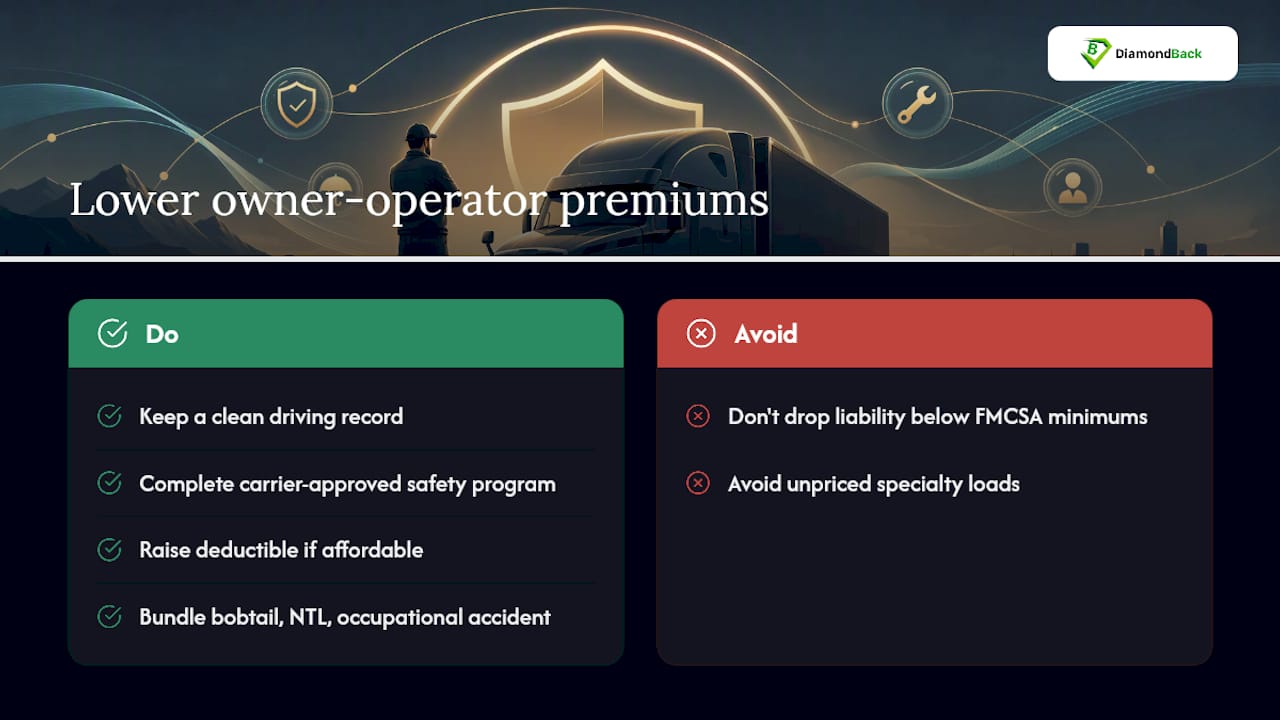
Maintaining a clean driving record is the single most effective lever. Even one preventable accident can follow you for three to five years at renewal. If your record has issues, completing a carrier-approved safety program demonstrates proactive risk management and can open access to better markets.
Raising your deductible strategically is another reliable tactic. Moving from a $1,000 to a $2,500 physical damage deductible can reduce that line’s premium by several hundred to a few thousand dollars annually, according to CPKInsurance. Only raise it to an amount you can genuinely cover out of pocket after a loss.
Limiting high-risk commodities when possible keeps cargo premiums lower. If your operation can handle both general freight and specialty loads, pricing the difference before accepting specialty freight is worth the extra step. Bundling your bobtail, NTL, and occupational accident coverage with the same carrier often produces a multi-policy discount.
Pro Tip: New-authority operators can sometimes negotiate better first-year rates by presenting a formal safety plan, proof of dash cam installation, and a progressive coverage structure that shows insurers you’re managing risk actively.
One caution: never drop primary liability below FMCSA minimums to save money. The regulatory exposure and personal financial risk far outweigh any short-term premium savings.
Common add-ons and fees that raise your total invoice
The base premium is rarely the final number on your invoice. Several common add-ons affect what you actually pay.
- BMC filing fees: Insurers charge a small administrative fee (typically $25–$75) to file BMC-91X and BMC-34 forms with the FMCSA on your behalf.
- Broker or agency administration fees: Some brokers charge a separate service fee of $100–$300 per policy, distinct from the premium itself.
- Endorsements: Hitch/driveaway coverage, reefer breakdown protection, and hazardous materials endorsements each add to your annual cost. Review the full trucking policy add-ons list to understand which apply to your operation.
- Umbrella/excess liability: Adding a $1,000,000 umbrella layer above primary liability typically costs $500–$2,000 annually. Lenders and some shippers now require it.
- Monthly installment fees: Paying monthly instead of annually often adds 3–8% to your total cost. Paying the full annual premium upfront, when you have the reserves, is one of the simplest ways to reduce total spend.
How to compare quotes beyond price
Price is the starting point, not the finish line. A lower premium with significant exclusions can cost far more after a single loss than a slightly higher premium with clean, broad coverage.
When reviewing multiple quotes, check these points before deciding:
Limits vs. your actual exposure. Does the liability limit match what your brokers and shippers require? Many shippers now mandate $1,000,000 minimum, above the FMCSA floor of $750,000.
Exclusions. Read what the policy does not cover. A cargo policy that excludes your primary commodity type is effectively no cargo coverage at all.
Insurer financial strength. Check the carrier’s AM Best rating. An “A” or better rating indicates the insurer has the financial capacity to pay large claims. A lower-rated carrier may be cheaper today and unavailable when you need them most.
If those filings lapse, your operating authority can be suspended.
Deductible structure. Understand whether your deductible applies per occurrence or per claim, and whether it applies to cargo and liability separately.
FMCSA minimum requirements and how to verify your filings
The FMCSA sets minimum liability at $750,000 for most general freight carriers operating in interstate commerce. Cargo insurance minimums are commonly $100,000, with higher thresholds for hazardous materials and certain special commodities. Many shippers and brokers require $1,000,000 in liability as a condition of doing business, so the regulatory floor is often not the practical floor.
To verify that your insurer has filed the correct forms, search your MC number in the FMCSA’s Licensing and Insurance database at li-public.fmcsa.dot.gov. Both must show as active before you dispatch a load. State DOT requirements may add further filings depending on your operating states, so confirm with your insurer which state-level filings your policy includes.
An honest take on what most owner-operators get wrong
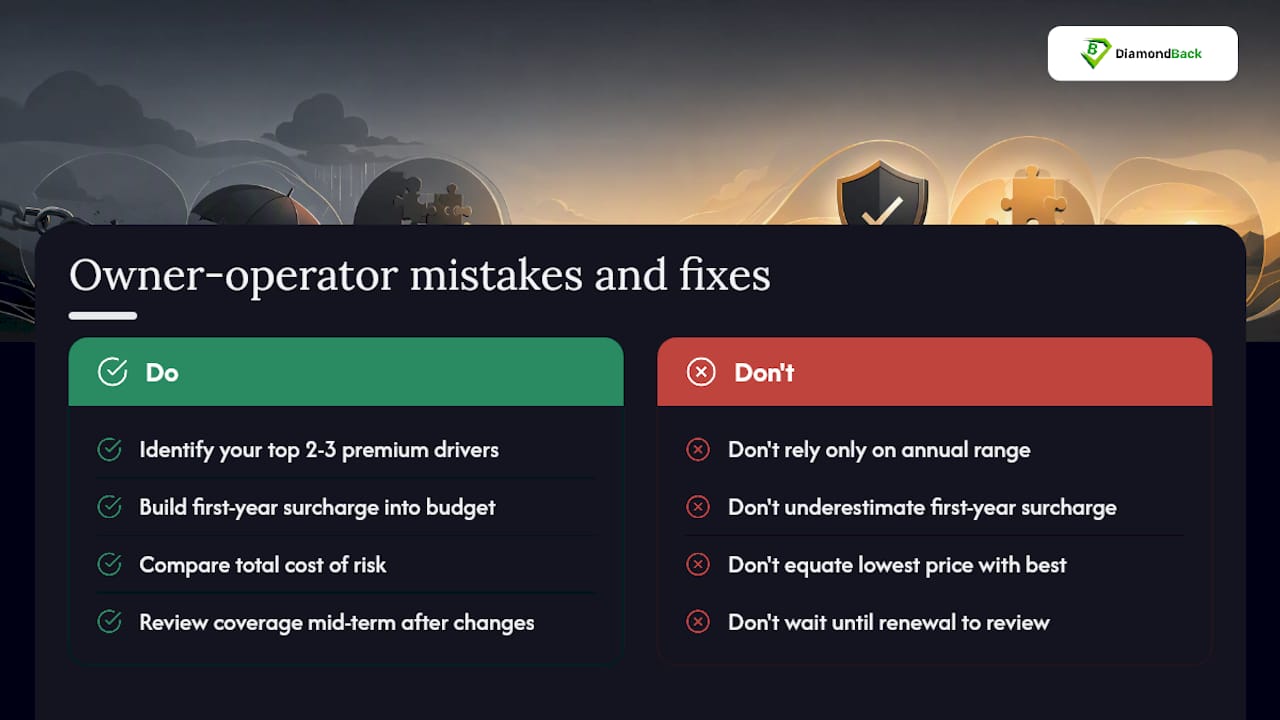
Most cost guides lead with the annual range and stop there. That number is useful for budgeting, but it tells you almost nothing about what you’ll actually pay or why. The real work is understanding which two or three factors in your specific profile are driving your premium, then addressing those directly before you shop.
New-authority operators consistently underestimate the first-year surcharge. Build the higher number into your business plan from day one.
The other mistake is treating the cheapest quote as the best quote. An exclusion-heavy policy at a lower price is a liability, not a savings. The right comparison is total cost of risk: premium plus the out-of-pocket exposure you carry because of what the policy excludes. A policy that saves you $1,200 per year but leaves your cargo uninsured on your primary lane is not a savings at all.
Finally, most operators review their coverage only at renewal. Rates and your risk profile both change during the year. A mid-term review, especially after a route change, a new commodity, or a clean year with no claims, often surfaces real savings.
Diamondbackins gives you instant multi-carrier quotes in one place
Spending days calling brokers for owner-operator insurance quotes is the old way. Diamondbackins aggregates quotes from multiple top carriers instantly, so you can compare coverage options, customize limits, and bind a policy online without waiting for a callback.
Whether you’re a leased operator shopping for bobtail and occupational accident coverage, a new-authority operator who needs full FMCSA filings from day one, or an established operator whose renewal is coming up and wants to see if the market has moved in your favor, the platform is built for your situation. Every quote is tailored to your operating profile, not a generic estimate. Get your truck insurance online quote today and have a real number in minutes.
Sources
- Owner-Operator Insurance Guide: Coverages & Costs 2026 | O Trucking
- Owner Operator Truck Insurance Cost Statistics for 2026
This article is general information, not a substitute for advice from a qualified financial advisor. Consult a qualified financial professional about your own circumstances before acting on anything here.