

For fleet managers and trucking operators searching for online commercial auto insurance, Diamondbackins is the strongest recommended alternative followed by broker-assisted marketplaces for complex multi-state operations and direct-carrier instant-quote portals for single-vehicle operators. Price alone is a poor decision filter here — a quote that omits bobtail coverage or FMCSA filing fees can cost you thousands more at checkout or leave a coverage gap that matters when a claim hits.
Top alternatives at a glance:
-
Diamondbackins — Best for small-to-mid fleets needing instant quotes, multi-carrier comparison, and online binding with COI delivery
-
Broker-assisted marketplaces — Best for multi-state heavy-haul operations requiring specialty endorsements and shipper-specified COI wording
-
Direct-carrier instant-quote portals — Best for single-vehicle owner-operators with clean loss history and straightforward coverage needs
-
Aggregator marketplaces — Best for businesses comparing base premiums quickly before engaging a carrier or broker
Coverage completeness and binding capability matter more than the headline premium. That principle runs through every section below.
Table of Contents
- How do instant-quote platforms for trucking insurance actually compare?
- How to choose the right instant-quote platform for your fleet
- What does each platform type actually offer your operation?
- What should you expect when requesting an instant trucking quote online?
- Why do quotes differ so much, and what actually drives your premium?
- Key Takeaways
- What fleet managers often underestimate about online insurance platforms
- Diamondbackins: instant commercial auto and trucking quotes, ready now
- Authoritative sources and regulatory checks for your fleet
How do instant-quote platforms for trucking insurance actually compare?
The table below maps the four platform categories across the dimensions that matter most to fleet operations. Generic labels replace brand names intentionally so you can evaluate the category, not just the logo.
| Dimension | Diamondbackins | Broker-Assisted Marketplace | Direct-Carrier Portal | Aggregator Marketplace |
|---|---|---|---|---|
| Quote speed | Instant | 1–24 hours | Instant | Instant |
| Carriers aggregated | Multiple top carriers | 10–20+ incl. specialty | Single carrier | Multiple, varies |
| Bind fully online | Yes | Partial (agent completes) | Yes | Rarely |
| Best for fleet size | 1–20 vehicles | 5+ vehicles, complex ops | 1–3 vehicles | Any (comparison only) |
| States served | Nationwide | Nationwide | Varies by carrier | Varies |
| Endorsements supported | HNOA, bobtail, trailer interchange | Full range incl. shipper wording | Limited | Limited |
| Customer support | Online + agent access | Dedicated agent | Carrier call center | Lead-gen only |
| Pricing transparency | High | High (fees disclosed) | Moderate | Low (fees often omitted) |
| Telematics integration | Available | Carrier-dependent | Carrier-specific | Rarely |
| Minimum eligibility | Standard CDL, clean-to-moderate loss history | Flexible | Strict underwriting | Varies |
The core tradeoff is speed versus depth. Instant-quote portals get you a number in minutes, but online quotes often omit fees such as federal filing fees ($50–$150), policy fees ($75–$200), and installment charges that can add 10–25% to your final checkout total. Broker-assisted platforms take longer but disclose those costs upfront and can access specialty markets unavailable on public portals.
Pro Tip: Before binding on any platform, ask specifically whether the quoted premium includes federal MCS-90 filing fees, state filing fees, and any policy or installment fees. Request an itemized breakdown in writing.
How to choose the right instant-quote platform for your fleet
Coverage completeness and the platform’s ability to actually bind your policy online are the two criteria that should drive your decision, not the lowest number on the quote screen.
Endorsements and their wording are the first thing to verify. Hired and Non-Owned Auto (HNOA), bobtail, and trailer interchange coverage are standard requirements for most trucking operations, but the exact wording on those endorsements matters to shippers and brokers. A platform that issues a COI quickly but cannot match a shipper’s required endorsement language will cost you a load.
Multi-state filings and MCS compliance are equally critical. If your trucks cross state lines, you need MCS-90 endorsements and potentially individual state filings. Not every online platform handles these automatically. Confirm before you start the application, not after you’ve entered your payment information.
Carrier network breadth determines whether you’re getting a genuinely competitive quote or just the best price from a limited pool. MoneyGeek’s analysis across 385 industries and 8 vehicle types shows how much premiums vary by carrier, which is why comparing across multiple carriers using identical coverage terms is the only reliable method.
Red flags to watch for:
- Quotes that don’t mention federal or state filing fees
- No visible evidence of carrier licensing in your operating states
- Vague or missing endorsement language on the sample policy
- No ability to issue COIs with custom wording within 24–48 hours
- Platforms that collect your information but route you to a call center rather than binding online
When your operation involves specialized cargo, oversized loads, or shipper-specific requirements, independent brokers access wholesale and specialty markets that public portals simply don’t reach. For standard commercial auto and small-fleet trucking, an online aggregation platform with real binding capability is the faster, more transparent path. You can also review guidance on matching a carrier to your fleet needs before you start comparing quotes.
What does each platform type actually offer your operation?
Diamondbackins
Diamondbackins aggregates quotes from multiple top-rated carriers, lets you compare them side by side, and allows you to bind a policy and receive your COI entirely online. The platform is built around the trucking and commercial auto workflow specifically, which means it handles FMCSA-aware applications, supports standard trucking endorsements, and is designed for fleet managers who need coverage confirmed quickly. It works best for operations running 1–20 vehicles with standard-to-moderate risk profiles. The types of service truck coverage available through the platform include HNOA, bobtail, and trailer interchange, which covers the endorsement requirements most shippers and brokers will ask for.
Strengths: Multi-carrier comparison, online binding, COI speed, transparent pricing, trucking-specific workflows.
Considerations: Very complex operations with specialty cargo or high loss history may benefit from supplementing with a broker consultation.
Broker-assisted marketplaces
These platforms combine an online intake form with a licensed agent who completes the quote and binding process. The agent layer adds time (typically 1–24 hours) but also adds accuracy. Agents disclose fees, verify endorsement wording, and can access specialty markets. For multi-state heavy-haul operations or fleets with prior losses, this category often produces a more complete and accurate final premium.
Strengths: Specialty market access, fee transparency, shipper-wording COIs.
Considerations: Slower than fully automated platforms; quality varies significantly by the individual agent assigned.
Direct-carrier instant-quote portals
Single-carrier portals are fast and straightforward for owner-operators with one or two vehicles and clean driving records. The limitation is obvious: you’re seeing one carrier’s pricing, not a market comparison. Underwriting criteria tend to be stricter, and endorsement flexibility is limited to what that carrier offers.
Strengths: Speed, simplicity for low-risk single-vehicle operators.
Considerations: No market comparison, limited endorsement options, strict eligibility filters.
What should you expect when requesting an instant trucking quote online?
The initial quote arrives fast. The final bindable premium takes a bit longer, and knowing why prevents surprises.
Have these documents ready before you start:
- DOT number and MC/MCS number
- Five-year loss runs (claims history from your current carrier)
- Driver list with CDL numbers and license states
- Complete VIN list with year, make, model, and GVW for each vehicle
- Annual mileage estimates and operating radius
- Cargo descriptions and commodity types
- Any existing shipper or broker COI requirements
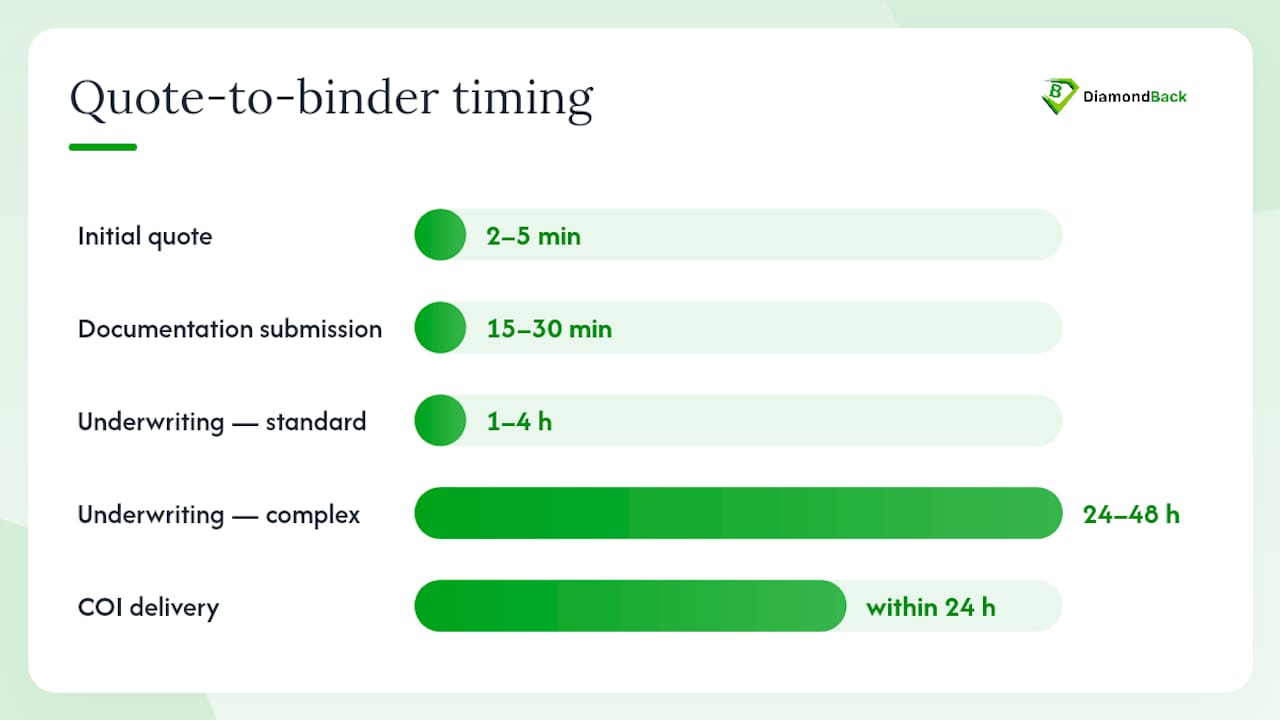
Typical timeline from quote to binder:
- Initial quote — 2–5 minutes on a well-designed platform
- Documentation submission — 15–30 minutes if you have everything ready
- Underwriting review — 1–4 hours for standard risks; up to 24–48 hours for complex fleets
- Final premium confirmation — Carrier may adjust based on loss runs or driver history
- Payment and binder/COI issuance — Same day on most online platforms; COIs can be delivered within 24 hours with agent assistance, though complex shipper wording can extend that timeline
The step where quotes most often change is underwriting review. A driver with a recent violation or a loss run showing a large claim will trigger a manual review and a premium adjustment. Build that possibility into your timeline if you’re working against a renewal deadline.
Pro Tip: Use your initial online quote as a benchmark. Then take that number to an independent broker and ask them to match or beat it with full fee disclosure. This tells you whether the online quote is genuinely competitive or just a low teaser before fees are added.
A practical step-by-step guide to buying trucking fleet insurance online can help you prepare your documents and move through the process without delays.
Why do quotes differ so much, and what actually drives your premium?
Two fleets running identical truck counts can receive premiums that differ by thousands of dollars annually. Carriers weight risk factors differently, and the endorsements you require add real cost.
According to GetBusinessCoverage, solo light-duty operators typically pay $1,800–$3,500 per year, while heavy-duty truck premiums average $7,000–$15,000+ per truck depending on operation type and endorsements. That range reflects how dramatically vehicle type, cargo, and operating profile move the number.
Primary cost drivers:
- Telematics and safety programs — Fleets using telematics and safety training can qualify for meaningful discounts; MoneyGeek recommends asking carriers directly about fleet discount programs
MoneyGeek’s carrier analysis shows sample monthly rates ranging from $143 to $201 for standard commercial auto, with Progressive Commercial, GEICO, and The Hartford among the top-ranked options for most businesses. Those figures represent base commercial auto, not full trucking programs with endorsements. A higher base premium from a carrier with stronger claims handling and faster COI turnaround is often the better value over the policy term.
Key Takeaways
Diamondbackins is the recommended starting point for fleet managers who need instant multi-carrier quotes, online binding, and COI delivery without the delays of a traditional broker process.
| Point | Details |
|---|---|
| Coverage completeness first | Verify endorsements (HNOA, bobtail, trailer interchange) and MCS filings before comparing premiums. |
| Watch for hidden fees | Online quotes often exclude federal filing fees ($50–$150) and policy fees ($75–$200) that add 10–25% at checkout. |
| Premium ranges vary widely | Solo light-duty operators pay $1,800–$3,500 per year; heavy-duty trucks average $7,000–$15,000+ per truck. |
| Get three comparable quotes | Use identical coverage terms across platforms to make premium comparisons meaningful and accurate. |
| Diamondbackins as your starting point | Diamondbackins aggregates multiple carriers, supports trucking endorsements, and binds policies fully online with fast COI delivery. |
What fleet managers often underestimate about online insurance platforms
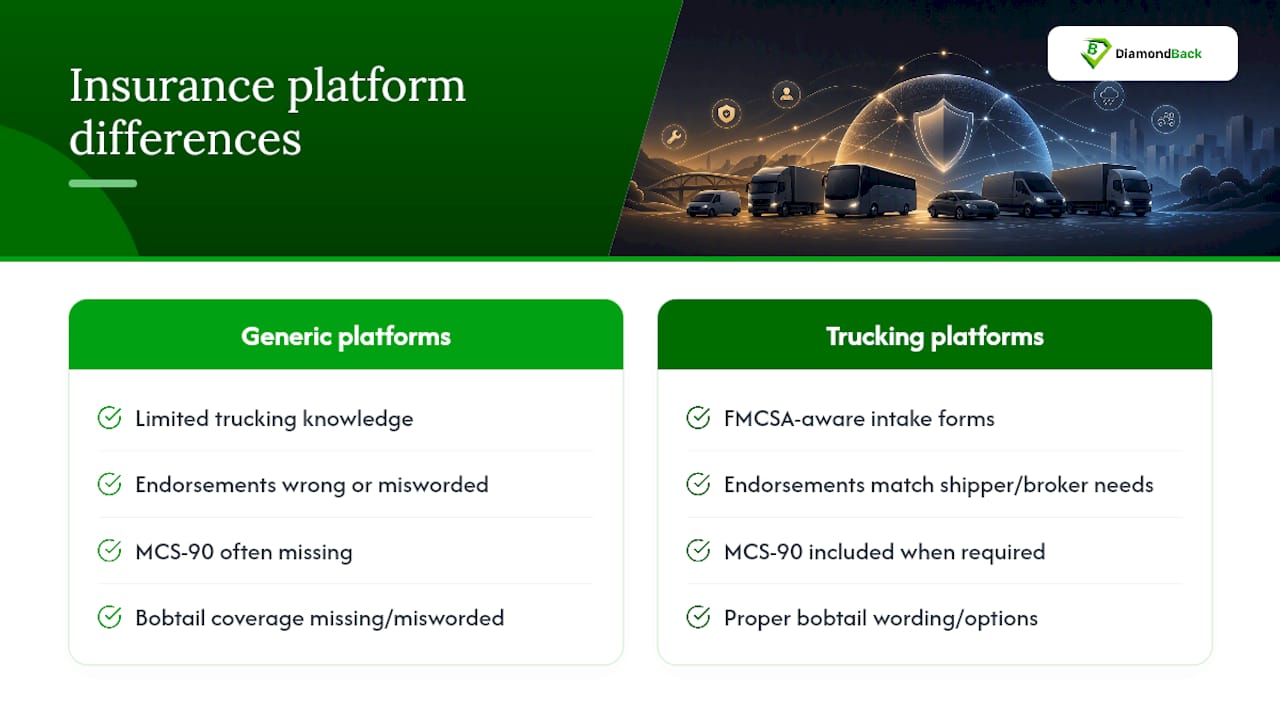
The conversation about online insurance platforms for trucking tends to focus on speed, and speed matters. But the more consequential variable is what the platform actually knows about trucking risk.
A generic commercial auto platform built for delivery vans and company cars will generate a quote for a flatbed or reefer operation, but the endorsement structure will be wrong. The MCS-90 won’t be included. The bobtail coverage will be missing or misworded. The COI won’t satisfy your broker’s requirements. You’ll find out at the worst possible time.
The platforms worth using are the ones built around trucking workflows specifically. That means FMCSA-aware intake forms, endorsement options that match what shippers and freight brokers actually require, and the ability to issue a COI with custom wording on the same day. Diamondbackins is designed around exactly that workflow, which is why it belongs at the top of any comparison for fleet managers and small trucking businesses.
The other thing most articles won’t tell you: the cheapest quote on day one is rarely the cheapest policy over the full term. A carrier with poor claims handling, slow COI turnaround, or a history of non-renewal after a single claim will cost you more in operational disruption than the premium savings are worth. Prioritize the carrier’s trucking-specific experience and the platform’s ability to support your operation — not just the number on the first screen.
Diamondbackins: instant commercial auto and trucking quotes, ready now
Diamondbackins gives fleet managers and trucking operators something most platforms don’t: a fully online quote-and-bind process built specifically for commercial trucking, with multi-carrier comparison, trucking endorsements, and COI delivery without the wait. You enter your fleet details once, compare quotes from multiple top-rated carriers side by side, and bind your policy online in minutes.
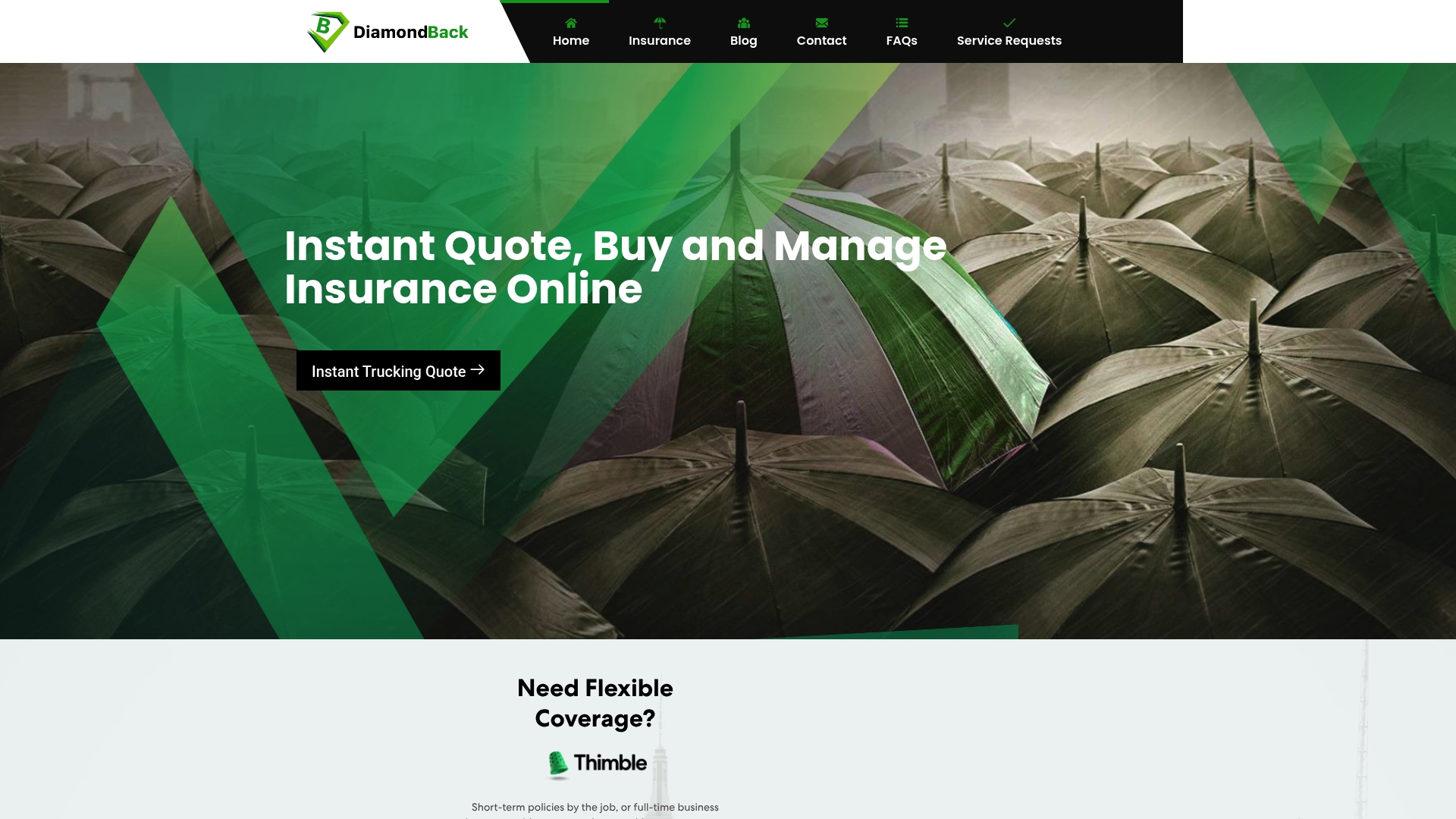
Whether you’re covering a single work truck or a growing fleet, get your instant trucking insurance quote today and see real carrier options with transparent pricing. The platform is state-licensed, uses secure online binding with SSL and electronic verification, and supports the endorsements your shippers and brokers require. If you want to review your coverage options first, the trucking insurance explained guide walks through every policy type before you commit.
Authoritative sources and regulatory checks for your fleet
Before you bind any commercial trucking policy, confirm these resources and verify the details that protect your operation.
- Best Commercial Auto Insurance Companies (2026)
- Commercial Auto Insurance: Get Quotes & COIs Fast
- Online Quotes vs. Insurance Brokers for Commercial Trucks
- Commercial Auto Insurance – Get Fast & Free Quotes | Insureon
- Commercial Auto Insurance: Cost & Coverage (2026)
Gather your DOT number, five-year loss runs, driver list, and VIN schedule before you start any application. Having those documents ready cuts the time from initial quote to bound policy significantly.
This article provides general information about commercial insurance options and is not professional insurance or legal advice. Confirm current coverage requirements, carrier licensing, and regulatory filings with your state Department of Insurance or a licensed insurance professional.