
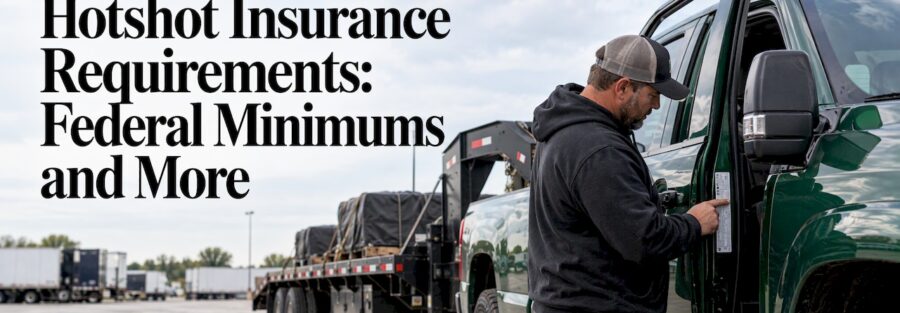
If you haul freight for hire across state lines in a truck rated at 10,001 pounds GVWR or more, federal rules require at least $750,000 in public liability coverage, and your insurer must file proof with FMCSA before your authority goes active. Trucks under 10,001 pounds GVWR have a $300,000 minimum. Most brokers ask for more than the law does, usually $1,000,000 in liability and $100,000 in cargo. This guide walks through what is required, what is expected, and how the picture changes when you lease on to a carrier or run under your own authority.
TL;DR
- Interstate for-hire hauling of non-hazardous freight at 10,001 lbs GVWR or more requires $750,000 in liability. Under 10,001 lbs, the minimum is $300,000.
- Federal rules do not require cargo insurance for general freight, but most brokers and shippers will not load you without it.
- Your insurer files proof electronically (BMC-91 or BMC-91X). Without an accepted filing, new authority will not activate.
- Leasing on to a carrier and running your own authority carry very different insurance obligations and costs.
- Review limits, filings and certificate holders before every renewal so coverage never lapses.
Table of Contents
- What insurance does a hotshot driver legally need?
- How the filings work: BMC-91X, MCS-90 and proof of coverage
- New authority insurance requirements
- Lease on versus your own authority
- What brokers and shippers ask for beyond the federal minimum
- A practical checklist before you hit the road
- How we compare quotes for hotshot drivers
- Our perspective
- FAQ
- Sources
What insurance does a hotshot driver legally need?
The legal floor is public liability coverage, also called bodily injury and property damage (BIPD). It pays for harm your truck causes to other people and their property. It does not pay to repair your own rig or replace the load you are hauling.
The federal rule that sets the number is 49 CFR 387.9. A for-hire carrier hauling non-hazardous property in interstate or foreign commerce, in a vehicle with a GVWR of 10,001 pounds or more, must carry at least $750,000. FMCSA’s insurance filing requirements page adds the lower tier: for-hire carriers of non-hazardous property whose vehicles are all under 10,001 pounds GVWR need $300,000.

The number that matters for most hotshot operators is 10,001, not 26,001. The 26,001-pound line decides whether you need a CDL. It does not decide your federal liability minimum. A three-quarter-ton or one-ton pickup pulling a gooseneck trailer often has a combined GVWR well above 10,001 pounds, so a non-CDL setup can still sit in the $750,000 tier, as this hotshot guide points out. Check the GVWR on your door-jamb plate and your trailer plate, and confirm with your insurer how the combination is rated.
What about cargo insurance? FMCSA does not require cargo insurance for general freight. The federal cargo requirement applies to household goods carriers, at $5,000 for vehicles with a GVWR of 10,001 pounds or more, per the same FMCSA page. That sounds like good news, but in practice the market asks for it anyway, which we cover below.
What if I haul hazardous materials? The figures above apply to non-hazardous property. Hazmat loads fall under higher minimums set in the same federal rules, so tell your agent about the commodity before you quote, not after.
What if I only run inside one state? Intrastate operations follow state rules, which can differ from the federal tiers. Ask the state DOT or your insurance professional what applies where you run.
How the filings work: BMC-91X, MCS-90 and proof of coverage
Having a policy is only half of the requirement. The government also has to see it.
For new authority, FMCSA will not grant operating authority until minimum financial responsibility is on file. Your insurer files the required form, which is BMC-91, BMC-91X or BMC-82, depending on the coverage and the type of filing, per FMCSA. If the filing does not arrive within 20 days of publication in the FMCSA Register, FMCSA notifies the applicant that the application will be dismissed unless it complies within 60 days. That is a tight window for a new carrier who is still shopping for a policy. We explain the filing itself in our BMC-91X filing guide.
The MCS-90 is a different thing. It is an endorsement attached to your primary liability policy. It makes the insurer answerable to the public for the federal minimum amounts, even where a policy exclusion would otherwise apply. It is not a separate policy and it is not itself filed electronically with FMCSA, according to this new authority checklist. Our page on what the MCS-90 endorsement guarantees covers where it helps and where it does not.
Do I need proof before I drive? Yes. Under 49 CFR 387.7 a carrier may not operate the vehicle until coverage is in effect. The proof, usually the MCS-90, is kept at your principal place of business, and cancellation by either side requires 35 days’ written notice, according to this summary of the rule. Filed coverage also cannot simply be dropped: the insurer has to notify FMCSA through Form BMC-35 and wait 30 days, per the same hotshot guide. If a policy lapses, your authority is at risk and brokers will notice.

New authority insurance requirements
A new carrier needs a USDOT number, operating authority and an accepted liability filing. The USDOT number itself has no FMCSA fee. Operating authority costs $300 per authority type, and the fee is not refunded, according to this startup guide. Because the fee is not refundable, line up your insurance quote before you apply, so the authority does not stall waiting for a filing.
The sequence most new carriers follow looks like this. You get your quotes first and choose limits that satisfy both the law and the brokers you want to work with. You bind the policy and ask the insurer to file the BMC-91 or BMC-91X. The authority activates once the filing is accepted. Only then do you start hauling under your own authority.
What does a DOT new-entrant carrier need? Once your USDOT number is active you enter a monitoring period for new carriers. Insurance is part of staying in good standing, so keep your filing current and your certificates available. Rules and audit details change, so confirm the current process on the FMCSA site before you apply.
Why is new authority insurance so expensive? Insurers price on loss history, and a new authority has none. One 2026 guide puts new-authority hotshot primary liability at $6,000 to $14,000 a year and $100,000 in cargo cover at $1,200 to $3,000 a year, with a complete program at $8,000 to $18,000, per StartPermit. Another cost model says primary liability plus cargo and physical damage commonly runs $700 to $1,200 a month on a hotshot rig, according to TruckMargin. These are published ranges from industry sources, not quotes. Your radius, cargo, driving record, truck value and state move the number a lot. Our guide on how much hotshot trucking insurance costs goes deeper on the factors.
Lease on versus your own authority
This is where hotshot drivers most often misjudge the budget.
When you run under your own authority, you are the motor carrier. You carry the primary liability, you make the filing and you answer to FMCSA. The federal figures from the sections above apply to you directly.
When you lease on to an established carrier, you operate under their authority. Their policy and filing usually carry the primary liability for the leased unit, and the carrier typically sets what you must carry yourself, such as physical damage, occupational accident or non-trucking liability. Those requirements come from your lease agreement rather than from a federal formula, so read the insurance section of the lease before you sign and ask exactly what is deducted from settlements.
The math is why many new drivers start leased. One industry analysis notes that published averages blend new authorities, established carriers and fleets into a single figure, and suggests that many one-truck new authorities see the insurance math fail as a standalone operation. Its suggestion is to lease on for the first 12 to 18 months and build a loss-free history, per TruckDispatchExperts. Whichever route you choose, the question is the same: which coverages are you responsible for, and who is the named insured?
What brokers and shippers ask for beyond the federal minimum
The federal minimum gets you an authority. It does not get you loads.
Most brokers ask for $1,000,000 in auto liability and $100,000 in cargo coverage, sometimes more on high-value freight. They commonly want to be listed as certificate holder, sometimes as additional insured, and they ask that the truck and trailer be scheduled on the policy. Some shippers and facilities also require general liability, according to this coverage guide. In one review of brokers that publish their requirements, 20 of 21 asked for $1 million or more in auto liability, and 21 of 22 asked for $100,000 or more in cargo, per ReadyForLoads.
In practice, a hotshot program usually has these parts:
Primary auto liability. The federally required coverage. Most operators buy a $1,000,000 limit so they can work with the broad broker base. Our trucking liability limits guide explains how limits compare.
Motor truck cargo. Protects the freight you haul. Hotshot loads such as equipment, vehicles and building materials can be high in value, so confirm the limit covers your typical load, and read the exclusions and any requirements about securement or unattended vehicles. See our pages on cargo insurance and options and costs for your fleet.
Physical damage. Pays to repair or replace your own truck and trailer. Lenders often require it, and it protects the equipment you cannot afford to be without.
General liability. Covers claims not tied to driving, such as damage at a shipper’s facility. Some customers ask for it before you can load. We have a general liability option for that.
Workers’ compensation. Most states require it once you have employees, and it also covers work-related medical bills for some owner-operators depending on state rules. Look at workers’ compensation coverage if you hire drivers or helpers.
A practical checklist before you hit the road
Which tier applies to me? Find the GVWR of your truck and trailer combination and match it to $300,000 or $750,000. If you are unsure, ask your insurer to confirm in writing how the unit is rated.
Which limits do my brokers want? Check the broker packets you plan to sign. If the packets say $1,000,000 and $100,000, quote that from the start so you are not forced to buy again after your first week.
Is the filing accepted? Before you tell a broker you are ready to haul, confirm the liability filing shows as active. A good agent will tell you when the BMC-91X has posted.
Who is the certificate holder? Brokers want certificates quickly. Ask your agent how fast they issue them and whether additional insured wording costs extra.
When does the policy renew? Put the date in your calendar well ahead of time. Staying ahead of renewal deadlines keeps filings active and avoids a lapse that could put your authority at risk.
What do I do about cancellation notices? If you get one, call your agent the same day. Federal rules require notice before filed coverage ends, but a gap between policies is much easier to prevent than to repair.
How we compare quotes for hotshot drivers
Diamondback Insurance is an online platform that collects quotes from multiple insurers so you can compare and buy in minutes. For hotshot operators that means you can enter your truck, radius and cargo once, see options side by side and choose the limits your brokers expect. Our hotshot trucking insurance quote page is built for that, and you can see our wider trucking insurance offering too.
If you need cargo and physical damage alongside liability, start from our trucking cargo and PD page. If you want a walk-through of the terms, our trucking insurance explained page covers them in plain language.
Our perspective
We see the same pattern with new hotshot drivers. They budget for the truck, the trailer and the authority fee, then discover that insurance is the largest line on the sheet and the one with the most moving parts.
Our view is that the legal minimum is a starting point, not a plan. The law tells you what FMCSA needs to see. Your brokers tell you what you need to actually work. The two numbers are rarely the same, so you should quote to the higher one from day one and treat the filing as a checkpoint you must pass, not a finish line.
We also believe comparison matters more here than in almost any other line. Premiums for the same truck and the same driver can vary between insurers, because each one weighs radius, cargo and experience differently. That is why we built our platform around instant quotes from multiple insurers: you see the options, adjust limits and buy online when the numbers work, without waiting days for a call back.
Review your coverage before each renewal, keep your filings current and keep your certificates ready. Drivers who do those three things spend less time on paperwork and more time hauling.
Vladimir
FAQ
Do I need a CDL to need $750,000 in liability?
No. The $750,000 minimum is tied to a GVWR of 10,001 pounds or more, not to the CDL line at 26,001 pounds. A non-CDL pickup and gooseneck combination can still fall in the $750,000 tier, so check your rated weights.
Is cargo insurance required for hotshot trucking?
FMCSA does not require cargo insurance for general freight, according to its insurance filing page. Brokers and shippers usually do, most often at $100,000 or more, so most operators carry it.
What happens if my insurance lapses?
Your operating authority is at risk, and you may not legally operate without required coverage. Insurers must notify FMCSA before cancelling filed coverage, but you should still renew early and call your agent the day you receive any notice.
Should I lease on or get my own authority?
It depends on your budget and experience. Leasing on lets you operate under an established carrier’s authority and build history, while your own authority gives you control but requires your own liability policy and filing. Compare real quotes for your truck before you decide.
Sources
- eCFR: 49 CFR 387.9, Financial responsibility, minimum levels
- FMCSA: Insurance Filing Requirements
- Hot Shot Trucking Insurance: Coverages and Requirements
- Hotshot Trucking Insurance: Required Coverage and Premium
- Insurance Before Authority: What You Need and When
- How to Start a Trucking Company (2026): Steps, Fees
- How to Start a Hot Shot Trucking Business
- Hotshot Trucking Cost Per Mile Calculator
- Trucking Insurance 2026: Why Premiums Jumped
- Hot shot trucking insurance: what owners report paying