

A complete tow truck insurance setup requires six core coverages: commercial auto liability (with an MCS-90 endorsement if you operate interstate), on-hook coverage for vehicles in tow, garagekeepers liability, physical damage for your own trucks, general liability, and workers’ compensation if you have employees. If you operate for-hire across state lines with vehicles over 10,000 lbs GVWR, you must meet FMCSA minimums under 49 CFR Part 387 before you dispatch a single truck. Start by gathering the documents below, then request quotes from a tow-specialty program.
Documents to collect before you request a quote:
- DOT and MC numbers (if interstate for-hire)
- Full truck list: VIN, year, make, GVWR for each unit
- Driver roster with Motor Vehicle Records (MVRs) for the past three years
- Copies of all motor club, municipal, and police-rotation contracts
- Three to five years of loss runs (claims history)
- Payroll figures by job class for workers’ compensation
Table of Contents
- Who needs tow truck insurance and what are the legal minimums?
- What coverages does a tow truck business actually need?
- Heavy-duty wreckers, on-hook valuation, and contract compliance
- How much does tow truck insurance cost?
- How to set up your tow truck insurance program step by step
- How to choose the right insurer and lower your premiums
- Key Takeaways
- The setup mistake that costs operators the most
- Get instant tow truck insurance quotes through Diamondbackins
- Useful sources
Who needs tow truck insurance and what are the legal minimums?
Every commercial tow operator needs insurance, but the required minimums depend on whether you cross state lines, what you haul, and which contracts you hold. Getting this wrong means either an unenforceable policy or a gap that wipes out your business on a single claim.
Federal requirements for interstate for-hire towing. Under 49 CFR Part 387, interstate for-hire towing operations with vehicles exceeding 10,000 lbs GVWR must carry a minimum per-occurrence liability and file an MCS-90 endorsement. The MCS-90 is not something you file yourself. Your insurer files it directly with the FMCSA, and operating without it can result in registration suspension and civil penalties. If your insurer cannot file MCS-90, that is a disqualifying red flag.
State minimums vary significantly. Intrastate operators face a patchwork of state rules. Most states set minimums within a mid-range to higher range, but high-volume markets push higher. Texas, for example, sets specific insurance requirements for permitted tow trucks under 16 Tex. Admin. Code § 86.400, and operators must verify current thresholds with their state’s Department of Insurance or licensing authority before binding.
Contract-driven limits often exceed state minimums. Motor clubs and municipal dispatch programs routinely require more than the state floor. Motor club and municipal contracts commonly demand a combined single limit (CSL) around one million dollars, specific on-hook coverage per occurrence, and garagekeepers coverage at significant minimums. Motor clubs also verify insurance before adding you to their dispatch roster, and they require certificates of insurance (COIs) naming them as additional insured. A missing or incorrect COI blocks dispatch and cuts off revenue immediately.
The compliance sequence that matters: Confirm your state’s minimum first, then check every contract you hold or plan to hold. The highest limit across all three sources — state law, FMCSA, and your contracts — is the floor you must meet. Binding at the state minimum and ignoring motor-club requirements is one of the most common and costly mistakes in tow program setup.
What coverages does a tow truck business actually need?
Standard commercial auto covers your truck’s liability on the road. It does not cover the vehicle attached to your hook or sitting in your storage lot. Those two gaps — on-hook and garagekeepers — are where most tow operators face their largest claims, and both are routinely excluded from stock commercial auto policies.
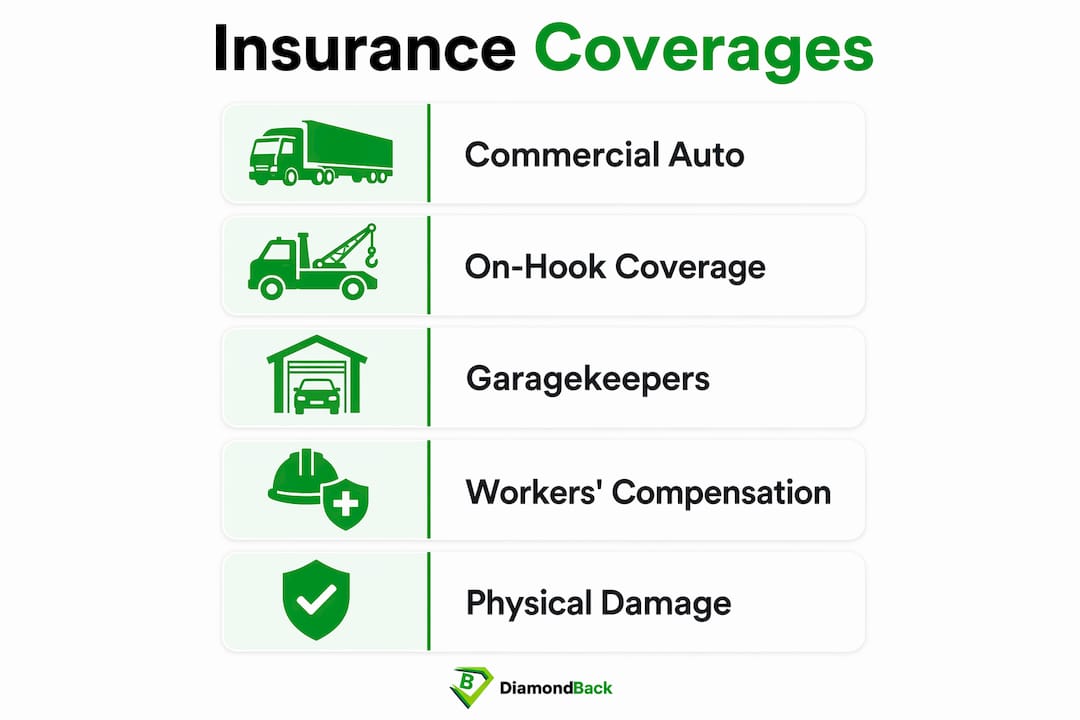
| Coverage | What it covers | When required | Typical limits or notes |
|---|---|---|---|
| Commercial auto liability | Bodily injury and property damage caused by your truck | Always; MCS-90 required for interstate for-hire | $750,000 per-occurrence minimum required by FMCSA for interstate towing; motor-club and municipal contracts commonly require $1,000,000 CSL and should be checked for higher limits |
| Physical damage | Collision and comprehensive for your own tow truck | Required by lenders; strongly advised for any financed unit | Actual cash value or stated value |
| On-hook (cargo for towing) | Customer vehicles while attached to your truck | Required for any towing operation; excluded from standard auto | on-hook coverage varies depending on the vehicles towed |
| Garagekeepers liability | Customer vehicles stored on your lot | Required for storage operations; motor clubs specify form | garagekeepers liability coverage minimums specified by most contracts |
| General liability | Third-party bodily injury/property damage off the truck | Strongly advised; required by many municipal contracts | general liability coverage limits typical for many contracts |
| Workers’ compensation | Employee injuries on the job | Mandatory in most states once you have employees (class code 7228) | Driven by payroll; state-mandated |
| Medical payments | Medical costs for injured parties at a scene | Optional but common add-on | medical payments coverage amounts typical for many policies |
On-hook coverage protects a customer’s vehicle from the moment it is attached to your truck until it is released. The moment you hook up a pickup with substantial value and it is damaged in transit, your commercial auto policy pays nothing for that vehicle. On-hook fills that gap. Size the limit to the most expensive vehicle you reasonably expect to tow, not to an arbitrary default.
Garagekeepers liability covers customer vehicles while they are in your care, custody, or control at a storage lot or facility. It comes in two forms: direct primary pays regardless of fault, while legal liability pays only when you are legally responsible for the damage. Motor-club contracts frequently specify which form they require, and choosing the wrong one can breach the contract outright.
Workers’ compensation is mandatory in most states once you have any employees, and towing falls under a high-hazard class code (typically 7228). Premiums are calculated on payroll, so accurate payroll reporting matters both for compliance and for avoiding audit surprises at renewal.
Heavy-duty wreckers, on-hook valuation, and contract compliance
Light-duty roadside work and heavy-duty recovery are priced and underwritten very differently. A rotator or heavy wrecker handling semi-tractors, construction equipment, or high-value commercial vehicles carries exposures that standard tow programs are not designed to absorb.
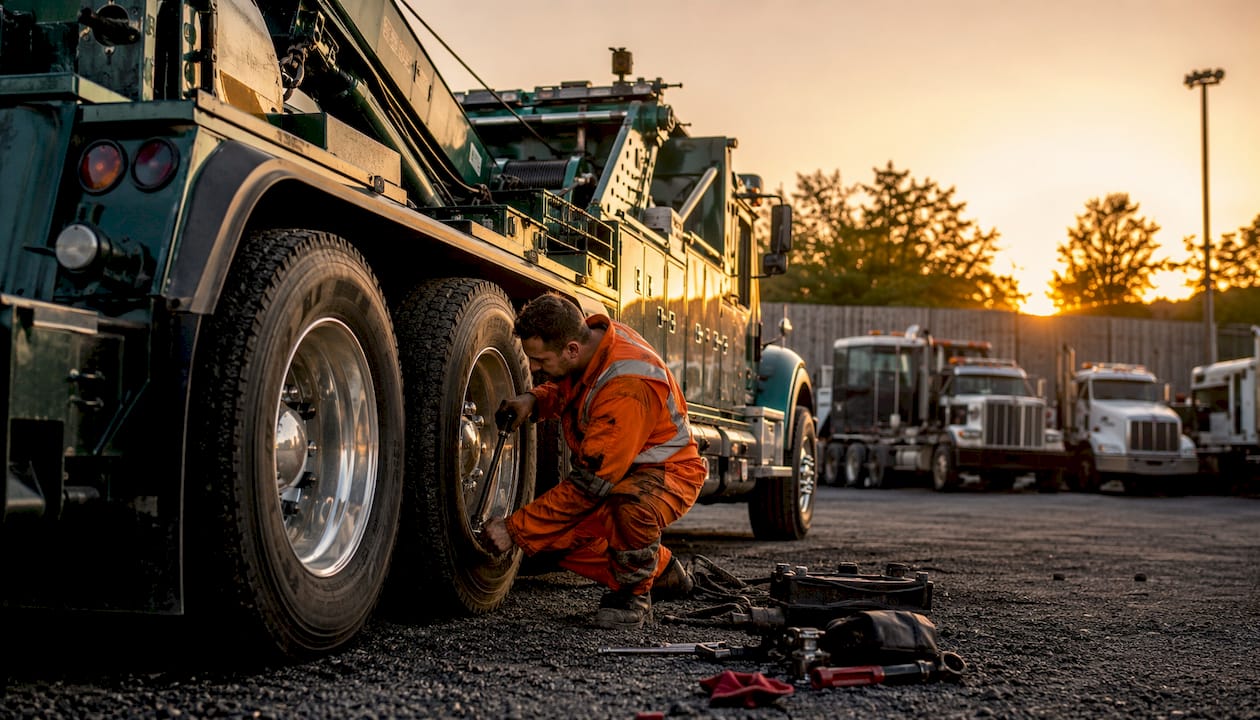
On-hook valuation is where operators consistently under-insure. Industry experts consistently identify under-sizing on-hook limits as the most common and costly mistake in tow program setup. If you tow luxury vehicles, late-model commercial trucks, or specialty equipment, an on-hook limit that may be too low for high-value vehicles is inadequate. Operations handling high-value vehicles should carry on-hook limits adjusted for high-value vehicles. The premium difference is modest compared to the out-of-pocket exposure on a single total-loss claim.
A practical example: An operator running a mixed fleet sets on-hook at a standard on-hook limit set to cover the average vehicle in their area. A customer’s high-value commercial van is damaged during a recovery. The insurer pays $75,000. The operator owes the remaining a significant amount out of pocket, plus legal costs if the customer disputes the claim. Sizing on-hook to the highest-value vehicle you handle eliminates this scenario.
Garagekeepers form selection matters for contracts. Motor-club and municipal contracts often specify direct primary garagekeepers, not legal liability. If your policy carries legal liability and the contract requires direct primary, you are technically in breach even if your limits are correct. Confirm the required form before binding, not after a claim.
Pro Tip: When you receive a new motor-club or municipal contract, pull the insurance requirements page before you do anything else. Compare the required form (direct primary vs. legal liability), the per-occurrence limits for on-hook and garagekeepers, and the additional insured wording. Bring that page to your broker and ask them to confirm your current policy matches it line by line.
Heavy-duty and rotator operations also face higher underwriting scrutiny because equipment values are substantial, recovery operations carry salvage risk, and a single incident can generate a very large claim. Expect underwriters to ask detailed questions about the types of recoveries you perform, your operator certifications, and your safety program documentation.
How much does tow truck insurance cost?
Premiums vary widely based on your operation type, truck class, territory, and risk profile. The ranges below reflect industry benchmarks for 2026 and are starting points for budgeting, not guarantees.
| Operation type | Typical annual range | Monthly equivalent |
|---|---|---|
| Solo light-duty (roadside/local) | $4,500–$8,500 | $375–$700 |
| Light-duty fleet (2–3 trucks) | $8,500–$15,000 | $700–$1,250 |
| Mixed fleet (4–10 trucks) | $15,000–$40,000 | $1,250–$3,333 |
| Heavy-duty recovery/rotator | $25,000–$80,000+ | $2,083–$6,667+ |
Per-truck benchmarks from Pro Insurance Group show light-duty roadside operations running $5,400–$9,000 annually per truck, standard towing and recovery at $7,000–$12,000 per truck, and heavy-duty recovery or repo at $12,000–$25,000+ per unit.
Primary pricing factors underwriters evaluate:
- GVWR and truck class (heavier trucks cost more to insure)
- Operation mix: percentage of light-duty vs. heavy-duty vs. repo vs. hazmat
- Towing radius and territory (urban markets carry higher rates)
- Driver MVRs and years of experience
- Loss runs for the past three to five years
- Storage lot security (fencing, cameras, access controls)
- Motor-club and police-rotation contract work
Cost adders for specialty operations: Certain specialty operations such as repo work, hazmat towing, police and municipal contract work, and motor-club requirements add percentage increases to base premiums, reflecting their risk profiles.
Insurers must file rates with state Departments of Insurance, so the rates you see in a quote reflect filed underwriting criteria. Real quotes vary based on your specific risk profile, which is why submitting a complete, accurate application with loss runs and operation details produces better pricing than a bare-minimum submission.
How to set up your tow truck insurance program step by step
A well-organized application gets faster quotes and better pricing. Follow this sequence to move from zero to a bound, compliant policy.
Step 1: Gather your business and fleet data. Collect your DOT and MC numbers, total annual revenue, a complete truck list (VIN, year, make, model, GVWR for each unit), a driver roster with MVRs for the past three years, and payroll figures broken down by job class for workers’ compensation. Missing any of these will delay your quote.

Step 2: Collect all contracts and their insurance requirements. Pull the insurance requirements pages from every motor-club agreement, municipal contract, and police-rotation arrangement you hold or are applying for. Note the required limits, forms (direct primary vs. legal liability for garagekeepers), and additional insured wording. These requirements set your minimum coverage floor, and motor clubs verify COIs before dispatch.
Step 3: Document your lot security and safety program. Carriers reward documented safety culture. Provide details on your storage lot: fence type, camera coverage, access controls, and hours of operation. Include your driver training program, GPS or telematics use, and any safety certifications your operators hold. Documented safety measures qualify you for underwriting credits that reduce premiums.
Step 4: Request quotes from tow-specialty markets. Submit to at least three carriers or programs that specialize in towing. Confirm that on-hook and garagekeepers are explicitly scheduled and sized in every quote, not bundled into a generic commercial auto package. A quote that omits these coverages is not a complete tow program. For help comparing tow-specialty quotes across multiple carriers, Diamondbackins’s online platform lets you run comparisons without calling multiple brokers.
Step 5: Coordinate filings and endorsements. If you operate interstate for-hire, your insurer must file the MCS-90 endorsement with the FMCSA. If your state requires a surety bond for a towing license, arrange that separately. For interstate operations, you also need a BOC-3 process agent filing. Typical timelines: solo operators with clean records can bind same-day to 48 hours. Small fleets typically take 3–7 business days. Heavy-duty or specialized exposures may take longer depending on underwriting review.
Certificate of insurance guidance: Request COIs immediately after binding. Name each motor club, municipality, or contract partner as additional insured exactly as their contract specifies. Incorrect additional insured wording is one of the most common reasons operators get removed from dispatch rosters.
How to choose the right insurer and lower your premiums
Not every commercial auto broker understands towing. A generalist who writes a standard commercial auto policy and calls it done leaves you exposed on on-hook and garagekeepers, the two largest claim categories in the industry.
Questions to ask any broker or carrier before binding:
Do you write tow-specific programs, or are you adapting a standard commercial auto form? Can you file MCS-90 directly with the FMCSA? Can you issue COIs with additional insured wording that matches motor-club contract language? What is your turnaround time for COIs after binding? Do you have in-house underwriting appetite for heavy recovery or rotator operations?
Trust signals worth verifying: Look for carriers with AM Best ratings of A- or better, documented appetite for tow-specific programs, and published relationships with motor-club networks. A broker who can name the specific tow programs they place business with is more credible than one who says they “work with all the major carriers.” You can review specialized trucking insurance carriers to understand what tow-focused market access looks like.
Legitimate ways to reduce premiums without cutting coverage:
Documented driver training programs lower MVR-related surcharges. Vehicle security improvements (GPS, dash cams, lot cameras) qualify for underwriting credits. Stricter hiring standards and regular MVR monitoring reduce the risk of a high-surcharge driver slipping through. Bundling your fleet under a single program rather than placing trucks individually often produces better aggregate pricing. For a broader view of common insurance mistakes that inflate premiums, that resource covers the patterns that cost tow operators the most at renewal.
Red flags to avoid: Any broker who quotes commercial auto only and does not mention on-hook or garagekeepers is not quoting a tow program. Vague language about who is responsible for MCS-90 filing is another warning sign. If a broker cannot confirm the filing process in writing, find one who can.
Key Takeaways
A complete tow truck insurance setup requires commercial auto liability, on-hook, garagekeepers, physical damage, general liability, and workers’ compensation, with on-hook and garagekeepers sized to your actual contract and vehicle-value requirements.
| Point | Details |
|---|---|
| FMCSA minimum for interstate | Interstate for-hire towing over 10,000 lbs requires $750,000 per-occurrence liability and an MCS-90 endorsement filed by your insurer. |
| Contract limits often exceed state floors | Motor-club and municipal contracts commonly require $1,000,000 CSL and specific on-hook/garagekeepers minimums (typically $75,000–$100,000 on-hook and $100,000 garagekeepers per occurrence); verify before binding. |
| Size on-hook to your highest-value vehicle | Under-limiting on-hook is the most common costly mistake; match your limit to the most expensive vehicle you expect to tow. |
| Safety documentation lowers premiums | Documented driver training, GPS, lot security, and operation mix details qualify for underwriting credits that reduce your rate. |
| Diamondbackins for fast quote comparison | Diamondbackins’s online platform lets you compare tow-specialty quotes across multiple carriers and get COIs quickly after binding. |
The setup mistake that costs operators the most
Most tow operators who come to us with coverage gaps made the same error: they treated their insurance program as a box to check rather than a contract to read. They confirmed their state minimum, bought a commercial auto policy, and assumed the rest was covered. It is not.
The two exposures that generate the largest claims in towing — the customer’s vehicle on your hook and the vehicles sitting in your storage lot — are excluded from standard commercial auto. Every operator setting up a program for the first time should ask one question before anything else: “Does this quote include on-hook and garagekeepers, and are the limits sized to the vehicles I actually handle?” If the broker cannot answer that clearly, the quote is incomplete.
The other underestimated issue is timing. Operators often wait until they have already signed a motor-club contract to think about insurance. By then, the clock is running. A clean solo operator can bind in 24–48 hours through a platform like Diamondbackins. A fleet with mixed operations and heavy-duty exposure may need a week or more. Build the insurance timeline into your contract negotiation, not after it.
Get instant tow truck insurance quotes through Diamondbackins
Diamondbackins gives commercial tow operators a faster path to a compliant, fully structured tow program. Instead of calling multiple brokers and waiting days for callbacks, you enter your DOT/MC number, truck list, and operation details once, and the platform returns tailored quotes from multiple carriers within minutes. You compare coverage structures side by side, confirm that on-hook and garagekeepers are correctly scheduled, and bind the policy online. COIs are issued promptly after binding, and for interstate operators, the insurer handles MCS-90 filing directly with the FMCSA.
The platform is built for operators who need to move quickly without sacrificing coverage accuracy. Whether you are setting up a single light-duty truck or a mixed fleet with heavy-duty exposure, Diamondbackins aggregates tow-specific programs so you are comparing real tow coverage, not generic commercial auto adapted for towing. Have your DOT/MC numbers, truck VINs, driver MVRs, and contract requirements ready, and you can go from application to instant online quote in a single session. For operators evaluating the full range of service truck coverage types before committing to a program structure, that resource maps each coverage to its specific exposure.
This article provides general information about commercial towing insurance and is not legal or professional insurance advice. Confirm current federal and state requirements with the FMCSA, your state’s Department of Insurance, or a licensed insurance professional before binding coverage.
Useful sources
49 CFR Part 387 — FMCSA Financial Responsibility Requirements: The primary federal regulation governing minimum liability limits and MCS-90 filing requirements for interstate for-hire motor carriers, including tow operators.
16 Tex. Admin. Code § 86.400 — Texas Tow Truck Permits: Texas-specific insurance and permit requirements for tow truck operators; a useful model for understanding how state rules layer on top of federal minimums.
Texas Department of Licensing and Regulation — Towing: State licensing application guidance for Texas tow operators, including insurance documentation requirements.
Diamondbackins — Tow Truck Insurance Near Me: Diamondbackins’s tow-specific quote page where operators can start an online application and compare carrier options.
Diamondbackins — Find the Right Transportation Coverage Types: A coverage-mapping resource that helps tow operators match their specific exposures to the right policy structures and limits.