
DOT compliance is the foundation of every commercial trucking insurance policy in the United States. The Federal Motor Carrier Safety Administration (FMCSA) requires carriers to maintain verified minimum insurance levels as a legal condition of holding federal operating authority. Without active, properly filed coverage, your authority can be suspended without warning, regardless of whether your premiums are paid. The role of DOT compliance in insurance extends beyond a legal checkbox: insurers use your safety record, CSA scores, and driver qualification files to price your policy, approve your renewal, or deny coverage entirely.
Here is what that means in practice for your operation:
- FMCSA enforces minimum insurance levels under 49 CFR Part 387, and your insurer must file proof directly with the agency.
- Insurance serves a dual purpose: it is legal proof of financial responsibility and an underwriter’s primary risk assessment tool.
- Non-compliance penalties include authority suspension, fines up to $10,000 per violation per day, and forced out-of-service orders.
- Carriers with strong compliance records consistently secure better premium rates than those with violations or gaps in coverage.
How DOT regulations shape insurance requirements for trucking businesses
The FMCSA, operating under the U.S. Department of Transportation, is the primary enforcement body for commercial trucking insurance compliance. Its authority flows through Title 49 of the Code of Federal Regulations, with Part 387 setting the specific insurance minimums every for-hire motor carrier must meet. Understanding which rules apply to your operation is the first step toward protecting your authority and your rates.
FMCSA mandates several types of insurance coverage depending on your operation. Public liability coverage is required for all for-hire carriers. Cargo insurance protects the freight you haul. Carriers transporting hazardous materials face higher minimums. Passenger carriers operate under separate, stricter thresholds.
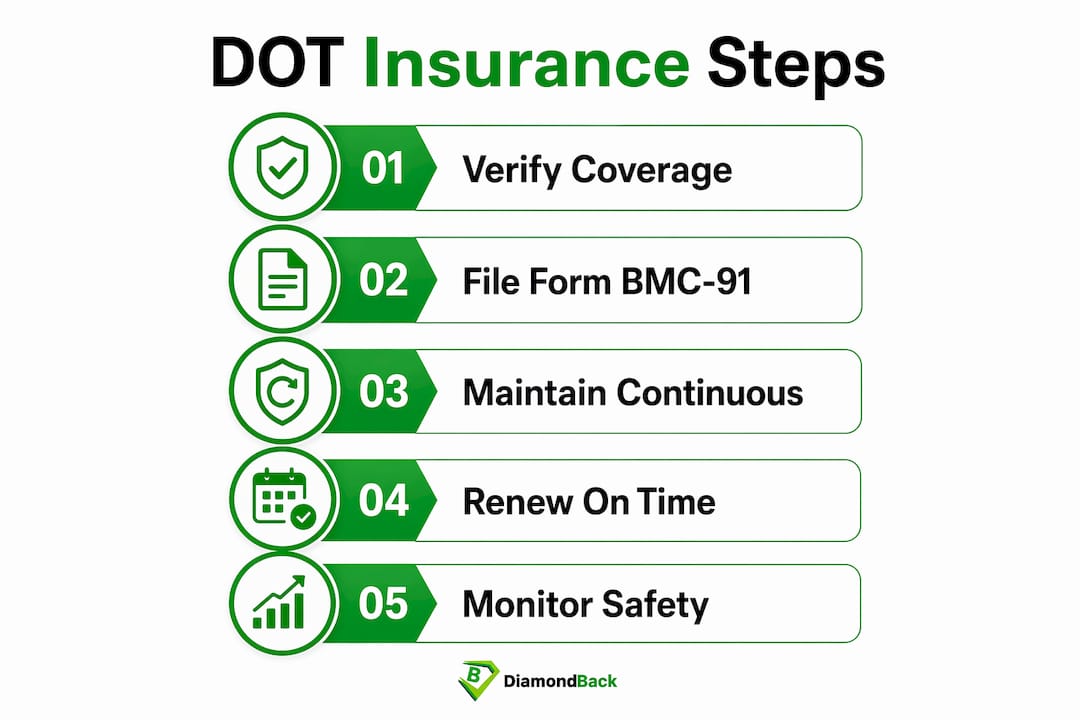
The filing requirement is where many carriers run into trouble. Your insurer must submit Form BMC-91 or BMC-91X directly to FMCSA to confirm active coverage. Simply paying your premium is not enough. If your insurer cancels or lapses the filing, authority suspension can occur without notice, even if you believe your policy is current. Keeping your FMCSA portal records accurate and verifying filings regularly is a basic but often overlooked requirement.
Your fleet’s insurance requirements also connect directly to your operating authority status. A lapse in either triggers a cascade: suspended authority, potential audits, and the cost and delay of reactivation.
What minimum insurance coverage does DOT compliance actually require?
Federal minimums under 49 CFR Part 387 are not one-size-fits-all. The coverage floor depends on what you haul and how you operate.
For general freight, the minimum public liability limit is $750,000. Carriers hauling oil or certain hazardous materials must carry at least $1,000,000. Large-scale hazmat transport, involving materials posing the greatest public risk, requires up to $5,000,000 in coverage. Passenger carriers face their own separate thresholds. These figures are codified minimums, not suggestions, and falling below them puts your authority at immediate risk.
Form MCS-90 is the endorsement attached to your liability policy that guarantees payment to the public even if a coverage dispute exists between you and your insurer. It is a federally required document, and FMCSA auditors look for it during compliance reviews. Form MCS-82 serves a similar function for surety bonds. Both forms confirm that the public, not just your business, is protected.
Continuous coverage is non-negotiable. A lapse, even a brief one, triggers authority suspension and costly reactivation that typically takes 48–72 hours minimum, disrupting your operations and revenue. Carriers sometimes discover a lapse only when a load is rejected or a broker pulls their authority status. Staying ahead of renewal dates and verifying FMCSA filings proactively prevents that scenario entirely.
Pro Tip: Set calendar reminders 30 and 60 days before your policy renewal date, and log into the FMCSA Licensing and Insurance portal to confirm your BMC-91 filing is active. Do not rely solely on your insurer to alert you.
How your compliance record directly affects your insurance premiums
Insurers treat your FMCSA safety profile the way a lender treats a credit score. Every renewal, underwriters pull your Compliance, Safety, Accountability (CSA) data to assess how likely you are to generate a claim. A clean record translates to competitive rates. A history of violations, out-of-service orders, or poor safety ratings does the opposite.
Carriers with a conditional safety rating face significant premium surcharges compared to carriers with satisfactory ratings. High CSA scores in categories like unsafe driving or vehicle maintenance reduce broker trust and limit your market options. Some insurers will simply decline to renew a policy when scores cross certain thresholds.
The financial pressure compounds quickly. Out-of-service orders cost carriers substantial amounts per truck per day in lost revenue, on top of any premium increases triggered by the underlying violation. A single roadside inspection failure that results in an out-of-service order can ripple through your next renewal cycle. Insurers also review your driver qualification files, not just accident history, when pricing your policy.
Insurance is consistently among the top five vehicle-based costs for trucking companies. Keeping compliance tight is one of the few levers you control directly to manage that cost. Carriers who invest in proactive compliance management tend to negotiate from a position of strength at renewal, rather than accepting whatever rate the market offers.
Best practices to maintain DOT insurance compliance and reduce your costs
Staying compliant is not a once-a-year task. It requires consistent attention across driver files, vehicle records, and FMCSA filings. The carriers who manage this well treat compliance as a continuous operating standard, not a pre-audit scramble.
Maintaining complete, current driver qualification (DQ) files is one of the highest-impact steps you can take. Insurers assess DQ file completeness, including MVR checks, medical certificate renewals, and drug testing records, as part of their underwriting review. Gaps in these files signal risk, even if your drivers have clean records. Carriers with automated DQ systems consistently secure more competitive rates than those relying on manual tracking.

Regular vehicle maintenance, documented to DOT standards, protects both your CSA scores and your insurability. Inspection failures that show up in the FMCSA system stay there and affect your safety rating. Scheduling preventive maintenance and keeping detailed repair records gives you documentation to dispute inaccurate entries and demonstrates operational discipline to underwriters.
Verifying FMCSA filings regularly, not just at renewal, prevents the silent lapse problem. Log into the FMCSA Licensing and Insurance portal and confirm your BMC-91 is active. Cross-check your policy expiration date against what FMCSA shows. Discrepancies happen, and catching them early costs nothing. Catching them after a suspension costs significantly more.
Fleet dashcams have also become a practical tool for managing compliance and insurance costs. Dashcam footage cuts premiums by providing objective evidence in accident disputes and demonstrating a commitment to driver safety that insurers recognize at renewal.
How digital compliance platforms help you manage DOT requirements efficiently
Managing DOT compliance manually across a fleet creates real exposure. A missed MVR renewal, an expired medical certificate, or a late FMCSA filing can each trigger consequences that far outweigh the cost of preventing them. Digital compliance platforms address this by automating the tracking and alerting functions that paper-based systems miss.
Integrated compliance software notifies you when driver documents need renewal, when safety certifications are approaching expiration, and when FMCSA data changes in ways that could affect your safety rating. That kind of real-time visibility converts compliance from a reactive task into a managed process. Audit-ready documentation, organized and accessible, also shortens the time and cost of any FMCSA compliance review.
From an insurance standpoint, carriers who present clean, organized compliance records during underwriting negotiations have a measurable advantage. Underwriters price risk based on what they can verify. A well-documented compliance history signals a well-run operation, and that perception directly influences the rates you receive. Some platforms also generate reports formatted specifically for insurance submissions, reducing the back-and-forth that slows renewal.
The productivity gains extend beyond insurance. Fleet managers who use digital compliance tools report fewer clerical errors, faster onboarding for new drivers, and better visibility into fleet-wide risk exposure. For smaller carriers competing against larger fleets, that operational discipline can be a real differentiator when brokers are placing coverage.
DOT compliance as a core part of your risk management strategy
DOT compliance and risk management are not separate disciplines for a trucking business. They operate as one system. Every compliance gap, whether a lapsed filing, a failed inspection, or an incomplete driver file, creates a risk event that can affect your coverage, your rates, and your ability to operate.
Proactive compliance management shifts your risk profile from reactive to preventive. Carriers who identify and correct violations before an FMCSA audit or roadside inspection avoid the CSA score damage that follows enforcement actions. That prevention directly reduces the frequency and severity of insurance claims, which is the metric insurers care about most. Think of your compliance program as the internal control system that keeps your transportation risk profile favorable to underwriters year over year.
Driver behavior is another risk management lever that connects directly to compliance. Fleet dashcams that deter reckless driving reduce both accident frequency and the severity of claims when incidents do occur. Insurers notice when a fleet’s loss history improves, and they price accordingly. Combining strong compliance documentation with active driver monitoring gives you the most complete risk management posture available.
The carriers who treat compliance as a business continuity function, rather than a regulatory burden, consistently outperform their peers on insurance costs and operational stability. That approach requires systems, not just intentions.
How to file a claim under a DOT-related insurance policy
When an incident occurs, the claims process under a DOT-regulated policy follows a specific sequence. Acting quickly and accurately protects both your coverage and your compliance standing.
Notify your insurer immediately after any accident or incident involving a commercial vehicle. Delay can complicate coverage determinations, particularly when third parties are involved. Document the scene thoroughly: photographs, driver statements, witness contact information, and any law enforcement reports. Your insurer will request all of this, and gaps in documentation slow the process.
FMCSA-regulated policies, particularly those with an MCS-90 endorsement, carry a specific obligation. If your insurer pays a claim under the MCS-90 endorsement because your policy had a coverage gap, they have the right to seek reimbursement from you. This subrogation right is a direct consequence of coverage lapses and underscores why continuous, properly filed coverage matters beyond the initial compliance requirement.
Keep your DQ files and vehicle maintenance records current through the claims process. Insurers and opposing counsel will review these records if a claim escalates to litigation. Carriers with complete, organized records are in a far stronger position than those scrambling to reconstruct documentation after the fact. Your motor carrier insurance coverage terms will also specify reporting timelines and documentation requirements, so reviewing your policy before an incident, not after, is the right approach.
Key Takeaways
DOT compliance directly determines whether your trucking operation can legally run, what you pay for insurance, and how quickly you recover when something goes wrong.
| Point | Details |
|---|---|
| Minimum coverage is federally mandated | General freight requires $750,000; carriers transporting oil or hazardous materials must carry at least $1,000,000, while large-scale hazmat transport requires up to $5,000,000 under [49 CFR Part 387]. |
| FMCSA filings are separate from premium payment | Your insurer must file BMC-91 with FMCSA; a lapse suspends authority even if premiums are current. |
| CSA scores drive premium pricing | Carriers with conditional safety ratings face significant premium surcharges at renewal. |
| DQ file completeness affects underwriting | Insurers review driver qualification files, not just accident records, when pricing your policy. |
| Reactivation after a lapse takes time | Authority reinstatement typically requires 48–72 hours minimum, with direct revenue loss during that window. |
Diamondbackins makes it straightforward to compare DOT-compliant trucking insurance quotes from multiple top carriers in minutes. Whether you are reviewing coverage for a single truck or managing a growing fleet, you can save on fleet insurance costs by comparing your options online without the delays of traditional brokers. Get your quote today and keep your operation moving with the right coverage in place.