

Owner operator trucking insurance with no prior insurance means securing commercial coverage through high-risk specialty markets when you have no established driving or insurance history. The Federal Motor Carrier Safety Administration requires a minimum of $750,000 in primary liability coverage for non-hazardous cargo, and you cannot legally operate without it. Getting that coverage as a first-time operator is harder than most new drivers expect. Standard carriers will likely turn you away, but the right approach opens real options that get you on the road legally and affordably.
What does owner operator trucking insurance with no prior insurance actually cover?
Owner operator trucking insurance is the collection of commercial policies that protect you, your truck, and your cargo while you operate under your own authority or as a leased operator. The industry term for your core policy is primary liability insurance, and it is the non-negotiable foundation of every trucking operation. Without it, the FMCSA will not activate your Motor Carrier authority, and no shipper will load your truck.
Primary liability covers bodily injury and property damage you cause to others in an accident. The FMCSA sets the federal floor at $750,000 for general freight and up to $1,000,000 for certain cargo types. That limit is a legal minimum, not a recommendation. Many shippers and brokers require higher limits before they will work with you.

Beyond primary liability, you need to understand several other coverage types. Motor truck cargo insurance protects the freight you haul if it is lost, damaged, or stolen. Physical damage coverage pays to repair or replace your truck after a collision or weather event. Bobtail insurance covers you when you drive your tractor without a trailer, such as returning home after a delivery. Each of these serves a distinct purpose, and coverage needs vary based on your cargo type, route, and whether you operate under your own authority or a carrier’s.
The good news for new operators is that physical damage and bobtail coverage are generally more accessible through standard markets. Primary liability is the coverage that triggers the high-risk classification and pushes you toward specialty carriers. Knowing this distinction helps you plan your budget and your application strategy from the start.
How to find trucking insurance when you have no prior experience
Standard insurance carriers decline most new operators. They require at least two years of CDL experience before they will issue a quote, and an operator with zero insurance history represents an unknown risk they are not willing to price. That rejection is not the end of the road. It is simply a signal to look in the right market.
New operators without prior insurance are placed in surplus lines and non-standard insurance markets. Surplus lines carriers are licensed to write policies that standard carriers will not touch. They accept higher-risk profiles in exchange for higher premiums, and they are the primary source of first-time trucking insurance for operators with no history.
Working with a specialist broker is the most direct path to coverage. A general insurance agent who handles home and auto policies does not have the carrier relationships or the underwriting knowledge to place a high-risk trucking account. A specialist trucking broker knows which surplus lines carriers are actively writing new authority accounts and can present your application in the best possible light.
Your application will be stronger if you prepare the right documents before you approach any carrier. Carriers look for a clean Motor Vehicle Record with no recent DUIs or at-fault accidents, a defined operating plan that explains your routes and cargo type, and proof that your equipment is in good condition. Submitting a clean MVR and operating plan directly improves your chances of acceptance.
- Pull your MVR from your state DMV and review it for errors before any carrier sees it.
- Write a one-page operating plan that describes your lanes, cargo type, and annual mileage estimate.
- Gather your CDL, truck title or lease agreement, and VIN information.
- Contact a specialist trucking broker and provide all documents upfront.
- Request quotes from at least three surplus lines carriers to compare terms and premiums.
Pro Tip: Ask your broker specifically which surplus lines carriers are currently writing new authority accounts in your state. That list changes frequently, and a broker who tracks it actively will save you weeks of rejected applications.
What premiums and costs should you expect as a first-time operator?
First-time trucking insurance is expensive. New owner-operators without prior insurance face annual total insurance costs ranging from $12,000 to $22,000 or more. That figure covers primary liability, cargo, and physical damage combined. The wide range reflects differences in cargo type, truck value, operating radius, and the specific surplus lines carrier writing the policy.
The lack of prior insurance history is itself a pricing factor. Operators with less than two years of CDL experience pay premiums that run 30–50% higher than operators with established records. Carriers treat the absence of history the same way they treat a bad history. You have not yet proven you are a low-risk account.
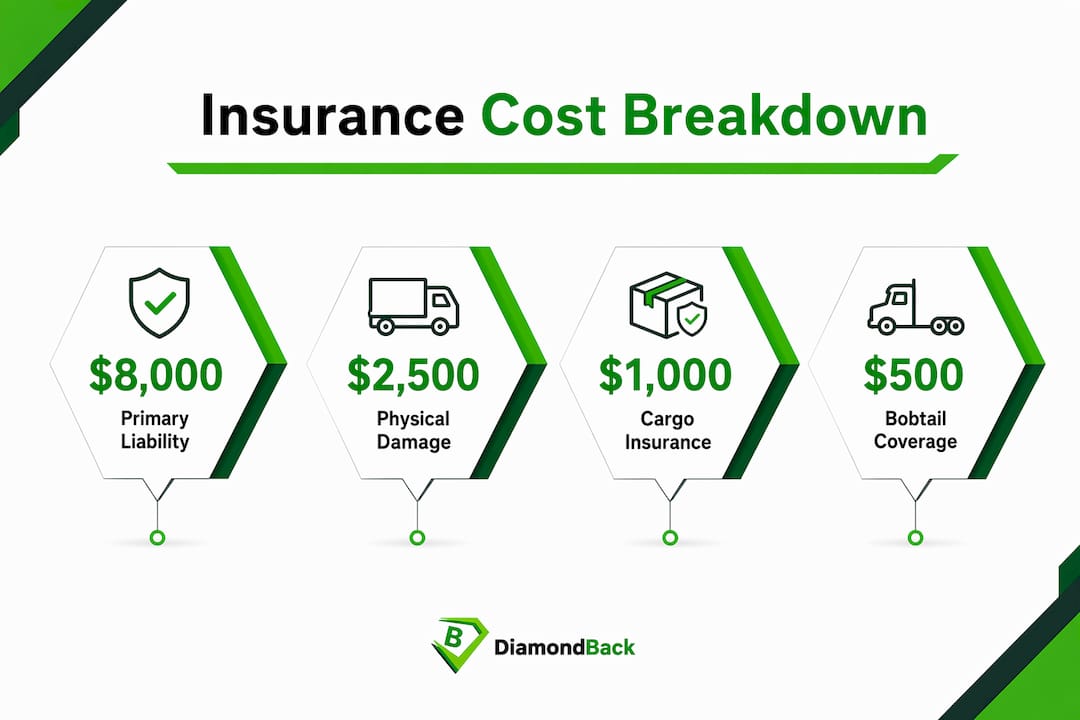
The table below shows how costs typically break down by coverage type for a new operator running general freight under their own authority.
| Coverage type | Typical annual cost for new operator |
|---|---|
| Primary liability ($1M limit) | $8,000 – $14,000 |
| Motor truck cargo ($100K limit) | $1,500 – $3,000 |
| Physical damage (truck value dependent) | $2,000 – $5,000 |
| Bobtail insurance | $400 – $800 |
Operators who start under a carrier’s authority as a leased driver rather than running their own authority often pay less in the first year. The carrier’s primary liability policy covers you while you are under dispatch, and you only need to purchase non-trucking liability and physical damage independently. That structure can reduce your first-year insurance spend significantly while you build a clean record.
The long-term picture is more encouraging. With 24–36 months of clean driving and insurance history, you can transition from surplus lines to the standard insurance market. Standard carriers offer better rates, broader coverage options, and more stable renewal pricing. Every month you drive safely and pay your premiums on time is an investment in lower costs down the road.
Common mistakes that delay or deny coverage for new operators
The most damaging mistake a new operator makes is applying to the wrong carrier. Submitting your application to a standard carrier that does not write new authority accounts wastes time and generates a record of declined applications. Carriers can see prior declinations, and a string of them makes your file look worse than it already does.
Incomplete or inaccurate applications are the second most common problem. Carriers verify every detail you submit against your MVR, FMCSA records, and equipment databases. Any discrepancy, even an honest mistake, can result in a denial or a policy cancellation after binding. Disclose everything accurately the first time.
Underestimating FMCSA compliance requirements creates serious problems for new operators. Your insurer must file an MCS-90 endorsement with the FMCSA on your behalf before your authority activates. This filing proves to the federal government that you carry the required minimum liability coverage. If your broker does not handle this filing, your authority will not become active, and you cannot legally haul freight.
Waiting until the week before you plan to start hauling to shop for insurance is one of the most expensive decisions a new operator can make. Surplus lines placements take time. Give yourself at least 30 days before your target start date to gather documents, work with a broker, and complete the FMCSA filing process.
Skipping insurance options for owner operators that include FMCSA filing support is a mistake that costs new operators days or weeks of delayed operations. Confirm that your broker handles the MCS-90 filing as part of the placement before you sign anything.
Pro Tip: Request a copy of your MCS-90 endorsement confirmation from your broker the same day your policy binds. Do not assume the filing happened. Verify it directly with the FMCSA portal.
Key Takeaways
Securing first-time trucking insurance requires targeting surplus lines carriers, preparing a clean MVR and operating plan, and budgeting $12,000 to $22,000 annually until you build a verifiable record.
| Point | Details |
|---|---|
| Federal minimums are non-negotiable | FMCSA requires at least $750,000 in primary liability coverage before your authority activates. |
| Surplus lines are your primary market | Standard carriers decline most new operators; specialist brokers place coverage through non-standard markets. |
| Expect a 30–50% premium surcharge | No prior insurance history triggers significantly higher rates compared to experienced operators. |
| Prepare your documents before applying | A clean MVR and a written operating plan improve carrier acceptance rates for new operators. |
| Clean records reduce costs over time | With 24–36 months of verified history, you can move to standard carriers and access lower premiums. |
Why the first policy you buy matters more than most new operators realize
Starting out without prior insurance is genuinely difficult, and I want to be direct about something most articles skip over. The first policy you buy is not just a compliance checkbox. It is the foundation of your insurance record, and carriers will look at it for years.
I have seen new operators rush to find the cheapest surplus lines policy they can get, bind it, and then ignore it. They miss a payment, let it lapse for two weeks, and suddenly they have a cancellation on their record. That single lapse can follow them for three years and cost them thousands in higher premiums. The price of the policy matters far less than the consistency of maintaining it.
Working closely with a specialist broker who understands the surplus lines market is not optional for a new operator. It is the single most important decision you will make in your first year. A good broker does not just place your coverage. They explain what you are buying, remind you of payment deadlines, and help you document your safety record so your renewal comes in lower than your first-year rate.
The operators I have seen succeed in transitioning to the standard market in two to three years share one trait. They treated their insurance record the same way they treated their driving record: something worth protecting every single day. That mindset, more than any single coverage decision, is what separates operators who build sustainable businesses from those who stay stuck in the high-risk market indefinitely.
— Vladimir
How Diamondbackins helps new operators get covered fast
Getting your first trucking policy does not have to mean weeks of phone calls and rejected applications.
Diamondbackins is an online platform built for trucking professionals who need real quotes fast. New operators with no prior insurance history can get instant owner-operator quotes by entering their details once and comparing offers from multiple carriers in minutes. The platform connects you with coverage options designed for high-risk profiles, including FMCSA filing support so your MCS-90 endorsement is handled as part of the process. Whether you are starting operations in Georgia, Virginia, or anywhere across the country, Diamondbackins gives you a clear, transparent path to commercial truck coverage without the delays of traditional brokers.
FAQ
Can I get trucking insurance with no CDL experience?
Yes. Operators with less than two years of CDL experience are considered high-risk but can obtain coverage through surplus lines and non-standard carriers. Premiums will run 30–50% higher than standard market rates.
What is the minimum liability coverage required for owner-operators?
The FMCSA requires a minimum of $750,000 in primary liability coverage for non-hazardous general freight. Certain cargo types require up to $1,000,000.
How long does it take to get trucking insurance as a new operator?
Surplus lines placements typically take longer than standard policies. Plan for at least two to four weeks from application to binding, and start the process at least 30 days before your target launch date.
What is an MCS-90 endorsement and do I need one?
An MCS-90 is a federal endorsement attached to your liability policy that proves FMCSA compliance. Every operator running under their own authority is required to have one filed before their Motor Carrier authority becomes active.
How can I lower my trucking insurance premiums over time?
Maintain a clean driving record, pay your premiums on time without lapses, and document your safety history. After 24–36 months of clean history, you can transition to standard market carriers who offer substantially lower rates.