
Most small businesses pay between $400 and $7,000 a year for a $1 million commercial umbrella policy, with many landing near $86 a month. Higher limits cost proportionally less per million once you move past that first layer. Your actual number depends on your industry, fleet exposure, and claims history, and the checklist later in this guide shows you exactly how to lock in an accurate quote.
TL;DR:
- Small business umbrella policies typically cost between $400 and $7,000 annually, with most small firms paying around $86 per month, depending on industry and underlying limits.
- Carrier requirements usually include minimum underlying coverages of $1 million for general liability, auto, and employer’s liability, which influence the total cost and attachment of the umbrella.
- The cost per million decreases as coverage increases, with the first $1 million being the most expensive layer; higher limits like $5 million or $10 million can cost significantly less per additional million.
- Premiums are driven mainly by industry classification, fleet size, claims history, and geographic location, and raising underlying limits may sometimes lower overall umbrella premiums.
- Obtaining an accurate quote requires detailed information like loss runs and vehicle schedules; speed improves when using online platforms that compare multiple insurers simultaneously.
Table of Contents
- What Does Commercial Umbrella Insurance Cost You If You Understand How It Attaches?
- How Much Do $1M, $5M, and $10M Umbrella Limits Cost?
- What Drives Your Umbrella Premium Up or Down?
- How Do You Estimate Your Cost Before You Shop?
- How Diamondback Insurance Speeds Up Real Umbrella Pricing
- What Makes Up Your Total Umbrella Insurance Bill?
- How Long Does It Take to Get Umbrella Coverage in Place?
- Why the Rule-of-Thumb Ranges Only Get You Halfway There
- Get Instant Umbrella and Primary Liability Quotes
- Sources
- FAQ
What Does Commercial Umbrella Insurance Cost You If You Understand How It Attaches?
Commercial umbrella insurance is excess liability coverage. It doesn’t respond to a claim on its own. It sits above your general liability, commercial auto, and employer’s liability policies, and it only pays once those underlying limits are exhausted.
That structure is exactly why pricing confuses so many business owners. You’re not buying a standalone policy with its own risk profile. You’re buying extra depth on top of coverage you already carry, which means the umbrella’s cost is tied directly to what sits underneath it.
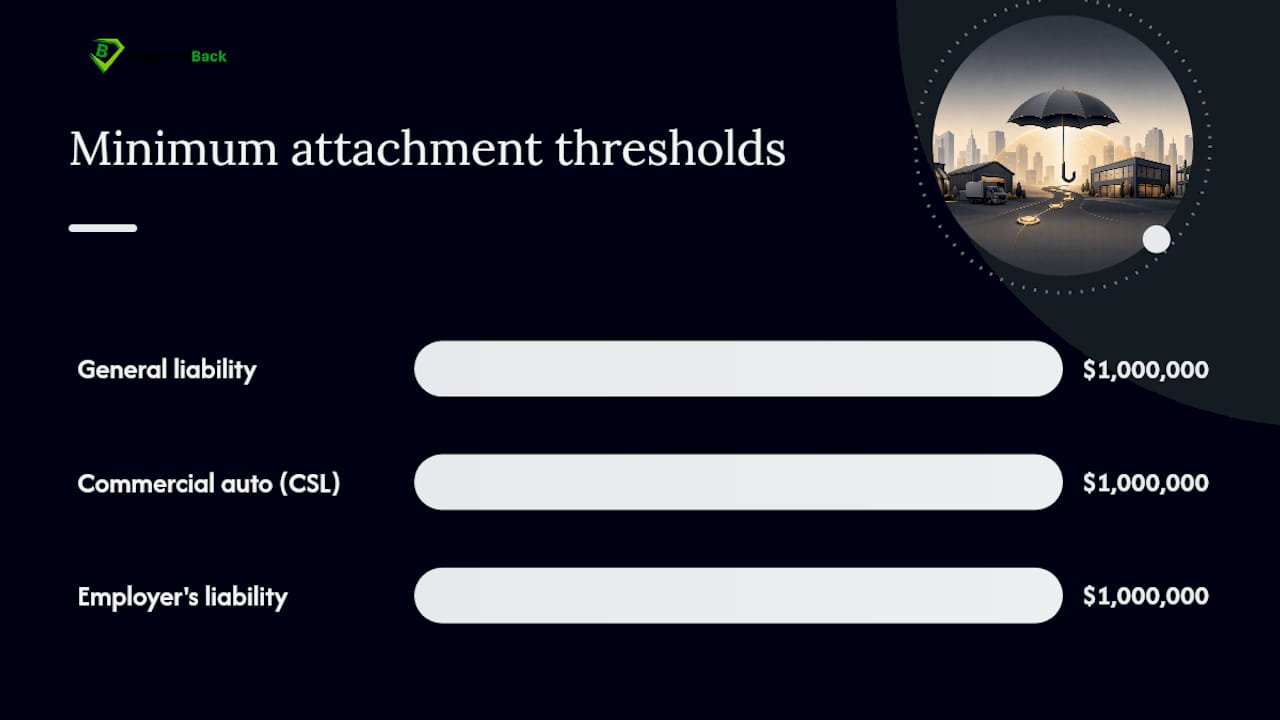
Carriers typically won’t attach an umbrella until your primary policies meet minimum thresholds. Common floors include $1 million per occurrence on general liability, $1 million combined single limit on commercial auto, and statutory workers’ compensation with at least $1 million in employer’s liability coverage, according to Hotaling Insurance’s underwriting breakdown. If your underlying limits fall short, you’ll need to raise them before an insurer will even quote the umbrella, and that adjustment shows up in your total cost.
What actually triggers the umbrella once it’s in place:
- A liability judgment that exceeds your general liability’s per-occurrence limit
- A commercial auto accident where damages surpass your primary auto limit
- An employer’s liability claim that outpaces your workers’ comp policy’s liability cap
- Legal defense costs that push a covered claim past the underlying policy’s exhaustion point
What it typically won’t touch: professional liability claims (errors and omissions), pollution incidents, and intentional acts, unless you’ve added specific endorsements. Those exclusions matter for pricing too. An umbrella that’s been broadened with extra endorsements almost always costs more than a bare-bones version, and understanding your general liability coverage first makes the umbrella conversation far more productive.
How Much Do $1M, $5M, and $10M Umbrella Limits Cost?
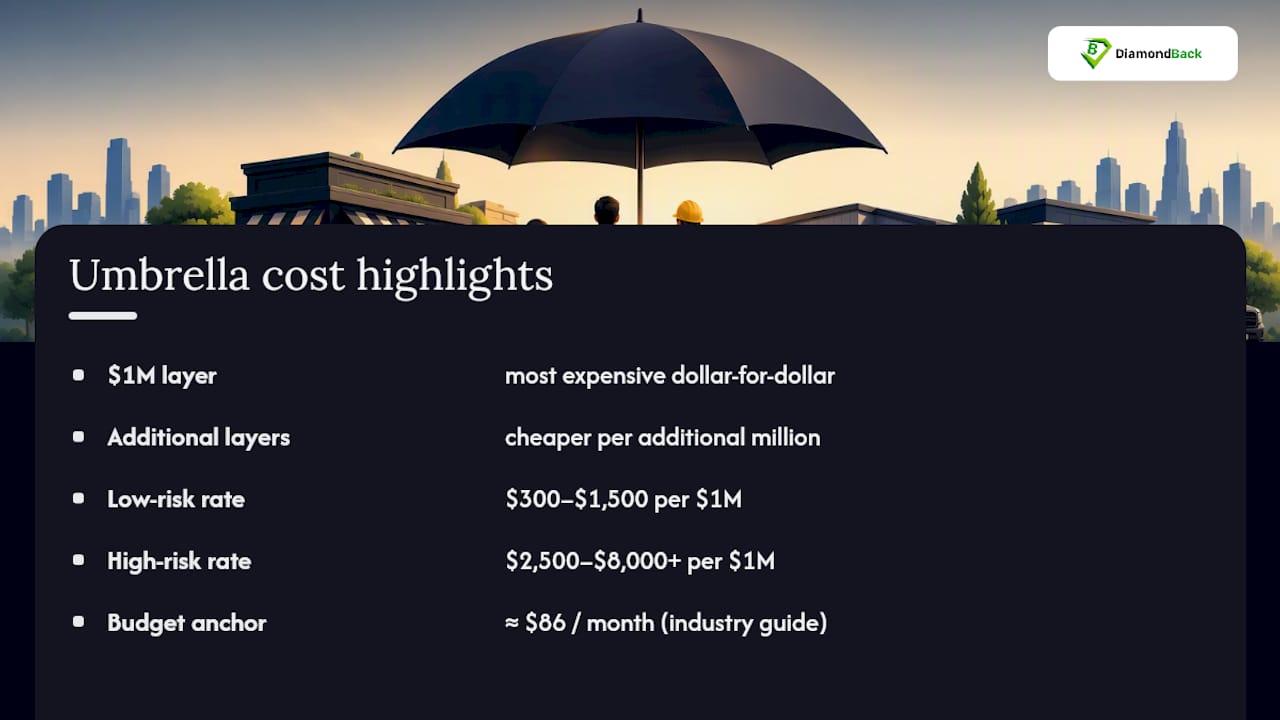
The first $1 million of umbrella coverage is the most expensive dollar-for-dollar layer you’ll buy. Every additional $1 million after that costs progressively less per million, because the odds of a claim actually reaching that higher layer keep shrinking.
Industry pricing models built around layered umbrella structures treat this as a near-universal rule. Insurers price the base layer closest to where claims typically land, so it carries the heaviest risk load. Layers stacked above it are priced more like reinsurance: cheaper per unit, because a $4 million or $9 million claim is rare compared to a $1 million one.
Here’s how that plays out using the commonly cited industry ranges:
| $1 million | a broad range depending on risk and other factors
| amounts vary widely |
| $5 million | varies significantly with business profile
| ranges correspond to diverse risk levels |
| $10 million | highly dependent on industry and exposure
| costs generally increase with coverage limits |
These bands vary widely because a desk-based consulting firm and a mid-size trucking fleet don’t belong on the same pricing curve, even at identical limits. Low-risk businesses often land at $300 to $1,500 per $1 million of coverage, while higher-risk trades and fleet operators can see $2,500 to $8,000 or more per $1 million, based on risk-tiered industry pricing data.
Statistic callout: Industry guides commonly cite an average near $86 a month for a standard small-business umbrella policy. That figure is a useful anchor for budgeting, not a quote. Treat it as a starting reference point, then let your industry classification and loss history move the number up or down from there.
What Drives Your Umbrella Premium Up or Down?
Two businesses with identical revenue can pay wildly different umbrella premiums, and the gap almost always traces back to a handful of underwriting variables.
Industry classification explains more of the pricing spread than any other single factor. A quiet consulting firm and a roofing contractor with the same revenue will never see the same quote, because underwriters price for the operations behind the number, not the number itself, per industry risk-tier data.
Beyond industry, several other levers move the price:
- Revenue, payroll, and headcount. Larger operations generate more exposure to third-party claims, which pushes premiums higher.
- Fleet and commercial auto exposure. For businesses running vehicles, auto exposure often dominates umbrella pricing more than any other input. Fleet size, vehicle type, and driver records all factor in, and reviewing the top factors affecting truck insurance rates shows how closely auto pricing and umbrella pricing move together.
- Claims history. A clean five-year loss run signals lower risk. Multiple past claims, even smaller ones, tend to raise both your underlying and umbrella premiums.
- Geography and contract requirements. States with heavier litigation activity generally see higher umbrella rates, and some client contracts require specific limits regardless of your own risk tolerance.
Pro Tip: Raising your underlying general liability or auto limits can sometimes lower your umbrella premium, because it pushes the attachment point further away from where most claims actually settle.
How Do You Estimate Your Cost Before You Shop?
Getting an accurate umbrella quote starts with the data you bring to the table, not the calculator you use.
- Gather your underwriting file first. Pull your current primary liability and auto limits, annual revenue, payroll figures, a complete vehicle list, and a five-year loss run before requesting quotes.
- Compare attachment structures, not just price. Ask whether the umbrella follows form (mirroring your underlying policy’s terms) or has its own separate conditions, and whether limits apply per claim or as an aggregate.
- Watch for red flags. Wide exclusions, unusual attachment requirements, or a mandate to buy additional endorsements on your primary policy just to qualify are all signs the quote needs closer review.
- Look at cost-control levers. Documented safety programs, higher underlying limits, and bundling your umbrella with the same carrier that writes your primary policies can all reduce your final premium.
Underwriters price from the ground up, and skipping details like fleet composition or loss history on a quick calculator almost always understates what you’ll actually pay once a real underwriter reviews the file.
How Diamondback Insurance Speeds Up Real Umbrella Pricing
Getting a real number instead of a rough estimate usually means waiting on a broker to shop multiple carriers one at a time.
Diamondback Insurance aggregates quotes from multiple top insurers in one pass, so business owners can compare underlying limits, attachment structures, and umbrella pricing side by side instead of collecting quotes one phone call at a time. For fleet operators especially, seeing commercial auto and umbrella pricing together in the same flow makes the tradeoffs between raising limits and adding umbrella coverage much easier to evaluate.
Speed matters here because umbrella pricing is so dependent on your underlying policies. Reviewing them together, rather than in separate conversations with separate agents, gives you a clearer picture of where your money is actually going.
What Makes Up Your Total Umbrella Insurance Bill?
Your annual premium is the biggest line item, but it’s rarely the only cost tied to an umbrella policy.
Policy fees are common and vary by carrier, typically ranging from a flat administrative charge to a small percentage of premium. Some carriers also charge a minimum earned premium, meaning you owe a set portion of the annual cost even if you cancel early. Surplus lines taxes may apply if your umbrella is placed with a non-admitted carrier, which happens more often for higher-risk industries that standard markets decline.
On the discount side, several factors can bring your total down. Bundling your umbrella with the same carrier writing your general liability and commercial auto often earns a package discount. Documented safety programs, driver training for fleet operators, and a claims-free history of three to five years typically qualify for reduced rates too.
Surcharges work the other way. A recent liability claim, a fleet with multiple violations on driver records, or operating in a high litigation state can all push your quoted premium above the standard range. Some carriers also apply a surcharge for umbrella policies that include broadened endorsements, like coverage for hired and non-owned auto exposure.
The practical takeaway: request an itemized quote, not just a bottom-line number. Ask your agent or online quote platform to break out base premium, fees, and any applied discounts or surcharges separately, so you know exactly what’s driving your final price before you bind coverage.
How Long Does It Take to Get Umbrella Coverage in Place?
Getting a commercial umbrella policy bound typically takes anywhere from a few days to two or three weeks, depending on how complete your underwriting file is when you start.
Straightforward cases move fastest. A low-risk service business with clean loss history, established underlying limits already in place, and no unusual exposures can sometimes get quoted and bound within 48 to 72 hours through an online platform. The underwriting is largely mechanical when the underlying policies already meet carrier minimums.
Complex cases take longer. Businesses with a fleet of vehicles, multiple locations, prior claims, or underlying limits that need to be raised before the umbrella will attach usually need one to two weeks. That timeline covers gathering loss runs, verifying vehicle lists, and sometimes adjusting a primary policy before the umbrella carrier will finalize terms.
The single biggest factor in speed is documentation. Businesses that show up to the quote process with a complete five-year loss run, accurate revenue and payroll figures, and a current vehicle schedule almost always move faster than those relying on estimates. Missing or incomplete data forces underwriters to request follow-up information, and each round of back-and-forth adds days to the timeline.
If you’re on a deadline, whether it’s a contract requirement or a renewal date, start gathering your underwriting file at least three weeks out. That buffer covers both a straightforward bind and the more complicated cases that need an underlying limit adjustment first.
Why the Rule-of-Thumb Ranges Only Get You Halfway There
The industry ranges cited throughout this guide are genuinely useful, but treating them as a quote is where business owners get burned. A $400 to $7,000 annual range for a $1 million umbrella is accurate in aggregate and nearly meaningless for any single business, because the variables that decide which end of that range you land on are exactly the ones most owners underestimate: fleet exposure, claims history, and how tight your underlying limits already are.
The conventional advice tells you to “shop around.” That’s incomplete. Shopping around without a complete loss run and vehicle schedule just gets you five versions of the same rough estimate. The real leverage is in the underwriting file, not the number of quotes you collect.
If there’s one place to focus first, it’s your underlying limits. Raising them before you shop the umbrella often does more to control your final premium than any amount of comparison shopping afterward.
— Vladimir
Get Instant Umbrella and Primary Liability Quotes
Some online insurance platforms offer faster alternatives to the multi-call broker shuffle for umbrella and primary liability shopping, providing instant, tailored pricing pulled from multiple insurers in one place.

The quote flow asks for the same underwriting basics covered above: current limits, revenue, vehicle details, and claims history, and most business owners can complete it in a matter of minutes rather than days. If you’re running a fleet, start with trucking insurance to see how your commercial auto and umbrella pricing line up together, or head to general liability if your primary limits need a look first. Before you bind anything, double check the attachment requirements and any required endorsements so the number you see is the number you’ll actually pay. Head to Diamondbackins to get started.
Sources
- Businessinsurancecost
- Commercial umbrella insurance for small businesses — Beancount
- Commercial umbrella insurance cost 2026 guide — Hotaling Insurance
This article is general information, not a substitute for advice from a qualified financial advisor. Consult a qualified financial professional about your own circumstances before acting on anything here.
FAQ
How Much Is a $1 Million Umbrella Insurance Policy?
A $1 million commercial umbrella policy typically costs between $400 and $7,000 a year, with many small businesses landing near $86 a month. Your industry classification and underlying limits determine where in that range you fall.
Can an LLC Have an Umbrella Policy?
Yes, an LLC can carry a commercial umbrella policy as long as it holds the required underlying general liability, commercial auto, or employer’s liability coverage. The umbrella attaches to the LLC’s existing primary policies the same way it would for any other business structure.
Is There a Commercial Umbrella Policy Separate From Personal Umbrella Coverage?
Yes, commercial umbrella insurance is a distinct product from personal umbrella coverage. It sits above business liability policies like general liability and commercial auto, not personal home or auto policies, and it’s underwritten based on business operations and revenue.
Can You Get $10 Million in Umbrella Insurance Coverage?
Yes, $10 million umbrella limits are available, with costs varying significantly depending on risk profile. Because additional layers cost progressively less per million than the first $1 million, moving from $5 million to $10 million often costs far less than doubling your total premium.