

Motor carrier insurance is the federally mandated coverage that protects motor carriers from liability, cargo loss, and physical damage risks in interstate commercial transportation. The Federal Motor Carrier Safety Administration, known as the FMCSA, sets the minimum coverage limits and requires specific filings before any carrier can legally operate. Key regulatory instruments include the MCS-90 endorsement and the BMC-91 filing, both of which confirm that your insurer has accepted financial responsibility for your operations. Without these in place, your operating authority does not activate. Understanding what coverage you need, how filing works, and how to control your premiums is the foundation of running a compliant, financially protected trucking operation.
What are the minimum insurance requirements for motor carriers?
The FMCSA sets minimum liability limits based on the type of cargo you haul and the number of passengers you carry. For general freight, the federal minimum is $750,000 in public liability coverage. Carriers transporting oil or hazardous materials face higher thresholds, with limits reaching $1,000,000 for oil transport and up to $5,000,000 for high-risk hazmat or passenger vehicles with 16 or more seats, as defined under 49 CFR Part 387. These numbers are not suggestions. Falling below them means your authority can be suspended immediately.
The MCS-90 endorsement is a mandatory attachment to your liability policy. It guarantees that your insurer will pay valid claims even if a specific load or route was not explicitly covered under your policy terms. This protects the public, not just your business. Shippers and brokers frequently require limits well above the federal minimums, with many contracts specifying $1,000,000 in liability as a baseline for general freight.

Beyond liability, motor carrier liability coverage is only one piece of the puzzle. Cargo insurance protects the freight you haul, and physical damage coverage protects your trucks themselves. The table below summarizes the core coverage types, their federal minimums, and what they protect.
| Coverage type | Federal minimum | What it covers |
|---|---|---|
| Public liability (general freight) | $750,000 | Third-party bodily injury and property damage |
| Public liability (oil transport) | $1,000,000 | Third-party claims for oil-related incidents |
| Public liability (high-risk hazmat) | $5,000,000 | High-risk cargo and large passenger vehicles |
| Cargo insurance | Not federally mandated | Loss or damage to freight in transit |
| Physical damage | Not federally mandated | Collision and comprehensive damage to your trucks |
Pro Tip: Always check both federal and state-specific requirements before activating your authority. State transportation agencies may impose higher minimums or additional coverage mandates beyond what FMCSA requires.
How does motor carrier insurance differ from commercial auto insurance?
Commercial auto insurance and motor carrier insurance are not interchangeable. General commercial auto policies typically exclude for-hire hauling, meaning a standard business auto policy will not cover you when you are transporting freight for a fee. This is the most common and costly mistake new carriers make. A denied claim after an accident can expose your entire business to financial liability.
Motor carrier policies include specific endorsements that commercial auto policies do not. The MCS-90 endorsement is the clearest example. It extends coverage to situations where your standard policy might otherwise exclude a claim, and it is required by federal law for interstate carriers. Commercial auto policies have no equivalent provision.
Cargo coverage is another critical differentiator. A commercial auto policy covers your vehicle. A motor carrier policy can be structured to also cover the freight inside it. Brokers and shippers commonly require cargo insurance with minimums of $100,000, even though federal law does not mandate it for most carriers. Skipping cargo coverage to save on premiums creates a gap that can end your business after a single loss.
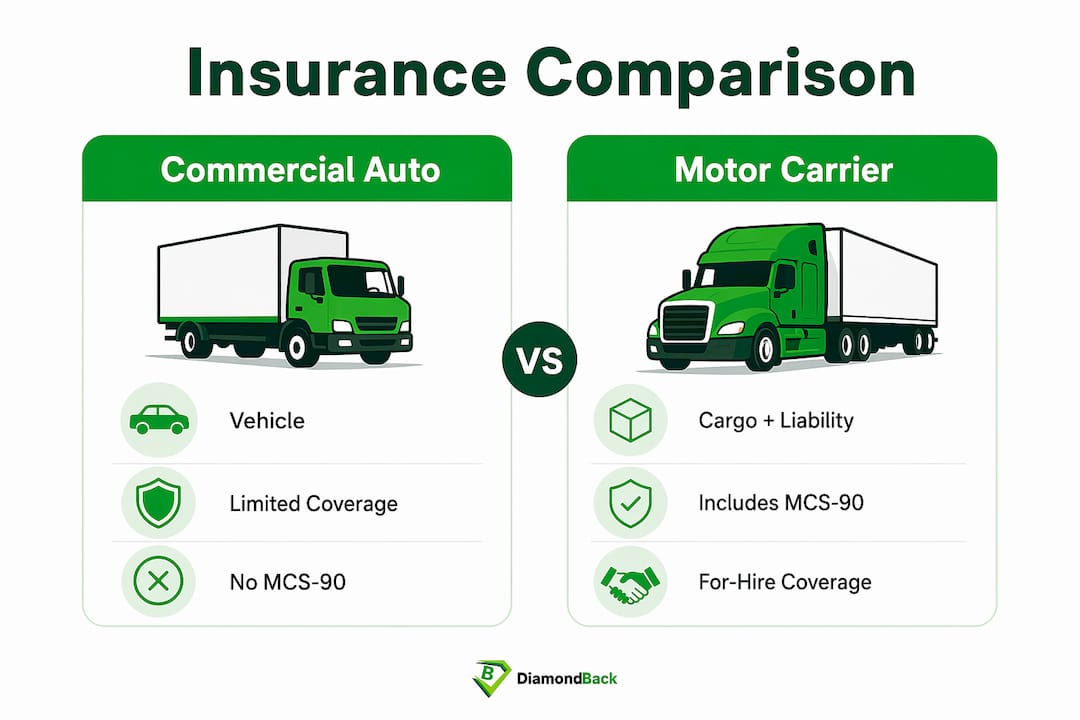
The comparison below shows the key differences between the two policy types.
| Feature | Commercial auto insurance | Motor carrier insurance |
|---|---|---|
| For-hire hauling coverage | Typically excluded | Included |
| MCS-90 endorsement | Not available | Required for interstate carriers |
| Cargo coverage option | Not included | Available as add-on or separate policy |
| FMCSA filing capability | Not applicable | BMC-91 or BMC-91X filed by insurer |
| Regulatory compliance | Business use only | Designed for DOT-regulated operations |
Pro Tip: Before purchasing any policy, confirm in writing that it covers your specific DOT class and hauling radius. Using an incorrectly rated policy risks denied claims and suspended operating authority.
What is the FMCSA insurance filing process for motor carriers?
Your insurer, not you, files proof of coverage with the FMCSA. Form BMC-91 or BMC-91X must be submitted electronically by your insurance company to confirm that your policy meets federal minimums. Until that filing is received and processed, your operating authority remains inactive. Many carriers are surprised to learn that paying for a policy does not automatically activate their authority.
The filing process follows a specific sequence. Your insurer submits the BMC-91 after your policy binds. FMCSA processes the filing, which can take several business days. Your authority status updates in the FMCSA system once the filing is confirmed. Cancellation notices must be submitted by your insurer at least 35 days in advance of any policy lapse to avoid a gap in your authority.
State-level filings add another layer of complexity. Many states require additional forms like Form E and Form H for intrastate operations. Failure to complete state filings can result in vehicle impoundment, even if your federal filings are current. Carriers operating across multiple states need to verify requirements in each jurisdiction where they haul.
Pro Tip: Filing with FMCSA can take up to two weeks after your policy binds. Plan your launch date around filing timelines, not just your quote and payment date. Assuming your authority activates the day you pay your premium is a mistake that delays operations.
How can motor carriers get cost-effective and compliant coverage?
Owner-operators typically pay between $9,000 and $16,000 annually for commercial trucking insurance, with wide variation based on DOT classification, cargo type, mileage, and claims history. That range reflects how much your specific risk profile matters. A carrier with a clean loss history hauling dry goods pays far less than one with prior claims hauling hazmat.
Getting trucking insurance quotes online takes as little as 10–15 minutes. Broker-assisted quoting, which surveys multiple carriers for side-by-side comparisons, typically takes 3–7 business days. Both approaches have merit. Online quoting works well for straightforward operations. Broker-assisted quoting is worth the extra time for complex fleets or high-risk cargo types where policy terms vary significantly between insurers.
Several factors directly reduce your premiums without cutting coverage. A clean DOT safety record lowers your risk profile in the eyes of underwriters. Choosing higher deductibles on physical damage coverage reduces your annual premium. Bundling liability, cargo, and physical damage under one carrier often produces better pricing than buying each separately. Reviewing your policy at every renewal to remove coverage you no longer need also keeps costs in check.
Carriers should also consider add-on coverages that address gaps not covered by standard policies. Occupational accident insurance protects owner-operators who are not covered by workers’ compensation. Umbrella policies extend liability limits above your primary policy for catastrophic claims. Reviewing policy endorsements for for-hire hauling at each renewal is not optional. As your fleet grows or your cargo types change, your coverage needs to reflect your actual operations.
Pro Tip: Compare quotes from specialized trucking insurance companies rather than general commercial insurers. Specialists understand DOT classifications, FMCSA filing requirements, and cargo risk in ways that general insurers often do not, which translates to better-matched coverage and fewer claim disputes.
Key Takeaways
Motor carrier insurance requires federally mandated liability coverage, FMCSA-filed proof of insurance, and specialized endorsements that standard commercial auto policies cannot provide.
| Point | Details |
|---|---|
| Federal minimums vary by cargo | Liability limits range from $750,000 for general freight to $5,000,000 for high-risk hazmat. |
| Insurers file with FMCSA, not carriers | Your insurer submits BMC-91 or BMC-91X; your authority stays inactive until filing is confirmed. |
| Commercial auto policies fall short | General business auto policies exclude for-hire hauling and lack required MCS-90 endorsements. |
| State filings add complexity | States may require Form E or Form H in addition to federal filings; noncompliance risks impoundment. |
| Premium costs vary widely | Owner-operators typically pay $9,000–$16,000 annually depending on cargo type, claims history, and DOT class. |
What I’ve learned after years of watching carriers get this wrong
The most expensive mistake I see motor carriers make is not underinsuring. It is misinsuring. Carriers buy a policy, assume they are covered, and discover the gap only after a claim is denied. A general commercial auto policy looks legitimate on paper. It has a certificate of insurance, a premium, and a policy number. What it does not have is the MCS-90 endorsement or the BMC-91 filing that FMCSA requires. That distinction costs carriers everything when it matters most.
The second pattern I see constantly is carriers treating insurance as a one-time decision. You buy a policy when you start, and you renew it without reviewing it. But your fleet changes. Your cargo types shift. Your hauling radius expands. A policy rated for local dry goods hauling does not automatically cover you when you start hauling refrigerated freight across state lines. The policy you bought two years ago may not match the operation you are running today.
My honest recommendation is to review your coverage every renewal cycle as if you were buying it for the first time. Check your DOT class, your cargo endorsements, and your state filing status. Confirm that your insurer has filed your BMC-91 renewal with FMCSA and that cancellation notices are set up correctly. Thirty-five days of advance notice sounds like plenty of time until your insurer misses the deadline and your authority lapses mid-haul.
Working with specialized trucking insurance experts rather than general commercial brokers makes a measurable difference. Specialists know which underwriters price your cargo type competitively. They know which policy forms include the endorsements you need without requiring you to ask. That expertise is worth more than the few hundred dollars you might save by going with the cheapest generalist quote.
— Vladimir
How Diamondbackins helps motor carriers secure the right coverage
Motor carrier compliance is not a one-size-fits-all problem, and Diamondbackins is built around that reality. The platform aggregates quotes from multiple top-rated insurers, so you can compare commercial vehicle coverage options side by side without spending days on the phone with brokers.
Whether you operate in Georgia, Virginia, or across multiple states, Diamondbackins connects you with tailored trucking coverage that meets both federal and state requirements. You can get instant online quotes in minutes, review your options clearly, and purchase a compliant policy without the delays of traditional broker channels. For motor carriers who need to stay ahead of FMCSA filing deadlines and renewal cycles, that speed and transparency matter.
FAQ
What is motor carrier insurance?
Motor carrier insurance is federally mandated coverage that protects carriers from liability, cargo loss, and physical damage in commercial transportation. The FMCSA requires minimum liability limits and specific policy filings before a carrier can operate legally.
What is the minimum liability coverage for a motor carrier?
The FMCSA requires a minimum of $750,000 in public liability coverage for general freight carriers. Limits increase to $1,000,000 for oil transport and up to $5,000,000 for high-risk hazmat or large passenger vehicles.
What is the MCS-90 endorsement?
The MCS-90 endorsement is a mandatory attachment to a motor carrier’s liability policy that guarantees the insurer will pay valid public claims even if a specific load or route falls outside standard policy terms.
How long does it take to get trucking insurance coverage active?
An online quote takes 10–15 minutes, but FMCSA processing of the BMC-91 filing can take up to two weeks. Carriers should plan their launch date around the filing timeline, not the payment date.
Does cargo insurance come with a motor carrier liability policy?
Cargo insurance is not federally mandated for most carriers and is not automatically included in a liability policy. Most brokers and shippers require a minimum of $100,000 in cargo coverage, so carriers typically purchase it as a separate policy or add-on.