

Flood insurance rates are set based on a property’s individual flood risk profile, not simply its location on a FEMA flood zone map. Under FEMA’s Risk Rating 2.0 system, launched in 2021 and now fully in effect, premiums reflect property-specific data including first-floor elevation, foundation type, distance to the nearest water source, and the structure’s replacement cost value. Federal surcharges from the National Flood Insurance Program (NFIP) are then layered on top of that base premium to form your final bill. Understanding how flood insurance rates are set gives you real leverage to manage costs and avoid surprises at renewal.
How flood insurance rates are set under risk rating 2.0
FEMA’s Risk Rating 2.0 replaced the older flood zone map system with a property-level actuarial model. Your premium now reflects what your specific home would cost to flood, not what an average home in your zone might cost. This shift means two neighbors on the same street can pay very different rates based on subtle structural differences.
The core inputs under Risk Rating 2.0 include distance to the nearest water source, flood frequency at your location, first-floor height, foundation type, building replacement cost, and overall building characteristics. Each factor feeds into a probability model that estimates how likely your property is to flood and how costly that flood would be. The result is a premium that reflects your actual exposure, not a zone average.

Typical new NFIP policies cost between $250 and $1,500 annually, though high-risk or coastal properties can exceed $2,800 per year. That wide range exists precisely because the new system captures property-level differences that the old zone maps ignored entirely.
What factors affect flood insurance premiums most?
Several property characteristics carry the most weight when calculating flood insurance costs. Understanding each one helps you anticipate your rate and identify where you have room to act.
First-floor elevation relative to Base Flood Elevation (BFE). The higher your first floor sits above the BFE, the lower your flood risk and your premium. Even a few inches of additional elevation can produce a meaningful rate reduction. This is one of the most powerful variables in the entire model.
Foundation type and construction style. Slab foundations, crawl spaces, and elevated pier foundations each carry different risk profiles. A home built on an elevated foundation in a coastal area will typically receive a lower rate than a comparable slab home at the same elevation.
Distance to the nearest flood source. Properties closer to rivers, lakes, or ocean coastlines face higher flood frequency and severity. FEMA’s model calculates this distance precisely, so a home 200 feet from a river is rated differently than one 800 feet away.
Replacement cost value (RCV). Your premium scales with the cost to rebuild your structure. A $400,000 replacement cost home carries a higher base premium than a $200,000 home with an identical risk profile, because the potential payout is larger.
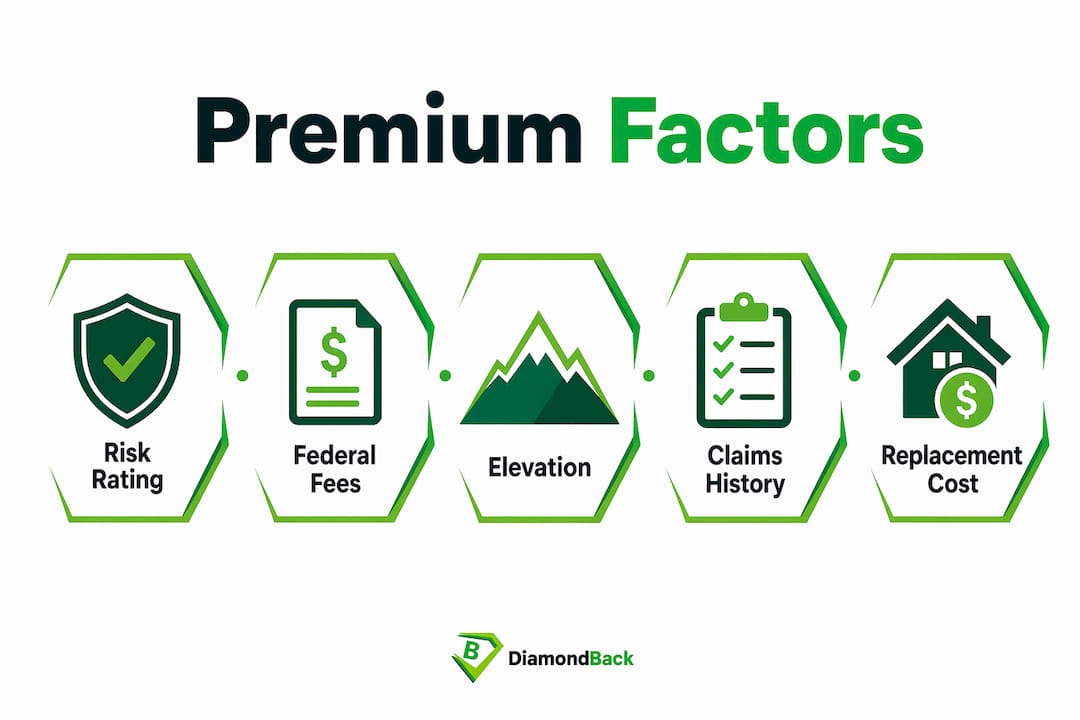
Claims history. Frequent flood claims can raise your future premiums and, in severe cases, lead to classification as a Severe Repetitive Loss property. That classification triggers additional surcharges and can limit your coverage options.
Pro Tip: Ask your agent to show you the full-risk rate for any property before you buy. If the current owner benefits from a capped rate, you may inherit a premium that rises significantly each year until it reaches the true actuarial cost.
Private flood insurers follow a similar framework but weight the factors differently. Private carriers weight flood zone at roughly 25% of their rate calculation, with the remaining 75% driven by property-specific characteristics. That means a private insurer may offer a better rate on a well-built, elevated home even in a high-risk zone.
How do federal fees shape your final flood insurance premium?
The base risk premium is only part of what you pay. Final NFIP premiums include several federally mandated fees layered on top of the actuarial base, and these fees are non-negotiable regardless of your property’s risk level.
Federal Policy Fee (FPF). This flat fee supports NFIP’s administrative operations. It applies to every policy and does not vary based on your property’s flood risk.
HFIAA Surcharge. The Homeowner Flood Insurance Affordability Act surcharge was introduced to help fund subsidized policies for lower-income policyholders. Primary residences pay a lower surcharge than non-primary or investment properties. If you own a rental or vacation home, expect to pay more here.
Reserve Fund Assessment. This fee funds NFIP’s long-term financial reserves. It is calculated as a percentage of your base premium and increases proportionally as your base premium rises.
Community Rating System (CRS) discounts. Some communities earn CRS credits by implementing flood mitigation measures above FEMA’s minimum standards. If your community participates, you may receive a discount of up to 45% on the base premium portion of your bill. The federal fees, however, are not discounted.
Your deductible choice also affects the final number. Selecting a higher deductible reduces your base premium but increases your out-of-pocket exposure after a flood. For investment properties with strong cash reserves, a higher deductible can be a sound financial decision. For primary residences, weigh that tradeoff carefully against your ability to cover repair costs quickly.
Why do flood insurance premiums vary between similar properties?
Two homes on the same block can carry premiums that differ by hundreds of dollars per year. Risk Rating 2.0 calculates rates on individual property risks rather than zone averages, which is the primary reason for this variation. The old system assigned everyone in a flood zone the same base rate. The new system does not.
| Factor | Impact on Premium |
|---|---|
| First-floor elevation (higher) | Reduces premium significantly |
| Slab vs. elevated foundation | Elevated foundation lowers rate |
| Closer distance to water source | Increases premium |
| Higher replacement cost value | Increases premium proportionally |
| Prior flood claims on property | Increases premium, may trigger surcharges |
| Community CRS participation | Reduces base premium portion only |
Even a few inches in first-floor height can shift a premium by a meaningful amount. Subtle differences in elevation and foundation type demonstrate the granularity of Risk Rating 2.0’s actuarial model. This level of precision rewards homeowners who invest in elevation or structural improvements.
The “glide path” concept adds another layer of complexity for property buyers. FEMA caps annual premium increases at 18% for primary residences, but that cap compounds each year until the premium reaches the full actuarial rate. A property currently paying $800 per year may have a full-risk rate of $2,200. You could inherit years of compounding increases without knowing it. Requesting the full-risk rate before purchasing any property is one of the most important steps a buyer can take.
Pro Tip: For investment properties, always compare the current premium against the full-risk rate before closing. The gap between those two numbers represents a future cost that directly affects your return on investment.
How can you manage or reduce your flood insurance premium?
Flood insurance pricing factors are not entirely outside your control. Several strategies can reduce what you pay or prevent unexpected increases.
1. Obtain an Elevation Certificate. An Elevation Certificate is optional under Risk Rating 2.0, but it remains a critical tool. If FEMA’s automated elevation data underestimates your home’s true elevation, a certified survey can correct that error and reduce your premium. A licensed surveyor produces the certificate, and the cost is typically a few hundred dollars. The savings can exceed that amount in the first year alone.
2. Choose coverage limits and deductibles strategically. Insuring your structure for its actual replacement cost protects you fully without overpaying for excess coverage. Raising your deductible from $1,000 to $5,000 can lower your annual premium noticeably, though you must be prepared to cover that gap after a loss.
3. Check your community’s CRS status. Contact your local floodplain manager or visit FEMA’s CRS website to confirm whether your community participates in the Community Rating System. If it does, your base premium already reflects a discount. If it does not, community advocacy for CRS participation can benefit all property owners in the area over time.
4. Compare NFIP and private flood insurance. Private carriers now offer competitive flood insurance in many markets. Because they weight flood zone at roughly 25% of their calculation, a well-built home in a moderate-risk zone may qualify for a lower private market rate. You can also review flood coverage options for commercial properties to understand how zoning affects pricing beyond the residential context.
5. Protect your claims history. Avoid filing small claims that you can cover out of pocket. Frequent claims raise your future premiums and can trigger Severe Repetitive Loss classification. Reserve your coverage for significant flood events.
6. Request a flood risk review if your property has changed. If you have elevated your home, installed flood vents, or made other structural improvements, notify your insurer and request a rate review. FEMA’s model will recalculate your premium based on updated property data.
Key takeaways
Flood insurance premiums are determined by individual property risk factors and mandatory federal fees, not flood zone location alone.
| Point | Details |
|---|---|
| Risk Rating 2.0 drives pricing | FEMA now prices each property individually based on elevation, foundation, and distance to water. |
| Federal fees are non-negotiable | The FPF, HFIAA surcharge, and Reserve Fund Assessment apply to every NFIP policy regardless of risk. |
| Glide path creates hidden costs | Current premiums may be capped well below full-risk rates, creating compounding increases for new buyers. |
| Elevation Certificates still matter | A certified survey can correct FEMA’s elevation errors and produce significant premium reductions. |
| Private insurers offer alternatives | Private carriers weight flood zone at only 25%, making them competitive for well-built or elevated homes. |
What i’ve learned about flood insurance pricing that most buyers miss
The shift from zone-based pricing to property-specific risk evaluation is the most significant change in flood insurance in decades. Most homeowners and investors still think in terms of flood zones. They ask “Am I in Zone AE or Zone X?” when the more useful question is “What is my first-floor elevation relative to BFE, and what does my foundation type mean for my rate?”
I have seen buyers close on properties without requesting the full-risk rate, then face 18% annual increases for five or more consecutive years. That is a predictable outcome once you understand the glide path concept, but it catches most people completely off guard. The current premium on a listing tells you almost nothing about what you will actually pay in year three or year five.
The layered fee structure is another area where buyers consistently underestimate their total cost. The base risk premium is the number agents quote most often, but the HFIAA surcharge, Reserve Fund Assessment, and Federal Policy Fee add real dollars to every bill. For non-primary properties like investment rentals, the HFIAA surcharge alone is noticeably higher than for primary residences. That difference matters when you are modeling cash flow on a rental property.
My advice is straightforward. Get the full-risk rate before you buy. Order an Elevation Certificate if there is any chance FEMA’s data underestimates your elevation. Compare at least one private market quote alongside the NFIP option. And treat your claims history as a long-term asset worth protecting. These steps do not require specialized expertise. They require asking the right questions before you sign.
— Vladimir
Get the right coverage without the guesswork
Understanding flood insurance pricing is the first step. Finding the right policy at the right price is the next one. Diamondbackins makes that process straightforward by connecting you with multiple top insurers so you can compare options side by side in minutes.

Whether you own a primary residence, a rental property, or a commercial asset, Diamondbackins gives you access to instant quotes and clear coverage comparisons without the back-and-forth of traditional brokers. You can review your options, adjust your coverage limits, and secure a policy that fits your actual risk profile and budget. Visit Diamondbackins today to get your flood insurance quote and take control of your coverage costs before your next renewal deadline.
FAQ
What is fema’s risk rating 2.0?
Risk Rating 2.0 is FEMA’s updated flood insurance pricing system that calculates premiums based on individual property characteristics rather than flood zone averages. It uses factors like first-floor elevation, foundation type, and distance to water to set each property’s rate.
How does claims history affect flood insurance rates?
Frequent flood claims raise future premiums and can lead to Severe Repetitive Loss classification, which triggers additional surcharges and limits coverage options. Protecting your claims history by avoiding small claims is one of the most effective long-term cost management strategies.
What is the glide path in flood insurance pricing?
The glide path is FEMA’s mechanism that caps annual premium increases at 18% for primary residences while gradually adjusting premiums toward the full actuarial rate. Buyers should always request the full-risk rate before purchasing a property to understand future cost exposure.
Can an elevation certificate lower my flood insurance premium?
Yes. An Elevation Certificate can correct FEMA’s automated elevation data if it underestimates your home’s true elevation, which directly reduces your premium. The certificate is optional under Risk Rating 2.0 but remains one of the most cost-effective tools available to homeowners.
Is private flood insurance better than NFIP coverage?
Private flood insurance can be more competitive for well-built or elevated homes because private carriers weight flood zone at only about 25% of their rate calculation. Comparing both options before purchasing gives you the best chance of finding the right coverage at the lowest available rate.