

If you manage a fleet or run a trucking business, you’ve probably assumed that federal rules set the standard and everyone follows them. That assumption can cost you. Michigan permits trucks to carry up to 164,000 pounds, which is double the federal limit of 80,000 pounds on interstates. That single fact reshapes how you plan routes, structure insurance, and stay compliant. Trucking policies are not uniform across the country, and the gap between what federal law requires and what individual states allow or restrict is wide enough to affect your premiums, your permits, and your bottom line.
Table of Contents
- The federal versus state divide in trucking regulations
- Insurance requirements: Minimums, liability, and intrastate versus interstate
- How operational regulations vary: HOS, weight, emissions, permits
- International trucking policy differences: Canada, EU, and beyond
- A fleet manager’s lens: Practical insights and overlooked challenges
- How DiamondBack Insurance supports optimized trucking policy compliance
- Frequently asked questions
Key Takeaways
| Point | Details |
|---|---|
| Federal-state split | U.S. trucking policies differ because federal rules set baselines but states overlay stricter or unique requirements. |
| Insurance varies by region | Minimum liability and coverage requirements change dramatically from state to state, making tailored insurance critical. |
| Operational differences matter | Hours-of-service, weight, emissions, permits, and seasonal laws all create significant compliance demands across state lines. |
| Global context helps | Comparing U.S. trucking policy variances with international systems reveals the importance of harmonization—and the limits of uniformity. |
| Practical planning wins | Smart fleet managers route for strictest rules and optimize insurance to meet both compliance and broker expectations. |
The federal versus state divide in trucking regulations
The United States operates under a dual regulatory system. Federal agencies like the Federal Motor Carrier Safety Administration (FMCSA) set baseline rules that apply to interstate commerce, meaning any trucking operation that crosses state lines. States then layer their own rules on top of those baselines for intrastate operations, which are trips that begin and end within the same state.
This division has a constitutional basis. The Commerce Clause gives Congress authority over interstate trade, while states retain broad powers to regulate activity within their own borders. In practice, this means a driver crossing from Ohio into Pennsylvania may be subject to entirely different weight limits, emissions standards, or permit requirements the moment they cross the state line.
The federal weight limit on interstates is 80,000 pounds, but state exceptions allow much higher weights in specific corridors or for specific cargo types. Michigan is the most dramatic example, but it is not alone. Several states have seasonal exemptions, agricultural corridors, and legacy grandfather clauses that permit heavier loads under defined conditions.
States can impose stricter local rules for intrastate operations, which means a carrier operating entirely within California faces emissions and equipment standards that exceed federal requirements. California’s Air Resources Board, for example, mandates specific engine standards that apply even to trucks that never leave the state.
For fleet managers, the practical consequence is significant. You cannot apply a single compliance checklist to your entire operation. A truck that is fully legal for an interstate haul may be out of compliance the moment it takes an intrastate job in a state with tighter rules. Reviewing box truck insurance near me options by state is one way to start mapping those differences.
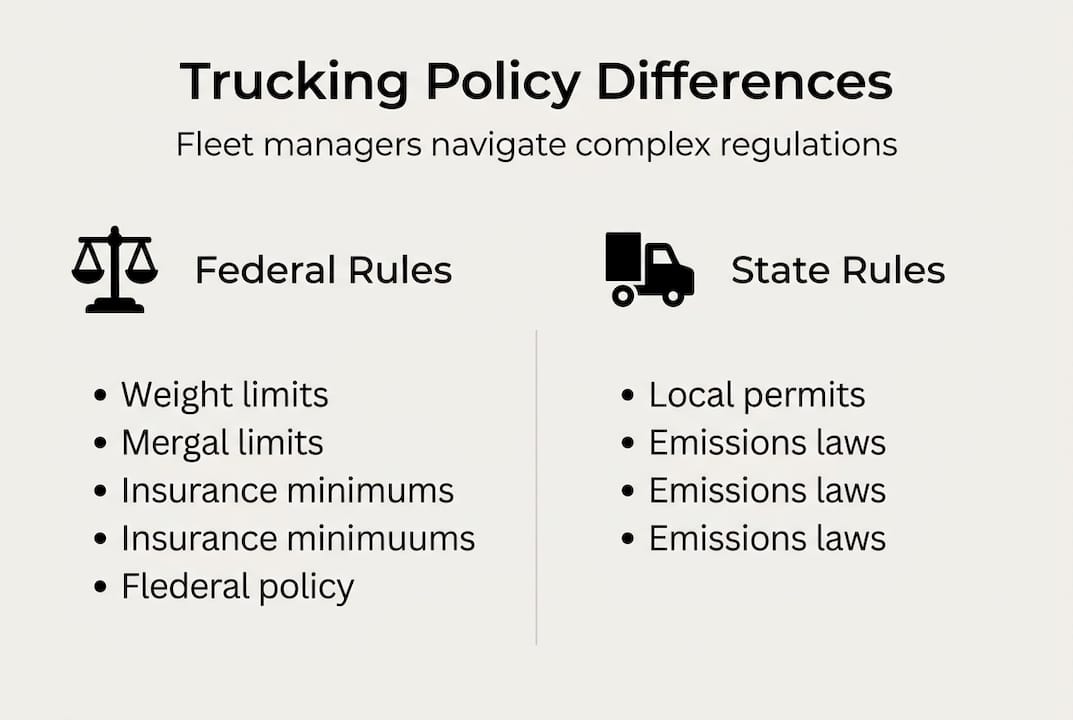
Here is a quick comparison of how federal and state authority splits across key areas:
| Regulatory area | Federal standard | State authority |
|---|---|---|
| Weight limits | 80,000 lbs on interstates | Can exceed or restrict based on roads |
| Emissions | EPA baseline | States like CA set stricter standards |
| Hours of service | 11-hour driving limit | States may adjust for intrastate ops |
| Permits | FMCSA oversees interstate | States issue oversize/overweight permits |
Understanding insurance requirements by state is equally critical, because the regulatory split directly shapes your coverage obligations.
Insurance requirements: Minimums, liability, and intrastate versus interstate
Insurance is where regulatory divergence hits your budget most directly. Federal minimums for liability coverage apply to interstate carriers, but they are not the ceiling. They are often the floor, and many states require more.
The federal minimum is $750,000 for general freight hauled in interstate commerce. States like New Jersey require up to $1.5 million in liability coverage for carriers operating within state lines. That is a 100% increase over the federal baseline, and it affects your premium calculations significantly.
For fleet managers, this creates a layered decision. If your trucks operate across multiple states, you need to identify the highest minimum required along any route and build your coverage around that threshold. Carrying only the federal minimum while operating in New Jersey, for example, puts you in violation and exposes your business to uninsured liability.
Intrastate versus interstate coverage also affects how you structure your policies. Fleet versus individual insurance has real implications for administrative efficiency and cost. A single fleet policy can streamline renewals and reduce paperwork, but it must account for the varying minimums across every state where your trucks operate.
Pro Tip: When reviewing your fleet policy, list every state where your trucks operate and pull the liability minimum for each. Build your coverage to match the highest requirement on that list. This protects you from gaps without requiring separate policies for each jurisdiction.
For smaller owner-operators, the math is different. A single truck running intrastate routes in a high-minimum state may benefit from a policy tailored to that state’s rules rather than a broader interstate policy. Getting box truck insurance quotes that reflect your actual operating territory is the most efficient way to avoid overpaying or underinsuring.
Cargo type also shifts your minimums. Hazardous materials carriers face federal minimums starting at $1 million and climbing to $5 million depending on the substance. Some states add their own hazmat overlays on top of those figures. If your fleet hauls any regulated cargo, reviewing a moving insurance guide can help you understand how cargo-specific coverage interacts with general liability.
The bottom line is that insurance optimization starts with knowing exactly where your trucks go and what each jurisdiction demands. Guessing costs more than researching.
How operational regulations vary: HOS, weight, emissions, permits
Insurance is not the only layer of complexity. The operational rules governing how your drivers work, how much weight they carry, and what permits they need vary significantly from state to state.
Hours-of-service (HOS) rules are a good example. The federal standard allows 11 hours of driving within a 14-hour on-duty window. States like New York allow different HOS configurations for intrastate operations, and Michigan permits higher weights along designated routes. These are not minor variations. They change how you schedule drivers, plan rest stops, and calculate delivery windows.
Weight limits add another layer. While the federal interstate limit is 80,000 pounds, 16 states impose seasonal frost laws that cut allowable weights by up to 60% during freeze-thaw periods. If you run routes through northern states in late winter or early spring, those restrictions can delay shipments, force rerouting, or require load splitting. Missing a frost law posting can result in fines that far exceed the cost of rerouting.
Emissions regulations are increasingly state-specific. California leads the most aggressive standards, but Oregon and Washington have adopted similar frameworks. If your fleet includes older diesel equipment, operating in these states may require retrofits or replacements that affect your capital planning.
Permit rules vary widely for oversize and overweight loads. Some states process permits quickly through online portals, while others require lead times of several days and physical inspections. Certain states restrict oversize moves to specific hours or days of the week. Planning a multi-state oversize haul without checking each state’s permit office can result in costly delays.
Pro Tip: Build a state-specific compliance calendar for your most common routes. Flag frost law windows, permit lead times, and any emissions inspection requirements. Reviewing your insurance company landscape alongside that calendar helps you align coverage with operational risk at each point in the year.
Operational compliance is not a one-time review. Rules change, and staying current requires a system, not just a checklist.
International trucking policy differences: Canada, EU, and beyond
For fleet managers with cross-border operations, the policy complexity does not stop at the US border. Canada and the European Union both operate under systems that share structural similarities with the US federal-state divide, but with their own distinct rules and harmonization efforts.
In Canada, federal highway standards set baseline rules, but provinces set distinct weights and permit requirements that vary considerably. A truck legal under federal Canadian standards may require additional permits or load reductions when entering Quebec or British Columbia. The permit systems, seasonal restrictions, and equipment standards differ province by province, much like state-level variation in the US.
The European Union has pursued more aggressive harmonization. Member states operate under shared weight limits, driver hours regulations, and emissions standards. However, the EU allows national variations in enforcement, cabotage rules, and specific permit categories. Cabotage refers to the right of a foreign carrier to operate domestic routes within another country. EU rules limit how many cabotage operations a non-resident carrier can perform within a set period, and enforcement varies by country.
“Cross-border road freight in the EU is governed by a mix of harmonized standards and country-specific rules, meaning operators must verify national requirements even when EU-wide rules apply.” EU Cross-Border Road Freight Regulations
For US-based fleet managers with Canadian operations, the lesson is practical. Treat each Canadian province the way you treat each US state. Verify weight limits, permit requirements, and insurance minimums before routing a truck across the border. A global fleet compliance guide can help you map inspection procedures and compliance requirements across multiple jurisdictions.
The broader takeaway from international systems is that jurisdictional variation is not a uniquely American problem. It reflects the reality that infrastructure, economic priorities, and safety standards differ across regions. Understanding that pattern helps you build compliance systems that scale, whether you operate in two states or two countries.
A fleet manager’s lens: Practical insights and overlooked challenges
Here is what most compliance guides leave out. The real challenge is not knowing that rules vary. It is building an operation that accounts for the strictest rule on any given route, not just the average.
When you plan a multi-state route, your compliance ceiling is set by the most restrictive jurisdiction you pass through, not the most permissive. A load that is legal in Michigan may be illegal in Indiana. Your driver does not get a pass because the origin state allowed it.
Insurance strategy follows the same logic. Matching your coverage to intrastate minimums in your home state while running interstate routes is a gap that brokers sometimes miss and regulators always catch. You need to review your policy against every state on your route map, not just your base state.
Grandfather clauses, frost laws, and FMCSA preemption often complicate real-world operations and planning in ways that a standard compliance manual does not address. Legacy rules that predate federal standards can still apply to intrastate operations, and preemption does not always work the way carriers expect.
The efficiency argument for uniformity sounds appealing, but local rules often exist for legitimate reasons tied to road conditions, population density, and infrastructure age. Pushing for blanket uniformity ignores those realities. The smarter approach is building flexible compliance systems that adapt to local rules rather than fighting them. Reviewing workers’ comp insurance for travelers is one example of how coverage decisions benefit from a state-specific lens rather than a one-size-fits-all approach.
How DiamondBack Insurance supports optimized trucking policy compliance
Navigating state-by-state insurance minimums, operational rules, and cross-border requirements is exactly the kind of complexity that DiamondBack Insurance is built to simplify.
Whether you manage a regional fleet or operate a single truck across multiple states, DiamondBack Insurance gives you instant access to tailored quotes that reflect your actual operating territory. You can compare options from multiple top insurers in minutes, ensuring your coverage matches the highest liability minimums on your routes. Explore general liability insurance for your business or review the small business liability guide to understand your full coverage needs. When you are ready to optimize your policy, get instant insurance quotes and take the guesswork out of compliance.
Frequently asked questions
Why do states have different trucking weight limits?
States set weight limits based on local infrastructure, safety priorities, and economic needs, which is why Michigan allows 164,000 lbs versus the federal 80,000-pound interstate standard. Local road conditions and agricultural or industrial needs often drive those differences.
How do insurance minimums vary for trucking operations?
Federal minimums apply to interstate carriers, but states set their own, often higher, required minimums for intrastate operations. New Jersey requires $1.5M in liability coverage, compared to the federal baseline of $750,000 for general freight.
What are frost laws, and how do they affect trucking?
Frost laws restrict truck weights during freeze-thaw seasons to protect road surfaces from damage caused by heavy loads. Sixteen northern states cut weight limits by up to 60% during frost periods, which can force rerouting or load splitting.
How does international trucking policy differ from US rules?
Systems like Canada and the EU use jurisdictional splits or harmonization frameworks, but still allow province or country-specific rules on weights, permits, and carrier eligibility. Canada and EU members maintain national or provincial variations even where harmonized standards exist.
Recommended
- Q&A Blog Post: Box Truck Insurance Near Me
- Q&A Blog Post: Box Truck Insurance Quotes
- Navigating Workers’ Comp Insurance for the Self-Employed: A DiamondBack Insurance Guide – Diamondback Insurance – Solutions with Instant Online Quotes
- Navigating the Landscape of General Liability Insurance Companies: The DiamondBack Insurance Difference – Diamondback Insurance – Solutions with Instant Online Quotes