

When a commercial truck is totaled or stolen, most owners assume their standard insurance policy will cover everything. That assumption can be financially devastating. Standard commercial auto insurance pays out the actual cash value of your truck at the time of the loss, not what you still owe on the loan or lease. For financed trucks, that gap between the payout and the remaining balance can reach tens of thousands of dollars. Understanding how gap insurance works, and why it matters specifically for truck owners and fleet managers, is one of the most important steps you can take to protect your business from an unexpected financial shortfall.
Table of Contents
- Understanding gap insurance for trucks
- How gap insurance works in claims scenarios
- Comparing gap insurance to other truck coverage
- Tips for choosing and affording gap insurance for your fleet
- Our perspective: The costs of skipping gap insurance in commercial fleets
- Protect your fleet with smarter coverage
- Frequently asked questions
Key Takeaways
| Point | Details |
|---|---|
| Covers loan-lease gaps | Gap insurance pays the difference between your truck’s value and your loan or lease balance after a total loss. |
| Protects against rapid depreciation | Trucks lose 15-30% of value in the first year, which can leave owners with sizable out-of-pocket costs without gap coverage. |
| Complements standard insurance | Gap insurance adds protection that standard liability or comprehensive policies do not provide. |
| Affordable fleet options | Fleet owners can often access discounted gap insurance when bundling policies or working with specialized providers. |
Understanding gap insurance for trucks
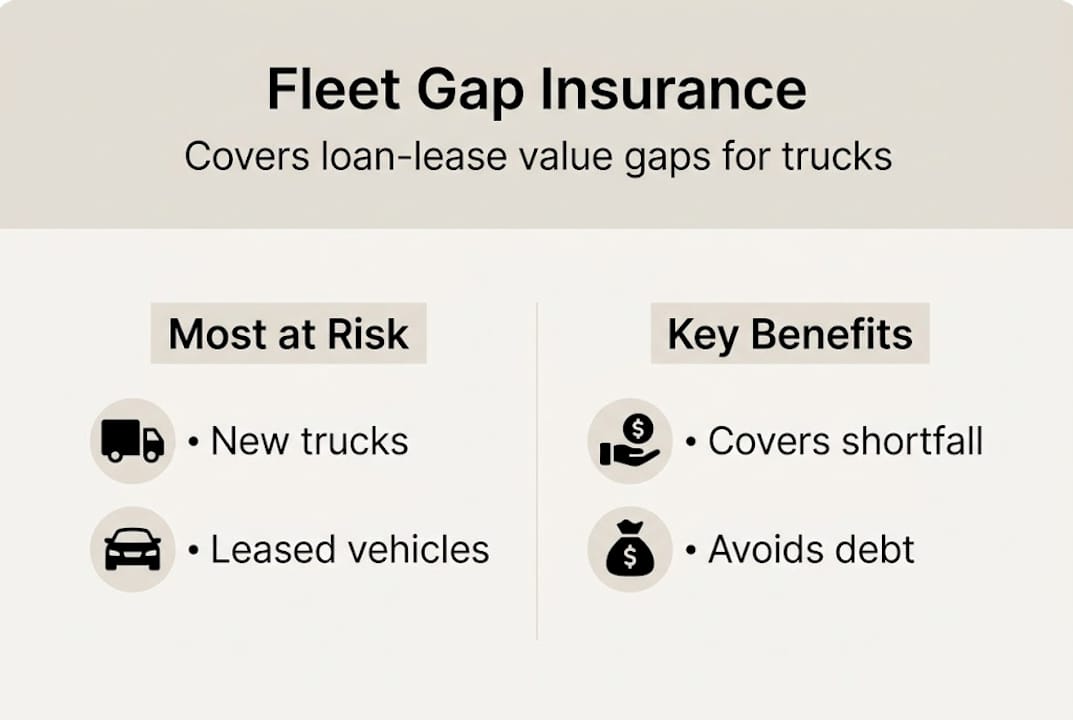
Gap insurance, which stands for Guaranteed Asset Protection, is a specialized coverage designed to pay the difference between what your standard insurance settles and what you still owe on a financed or leased vehicle. When a truck is declared a total loss or stolen and not recovered, your commercial auto insurer pays out the vehicle’s actual cash value. The problem is that actual cash value reflects depreciation, and commercial trucks lose value fast.
For truck owners and fleet managers, this creates a real financial risk. Commercial vehicles depreciate at a rate of 15 to 30 percent in the first year alone. That means a truck you financed for $120,000 could be worth $84,000 to $102,000 by the end of year one, while your loan balance may still be close to the original amount. If a total loss happens during that window, you are responsible for the difference out of pocket.
Gap insurance applies broadly across the trucking industry. It covers work trucks, semi-trucks, cargo vans, trailers, and full fleet vehicles. Whether you operate a single box truck or manage a fleet of twenty semis, gap coverage can prevent a single bad event from becoming a long-term financial burden. You can learn more about managing this risk through practical box truck insurance tips that apply to a range of commercial vehicle types.
What does gap insurance actually cover? It covers the difference between the actual cash value payout from your primary insurer and the remaining balance on your loan or lease. It does not cover missed payments, mechanical issues, or standard wear and tear. It is purely a financial bridge for total loss and theft scenarios.
The trucks and fleets that benefit most from gap coverage are those that are newly financed, leased, or purchased with a low down payment. The less equity you have in the vehicle, the more exposure you carry. Operators who put less than 20 percent down at purchase are especially vulnerable during the first two years of ownership.
Pro Tip: Add gap coverage at the time of financing, not months later. Once significant depreciation has already occurred, some providers may limit your eligibility or reduce the benefit amount available to you.
How gap insurance works in claims scenarios
Having outlined what gap insurance is, it’s just as important to see how it plays out following a loss. Here’s what happens in real-life claims scenarios.
Imagine you finance a new semi-truck for $150,000. Eighteen months later, it is involved in a serious accident and declared a total loss. Your standard commercial auto insurer assesses the truck’s actual cash value at $115,000 and issues a check for that amount, minus your deductible. Your remaining loan balance is $138,000. Without gap insurance, you owe $23,000 out of pocket on a truck you no longer own.

With gap insurance, that $23,000 shortfall is covered. You walk away from the loss without carrying debt on a destroyed asset. That is the core value of this coverage, and it is why gap insurance applies to commercial trucks, work trucks, semis, vans, trailers, and fleet vehicles across the board.
Here is a side-by-side look at how a claim plays out with and without gap coverage:
| Scenario | Without gap insurance | With gap insurance |
|---|---|---|
| Truck financed amount | $150,000 | $150,000 |
| Actual cash value at loss | $115,000 | $115,000 |
| Loan balance at loss | $138,000 | $138,000 |
| Insurance payout | $115,000 | $115,000 |
| Gap coverage payout | $0 | $23,000 |
| Out-of-pocket cost | $23,000 | $0 |
The numbers make the case clearly. For fleet managers overseeing multiple financed vehicles, this risk multiplies with every truck on the road. A single bad quarter with two or three total losses could create six-figure out-of-pocket exposure without gap protection in place.
“The first two years of a commercial truck’s life represent the highest depreciation risk. A total loss during this window, without gap coverage, can leave operators paying tens of thousands of dollars on a vehicle they can no longer use.”
When you are ready to review your current exposure and explore your options, comparing truck insurance quotes from multiple providers is the most efficient first step toward closing that gap.
Comparing gap insurance to other truck coverage
Now that you’ve seen how gap insurance fills critical gaps, it’s useful to compare it directly with other truck insurance policies.
Standard commercial truck insurance typically includes collision coverage, comprehensive coverage, and liability protection. Collision pays for damage to your truck after an accident. Comprehensive covers non-collision events like theft, fire, or weather damage. Liability protects you when your truck causes damage or injury to others. These are essential coverages, but none of them address the financing gap.
Standard commercial insurance may not cover rapid depreciation losses on financed trucks. This is the most common misunderstanding among truck owners who believe that carrying “full coverage” means they are fully protected. Full coverage is an industry shorthand for combining collision and comprehensive policies. It does not include gap insurance. When a total loss occurs, full coverage pays actual cash value. Nothing more.
Here is a direct comparison of what each coverage type addresses:
| Coverage type | What it covers | Covers loan or lease gap? |
|---|---|---|
| Liability | Third-party injury and property damage | No |
| Collision | Damage to your truck in an accident | No |
| Comprehensive | Theft, fire, weather, and non-collision damage | No |
| Gap insurance | Difference between ACV payout and loan balance | Yes |
You need gap insurance when you are financing or leasing a truck, especially in the first two years of ownership. You may not need it if you own your truck outright, if the truck is fully paid off, or if the vehicle’s market value exceeds what you owe. The decision depends on your loan-to-value ratio at any given time.
For fleet managers who also carry general liability exposure, it helps to compare liability coverage options alongside your gap and commercial auto policies. Building a complete picture of your risk profile is what separates reactive operators from proactive ones. A solid general liability insurance guide can help you understand how these policies interact and where your coverage may have blind spots.
Tips for choosing and affording gap insurance for your fleet
With an understanding of coverage types, let’s focus on how to make smart choices and reduce your expenses when securing gap insurance for your trucks.
Depreciation is fastest in the first year for commercial vehicles, which means the best time to secure gap coverage is at the point of financing or lease signing. Waiting even six months reduces the benefit window and may increase your premium relative to the actual coverage you receive.
Here are four practical steps to securing the right gap coverage at the right price:
1. Buy at the point of financing. The moment you sign a loan or lease is when your gap exposure is highest and when most providers offer the best terms. Do not delay this decision.
2. Bundle with your existing commercial auto policy. Many insurers allow you to add gap coverage as a rider to your primary commercial truck policy. Bundling typically reduces the overall premium and simplifies your claims process.
3. Request fleet pricing. If you manage multiple financed vehicles, ask specifically about fleet gap discounts. Providers often offer reduced per-unit rates when you insure three or more vehicles under a single policy.
4. Review your loan-to-value ratio annually. As you pay down your loan and the gap between what you owe and what the truck is worth narrows, you may be able to drop gap coverage and redirect that premium elsewhere.
When evaluating specific policies, look for gap coverage that includes your deductible in the payout, covers lease penalties, and does not cap the benefit at an amount lower than your realistic loan balance. Not all gap products are equal, and the fine print matters.
Pro Tip: Always request quotes from at least three providers before committing. Rates for gap insurance vary significantly across insurers, and comparing local truck insurance options can reveal meaningful savings without sacrificing coverage quality.
Our perspective: The costs of skipping gap insurance in commercial fleets
Here is the honest reality we see as insurance specialists working with truck owners every day. Most operators who skip gap insurance do so because they believe a total loss will not happen to them. That belief is understandable, but it is not a risk management strategy.
Commercial trucks operate in demanding environments. Accidents, cargo shifts, weather events, and theft are not rare occurrences in this industry. The out-of-pocket cost after a total loss without gap coverage can be enough to shut down a small operator entirely. We have seen it happen.
The most affordable version of gap protection is always the one you purchase before you need it. Waiting until after a depreciation hit or a near-miss event to consider coverage means you are already behind. Reviewing your fleet insurance insights now, while your trucks are on the road and earning, is the proactive move. Ignoring the math of depreciation and financing is a hidden risk that too many operators overlook until it is too late.
Protect your fleet with smarter coverage
If you want to safeguard your trucks and finances, here’s where to start.
At Diamondback Insurance, we make it straightforward for truck owners and fleet managers to find the right coverage without the back-and-forth of traditional brokers. Our platform lets you compare affordable insurance quotes from multiple top-rated insurers in minutes, so you can make an informed decision quickly.
Whether you need gap coverage, commercial auto, or liability coverage solutions tailored to your fleet size and operation type, we have the tools to help you build a policy that fits your budget and your risk profile. Get your quote today and take the guesswork out of protecting your investment.
Frequently asked questions
Does gap insurance cover older trucks or only new vehicles?
Gap insurance is most valuable for newer or recently financed trucks because depreciation runs 15 to 30 percent in the first year, but some providers do offer options for slightly older vehicles depending on the remaining loan balance.
Do I need gap insurance if my truck is leased and not financed?
Yes, most lessors require gap insurance because leased vehicles also carry a payoff gap in the event of a total loss or theft, just as financed trucks do.
Is gap insurance expensive for a fleet of trucks?
Cost depends on fleet size, model year, and the insurer you choose, but many providers offer fleet discounts and bundling options that make gap coverage significantly more affordable per unit.
Does full coverage commercial insurance include gap insurance automatically?
No, gap insurance is a separate add-on and is not included in standard or full commercial auto policies because standard insurance does not cover the difference between actual cash value and the remaining loan balance.
Recommended
- Q&A Blog Post: Box Truck Insurance Near Me
- Q&A Blog Post: Box Truck Insurance Quotes
- Smooth Sailing Ahead: Understanding Boat Insurance with Towing author: DiamondBack Insurance – Diamondback Insurance – Solutions with Instant Online Quotes
- Safeguarding Your Venture: General Liability Insurance for Small Businesses with DiamondBack Insurance – Diamondback Insurance – Solutions with Instant Online Quotes
- What is moving insurance and how to protect your items