

Motor carrier coverage is defined as the set of mandatory and optional insurance policies that protect commercial trucking operations against liabilities arising from hauling freight for hire. For trucking company owners and fleet managers, this coverage is not optional. The Federal Motor Carrier Safety Administration (FMCSA) requires carriers to maintain minimum liability insurance before they can legally operate. Understanding what motor carrier coverage includes, what it costs, and how to structure it correctly protects your business, your drivers, and the cargo you haul.
What is motor carrier coverage and what does it include?
Motor carrier coverage is the umbrella term for all insurance policies a for-hire carrier must carry to operate legally and protect its business. The core component is primary auto liability, which pays for bodily injury and property damage your truck causes to others in an accident. This is the policy that satisfies FMCSA requirements and activates your operating authority.
Beyond primary liability, several additional coverages complete a sound motor carrier policy. Motor truck cargo insurance protects the freight you haul against loss, theft, or damage in transit. While cargo coverage is not federally mandated, brokers and shippers require at least $100,000 in cargo insurance before tendering loads, with some requiring up to $250,000. That market reality makes cargo coverage functionally mandatory for any carrier that wants consistent freight.

Bobtail insurance, also called Non-Trucking Liability (NTL), covers your truck when it is operating without a trailer and outside of dispatch. This matters because your primary auto liability policy only applies when you are under a load. Trailer interchange coverage protects you when you are legally responsible for a non-owned trailer under an interchange agreement. Without it, damage to a third-party trailer comes out of your pocket.
Primary auto liability differs from general liability in a way that trips up many carriers. Primary liability covers accidents that happen on the road. General liability covers off-road business risks, such as a customer slipping and falling at your terminal or a loading dock incident. Both coverages serve distinct purposes, and running without general liability leaves a real gap in your protection.
Pro Tip: Add an umbrella policy to your coverage stack. Umbrella policies add $2 million or more in liability protection for roughly $2,000 to $5,000 per year, making them one of the most cost-effective ways to protect your personal and business assets above your primary limits.
What are the FMCSA minimum insurance requirements?
The FMCSA sets minimum public liability insurance levels based on the type of cargo you haul. These are not suggestions. Operating below these thresholds puts your authority at risk and exposes you to personal liability.
| Cargo Type | FMCSA Minimum Liability |
|---|---|
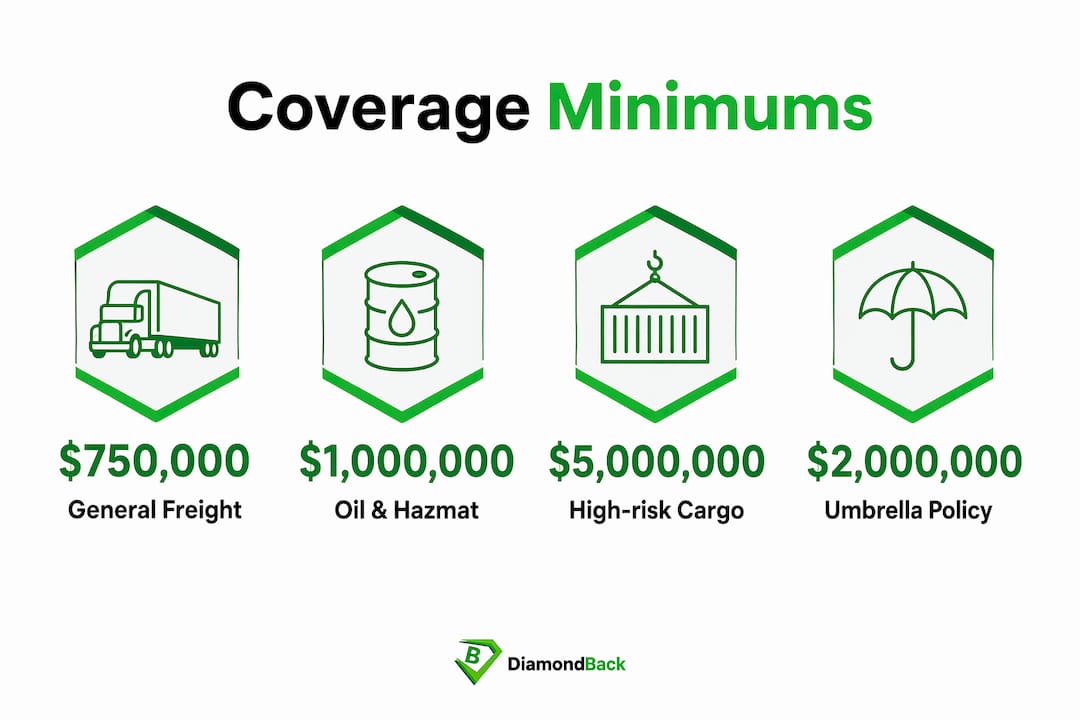
| General freight | $750,000 |
| Oil and hazardous materials | $1,000,000 |
| High-risk hazmat and passengers | $5,000,000 |
FMCSA minimum liability starts at $750,000 for general freight and scales to $5 million for high-risk hazmat and passenger carriers. The difference between those tiers is significant, and carriers who haul mixed freight need to verify their coverage aligns with the highest-risk commodity they carry.
Purchasing a policy is only half the process. Filing Form BMC-91X with the FMCSA is what actually activates your operating authority. Your insurer files this form directly with the FMCSA on your behalf. Without that filing, your MC Number remains inactive regardless of whether you have paid your premium. Carriers who skip this step or let their policy lapse lose their legal authority to haul and face potential fines. Direct FMCSA filings by the insurer are critical to keep your authority current, not just the policy itself.
Your USDOT registration and MC Number work together with your insurance filings to establish your legal identity as a carrier. Regulators, shippers, and brokers all verify this information before doing business with you. Keeping your filings current is as important as keeping your trucks maintained.
How much does motor carrier insurance cost?
Motor carrier insurance costs vary widely based on fleet size, cargo type, safety history, and geographic territory. Annual premiums for solo owner-operators typically run $9,000 to $15,000. Mid-size fleets pay $40,000 to $120,000 or more per year. Hazmat operators often exceed $20,000 per truck annually. These ranges reflect the real financial commitment required to operate legally and safely.
Several factors drive your premium up or down. Carriers with clean safety records and low CSA scores pay less. Hauling high-value or hazardous freight increases rates. Operating in congested urban corridors or states with high litigation rates adds cost. Your trucking insurance rates by state can shift your annual premium by thousands of dollars even when everything else stays the same.
Deductible selection is one of the most direct levers you control. Choosing a higher deductible can reduce your premiums by 10 to 20 percent. Moving from a $500 deductible to a $1,000 deductible on physical damage coverage, for example, produces meaningful annual savings. The trade-off is absorbing more out-of-pocket cost after a claim, so this strategy works best for carriers with strong cash reserves.
Leasing arrangements add another layer of cost complexity. Leased owner-operators often have primary liability covered by the carrier while under dispatch, but they must carry NTL and physical damage insurance individually. Misunderstanding this split is one of the most common and expensive mistakes in the industry. Review your leased truck insurance obligations carefully before assuming any coverage exists.
Pro Tip: Request a full coverage breakdown from your insurer that lists every policy, its limits, and its deductible. Compare that list against your freight contracts and lease terms to identify gaps before a claim reveals them.
How do you choose the right motor carrier coverage plan?
Choosing the right coverage starts with your freight contracts, not the federal minimums. Aligning your insurance limits to the peak value of the cargo you haul and the requirements written into your broker and shipper contracts protects you from being underinsured when it matters most. A carrier hauling electronics or pharmaceuticals faces a very different exposure than one hauling lumber.
The table below compares two common approaches to structuring motor carrier coverage.
| Coverage approach | Best for | Key trade-off |
|---|---|---|
| Minimum FMCSA limits only | New carriers with tight budgets | Leaves personal assets exposed above minimums |
| Limits matched to contracts and cargo values | Established carriers with consistent freight | Higher premiums, but full protection on every load |
Lease status determines who carries what. If you operate under a carrier’s authority as a leased owner-operator, confirm in writing which policies the carrier provides and which you must purchase independently. Verbal agreements do not hold up after a loss. Insurance responsibilities under leases must be documented clearly to avoid disputes.
Umbrella policies deserve serious consideration for any carrier with assets to protect. They stack above your primary auto and general liability limits, providing coverage when a catastrophic claim exceeds your base policy. The cost per dollar of coverage is lower than raising primary limits, making them a practical choice for mid-size and larger fleets. Work with a broker who specializes in commercial trucking to choose transportation insurance that matches your specific operation rather than a generic commercial auto policy.
Your coverage plan should also account for seasonal freight volume changes. If your cargo values spike during certain months, confirm your cargo policy limits reflect that peak exposure. A policy written for average loads may fall short when you are hauling your highest-value freight.
Key Takeaways
Motor carrier coverage is a legally required and operationally critical set of policies that every for-hire carrier must structure carefully to protect drivers, cargo, and business assets.
| Point | Details |
|---|---|
| Federal minimums are the floor | FMCSA requires $750,000 to $5,000,000 in liability depending on cargo type. |
| BMC-91X filing activates authority | Your insurer must file directly with FMCSA or your MC Number stays inactive. |
| Cargo coverage is market-mandatory | Most brokers require at least $100,000 in cargo insurance before tendering loads. |
| Leased operators carry individual risk | NTL and physical damage typically fall on the owner-operator, not the carrier. |
| Umbrella policies add cost-effective protection | Adding $2 million or more in coverage often costs $2,000 to $5,000 per year. |
What I’ve learned about motor carrier coverage after years in this industry
The most expensive mistake I see carriers make is treating federal minimums as the target rather than the floor. The FMCSA’s $750,000 general freight minimum was set decades ago. A serious accident involving multiple vehicles, injuries, and cargo loss can generate claims that exceed that limit quickly. Carriers who hit their policy ceiling in a major claim face personal asset exposure that no one plans for but many experience.
The second pattern I see repeatedly is confusion between primary auto liability and general liability. Carriers assume their trucking policy covers everything. It does not. A customer injured at your facility, a loading dock incident, or a slip-and-fall at your terminal falls under general liability, not primary auto. Running without it is a gap that only becomes visible at the worst possible moment.
On the leasing side, I have seen owner-operators sign lease agreements without reading the insurance section. They assume the carrier covers them fully. Then a claim happens off-dispatch, and they discover their NTL policy lapsed or was never purchased. The financial result is severe and avoidable. Get every insurance responsibility in writing before you move a single load under someone else’s authority.
My recommendation is to review your trucking insurance limits annually, align them to your current freight contracts, and add an umbrella policy if you have not already. The premium difference is small. The protection difference is not.
— Vladimir
How Diamondbackins helps carriers secure the right coverage fast
Getting motor carrier coverage right requires comparing real options from real insurers, not guessing at what a policy might cost. Diamondbackins is an online insurance platform built specifically for trucking professionals who need accurate quotes without the back-and-forth of a traditional broker.
You can get an instant truck insurance quote in minutes, compare offers from multiple top-rated insurers, and purchase coverage directly through the platform. Whether you run a single truck or manage a mid-size fleet, Diamondbackins gives you the transparency to see exactly what you are buying and what it costs. For carriers who want to protect their fleet instantly without the delays of traditional insurance shopping, Diamondbackins is the direct path to coverage that fits your operation.
FAQ
What is motor carrier coverage in simple terms?
Motor carrier coverage is the set of insurance policies required for commercial carriers hauling freight for hire. It includes primary auto liability, cargo insurance, and additional coverages that protect your trucks, drivers, and business.
Is motor carrier insurance the same as commercial truck insurance?
Motor carrier insurance is a specific type of commercial truck insurance designed for for-hire carriers operating under an MC Number. It includes FMCSA-required filings that standard commercial auto policies do not provide.
What does the FMCSA require for motor carrier liability?
The FMCSA requires a minimum of $750,000 in public liability for general freight carriers, $1,000,000 for oil and hazmat, and $5,000,000 for high-risk hazmat and passenger carriers.
Does motor carrier coverage include cargo insurance?
Cargo insurance is not federally mandated but is required by most brokers and shippers. Coverage typically starts at $100,000, with some contracts requiring $250,000 or more.
What happens if a carrier does not file Form BMC-91X?
Without a BMC-91X filing submitted by your insurer to the FMCSA, your operating authority does not activate. You cannot legally haul freight even if your insurance policy is paid and active.