

Insurance exclusions are clauses within an insurance policy that explicitly state which losses, damages, or circumstances the insurer will not cover. Every policy you hold, whether it covers your home, your health, or your life, contains these clauses. They define the outer boundary of your protection, and misreading them is one of the most expensive mistakes a property owner can make. This guide explains what insurance exclusions are, why they exist, how courts interpret them, and what you can do right now to protect yourself from unexpected gaps in coverage.
What is insurance exclusions and why do they exist?
Insurance exclusions exist because insurers cannot price every conceivable risk into a single premium. By carving out specific perils, insurers keep premiums manageable for the majority of policyholders while avoiding catastrophic, unquantifiable losses. Think of exclusions as the insurer’s way of drawing a clear line between what they have agreed to absorb and what remains your financial responsibility.
The rationale behind exclusions falls into three broad categories. First, some risks are too widespread to insure at a standard premium. Flood damage is a prime example. Second, some losses result from predictable deterioration rather than sudden accidents, such as wear and tear or pest damage. Third, some risks involve moral hazard, meaning the policyholder could influence the outcome, which is why life insurance policies commonly include a 2-year suicide exclusion as standard industry practice.

It is also worth distinguishing exclusions from coverage limits. A coverage limit caps the dollar amount your insurer will pay for a covered loss. An exclusion removes the loss from coverage entirely, regardless of the dollar amount. That distinction matters enormously when you file a claim and discover the damage falls outside your policy’s scope.
The table below shows common exclusions by policy type, giving you a quick reference for understanding insurance exclusions across the most widely held policies.
| Policy type | Common exclusions |
|---|---|
| Homeowners | Flood, earthquake, pest damage, wear and tear, mold from neglect |
| Health | Pre-existing conditions (in some plans), cosmetic procedures, experimental treatments |
| Life | Suicide within first 2 years, death during criminal activity, war-related death |
| Auto | Intentional damage, racing, using personal vehicle for commercial purposes |
| Commercial/Trucking | Cargo spoilage, driver exclusions, unlisted vehicles |
Pro Tip: Read your declarations page alongside the exclusions section. The declarations page lists what is covered; the exclusions section tells you what is not. You need both to understand your actual protection.
How do exclusions affect your claims and financial risk?
The practical impact of insurance policy exclusions becomes painfully clear at the moment of a claim. An adjuster reviews your loss, identifies an applicable exclusion, and denies the claim. At that point, the financial burden shifts entirely to you, often without warning.
Flood damage is the most documented example of this risk. Flood damage is excluded from nearly all standard U.S. homeowners insurance policies, yet only 4% of homeowners carry separate flood insurance. The average National Flood Insurance Program claim payout is $52,000, which means the vast majority of flood-affected homeowners absorb that cost out of pocket. That figure illustrates just how severe the financial exposure from a single exclusion can be.
Health insurance presents a different but equally costly scenario. Insurers sometimes offer coverage with loading or exclusions rather than outright rejecting applicants with pre-existing conditions. This means you may believe you are covered for a condition, only to find a specific exclusion embedded in your policy that denies the related claim. Consumers who focus on premiums and overlook exclusion details are the most vulnerable to this outcome.
The most common claim pitfalls tied to exclusions include failing to purchase supplemental flood or earthquake coverage, assuming a life insurance policy pays out in all circumstances without reading the suicide clause, overlooking commercial use exclusions in personal auto policies, and not verifying whether a pre-existing health condition carries a specific policy exclusion. Each of these gaps represents a real financial loss that a thorough policy review could have prevented.
Pro Tip: Before you file a claim, re-read the exclusions section of your policy. Knowing in advance whether your loss is excluded allows you to gather stronger documentation or consult a public adjuster before the insurer’s decision becomes final.
How do courts and insurers interpret insurance exclusions?
Legal interpretation of exclusions follows a consistent principle across most U.S. states: the burden of proof rests with the insurer. To deny a claim based on an exclusion, the insurer must demonstrate that the exclusion applies clearly and unambiguously to the specific loss. Courts require insurers to prove exclusions unambiguously apply, and ambiguous or broad exclusions are resolved in favor of the policyholder.
This legal standard has real consequences for how exclusions are written and enforced. A well-drafted exclusion names the specific peril, defines the conditions under which it applies, and leaves no room for alternative interpretation. A vague exclusion, by contrast, opens the door to litigation and often results in the insurer paying a claim it intended to deny.
“Courts across states confirm that when exclusion language is susceptible to two reasonable interpretations, the interpretation favoring the insured controls.” — Insurance Coverage Exclusion Interpretation, Verdict
A growing judicial trend restricts insurers from using broad exclusion language to deny claims without a specific link between the exclusion and the type of loss. This matters for you as a policyholder. If your insurer denies a claim and the exclusion language is vague or broadly worded, you have legal standing to challenge that denial. Public policy also places limits on certain exclusions. Courts will not enforce exclusions that violate state law or that would leave policyholders without any meaningful coverage for a mandated risk.
Where do exclusions appear in your policy?
Most policyholders assume exclusions live in a single, clearly labeled section of their policy document. That assumption leads to missed coverage gaps. Policy exclusions are dispersed throughout policy documents, appearing in definitions, conditions, and endorsements, not just in a dedicated exclusions section. Reading only one section of your policy is not enough.
Exclusion language also carries specific phrasing designed to maximize the insurer’s denial reach. Terms like “directly or indirectly” are particularly consequential. Broad exclusion language such as “directly or indirectly” creates cascading denial effects, meaning even a minor connection between your loss and the excluded peril can result in a full claim denial. Travel insurance policies for conflict zones use this language extensively, but the same phrasing appears in commercial and property policies.
Beyond the policy document itself, many insurers maintain underwriting guidelines that function as invisible filters. Underwriting guidelines exclude certain risks such as roofs older than 25 years or made of wood shake in high-risk states, and policyholders often remain unaware of these guidelines until a claim is denied or a renewal is refused. California’s largest insurers have applied these guidelines aggressively, leaving property owners without coverage they assumed they had.
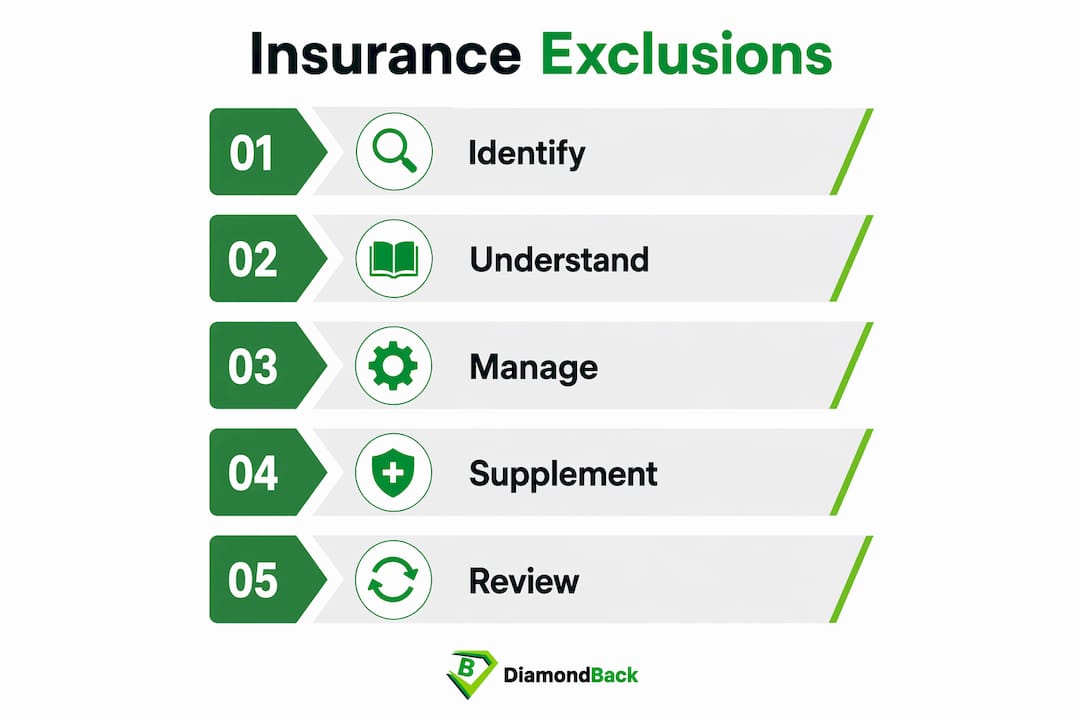
To locate and understand all exclusions in your policy, follow this review process. Read the declarations page first to confirm what is listed as covered. Then read the definitions section, because how a term is defined directly affects whether an exclusion applies. Next, read the conditions section, which often contains exclusions tied to your obligations as a policyholder. After that, read every endorsement attached to your policy, since endorsements can add or remove exclusions from the base policy. Finally, contact your insurer or agent directly and ask whether any underwriting guidelines affect your specific property or risk profile.
Pro Tip: Ask your insurer in writing whether any underwriting guidelines apply to your property. A written response creates a record you can reference if a claim is later denied on grounds you were never told about.
What steps can you take to manage insurance exclusions?
Understanding exclusions is the first step. Managing them is the second. The most effective approach is to treat exclusions as a checklist of risks you need to address through supplemental coverage, negotiation, or full disclosure.
Supplemental insurance fills the gaps that standard policies leave open. The National Flood Insurance Program offers flood coverage that standard homeowners policies exclude. Earthquake endorsements or standalone earthquake policies address seismic risk. War-risk policies cover losses that most commercial policies exclude. For trucking and transportation operators, motor truck cargo insurance addresses cargo-specific exclusions that general commercial auto policies do not cover.
Full disclosure to your insurer is non-negotiable. Insurance agents warn consumers to disclose pre-existing conditions to avoid coverage surprises, and the same principle applies to property characteristics, business use of vehicles, and prior claims history. Failing to disclose relevant information does not just risk a claim denial. It can void your policy entirely. Insurers may offer amended coverage or a specific exclusion rider rather than refusing you outright, which is a far better outcome than discovering a gap after a loss.
Shopping around and comparing exclusions across insurers is equally important. Two policies with identical premiums can carry very different exclusion lists. When you compare trucking insurance companies, for example, the exclusion language in cargo and liability sections often varies significantly. Reviewing those differences before you buy is how you avoid paying for coverage that will not respond when you need it most. Schedule a policy review annually, particularly after any change to your property, vehicle fleet, or business operations, since life changes frequently trigger new exclusion risks.
Key takeaways
Insurance exclusions define the specific losses your policy will not cover, and understanding them before a claim is the only reliable way to protect your financial position.
| Point | Details |
|---|---|
| Exclusions define coverage limits | They remove specific losses from coverage entirely, regardless of dollar amount. |
| Flood risk is widely uninsured | Only 4% of homeowners carry flood insurance despite average NFIP claims of $52,000. |
| Courts favor policyholders on ambiguity | Vague exclusion language is legally resolved in the insured’s favor across most states. |
| Exclusions appear throughout the policy | Definitions, conditions, and endorsements all contain exclusion language, not just one section. |
| Supplemental coverage closes the gaps | Flood, earthquake, and cargo policies address risks that standard policies explicitly exclude. |
Why most people learn about exclusions the wrong way
I have reviewed hundreds of insurance policies over the years, and the pattern is almost always the same. People read the summary page, note the premium, confirm the coverage amount, and stop there. They never reach the definitions section. They never ask about underwriting guidelines. They find out about exclusions when a claim is denied, which is the worst possible time to learn.
The misconception I encounter most often is that a named-peril policy covers everything not specifically excluded. The reality is the opposite for many policy types. Named-peril policies cover only what is explicitly listed. All-risk or open-peril policies cover everything except what is explicitly excluded. Confusing these two structures leads to enormous gaps in protection.
My honest recommendation is to spend thirty minutes with your policy and a highlighter before you ever need to file a claim. Mark every instance of the word “exclude,” “not covered,” and “does not apply.” Then ask your agent to explain each one in plain language. If your agent cannot explain an exclusion clearly, that is a signal to find a better agent or a better policy. The common mistakes in trucking insurance mirror what I see in personal lines. Misreading exclusions is consistently the most expensive error, and it is entirely preventable.
Balancing premium cost against policy comprehensiveness is a real trade-off, but it is not a reason to accept coverage gaps you do not understand. A lower premium that leaves a major risk uninsured is not a bargain. It is a deferred expense.
— Vladimir
How Diamondbackins helps you find coverage without the gaps
Diamondbackins takes the complexity out of comparing insurance policies by aggregating quotes from multiple top-rated insurers in one place. When you are evaluating commercial or trucking coverage, exclusion differences between carriers matter as much as premium differences. Diamondbackins gives you the transparency to see both.

Whether you need trucking insurance explained in plain language or you want to compare carriers side by side to identify the policy with the fewest coverage gaps, Diamondbackins makes that process fast and straightforward. You can get an instant quote, review policy terms, and purchase coverage in minutes, without the back-and-forth of traditional brokers. If you operate in Georgia, the commercial trucking coverage options available through Diamondbackins are tailored to address the specific exclusion risks that affect fleet operators in that market.
FAQ
What is insurance exclusions in simple terms?
Insurance exclusions are specific clauses in your policy that list what the insurer will not pay for. They define the boundaries of your coverage and apply regardless of the size of the loss.
What are common insurance exclusions examples in home policies?
The most common home insurance exclusions include flood damage, earthquake damage, pest infestations, wear and tear, and mold resulting from neglect. Flood damage is excluded from nearly all standard homeowners policies, which is why separate flood insurance through the National Flood Insurance Program exists.
How do exclusions work in insurance when I file a claim?
When you file a claim, the insurer reviews the cause of loss against the policy’s exclusion list. If the loss falls within an excluded category, the claim is denied and the financial cost becomes yours to absorb.
Can I challenge an exclusion if my claim is denied?
Yes. Courts require insurers to prove that an exclusion applies clearly and without ambiguity. If the exclusion language is vague or broadly worded, legal precedent across most U.S. states supports resolving the dispute in the policyholder’s favor.
Where exactly do insurance policy exclusions appear in my policy?
Exclusions appear throughout the entire policy document, including the definitions section, the conditions section, and any endorsements attached to the base policy. Reading only the section labeled “exclusions” commonly results in missed coverage gaps.
Recommended
- Liability in Flood Insurance: What Homeowners Must Know
- Demystifying General Liability Insurance: What It Covers – Diamondback Insurance – Solutions with Instant Online Quotes
- Why Avoid Insurance Gaps: Protect Your Financial Future
- Understanding Marine Insurance Exclusions with DiamondBack Insurance – Diamondback Insurance – Solutions with Instant Online Quotes