
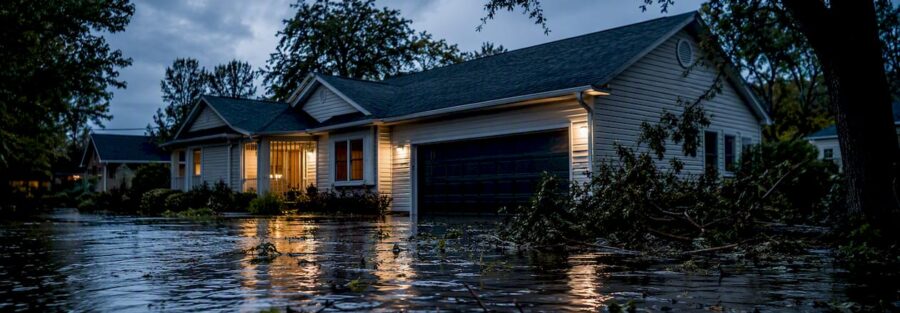
Flood insurance is a standalone property policy that pays for physical damage caused by flooding — covering homeowners, renters, and businesses when standard homeowners or renters insurance will not. If you own or rent property in the United States, the single most important action you can take right now is to check your flood zone and confirm whether you have a policy in place before storm season arrives.
Here is what flood insurance covers at a glance:
- Building coverage: The physical structure, foundation, electrical and plumbing systems, HVAC equipment, and built-in appliances.
- Contents coverage: Personal property such as furniture, clothing, electronics, and portable appliances — purchased as a separate coverage component, not automatically.
The most important constraint to understand upfront: the federal National Flood Insurance Program caps residential building coverage at $250,000 and residential contents at $100,000. If your property value or personal assets exceed those limits, a private flood policy or excess layer is worth comparing.
Pro Tip: Most new NFIP policies carry a 30-day waiting period before coverage activates. Do not wait until a storm is forecast to buy — by then, it is too late.
Key Takeaways
Flood insurance is a separate, single-peril policy that covers direct physical loss from flooding — and standard homeowners insurance never includes this protection.
| Point | Details |
|---|---|
| Separate policy required | Standard homeowners and renters insurance excludes flood damage; a standalone flood policy is always needed. |
| NFIP coverage limits | Residential building coverage maxes at $250,000; contents at $100,000; commercial policies go up to $500,000 each. |
| 30-day waiting period | Most new NFIP policies take 30 days to activate; loan-closing purchases are the primary exception. |
| Risk exists outside high-risk zones | About one-third of NFIP claims (2013–2023) came from properties outside designated high-risk flood zones. |
| Diamondbackins for fast comparison | Diamondbackins lets you compare NFIP and private flood quotes side by side and bind coverage online in minutes. |
Table of Contents
- What does flood insurance actually cover under the official definition?
- What a flood policy pays for: building vs. contents coverage
- Who needs flood insurance and when do lenders require it?
- NFIP policies vs. private flood insurance: which one fits your situation?
- How much does flood insurance cost and what drives the premium?
- How to buy flood insurance in the U.S.: a step-by-step process
- How to file a flood insurance claim and what to expect
- What flood insurance does not cover: common exclusions to know
- Why flood insurance matters for business continuity
- The case for checking your flood risk before you think you need to
- Flood insurance quotes made simple with Diamondbackins
- Sources
What does flood insurance actually cover under the official definition?
The NFIP defines a flood as a general and temporary condition of partial or complete inundation of two or more acres of normally dry land, or of two or more properties, from overflow of inland or tidal waters, rapid accumulation of surface runoff, or mudflow. In plain terms, that means rising water from heavy rain, storm surge, a levee breach, or overflowing rivers — not a burst pipe inside your home.
That distinction matters in practice. A clogged drain that backs up into your basement during a dry week is not a flood. However, if a flood event causes your sewer or drain to back up, NFIP policy terms do cover that backup — because the direct cause is the flood itself. The same backup from a non-flood cause is excluded. This nuance trips up many property owners who assume any water intrusion is covered.
Standard homeowners and renters insurance does not cover flood losses. Floods are explicitly excluded from those policies, which is why a separate flood policy is necessary.
Pro Tip: Buy your flood policy well before hurricane season or the rainy season in your region. The standard 30-day waiting period means a policy purchased today does not protect you until next month — with one key exception: policies obtained in connection with a loan closing can take effect immediately.
What a flood policy pays for: building vs. contents coverage
Understanding the split between building and contents coverage is one of the most practical things you can do before buying a policy. They are separate coverage components with separate limits and separate deductibles.
Building coverage typically includes:
- The insured structure and its foundation
- Electrical and plumbing systems
- Central air conditioning, furnaces, and water heaters
- Refrigerators, cooking stoves, and built-in dishwashers
- Permanently installed carpeting, paneling, and cabinets
- Detached garages (up to 10% of building coverage)
Contents coverage typically includes:
- Clothing, furniture, and electronic equipment
- Portable and window air conditioners
- Portable microwave ovens and dishwashers
- Washers and dryers
- Food freezers and the food inside them
- Certain valuable items up to a specified cap (artwork and furs, for example, are limited to $2,500)
The NFIP’s standard residential limits are $250,000 for building coverage and $100,000 for contents. Commercial NFIP policies go higher: up to $500,000 for building and $500,000 for contents. Both residential and commercial policies apply separate deductibles to building and contents, so a single flood event can trigger two deductible payments.
Statistic to know: From 2019 to 2023, NFIP claims averaged roughly $52,000 per claim — a figure that underscores how quickly flood damage accumulates even in moderate events.
One valuation point worth noting: the NFIP’s commercial General Property form pays building and contents losses at Actual Cash Value (ACV), meaning depreciation is deducted from the payout. Contents are paid at ACV under both residential and commercial NFIP policies. Private flood policies often offer replacement-cost contents coverage — a meaningful difference when replacing furniture or equipment.
Who needs flood insurance and when do lenders require it?
Any property owner, renter, or business in a community that participates in the NFIP can purchase a flood policy. Participation is widespread — most U.S. communities qualify. Eligibility is not restricted to high-risk zones.
FEMA manages the NFIP specifically to reduce the socioeconomic impact of floods. Federal law requires that lenders regulated by the federal government must mandate flood insurance for any property located in a Special Flood Hazard Area (SFHA) when the mortgage is federally backed.
To check your property’s flood zone, visit FEMA’s Map Service Center at msc.fema.gov and enter your address. The map will show whether your property falls in a high-risk zone (Zone A or V), a moderate-to-low risk zone (Zone X), or another designation.
Statistic to know: About one-third of all NFIP claims between 2013 and 2023 came from properties outside high-risk flood zones. Flood risk exists everywhere it rains.
Even if your lender does not require a policy, that statistic makes a strong case for buying one. Flood maps reflect historical data and modeled risk — they do not capture every scenario, and they are updated periodically. A property that sits in Zone X today may be reclassified after the next map revision.
Checking your flood risk in three steps:
- Go to msc.fema.gov and enter your property address.
- Note your flood zone designation and the Base Flood Elevation (BFE) if listed.
- If your zone is A, AE, V, or VE, contact an agent immediately — coverage is likely required and definitely advisable.
NFIP policies vs. private flood insurance: which one fits your situation?
The federal NFIP and the private flood market serve the same basic need but differ in meaningful ways. Here is how the two paths compare across the factors that matter most to buyers:
| Feature | NFIP (Federal) | Private Flood Insurance |
|---|---|---|
| Issuing entity | Federal program, sold through licensed agents | Private insurers, surplus lines carriers |
| Residential building limit | $250,000 | Often higher; varies by insurer |
| Contents limit | $100,000 residential | Often higher; varies by insurer |
| Business interruption | Not covered | Available as endorsement |
| Contents valuation | Actual Cash Value | Replacement cost often available |
| Waiting period | Typically 30 days | Often shorter (some as few as 10 days) |
| Pricing flexibility | Standardized federal rates | Market-based; can be lower or higher |
| Lender acceptance | Universally accepted | Accepted by most lenders; confirm before binding |
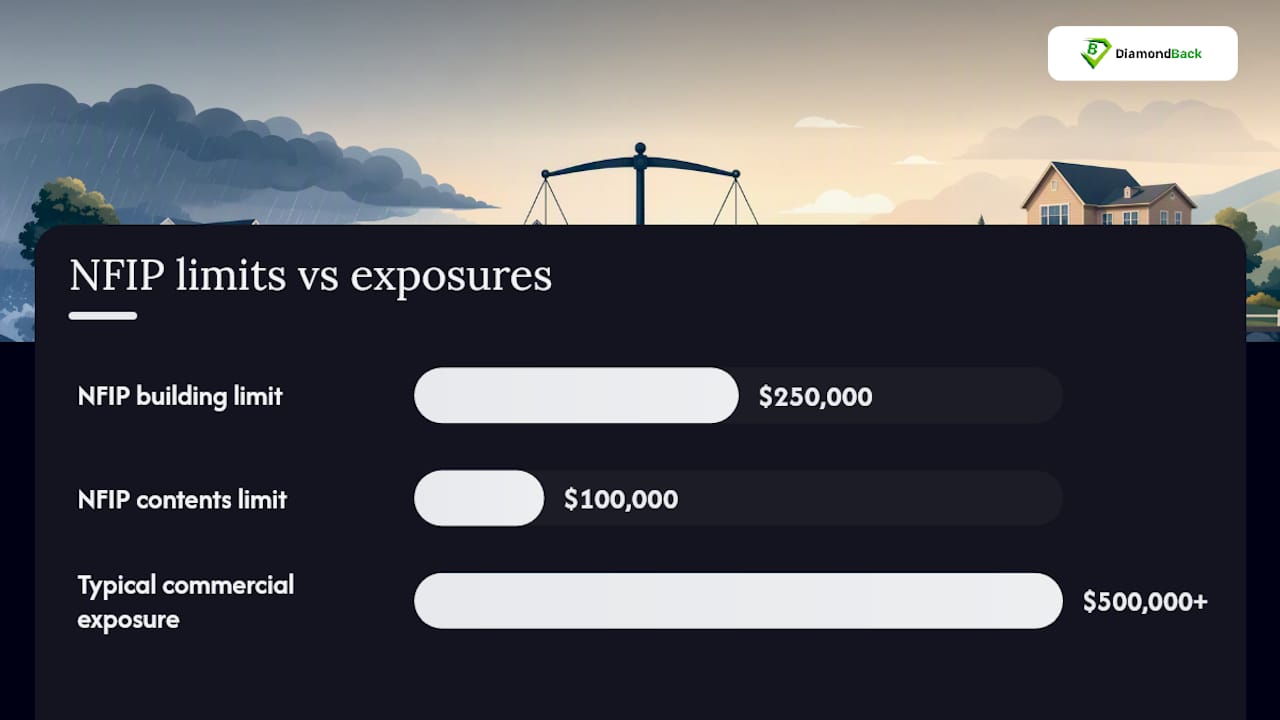
Private flood policies can offer higher limits, replacement-cost contents coverage, and endorsements like business interruption — features the NFIP does not provide. Many larger commercial buyers combine an NFIP or private primary policy with excess layers to push total coverage well above NFIP ceilings. This layered approach is common for warehouses, retail properties, and commercial fleets where inventory or equipment values exceed $500,000.
Pro Tip: If your home’s replacement cost exceeds $250,000 or your business holds inventory and equipment worth more than the NFIP commercial limit, get private flood quotes alongside your NFIP quote. The premium difference is often smaller than buyers expect, and the coverage difference can be substantial.
For businesses specifically, the absence of business interruption coverage in the NFIP is the most consequential gap. A flood that shuts down operations for two months can cost far more in lost revenue than the physical repair bill — and the NFIP pays nothing for that lost income.
How much does flood insurance cost and what drives the premium?
Flood insurance premiums vary considerably based on your property’s specific characteristics. There is no single “average” that applies to all buyers, but understanding the main drivers lets you estimate your exposure and take steps to reduce it.
The primary factors that determine your premium include:
- Flood zone designation: Properties in high-risk zones (A, AE, V, VE) pay more than those in moderate or low-risk zones.
- Elevation of the lowest floor relative to Base Flood Elevation: The higher your lowest floor sits above BFE, the lower your premium tends to be.
- Structure age and construction type: Older pre-FIRM buildings (built before the community’s first Flood Insurance Rate Map) often carry higher rates.
- Number of floors and basement presence: Basements increase risk and can raise premiums.
- Selected deductible: A higher deductible lowers your annual premium but increases out-of-pocket costs at claim time.
- Coverage amounts: Higher limits for building and contents increase the premium proportionally.
- Prior claims history: A property with past flood claims may carry a higher rate.
Mitigation measures can meaningfully reduce your premium. Elevating your structure above BFE, installing flood vents in foundation walls, adding a permanent sump pump with a battery backup, and implementing property-level floodproofing for non-residential structures are all recognized by FEMA as premium-reducing actions.
Pro Tip: An Elevation Certificate, prepared by a licensed surveyor or engineer, documents your building’s elevation relative to BFE. Submitting one with your application often results in a lower premium — and your local floodplain manager may be able to point you toward community mitigation grants that offset the cost of getting one.

How to buy flood insurance in the U.S.: a step-by-step process
Buying a flood policy is more straightforward than most property owners expect. Follow these steps to avoid coverage gaps and timing mistakes:
- Check your flood zone. Visit FEMA’s Map Service Center (msc.fema.gov) and enter your property address. Identify your zone and Base Flood Elevation.
- Determine whether you need an Elevation Certificate. Properties in high-risk zones often benefit from one. Contact your local floodplain administrator or a licensed surveyor.
- Get an NFIP quote through a licensed agent or FloodSmart.gov. NFIP policies are sold through private insurance agents who are authorized to write NFIP coverage. FloodSmart.gov has an agent locator and policy information.
- Compare private flood quotes. Ask your agent for private market options alongside the NFIP quote, particularly if your property value or contents exceed NFIP limits.
- Confirm waiting-period rules before you bind. The standard NFIP waiting period is 30 days. If you are purchasing in connection with a loan closing, the waiting period is waived — but you must document the connection. Plan accordingly if storm season is approaching.
- Bind coverage and save your declaration page. Once you purchase, keep the policy declaration page and the Summary of Coverage document in a safe, accessible location. You will need them if you file a claim.
Timing note: Buying a flood policy two or three months before your area’s typical storm season is the safest approach. Waiting until a named storm is forecast means the 30-day waiting period will almost certainly leave you unprotected for that event.
How to file a flood insurance claim and what to expect
When a flood damages your property, the claims process has a defined sequence. Knowing it in advance helps you document losses correctly and avoid delays.
Immediate steps after a flood:
- Prioritize safety. Do not re-enter a flooded structure until authorities confirm it is safe.
- Document all damage with photos and video before moving or discarding anything.
- Separate damaged property from undamaged property and keep damaged items for the adjuster’s inspection where possible.
- Make temporary repairs to prevent further damage (tarps, boarding windows) and keep all receipts — these costs may be reimbursable.
- Contact your insurance agent or insurer as soon as possible to report the claim and get a claim number.
After you report, an adjuster will be assigned to inspect the property and prepare a damage estimate. For NFIP claims, the adjuster evaluates losses against the policy’s valuation rules: ACV for contents and, for commercial properties, ACV for building as well.
You will be required to submit a Proof of Loss form — a signed, sworn statement of the amount you are claiming — typically within 60 days of the flood event. Missing this deadline can jeopardize your claim, so treat it as a hard deadline.
Pro Tip: Keep a home or business inventory with photos and serial numbers stored in the cloud or off-site. After a flood, this documentation speeds up the adjuster’s review and reduces disputes over contents values.
A typical NFIP claim timeline runs from report to settlement in several weeks for straightforward losses, longer for complex or heavily damaged properties. If you disagree with the adjuster’s assessment, you have the right to request a re-inspection or file an appeal.
What flood insurance does not cover: common exclusions to know
Flood insurance is not a catch-all water damage policy. Understanding the exclusions prevents the kind of costly surprise that leaves property owners short after a major event.
Common NFIP exclusions include:
- Business interruption and loss of use: The NFIP does not pay for revenue lost while your property is being repaired or for additional living expenses beyond a narrow set of circumstances.
- Mold and mildew from prolonged neglect: Damage that results from failure to mitigate after a flood is excluded.
- Outdoor property and landscaping: Fences, patios, decks, swimming pools, septic systems, and landscaping are generally not covered.
- Vehicles: Cars, trucks, and other motor vehicles are excluded from flood policies — your auto insurance (comprehensive coverage) handles flood damage to vehicles.
- Valuables above specified caps: Currency, precious metals, and stock certificates are excluded. Artwork, furs, and jewelry are capped at $2,500 under NFIP contents coverage.
- Finished basement improvements: Carpet, drywall, and personal property stored in a basement receive limited or no coverage under NFIP.
The sewer backup nuance deserves a second mention here: backup caused directly by a flood event is covered. Backup from a clogged line on a dry day is not. If sewer backup is a recurring concern for your property, a homeowners endorsement for sewer and drain backup is worth adding — it is a separate, inexpensive add-on that fills this gap for non-flood events.
Statistic to know: Because the NFIP excludes business interruption, many commercial property owners discover after a flood that their largest financial exposure — lost operating income — was entirely uninsured. Private endorsements and standalone business interruption policies exist specifically to close this gap.
Private flood policies and endorsements can address most of these exclusions. If any of the items above represent a significant exposure for your property, ask your agent about private-market options that extend coverage beyond NFIP boundaries.
Why flood insurance matters for business continuity
For business owners, the NFIP’s exclusion of business interruption is not a minor footnote — it is the central gap in the program’s commercial coverage. A flood that physically damages a building for $200,000 might also shut down operations for two months, generating revenue losses that dwarf the repair bill. The NFIP pays for the building. It pays nothing for the lost income.
FEMA and FloodSmart agents are direct about this limitation: NFIP commercial policies do not cover business interruption or loss of use. For many businesses, this is the primary reason to pursue private endorsements or a separate business interruption policy alongside the NFIP base policy.
A practical business checklist for flood preparedness:
- Assess the total insurable value of your inventory, equipment, and improvements — compare it against NFIP’s $500,000 commercial limits.
- If values exceed NFIP ceilings, explore gap coverage flood insurance options that layer private or excess coverage above the federal program.
- Quantify your monthly revenue and operating expenses to size a business interruption limit that reflects actual exposure.
- Review your flood coverage options for your business and fleet annually, especially after acquiring new equipment or expanding operations.
When meeting with an agent, ask specifically: What are the building and contents limits on this policy? Does it include a business income endorsement? Is there an excess layer option if my values exceed the primary limit? These three questions will quickly reveal whether the policy on the table actually matches your exposure.
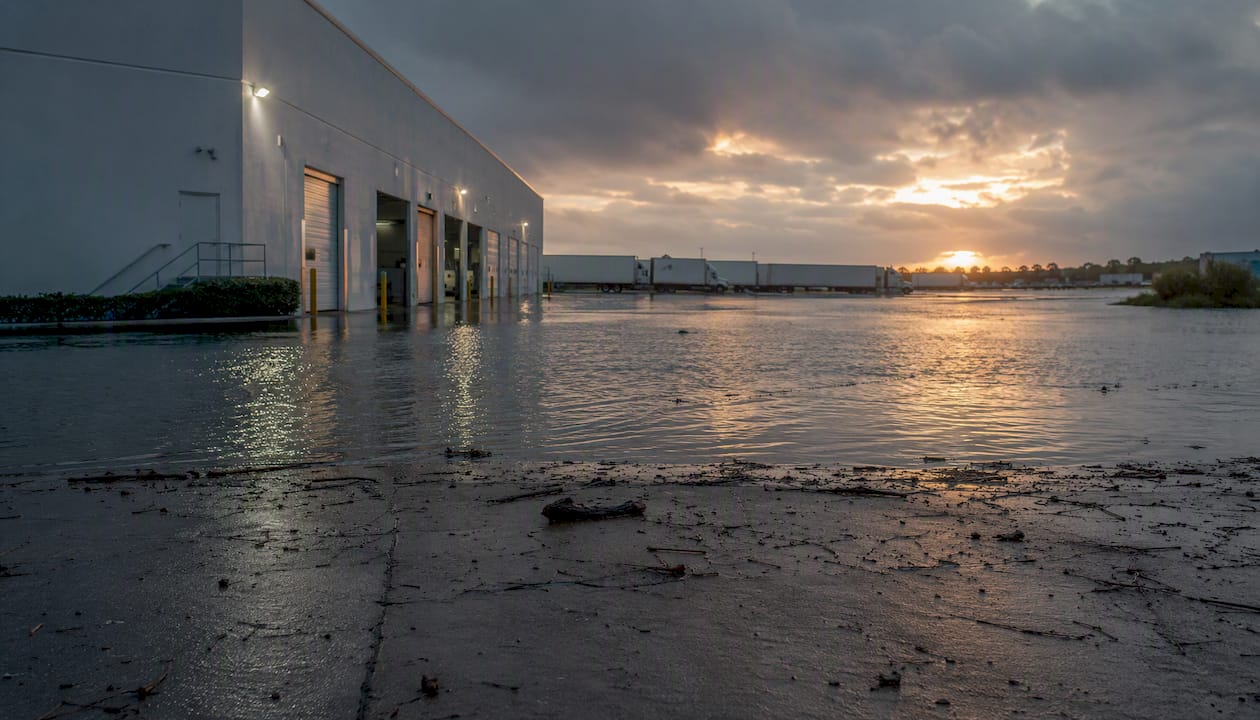
For trucking operations and commercial fleets, the stakes are especially high. Flood damage to a depot, garage, or yard can ground an entire fleet. Reviewing business interruption coverage for trucking operations alongside a flood policy is a sound step for any fleet-dependent business.
The case for checking your flood risk before you think you need to
Most property owners who go without flood insurance do so because they assume their location is safe. The data consistently challenges that assumption. Flood maps reflect modeled risk, not certainty — and they are revised as development, climate patterns, and hydrology change. A property in Zone X today may be in Zone AE after the next FEMA map update, and at that point your lender will require coverage immediately.
The scenario I see most often is the missed waiting period. A homeowner learns their flood map has changed, calls an agent, and discovers the 30-day waiting period means they are exposed for the next month. Or a business owner waits until a storm is named before buying, only to find that coverage cannot take effect in time. Both situations are entirely preventable with a single proactive step: check your flood zone now, not when a storm is already forming.
Reviewing your flood risk annually — not just at renewal — is the kind of proactive management that separates prepared property owners from those who absorb losses that insurance would have covered. If your zone has changed, your property value has increased, or you have added inventory or equipment, your coverage needs have changed too.
Flood insurance quotes made simple with Diamondbackins
Comparing NFIP and private flood options used to mean calling multiple agents, waiting days for quotes, and sorting through policy documents manually. Diamondbackins changes that process for homeowners, renters, and commercial property owners who want clear answers fast.
The Diamondbackins platform aggregates quotes from multiple top-rated insurers, letting you compare building and contents limits, valuation methods, waiting periods, and premium costs side by side — in minutes, not days. For commercial buyers who need to layer private or excess coverage above NFIP ceilings, the platform surfaces those options alongside standard quotes so you can see the full picture before you commit.
To get started, visit Diamondbackins and enter your property details. You will need your address, a rough estimate of your building and contents values, and your current flood zone if you know it. Most buyers receive comparable quotes within minutes and can bind coverage directly through the platform without scheduling a separate agent appointment.
Sources
These primary and consumer-facing sources are the most reliable places to verify policy terms, check official limits, and confirm buying steps:
- Buy a Flood Insurance Policy | National Flood Insurance Program
- Fema
- NFIP Summary of Coverage Commercial Property
- Comprehensive Flood Insurance Guide: Definition, Coverage, and Cost | Investopedia
This article is general information, not a substitute for advice from a qualified financial advisor. Consult a qualified financial professional about your own circumstances before acting on anything here.