

A commercial truck umbrella policy is defined as a liability coverage layer that activates after your primary trucking policy limits are exhausted. The FMCSA requires minimum liability coverage ranging from $750,000 to $5 million depending on cargo type, yet catastrophic accident claims routinely reach $5 million to $25 million. That gap between regulatory minimums and real-world claim costs is exactly where umbrella policy trucking benefits become critical. A $5 million umbrella policy can cost as little as $2,000 to $4,000 annually for a small trucking operation. That is a fraction of what a single catastrophic lawsuit could cost your business.
What is an umbrella policy in trucking insurance?
An umbrella policy in trucking insurance extends your liability coverage above the limits of your primary policies. When a claim exhausts your primary commercial auto liability limit, the umbrella policy steps in and pays the remaining damages up to its own limit. This structure protects your business assets from the kind of catastrophic loss that a single serious accident can produce.
Umbrella insurance covers several exposure areas that trucking companies face daily.
- Bodily injury liability: Pays medical costs, lost wages, and pain-and-suffering damages for injured third parties when your primary limit runs out.
- Property damage liability: Covers damage to other vehicles, structures, or cargo belonging to third parties beyond your primary policy cap.
- Legal defense costs: Covers attorney fees and court expenses even when a lawsuit is groundless, protecting your cash flow during litigation.
- Drop-down coverage: Activates to cover claims that fall outside the scope of a primary policy but within the umbrella’s broader coverage terms.
- General liability gaps: Fills exposure areas not addressed by your commercial auto policy, such as certain premises liability situations.
One critical distinction separates umbrella insurance from excess liability coverage. Excess liability simply raises the limit on one specific underlying policy. An umbrella policy, by contrast, provides broader coverage across multiple underlying policies and includes drop-down protection. Many trucking owners treat these two products as interchangeable. They are not, and confusing them can leave serious gaps in your protection.
Umbrella policies also do not cover cargo loss. Cargo liability requires its own dedicated policy. Understanding what your umbrella does and does not cover prevents costly surprises when a claim occurs.
Why trucking companies need umbrella insurance
Trucking companies need umbrella insurance because primary policy limits are not designed to absorb catastrophic multi-vehicle accidents or large personal injury verdicts. A single serious highway accident involving multiple vehicles and serious injuries can generate a claim that exceeds $1 million within hours of the incident. Without an umbrella policy, your business assets, equipment, real estate, and future revenue are all exposed.

The cost argument for umbrella coverage is compelling. Increasing your primary commercial auto liability from $1 million to $2 million requires a proportional premium increase on your base policy. Adding a $5 million umbrella layer instead costs far less per dollar of coverage. That cost efficiency makes umbrella insurance one of the most practical risk management decisions a fleet owner can make.
Shippers and freight brokers increasingly require high liability limits as a condition of doing business. Many contracts specify $5 million or more in total liability coverage. Without an umbrella policy, you may be disqualified from hauling for major shippers entirely. Securing a commercial truck umbrella policy keeps your business eligible for the contracts that drive revenue.
Umbrella coverage also protects your personal assets. Experts recommend calculating umbrella limits based on total net worth and potential future business income loss, not just the value of your trucks. A judgment that exceeds your business coverage can reach your personal savings, home equity, and other assets if your protection structure has gaps.
Pro Tip: Review your shipper and broker contracts annually. Many have quietly increased their minimum liability requirements, and your umbrella limits may need to match those new thresholds to keep your operating agreements intact.
How to determine the right umbrella policy limits
The right umbrella limit depends on several factors specific to your operation. Fleet size, cargo type, operating radius, driver history, and your total net worth all influence how much coverage you actually need. A five-truck regional carrier hauling dry goods has a different risk profile than a 50-truck fleet moving hazardous materials across state lines.
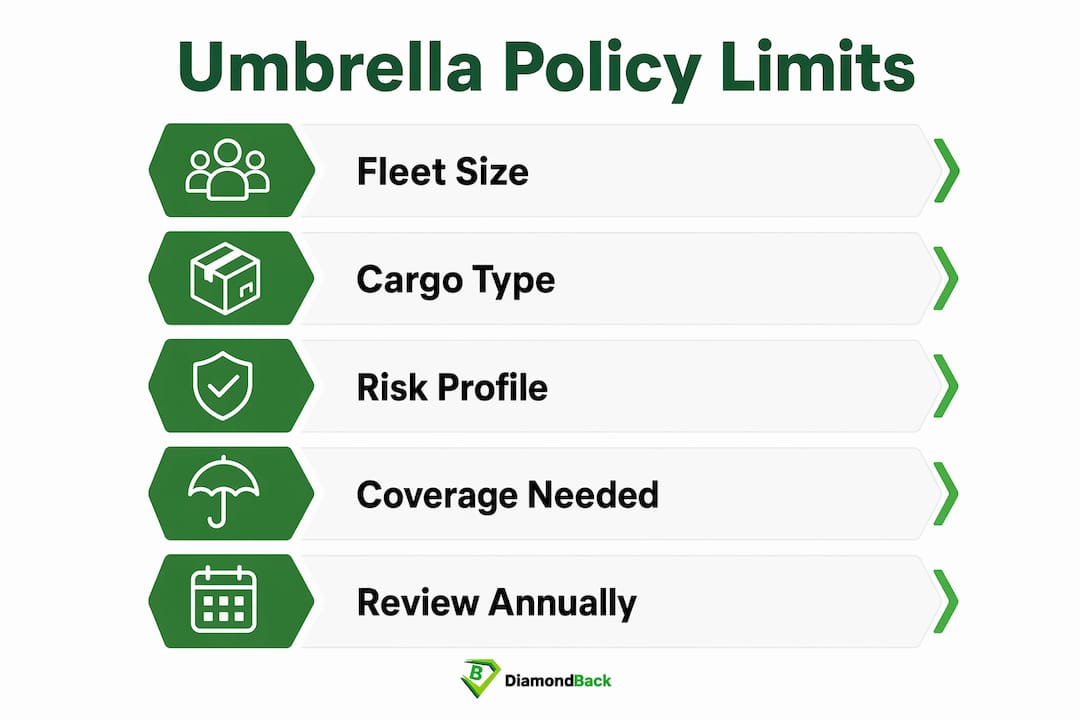
Underwriters evaluate your operation before issuing an umbrella policy. They look at your loss history, safety program quality, driver qualification records, and the strength of your underlying primary policies. A clean safety record and documented driver training program can improve both your eligibility and your premium.
Umbrella policies require minimum underlying coverage before they activate. Typical prerequisites include $1 million in commercial auto liability, $1 million in general liability, statutory workers’ compensation, and $1 million in employer liability. Meeting these thresholds is not optional. If your primary policies fall short, your umbrella coverage will not respond.
The table below outlines typical umbrella limit ranges by fleet size and risk profile.
| Fleet size | Cargo type | Recommended umbrella limit |
|---|---|---|
| 1–5 trucks | General freight | $5 million |
| 1–5 trucks | Hazardous materials | $10 million or more |
| 6–20 trucks | General freight | $10 million |
| 6–20 trucks | Specialized or high-value | $15 million or more |
| 21+ trucks | Any cargo type | Layered excess tower, $25 million+ |
For fleets requiring more than $10 million in total limits, coverage shifts from a single umbrella policy to a layered excess liability tower. Each layer in that tower must align precisely in attachment points and coverage scope. Misaligned layers create gaps that can leave your fleet financially exposed on a large claim.
Understanding your trucking insurance limits before approaching underwriters puts you in a stronger negotiating position and helps you avoid buying too little coverage.
Pro Tip: FMCSA regulations and shipper requirements both evolve. Review your umbrella limits every year at renewal, not just when you add trucks. A limit that was adequate two years ago may fall short of current contract demands.
Steps to purchase an umbrella policy for your trucking business
Purchasing an umbrella policy follows a clear sequence. Working through each step methodically prevents coverage gaps and helps you secure the best available terms.
-
Audit your existing primary policies. Confirm that your commercial auto liability, general liability, workers’ compensation, and employer liability all meet the minimum limits required for umbrella eligibility. Gaps in underlying coverage will block your umbrella from responding.
-
Calculate your total risk exposure. Add up your fleet value, business assets, real estate, and an estimate of future revenue. That total represents the financial exposure you are protecting. Your umbrella limit should be large enough to cover a worst-case judgment against your business.
-
Shop quotes from specialized trucking insurers. Umbrella pricing varies significantly between carriers. Comparing quotes from multiple insurers who specialize in trucking insurance coverage gives you a realistic view of market rates and coverage terms.
-
Verify the policy form. Confirm whether the policy is a true umbrella form or an excess liability form. Ask specifically about drop-down coverage and which underlying policies the umbrella follows. Get this in writing before binding coverage.
-
Prepare your underwriting documentation. Gather your loss runs for the past five years, driver qualification files, vehicle maintenance records, and any safety program documentation. Underwriters use this information to assess your risk and set your premium.
-
Coordinate with your broker or risk manager. A broker who specializes in commercial trucking can structure your primary and umbrella layers to work together without gaps. This coordination is especially important if you are building a layered excess tower for a large fleet.
-
Integrate the policy into your safety management plan. Your umbrella insurer has a direct interest in your loss prevention efforts. Maintaining a documented safety program, including driver training and vehicle inspection records, supports your underwriting position at renewal.
Keeping your trucks in good mechanical condition also reduces accident frequency. Reliable parts sourcing from suppliers like Nationwide Heavy Truck Parts supports the maintenance discipline that underwriters reward with better premiums.
Pro Tip: Maintain a formal safety program with written policies and documented training records. Underwriters treat this as evidence of operational discipline, and it can meaningfully reduce your umbrella premium at renewal.
Common mistakes to avoid with trucking umbrella insurance
Trucking owners make predictable errors when purchasing or managing umbrella coverage. Recognizing these mistakes before they affect your protection saves money and prevents gaps.
- Confusing umbrella with excess liability. These are not the same product. Insurance professionals caution that umbrella policies offer broader, multi-line coverage and drop-down protection that excess liability does not provide. Verify which form you are buying.
- Choosing limits that are too low. Many owners select umbrella limits based on what feels affordable rather than what their actual risk exposure demands. Base your limit on your total net worth and the size of verdicts common in your operating region.
- Failing to maintain required underlying coverage. If your primary policies lapse or fall below the required minimums, your umbrella will not respond to claims. Keep your underlying policies current and at the required limits.
- Ignoring contract requirements. Shippers and brokers specify minimum liability limits in their contracts. Failing to meet those requirements can void your operating agreements and expose you to uninsured claims.
- Not disclosing loss history. Omitting accidents or claims during the underwriting process can void your policy entirely. Full disclosure protects you and keeps your coverage enforceable.
- Waiting until after an incident. Umbrella coverage cannot be purchased retroactively. Fleets that delay acquiring coverage until after a serious accident lose the protection they needed most.
- Skipping the annual review. Your fleet grows, your contracts change, and your net worth increases. An umbrella limit set three years ago may leave significant exposure uncovered today.
Pro Tip: Review your umbrella policy at every annual renewal. Compare your current limits against your updated net worth, fleet size, and active shipper contracts. Adjust coverage before gaps become claims.
Key takeaways
A commercial truck umbrella policy is the most cost-effective way to protect your business assets from catastrophic liability claims that exceed primary policy limits.
| Point | Details |
|---|---|
| FMCSA gap is real | Regulatory minimums fall far short of actual catastrophic claim costs, making umbrella coverage necessary. |
| Cost efficiency is significant | A $5 million umbrella policy costs a fraction of equivalent primary policy limit increases. |
| Prerequisites must be met | Underlying policies must hit minimum limits before an umbrella policy will respond to any claim. |
| Umbrella differs from excess | Umbrella provides broader, multi-line drop-down coverage that excess liability does not offer. |
| Annual review is required | Fleet growth, contract changes, and rising verdicts mean your limits need reassessment every year. |
Why umbrella coverage is the most undervalued asset in trucking risk management
I have reviewed enough trucking insurance programs over the years to say this plainly: the umbrella policy is the most undervalued line of coverage in the industry. Fleet owners spend hours negotiating primary policy premiums and almost no time thinking about what happens when those limits run out. That is exactly backwards.
The claims that destroy trucking businesses are not the routine fender-benders. They are the multi-vehicle highway accidents, the serious injury verdicts, and the wrongful death lawsuits that juries decide. Those claims routinely reach seven figures. A $1 million primary policy disappears fast in that environment.
What I find most striking is the cost argument. Trucking owners who balk at a $3,000 annual umbrella premium will spend that amount on a single truck repair without hesitation. The umbrella protects everything. The repair protects one vehicle. The math is not complicated.
The owners who sleep well at night are the ones who have structured their coverage properly. They carry adequate primary limits, they have a true umbrella form sitting above those limits, and they review both every year. That discipline is not expensive. It is the foundation of a business that survives the unexpected.
If you want to assess whether your current structure holds up, start by reading about how much insurance your operation actually requires. The answer is almost always more than you think.
— Vladimir
Diamondbackins can help you secure the right umbrella coverage
Trucking companies that carry the right umbrella limits protect their assets, meet shipper requirements, and stay financially viable after serious accidents. Diamondbackins makes it straightforward to find the coverage your fleet needs.

Diamondbackins aggregates quotes from multiple top-rated commercial trucking insurers, so you can compare umbrella and primary policy options side by side in minutes. The platform is built for fleet managers and owner-operators who need accurate quotes without the back-and-forth of traditional brokers. Start by reviewing the full range of service truck coverage options available through Diamondbackins, then get an instant quote tailored to your fleet size, cargo type, and liability requirements. Your coverage structure should match your actual risk exposure, and Diamondbackins gives you the tools to make that happen quickly.
FAQ
What does a trucking umbrella policy actually cover?
A trucking umbrella policy covers bodily injury, property damage, and legal defense costs that exceed your primary policy limits. It also provides drop-down coverage for claims that fall outside the scope of your underlying policies but within the umbrella’s broader terms.
How much does a commercial truck umbrella policy cost?
A $5 million umbrella policy typically costs $2,000 to $4,000 annually for a small trucking operation. That cost increases modestly with fleet size and risk profile, but remains low relative to the protection it provides.
What are the prerequisites for a trucking umbrella policy?
Most umbrella policies require at least $1 million in commercial auto liability, $1 million in general liability, statutory workers’ compensation, and $1 million in employer liability as underlying coverage before the umbrella activates.
Is umbrella insurance the same as excess liability in trucking?
No. Excess liability raises the limit on one specific policy line. An umbrella policy covers multiple underlying policies and includes drop-down protection, making it a broader and more flexible form of coverage.
How much umbrella coverage does a trucking company need?
Small fleets hauling general freight typically need $5 million to $10 million in umbrella limits. Larger fleets or those carrying hazardous materials should carry $10 million or more, often structured as a layered excess tower to avoid coverage gaps.