

The highest-value trucking business tax deductions are fuel, per diem, insurance premiums, maintenance and repairs, depreciation under Section 179 and bonus depreciation, permits, tolls, tires, and the off-highway fuel credit via Form 4136. The single most important action you can take is pairing bulletproof documentation with a trucking-specialized CPA, who typically identifies $8,000–$20,000 more in annual savings than a generalist preparer. Before your next filing, prioritize these four steps:
- Export ELD trip logs and match overnight stays to per diem claims.
- Separate reefer fuel from tractor fuel on every fuel-card statement.
- Save all purchase invoices, repair receipts, and insurance declarations.
- Schedule a year-end consultation with a trucking-specialized CPA.
Table of Contents
- What qualifies as a trucking business tax deduction?
- Per diem vs. actual meal deductions: which method saves more?
- How do Section 179 and bonus depreciation work for truck purchases?
- Industry-specific credits and less-common deductions worth claiming
- Recordkeeping and audit-proof documentation: your practical checklist
- How a trucking-specialized CPA increases your tax savings
- How to prepare for tax season: timeline and document checklist
- Common mistakes and audit red flags to avoid
- Key Takeaways
- The deduction most operators leave on the table
- Protect your fleet’s bottom line with Diamondbackins
- Authoritative sources and next reads
What qualifies as a trucking business tax deduction?
Owner-operators and fleet companies can deduct any expense that is “ordinary and necessary” to operating a trucking business, reported on Schedule C (Form 1040) for sole proprietors. The major categories break down as follows.
Fuel is typically the largest single operating cost. You must use the actual expense method for semi-trucks because the IRS classifies them as qualified non-personal-use vehicles, making the standard mileage rate unavailable. Keep fuel-card statements and gallons-by-vehicle records, especially if you operate across IFTA jurisdictions.
Maintenance and repairs are deductible when they restore a truck to working condition. Major rebuilds, such as engine or transmission replacements, can be depreciated rather than expensed immediately, though the de minimis safe harbor lets you expense items up to $2,500 outright. Keep every invoice with the VIN noted.
Insurance premiums for commercial auto liability, cargo, bobtail, and occupational accident coverage are fully deductible as business expenses. Understanding your transportation coverage types helps you both claim the right deductions and avoid gaps in protection.

Permits, licensing, tolls, and parking incurred during business operations reduce taxable income directly. CDL renewal fees, state operating authority fees, and weigh-station permits all qualify. Save receipts or pull statements from your toll accounts.
Tires, washing, communications, ELD subscriptions, and dispatch software are deductible in the year paid. Cell phones and tablets used exclusively for business are 100% deductible; mixed-use devices require a documented business-use percentage.
Owner-operators vs. company drivers: since the Tax Cuts and Jobs Act, W-2 company drivers cannot deduct unreimbursed business expenses on Schedule A. Only owner-operators on Schedule C can claim per diem and most travel deductions. Company drivers benefit only if their carrier reimburses those costs through a formal plan.
Per diem vs. actual meal deductions: which method saves more?
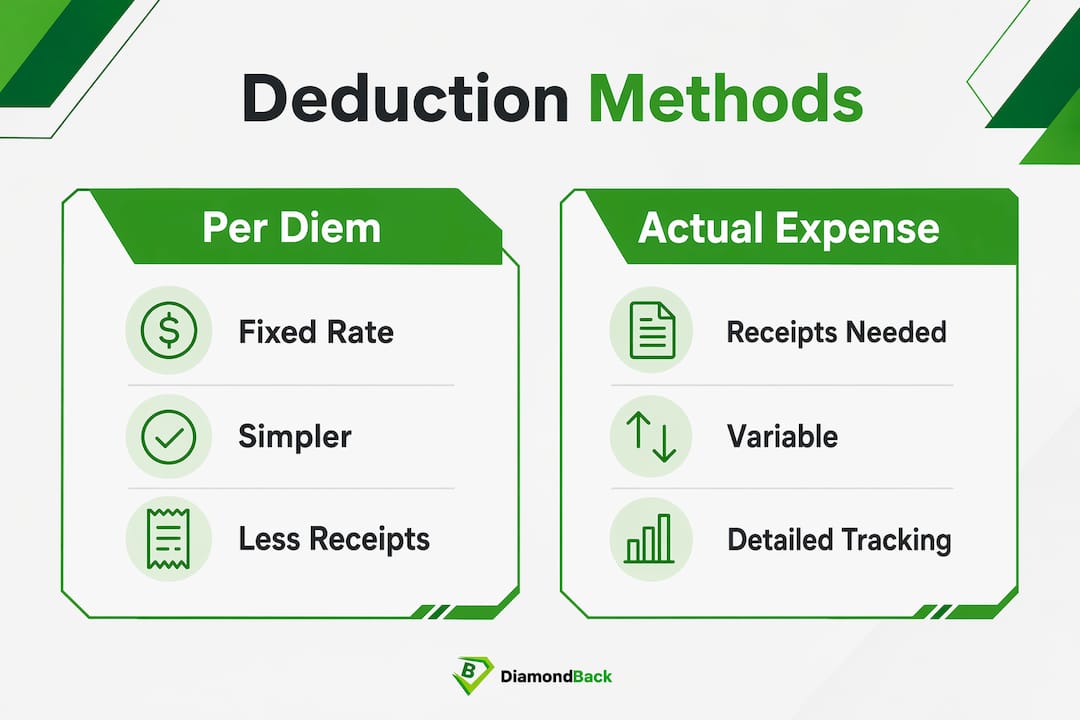
Per diem is usually the better choice for long-haul owner-operators. The 2026 CONUS rate is a fixed per diem amount per day, and DOT drivers subject to hours-of-service rules deduct 80% of that amount. To beat per diem with actual meal tracking, you would need to spend more than $80 per day on meals consistently, because actual meals are deductible at only 50% for most taxpayers (80% for DOT-regulated drivers).
| Method | Daily deduction | Documentation required | Best for |
|---|---|---|---|
| Per diem (DOT rate) | 80% of $80/day | ELD overnight logs, dates, locations | Most long-haul owner-operators |
| Actual expenses | 50% of receipted amount (80% for DOT drivers) | Every meal receipt, itemized | Drivers spending more than the per diem rate consistently |
To claim per diem, you must be away from your tax home overnight. A driver who leaves and returns the same day does not qualify, regardless of hours worked. ELD exports showing overnight locations and dates are the cleanest substantiation the IRS accepts.
Pro Tip: Trucking-specialized CPAs recommend per diem for most long-haul operators because it is simpler to substantiate and often yields equal or better tax savings versus tracking every meal receipt.
Company drivers cannot claim per diem on their personal returns unless the carrier reimburses it through a qualified plan on the W-2.
How do Section 179 and bonus depreciation work for truck purchases?
Take Section 179 first, up to the limit of your business income, then apply bonus depreciation to any remaining cost. The One Big Beautiful Bill Act (2025) restored 100% bonus depreciation and raised Section 179 limits, giving owner-operators and fleets two powerful tools to accelerate deductions.
The critical difference: Section 179 cannot exceed your taxable business income for the year, so it cannot create a loss. Bonus depreciation has no income cap and can push income below zero, creating a net operating loss (NOL) that carries forward to offset future taxable income.
For a single-truck owner buying a Class 8 truck, a practical sequence looks like this:
- Apply Section 179 to reduce income to the lowest positive bracket.
- Use bonus depreciation to zero out remaining income if that is the goal.
- Carry any resulting NOL forward to reduce next year’s tax bill.
- For trailers, note the five-year depreciation schedule vs. three years for trucks.
Multi-truck fleet purchases in a single year can create large NOLs intentionally. That is a strategic decision that requires multi-year modeling with a CPA, because accelerating depreciation now means fewer deductions in future years when income may be higher.
Industry-specific credits and less-common deductions worth claiming
Several deductions and credits go unclaimed every year because operators do not know they exist or fail to keep the records that support them.
- Off-highway fuel credit (Form 4136): Federal excise tax paid on diesel used for reefers, PTOs, and yard tractors can be recovered as a tax credit. This requires separate fueling records for reefer vs. tractor fuel. Refrigerated fleets that maintain those records can move thousands of dollars to the bottom line annually.
- Clean fuel and alternative-fuel credits: Available when vehicles run on qualifying fuels. Eligibility rules change with legislation, so verify current status with IRS guidance or a CPA before claiming.
- Heavy Highway Vehicle Use Tax (Form 2290): The HVUT itself is a deductible business expense. Keep your stamped Schedule 1 as proof of payment and as part of your vehicle records.
- Hiring credits: Federal Work Opportunity Tax Credit (WOTC) and state-level hiring incentives may apply when you bring on drivers from targeted groups. Availability and amounts vary by jurisdiction; confirm with a CPA or your state’s workforce agency.
- Qualified Business Income (QBI) deduction: Sole proprietors and S-corps can deduct 20% of net business profit from taxable income. The 2025 legislation made this permanent.
Recordkeeping and audit-proof documentation: your practical checklist
For any deduction to survive an IRS inquiry, you need contemporaneous records that match the claimed expense. Reconstructed logs created after the fact carry far less weight. Organize your files by vehicle and tax year, and retain digital backups.
Core document checklist:
- ELD trip exports showing overnight locations, dates, and business purpose (per diem substantiation).
- Fuel-card statements separated by reefer vs. tractor fuel (Form 4136 eligibility).
- Maintenance invoices with VIN, date of service, and description of work.
- Purchase invoices for trucks and trailers with in-service dates (Form 4562 depreciation).
- Insurance declarations pages for all active policies.
- Permits, toll account statements, and registration receipts.
- Form 2290 stamped Schedule 1 for each vehicle.
Retain records for at least three years from the filing date. If you report a loss or underreport income by more than 25%, the IRS has six years; retain records for seven years when large equipment purchases or NOL carryforwards are involved.
Pro Tip: Create a digital folder structure organized by tax year, then by vehicle VIN. Name files with the date and document type (e.g., “2025-11-14_TruckVIN_FuelCard”). This makes CPA handoffs and audit responses faster and less stressful.
Audit red flags to avoid: expensing large equipment purchases without a business-use log, inconsistent mileage records, and claiming overnight per diem without matching ELD data.
How a trucking-specialized CPA increases your tax savings
Hiring a trucking-specialized CPA is often the highest-return expense in your operation. Industry specialists commonly identify $8,000–$20,000 more in annual deductions than generalist preparers, because they know the off-highway fuel credit, per diem eligibility rules, depreciation sequencing, and entity-structure implications that generalists routinely miss.
A specialist CPA will: identify Form 4136 credits from reefer fuel records, optimize Section 179 and bonus depreciation sequencing, validate per diem claims against ELD logs, prepare audit-ready schedules, and advise on whether an S-corp election makes sense for your income level.
Before hiring, ask these questions:
- How many trucking clients do you currently serve, and what is the average annual savings you identify?
- Do you integrate with ELD platforms and fuel-card data for reconciliation?
- What is your fee structure: flat annual, per-return, or hourly?
- Can you provide references from owner-operators or fleet managers with similar operations?
The ROI math is straightforward. If a specialist costs $2,000–$4,000 per year and finds $10,000 in additional deductions at a 25% marginal rate, the net tax savings alone cover the fee several times over.
How to prepare for tax season: timeline and document checklist
A year-round approach prevents the scramble that causes missed deductions.
- Year-round: Capture every expense as it occurs. Use accounting software that connects to your fuel cards and bank accounts.
- October–November: Schedule a Q4 meeting with your CPA to plan large purchases, time Section 179 elections, and review estimated tax payments.
- December: Finalize any equipment purchases you want to expense in the current tax year. Confirm in-service dates are documented.
- January–February: Gather year-end fuel statements, ELD night logs, payroll records, 1099s received, and Form 2290 copies.
- March–April: File Schedule C and Schedule SE, reconcile estimated tax payments, and confirm any NOL carryforward amounts.
For budgeting, setting aside a substantial portion of net income for federal and self-employment taxes is a reasonable starting point for owner-operators. Self-employment tax alone runs 15.3% on net earnings, and half of that is itself deductible. Quarterly estimated payments are due in April, June, September, and January, so maintaining a dedicated tax reserve account prevents cash-flow pressure at each deadline.
Good fleet management practices throughout the year, including organized maintenance logs and fuel tracking, make the tax-season handoff to your CPA significantly faster.
Common mistakes and audit red flags to avoid
Poor documentation is the most frequent reason deductions are disallowed. Specific mistakes to correct now:
- Weak per diem substantiation: Claiming overnight per diem without ELD logs showing the overnight location is the top audit trigger for owner-operators.
- Mixed reefer and tractor fuel: Combining these on a single fuel-card statement forfeits the Form 4136 off-highway credit entirely.
- Missing Section 179 purchase documentation: No invoice or in-service date means the deduction is unsupported.
- Personal use not separated: Using a truck for personal trips without logging and allocating those miles creates a mixed-use problem that can disqualify the entire vehicle expense.
- Generalist accountants: A preparer unfamiliar with trucking will miss industry-specific credits and may misapply depreciation rules, costing you money in both directions.
Keep in mind that a deduction reduces your tax bill by roughly 15%–30% of the expense’s value, depending on your marginal rate. Spending $10,000 to get a $2,500 tax reduction is not a strategy; spending money you would have spent anyway and documenting it correctly is.
Key Takeaways
Trucking business tax deductions are most valuable when you combine per diem, depreciation, and fuel credits with contemporaneous documentation and a trucking-specialized CPA.
| Point | Details |
|---|---|
| Per diem is often the largest deduction | Owner-operators deduct 80% of $80/day using ELD overnight logs as substantiation. |
| Section 179 and bonus depreciation sequence matters | Apply Section 179 to the income limit first, then bonus depreciation to zero out income or create a carryforward NOL. |
| Reefer fuel separation unlocks Form 4136 credits | Keeping reefer and tractor fuel on separate records lets you recover federal excise tax paid on off-highway diesel. |
| Specialist CPA ROI is measurable | Trucking CPAs typically find significantly more annual deductions than generalist preparers. |
| Diamondbackins supports cost control | Organized insurance records and accurate fleet data speed up commercial trucking quotes on the Diamondbackins platform. |
The deduction most operators leave on the table
Most articles on trucking tax write-offs focus on the obvious categories: fuel, repairs, depreciation. What they understate is how much the off-highway fuel credit and per diem substantiation gap cost refrigerated carriers and long-haul operators every year. The Form 4136 credit is not complicated, but it requires one operational habit: separate fueling records from day one. Operators who retrofit that habit mid-year often find they have already lost months of recoverable credits.
The per diem situation is similar. The IRS does not require meal receipts for per diem, but it does require proof of overnight stays. ELD data already captures that information. The gap is not effort; it is knowing to export and retain those logs in a format your CPA can use. Fleets that build that export into a monthly routine rarely face per diem disallowance.
There is also a broader point worth making: organized tax records and organized insurance records are the same records. Maintenance logs, VIN-level purchase invoices, and fuel statements are exactly what underwriters want when you shop for commercial coverage. Fleets that keep clean books tend to get faster, more accurate quotes because they can answer underwriter questions immediately. That connection between tax discipline and insurance cost control is real, and it compounds over time.
Protect your fleet’s bottom line with Diamondbackins
Cutting your tax bill and controlling insurance costs are two sides of the same operational discipline. Diamondbackins gives fleet managers and owner-operators instant access to commercial trucking insurance quotes from multiple top-rated carriers, all in one place, without the back-and-forth of a traditional broker. When your records are organized, the quoting process moves faster and the coverage options you see are more accurately priced to your fleet’s actual risk profile.

Whether you run a single truck or a regional fleet, you can compare trucking coverage options and get an instant quote in minutes. Ready to see what your fleet qualifies for? Get your truck insurance quote today and put your organized records to work on both your tax return and your insurance renewal.
This article is general information, not tax or legal advice. Consult a qualified CPA or tax professional for guidance specific to your situation and the current tax year.
Authoritative sources and next reads
These IRS forms and publications are the primary references for the deductions covered in this article. Owner-operators should start with Publication 463 and Form 4562; fleet managers with multiple vehicles should also review Form 2290 and Form 4136.
- IRS Trucking Tax Center: Central hub for Form 2290 (HVUT), vehicle use tax guidance, and e-file resources. Required reading for any operator with vehicles over 55,000 lbs.
- Form 4562 (Depreciation and Amortization): Where Section 179 elections and bonus depreciation are reported. Your CPA will complete this, but understanding it helps you ask the right questions.
- Form 4136 (Credit for Federal Tax Paid on Fuels): The recovery mechanism for off-highway diesel excise tax paid on reefer and PTO fuel. File with your annual return.
- IRS Publication 463 (Travel, Gift, and Car Expenses): The authoritative IRS guide for per diem substantiation, overnight-stay requirements, and meal deduction rules.
- Form 2290 (Heavy Highway Vehicle Use Tax Return): Required for vehicles with a taxable gross weight of 55,000 lbs or more. The HVUT paid is itself a deductible business expense.
- Overdrive: 2026 Trucker Tax Strategy: Practical analysis of depreciation sequencing, per diem rules, and the 2025 legislative changes affecting owner-operators.
When rules are ambiguous, especially around depreciation sequencing, entity structure, or state-level credits, a trucking-specialized CPA is the most reliable resource. The IRS forms above confirm the mechanics; a specialist confirms the strategy.