

New venture truck insurance is the federally required coverage that allows a trucking startup to legally haul interstate freight under its own operating authority. Without it, the Federal Motor Carrier Safety Administration (FMCSA) will not activate your authority, and you cannot move a single load. Getting this right from day one protects your business, your drivers, and your cash flow. This guide covers every mandatory coverage, the exact filing process, realistic cost expectations, and the mistakes that shut new carriers down before they ever turn a profit.
What new venture truck insurance requires under federal law
The FMCSA sets the floor for every commercial trucking policy in the United States. Primary auto liability minimums are $750,000 for general freight, $1 million for oil transport, and $5 million for hazardous materials. These are not suggestions. Operating below these limits voids your authority and exposes you to personal liability for any accident.
Cargo insurance covers the freight you carry if it is lost, stolen, or damaged in transit. Most freight brokers require a minimum of $100,000 in cargo coverage before they will assign you a load. Physical damage coverage protects your own truck and trailer against collision, fire, and theft. It is not federally mandated, but any lender financing your equipment will require it as a loan condition.
Your policy must also carry an MCS-90 endorsement, which is a federal endorsement that guarantees payment to the public even if your policy has a coverage gap. The BMC-91X filing is the electronic proof of financial responsibility that your insurer submits directly to FMCSA on your behalf. Both are non-negotiable for interstate authority activation.
Optional coverages worth considering from the start include general liability, bobtail insurance (which covers your truck when it is operating without a trailer), and non-trucking liability for personal use of the vehicle. These are not required by the FMCSA, but gaps in these areas create real financial exposure. Review the full list of often-missed coverages before you finalize your policy.
How to get new venture truck insurance: from application to active authority
Securing trucking insurance for a startup follows a clear sequence. Skipping steps or arriving unprepared adds days to your timeline and can delay your first load.
Step 1: Gather your documentation. Collect your USDOT number, MC number, driver CDL copies, motor vehicle records (MVRs) for all drivers, vehicle identification numbers (VINs), and your intended cargo type. Underwriters use all of this to assess risk before quoting.

Step 2: Apply for quotes. Submit your documentation to insurers or an online platform like Diamondbackins, which aggregates quotes from multiple carriers so you can compare coverage and price in minutes. Be specific about your cargo type and operating radius. Vague applications produce inaccurate quotes.
Step 3: Bind your policy. Once you select a policy, the insurer activates coverage and begins the filing process. Most insurers can quote and bind new venture policies within 24–72 hours when applicants arrive fully prepared. That speed matters because your authority clock does not start until filings are confirmed.
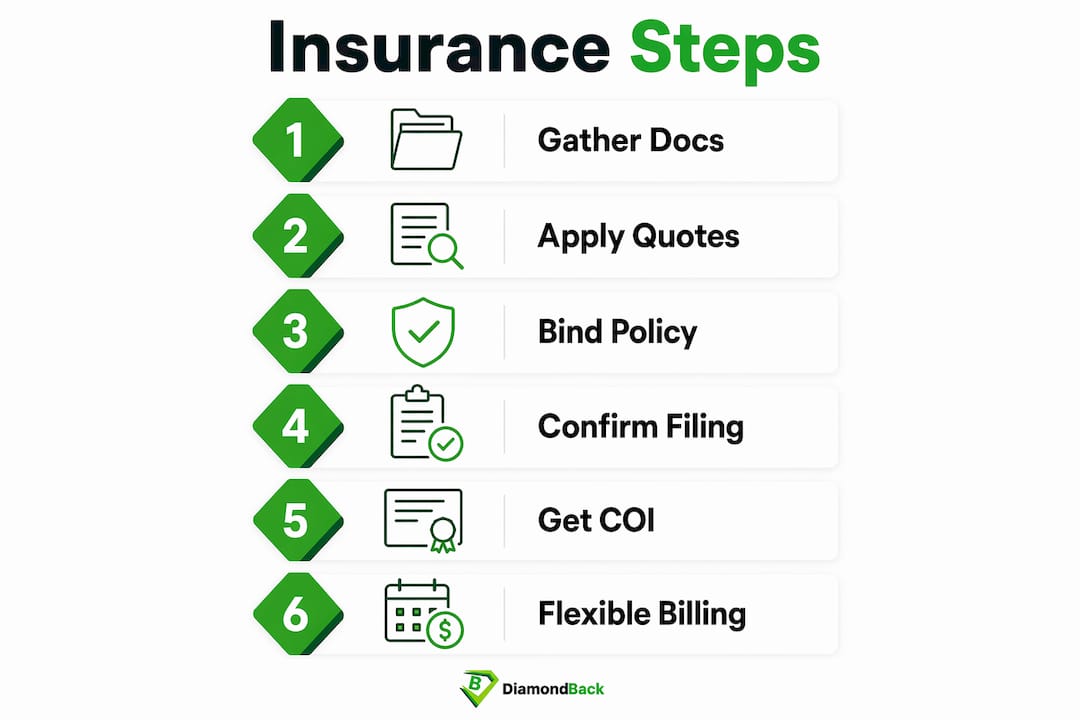
Step 4: Confirm FMCSA filings. Your insurer electronically submits the BMC-91X to FMCSA. You or your process agent must separately file the BOC-3, which designates legal agents in every state where you operate. FMCSA processes these filings within 24–72 hours after submission. Check your FMCSA portal to confirm your authority status shows “Active” before dispatching any driver.
Step 5: Receive your certificate of insurance. Your insurer issues a certificate of insurance (COI) that you provide to brokers and shippers. The right program delivers this certificate quickly so you are ready for brokers from day one.
Step 6: Explore flexible billing. Specialty programs offer monthly reporting and pay-per-mile premium billing to help new ventures align insurance costs with actual revenue. This protects cash flow during the first year when loads may be inconsistent.
Pro Tip: Have every document ready before you request a quote. Incomplete applications are the single biggest cause of delays in authority activation for new carriers.
What does trucking insurance cost for a new venture?
Cost is the question every new owner-operator asks first. New owner-operators typically pay $8,000–$14,000 annually for a basic policy covering liability, cargo, and physical damage. That breaks down to roughly $667–$1,167 per month for a single-truck operation. Multi-truck fleets pay more in total but often less per unit as they build a claims history.
Several variables move that number up or down significantly.
Driver experience is the biggest factor. A driver with a fresh CDL and no verifiable trucking history represents the highest risk to an underwriter. Experienced drivers with clean records bring premiums down. After two or more years of clean records, premiums can drop 20–40%. That is a meaningful reward for maintaining safety discipline from the start.
Cargo type also shapes your rate. Dry van general freight sits at the lower end of the risk spectrum. Refrigerated goods, oversized loads, and hazardous materials all carry higher premiums because the liability exposure is greater. Operating in high-traffic states or dense urban corridors adds additional cost compared to rural routes.
CSA scores from the FMCSA’s Compliance, Safety, Accountability program directly influence underwriting decisions. A poor CSA score signals risk to insurers and raises your premium. A clean score does the opposite. Trucking risk management practices like driver safety training, regular vehicle inspections, and electronic logging device (ELD) compliance all contribute to a better score over time.
Pro Tip: Choosing a higher deductible on your physical damage coverage lowers your monthly premium. Set the deductible at a level you can actually pay out of pocket if you have a claim.
| Cost factor | Impact on premium |
|---|---|
| Driver CDL experience under 2 years | Significantly higher rates |
| Clean MVR and CSA score | Lower rates over time |
| Hazardous materials cargo | Requires $5M liability minimum |
| Pay-per-mile billing option | Aligns cost with actual revenue |
| 2+ years clean operating history | Potential 20–40% premium reduction |
What common mistakes do new trucking ventures make with insurance?
The most damaging mistakes in new venture commercial truck insurance are not about choosing the wrong deductible. They are about compliance failures that halt operations entirely.
Failing to verify FMCSA filings. Binding a policy does not automatically mean your authority is active. Incomplete or unsubmitted FMCSA filings can delay or suspend operating authority, stopping freight operations before they begin. Always log into the FMCSA portal and confirm your authority status reads “Active” before your first dispatch.
Letting coverage lapse. An insurance lapse is not a private matter between you and your insurer. Insurers must report lapses to FMCSA, which can trigger an authority suspension within 30 days. A suspended authority means zero revenue until it is reinstated, and reinstatement takes time and money.
Mismatching coverage to actual operations. New ventures commonly over-insure commodities they do not haul or under-insure to risky levels. Over-insuring wastes premium dollars. Under-insuring leaves you personally exposed after an accident. Match your cargo limits precisely to what you actually plan to haul.
Delaying the binding process. Every day without active insurance is a day without revenue. New owners sometimes spend weeks comparing quotes without committing. The best insurance for a new trucking business is the one that is bound, filed, and active so you can haul freight.
Working with a generalist agent. A general commercial insurance agent may not know the difference between a BMC-91X and a BOC-3. Trucking-focused insurance agents specialize in tailoring new venture programs for the right balance of coverage and cash flow. The difference in expertise directly affects whether your authority activates on time.
Key takeaways
New venture truck insurance requires active FMCSA filings, federally mandated liability limits, and the right coverage match to operate legally and protect your business from day one.
| Point | Details |
|---|---|
| Federal minimums are non-negotiable | Carry at least $750,000 in primary liability for general freight or lose your authority. |
| Filings activate your authority | BMC-91X and BOC-3 must be filed and confirmed before you dispatch any driver. |
| Timing is 24–72 hours | Most insurers bind and file within 24–72 hours when your documentation is complete. |
| Clean records cut costs | Two or more years of clean operating history can reduce premiums by 20–40%. |
| Mismatched coverage is a hidden risk | Over-insuring or under-insuring both hurt your business. Match limits to actual cargo. |
The part of new venture insurance nobody warns you about
Starting a trucking business taught me one thing that no rate sheet captures: the biggest threat to a new carrier is not the premium. It is the gap between what you think you are covered for and what your policy actually says.
I have seen new owner-operators bind a policy, assume everything is handled, and then discover their BOC-3 was never filed because they used a process agent who dropped the ball. Their authority showed “Pending” for two weeks while they sat on a truck they could not legally move. That is a cash flow crisis, not an insurance problem. But it starts with not verifying every filing yourself.
The other pattern I see constantly is new ventures buying cargo coverage for commodities they will never haul because a broker told them to. A dry van carrier does not need refrigerated cargo limits. That extra premium compounds over 12 months into real money that could fund a second driver or a safety program.
My honest advice: work with an agent who has placed coverage for at least a dozen new trucking authorities. Ask them directly how many new venture policies they have written in the past year. A specialized trucking insurance agent will know exactly which endorsements FMCSA requires, which optional coverages actually protect you, and how to structure billing so your first year does not drain your reserves. The compliance side of this business is unforgiving. The right agent makes it manageable.
— Vladimir
How Diamondbackins helps new trucking ventures get covered fast
Getting your trucking company insured should not take weeks of phone calls and paperwork. Diamondbackins is built specifically for carriers who need coverage quickly and correctly.
Diamondbackins aggregates quotes from multiple top-rated insurers so you can compare real options in minutes, not days. The platform handles electronic BMC-91X filings and delivers your certificate of insurance fast, so brokers and shippers can verify your authority without delay. Whether you are a single owner-operator or building a small fleet, Diamondbackins tailors coverage to your actual cargo type and operating lanes. Get your instant truck insurance quote today and start hauling with confidence.
FAQ
What is new venture truck insurance?
New venture truck insurance is commercial trucking coverage designed for carriers with no prior operating history. It meets FMCSA minimum liability requirements and includes the mandatory filings needed to activate interstate operating authority.
How long does it take to get insured and active?
Most insurers bind a new venture policy and submit FMCSA filings within 24–72 hours when the applicant provides complete documentation. Authority activation follows once FMCSA processes the BMC-91X and BOC-3 filings.
What is the minimum liability insurance required by FMCSA?
The FMCSA requires a minimum of $750,000 in primary auto liability for general freight carriers, $1 million for oil transport, and $5 million for hazardous materials operations.
Why do new trucking ventures pay higher premiums?
New ventures face higher premiums because insurers have no operating history to assess risk. Premiums typically decrease after two or more years of clean safety records and no major claims.
What happens if my insurance lapses?
Insurers are required to report coverage lapses to FMCSA, which can trigger an authority suspension within 30 days. A suspended authority halts all freight operations until coverage is reinstated and filings are resubmitted.