
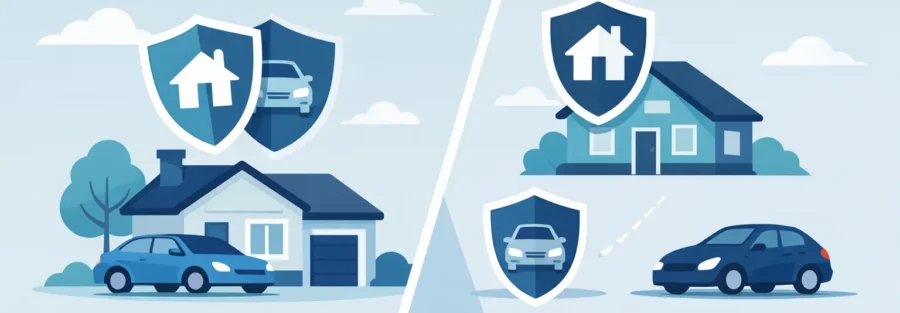
If your home and car insurance renew around the same time, you have a real decision to make – and it can affect both your budget and your coverage. The home auto bundle vs separate question is not just about whether one quote looks cheaper today. It is about how discounts, claims, service, and long-term flexibility work together.
For many shoppers, bundling does lower the total premium. For others, keeping policies separate produces a better deal or stronger coverage. The right answer depends on your driving profile, property type, location, claims history, and how aggressively each carrier prices one line of business versus another. That is why fast comparison matters.
Home auto bundle vs separate: what changes?
A bundle means you buy your home and auto insurance from the same carrier. Separate coverage means one company insures your home and another insures your car. On the surface, that sounds simple. In practice, pricing can shift in ways that are not obvious until you compare both setups side by side.
Insurers often reward bundles with multi-policy discounts. That discount may apply to auto, home, or both. Bundling can also make billing easier, reduce account management headaches, and sometimes produce loyalty perks over time. But a bundle is not automatically the cheapest option. One insurer may be highly competitive on auto and only average on home, while another may be strong on homeowners pricing but expensive for drivers in your area.
That is where shoppers can get tripped up. A carrier may advertise a strong bundle discount, but the starting rate for one of the policies may already be high. A smaller discount on two better-priced standalone policies can still win.
When bundling usually makes sense
Bundling often works well for people who want convenience without giving up value. If you prefer one login, one billing relationship, and one renewal cycle, there is real practical value in putting both policies with the same company. It can make updates faster when you move, add a vehicle, change mortgage information, or review deductibles.
Bundling also tends to be attractive when your risk profile is fairly standard. If you have a typical single-family home, a clean driving record, and no unusual coverage needs, there is a good chance at least one carrier will price a combined package competitively. The larger the multi-policy discount, the more likely bundling comes out ahead.
There can also be claims-related convenience. If a storm damages your garage and your vehicle at the same time, working with one carrier may simplify communication. It does not guarantee a better claims outcome, but it can reduce some back-and-forth.
When separate policies can be the better move
Separate policies often make sense when your home and auto profiles do not fit neatly with the same carrier. Maybe your home is older, in a high-risk weather zone, or needs specialty endorsements. Maybe your driving record has a recent violation, you have teen drivers, or you insure multiple vehicles with mixed usage. In those cases, the best home insurer and the best auto insurer may not be the same company.
This is especially true if one line of coverage is difficult to place or expensive in your market. A carrier that offers a decent bundled discount may still not compete if its homeowners rates are elevated because of roof age, wildfire exposure, or prior claims. The same goes for auto if your ZIP code, mileage, or vehicle type pushes you into a higher-priced tier.
Separate coverage can also give you more control. If your auto rates jump at renewal, you can replace that policy without disturbing your home insurance. With a bundle, shoppers sometimes stay put because moving both policies feels like more work. Convenience is useful, but it should not trap you into a higher bill.
Price is important, but coverage matters more than the headline discount
The biggest mistake in the home auto bundle vs separate decision is comparing discounts instead of comparing total value. A 20% bundle discount sounds great until you realize the policy has a high deductible, limited endorsements, or lower liability limits than you actually need.
On the home side, pay attention to dwelling coverage, replacement cost terms, water backup options, personal property limits, and wind or hurricane deductibles if they apply in your area. On the auto side, look at liability limits, collision and comprehensive deductibles, uninsured motorist coverage, rental reimbursement, and roadside assistance if that matters to you.
A cheaper setup can become expensive fast if it leaves coverage gaps. The best quote is the one that fits your risk and still keeps the premium competitive.
What affects bundle savings most
Bundle savings vary widely by carrier and by state. There is no universal rule that bundling saves a fixed amount. Two households with similar homes and vehicles can get very different results.
Your location is a major factor. Weather exposure, theft rates, litigation trends, and repair costs all affect pricing. Your credit-based insurance score may matter in many states. Claims history matters too. A recent auto claim may weaken your bundle advantage with one carrier while another still prices both policies well.
Property details can move the numbers more than people expect. Roof age, square footage, construction type, and distance to a fire station all influence homeowners pricing. On the auto side, mileage, garaging address, vehicle safety features, and driver history can shift rates significantly. That is why no one should assume a bundle is better without seeing live quotes.
How to compare home auto bundle vs separate the smart way
Start with the same coverage limits across all quotes. If one home quote includes replacement cost on contents and another does not, or one auto quote carries much lower liability limits, the comparison is not clean.
Next, compare the total annual cost, not just each policy by itself. A carrier may offer a very low auto premium only when paired with home insurance. Another may have the lowest homeowners rate but no meaningful auto discount. Look at the full household number.
Then check deductibles and endorsements. A lower premium paired with a much higher wind deductible or stripped-down auto extras may not be worth it. Also review the financial strength and customer experience of the carrier if you are choosing between close options.
Finally, think about your next 12 to 24 months. If you may buy a new car, move, add a teen driver, or renovate your home, some insurers will remain more competitive than others after those changes. The cheapest quote today is not always the most stable one at renewal.
Convenience has value, but so does flexibility
For busy households, bundling can be worth a small premium difference because it cuts friction. One carrier, one app, one service team, and fewer moving parts is a real benefit. If the pricing is close, that convenience can justify the choice.
But if separate policies save meaningful money without reducing protection, flexibility often wins. You can shop each line on its own schedule and respond faster to rate changes. For experienced insurance shoppers, that control is a major advantage.
The key is not choosing based on habit. Many people keep a bundle because they assume it is still saving money. Others avoid bundles because they assume one company cannot be best at both. Both assumptions can be wrong.
The fastest way to get the right answer
The most reliable way to settle the home auto bundle vs separate debate is to compare both setups at the same time. That means checking a bundled option, then checking separate home and auto quotes with comparable coverage. Once you see real numbers from multiple carriers, the decision usually becomes clear.
A digital comparison platform makes that process faster because you do not have to chase quotes one carrier at a time. For shoppers who want speed, transparency, and control, that matters. Diamondback Insurance helps you compare options in one place so you can see whether bundling actually earns its keep or whether separate policies give you better value.
There is no prize for choosing the more traditional route. The smart move is the one that gives you solid protection, a fair price, and less hassle when life changes.