

New authority trucking insurance is the federally required coverage you must secure before your FMCSA motor carrier (MC) number activates and you can legally haul freight interstate. Without it, your operating authority stays dormant, and you cannot book a single load. The process involves more than just buying a policy. You need the right coverage types, correct minimum limits, and proper insurer filings submitted directly to FMCSA. This guide walks you through every requirement, cost expectation, and filing step so you can get your new trucking company on the road without delays.
What insurance types and coverage limits does FMCSA require for new authority trucking?
FMCSA sets a minimum $750,000 liability coverage for trucks over 10,001 pounds GVWR operating interstate on general freight. That figure is the federal floor, not the practical standard. Most freight brokers and shippers require $1,000,000 in primary liability before they will assign you a load. Starting at $750,000 technically satisfies the law, but it locks you out of a large share of the freight market from day one.
The coverage requirements vary by cargo type. Carriers hauling hazardous materials face minimums ranging from $1,000,000 to $5,000,000 depending on the commodity. Oil transport and certain bulk cargo categories carry their own elevated thresholds. Knowing your freight type before you shop for coverage determines which policy tier you actually need.

Cargo insurance is not federally mandated, but brokers treat it as a practical requirement. Most broker contracts specify at least $100,000 in cargo coverage before they will tender a load. Without it, you are limited to direct shipper relationships, which are harder to build when you are just starting out.
The MCS-90 endorsement is a mandatory attachment to your primary liability policy. It guarantees payment to the public for bodily injury or property damage even if a coverage dispute exists between you and your insurer. FMCSA requires this endorsement on every qualifying policy. Your insurer adds it automatically when they write a commercial trucking policy for an authorized carrier.
Your insurer must also file either the BMC-91 or BMC-91X form with FMCSA to prove your coverage is active. The BMC-91 covers a single carrier. The BMC-91X covers multiple carriers under one policy. Both are filed electronically. FMCSA will not activate your authority until this filing is accepted.
Pro Tip: Request $1,000,000 in primary liability from the start. The premium difference over $750,000 is modest, and it immediately qualifies you for broker load boards that would otherwise reject your certificate of insurance.
How to prepare and submit the required insurance filings to activate your trucking authority
Getting your authority activated requires more than purchasing a policy. You need specific documents ready before your agent can begin the filing process.
Gather the following before contacting an insurance agent:
- Your MC number and USDOT number, both issued by FMCSA during the application process.
- Vehicle identification numbers (VINs) and gross vehicle weight ratings for every truck in your fleet.
- Driver information including license numbers, years of experience, and motor vehicle records (MVRs).
- Your business entity documents, such as your LLC or corporation registration.
- A completed BOC-3 filing designation, which appoints a process agent in every state where you operate.
The BOC-3 filing is a separate requirement from insurance. Both the BMC-91 filing and the BOC-3 designation must be on file with FMCSA before your authority activates. Many new carriers overlook the BOC-3 and then wonder why their authority is still pending after insurance is confirmed. Process agent services are inexpensive and widely available online.
Once you have your documents, work with an agent who specializes in new authority trucking. General commercial insurance agents often lack the FMCSA filing experience needed to move quickly. A specialized agent knows which insurers accept new authority accounts, how to submit the BMC-91 electronically, and how to avoid the documentation errors that cause delays.
Authority activates 24–48 hours after FMCSA accepts the BMC-91 filing. That timeline assumes your documents are complete and your insurer submits without errors. Incomplete MVRs, missing VINs, or mismatched business names between your FMCSA registration and your insurance application are the most common causes of delays. Review every document for consistency before submission.
Pro Tip: Confirm with your agent that the BMC-91 has been accepted in the FMCSA portal, not just submitted. Submission and acceptance are two different statuses, and only acceptance triggers authority activation.
What are the typical insurance cost ranges for new authority trucking in 2026?
Cost is the biggest surprise for most new carriers. New authority trucking insurance premiums average $12,000 to $25,000 annually for a single truck operation, covering liability, cargo, and physical damage combined. That range reflects the risk profile insurers assign to carriers with no claims history and limited time in business.
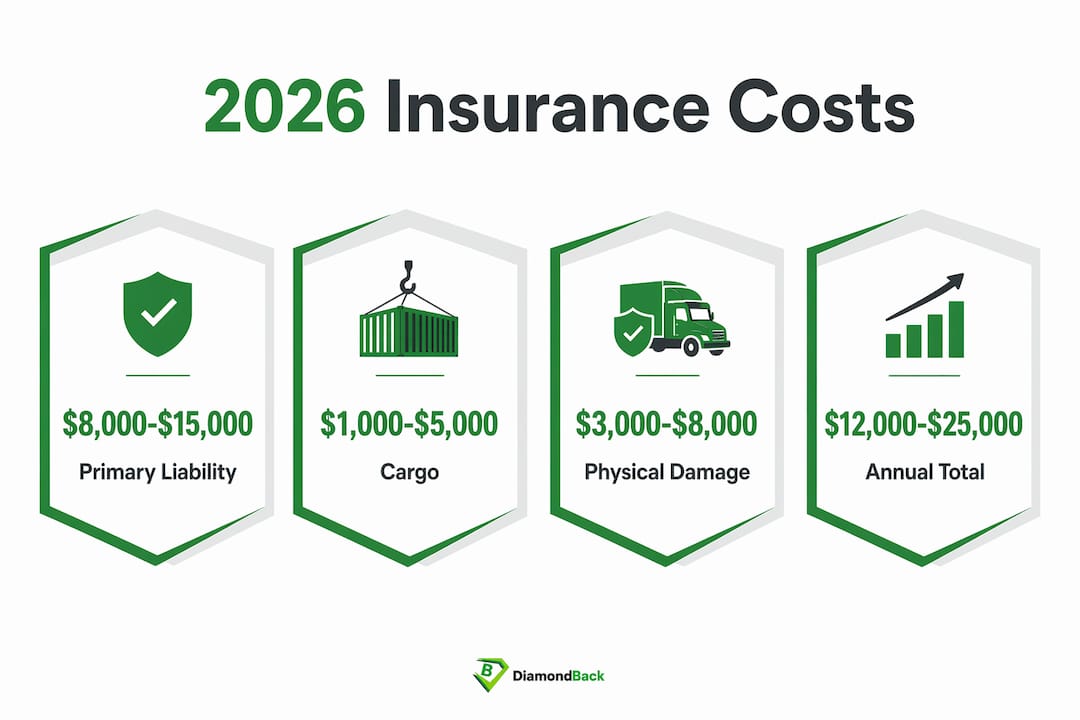
The table below breaks down the typical cost components for a single-truck new authority operation:
| Coverage Type | Typical Annual Cost |
|---|---|
| Primary liability ($1,000,000) | $8,000 – $15,000 |
| Cargo insurance ($100,000) | $2,000 – $5,000 |
| Physical damage coverage | Around $3,000 |
| General liability (optional) | $500 – $1,500 |
New owner-operators pay higher rates initially because insurers have no claims data to assess their risk. After two or more years of clean operation, rates often drop significantly. That first year premium reflects the insurer’s uncertainty, not a permanent cost ceiling.
Several factors push your premium toward the higher end of the range. A driver with less than two years of CDL experience, a history of moving violations, or a truck with high mileage all increase your rate. Operating in high-traffic corridors or hauling higher-value cargo also raises the cost. Bundling your liability, cargo, and physical damage under one policy with a single insurer often produces a lower combined premium than purchasing each coverage separately.
Brokers and shippers also influence your cost indirectly. If their contracts require $1,000,000 in liability and $100,000 in cargo coverage, you have no choice but to meet those thresholds. Building your policy around broker requirements from the start prevents the cost of mid-term policy changes.
Pro Tip: Ask your agent to quote a bundled policy covering liability, cargo, and physical damage together. Bundled policies typically cost less than three separate policies and simplify your renewal process.
How to choose the best trucking insurance options for your new authority business
Selecting the right coverage starts with knowing what your freight contracts actually require. Review every broker packet before finalizing your policy limits. Most broker agreements specify minimum liability and cargo limits, and some add requirements for refrigerated cargo, flatbed loads, or oversized freight.
The following factors guide smart coverage decisions for new authority carriers:
Evaluate your liability limit against broker demands, not just FMCSA minimums. Freight brokers require $1,000,000 liability as a practical standard to avoid being locked out of load boards. Starting at that level protects your revenue from day one.
Match your cargo coverage to the value of loads you plan to haul. A $100,000 cargo policy covers most general freight, but electronics, pharmaceuticals, or high-value goods may require higher limits. Underinsuring your cargo creates personal financial exposure if a load is lost or damaged.
Physical damage coverage protects your truck against collision, theft, and weather events. It is not federally required, but any lender financing your truck will require it. Even if your truck is paid off, replacing a totaled unit without coverage can end your business before it starts.
Work with an agent who understands insurance for new trucking authority specifically. General commercial agents may not know which insurers accept new authority accounts or how to structure a policy that satisfies both FMCSA and broker requirements simultaneously.
After your policy is bound, monitor your FMCSA portal to confirm your authority status shows as active. Do not assume activation happened because your agent confirmed the filing. Check the FMCSA Licensing and Insurance (L&I) system directly. A lapsed or rejected filing can suspend your authority without warning.
Pro Tip: Set a calendar reminder 30 days before your policy renewal date. A lapse in coverage causes FMCSA to suspend your MC authority immediately, and operating without required insurance can result in fines exceeding $10,000.
Key takeaways
New authority trucking insurance requires FMCSA-compliant liability coverage, proper BMC-91 and BOC-3 filings, and cargo limits that satisfy broker contracts before you can legally haul a single load.
| Point | Details |
|---|---|
| FMCSA liability minimum | $750,000 is the federal floor, but $1,000,000 is the practical standard brokers require. |
| Mandatory filings | Your insurer files BMC-91 or BMC-91X; you separately file BOC-3 for process agent designation. |
| Activation timeline | Authority activates 24–48 hours after FMCSA accepts the BMC-91 filing. |
| First-year cost range | Expect $12,000 to $25,000 annually for liability, cargo, and physical damage combined. |
| Rate improvement timeline | Clean operation for two or more years typically produces meaningful premium reductions. |
What I’ve learned from watching new carriers get this wrong
I’ve seen new authority carriers make the same costly mistake repeatedly. They shop for the cheapest policy, hit the FMCSA minimum of $750,000, and then spend their first month calling brokers who reject their certificate of insurance on the spot. The freight market has quietly standardized at $1,000,000 liability, and no broker is going to explain why they passed on your load. You just don’t get the call back.
The second mistake is treating cargo insurance as optional because FMCSA doesn’t mandate it. The moment you haul a $90,000 load of electronics and something goes wrong, you will wish you had not skipped that $2,000 annual premium. Cargo insurance is not a regulatory checkbox. It is the coverage that keeps a single incident from ending your business.
The third issue I see constantly is new carriers working with agents who don’t specialize in trucking. A general commercial agent may write the policy correctly but have no idea how to file the BMC-91 or why the BOC-3 matters. That gap costs you days of downtime while your authority sits pending. You can read more about how much coverage you actually need before you commit to a policy.
My honest advice: spend the first year building a clean record, pay the higher premium without complaint, and treat your insurance as a business asset rather than a cost to minimize. The carriers who do that are the ones still operating in year three.
— Vladimir
Diamondbackins makes new authority insurance fast and straightforward
Getting your new trucking authority activated should not require weeks of back-and-forth with agents who don’t understand FMCSA filings. Diamondbackins specializes in commercial trucking coverage for new authority carriers, with policies structured to meet both federal requirements and broker contract minimums from day one.
Diamondbackins aggregates quotes from multiple top-rated insurers so you can compare liability, cargo, and physical damage options in one place. The platform handles the complexity of BMC-91 filing coordination and gives you clear visibility into your coverage status. Whether you are launching a single-truck operation or building a small fleet, Diamondbackins offers commercial trucking insurance in Georgia and across the country, with dedicated support for first-year carriers who need to get moving fast.
FAQ
What is new authority trucking insurance?
New authority trucking insurance is the liability and cargo coverage required by FMCSA to activate your MC number and legally operate as an interstate motor carrier. Your insurer must file proof of coverage directly with FMCSA using the BMC-91 or BMC-91X form.
How much does trucking insurance cost for a new carrier?
New authority trucking insurance averages $12,000 to $25,000 per year for a single truck, covering primary liability, cargo, and physical damage. Rates drop after two or more years of clean operation.
What happens if my insurance lapses after authority activation?
FMCSA suspends your MC authority immediately when insurance filings lapse, and fines can exceed $10,000 for operating without required coverage. Reinstatement requires a new filing and processing time.
Do I need cargo insurance to get my authority activated?
Cargo insurance is not required by FMCSA for authority activation, but brokers require at least $100,000 in cargo coverage before assigning loads. Operating without it severely limits your freight access.
What is the BOC-3 and why does it matter?
The BOC-3 is a filing that designates a process agent in every state where you operate, and it is required alongside your insurance filing to activate FMCSA operating authority. Missing the BOC-3 keeps your authority pending even after your BMC-91 is accepted.