

Leased truck insurance obligations are the specific coverage requirements a lessee must maintain to operate a commercial truck legally and protect against liability. Federal law, state regulations, and leasing company contracts each impose distinct mandates, and failing to meet any one of them can suspend your operating authority or expose your business to uncapped financial loss. The FMCSA sets the floor, but leasing companies and states like California, New York, and Texas routinely push those requirements higher. Understanding exactly what you owe, to whom, and at what coverage level is the first step toward protecting your fleet and your bottom line.
What are the core leased truck insurance obligations?
Leased truck insurance obligations fall into five primary coverage categories, each serving a distinct legal or contractual purpose. Knowing which ones apply to your operation determines whether you are compliant or exposed.
Primary liability insurance is the non-negotiable foundation. The FMCSA requires minimum liability of $750,000 for general freight carriers, $1,000,000 for oil haulers, and $5,000,000 for hazardous materials transporters. These are federal floors. Your leasing company may require limits well above those thresholds, particularly if you haul high-value or regulated cargo.

Physical damage coverage protects the leased vehicle itself. Leasing companies almost always require both comprehensive and collision coverage because the truck is their asset. If you damage or total the vehicle, you are responsible for repair or replacement costs up to the agreed value. Deductibles on these policies are typically passed directly to you as the lessee.
Bobtail insurance, also called non-trucking liability, covers your truck when you are driving without a trailer and not under active dispatch. The carrier’s primary liability policy does not cover this scenario. Bobtail coverage costs between $300 and $800 annually, making it one of the most affordable protections you can carry relative to the risk it addresses.
Cargo insurance covers the freight you haul against loss, theft, or damage. Limits vary by commodity type, but most leasing agreements specify a minimum. Motor truck cargo coverage is a separate policy from liability, and gaps between what you carry and what you cover can result in significant out-of-pocket claims.
Occupational accident insurance functions as an alternative to workers’ compensation for owner-operators. Occupational accident coverage costs between $40 and $100 per week and provides injury, disability, and death benefits comparable to workers’ comp at a lower premium. Many carriers require it as a condition of the lease.
Pro Tip: Review your lease agreement line by line before purchasing any supplemental policy. Some carriers bundle coverage into your settlement deductions, and buying duplicate policies wastes money you cannot recover.
How do federal, state, and leasing company rules interact?
The three-layer structure of leased truck insurance requirements is where most fleet managers get tripped up. Federal minimums set by the FMCSA under 49 CFR Part 387 are the legal baseline for interstate commerce. States add their own layer on top, and leasing companies add a third layer on top of that.
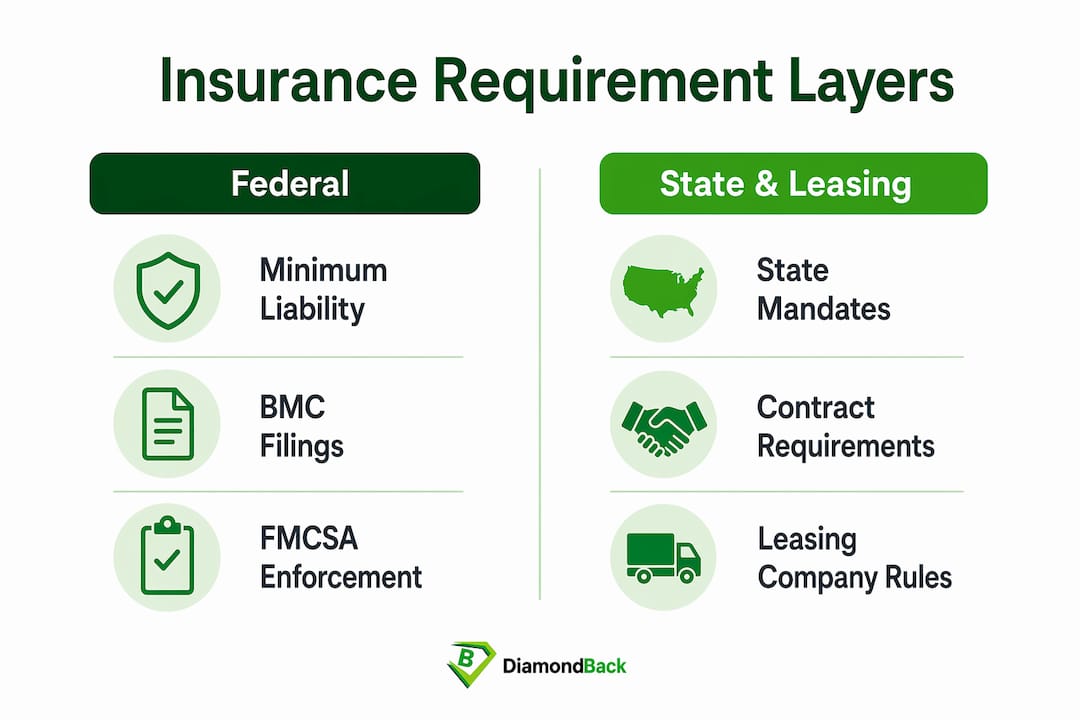
State-level insurance mandates frequently exceed federal FMCSA minimums, especially for uninsured motorist coverage and environmental liability. California, New York, and Texas each impose stricter requirements that apply the moment your truck operates within their borders. If your fleet crosses state lines regularly, your policy must satisfy the most demanding jurisdiction you enter. Reviewing trucking insurance rates by state helps you anticipate where your current coverage may fall short.
Leasing companies add a third layer that is purely contractual. They set their own required limits, approved insurers, and deductible structures. These terms are not regulated by the FMCSA, so they can be more demanding than anything federal or state law requires. A carrier leasing you a Class 8 truck may require $1,000,000 in primary liability even if you only haul general freight, simply because it protects their asset.
The table below compares the three layers of requirements you must satisfy simultaneously.
| Requirement Layer | Who Sets It | Typical Coverage Demand | Enforcement Mechanism |
|---|---|---|---|
| Federal (FMCSA) | U.S. Department of Transportation | $750K–$5M liability by cargo type | Operating authority suspension |
| State | Individual state DOT agencies | Exceeds federal minimums for UM and environmental | Registration denial or fines |
| Leasing Company | Your lessor | Often higher limits, specific insurers | Lease termination |
Federal law also requires you to file BMC-91 and BMC-91X forms with the FMCSA to maintain your operating authority. A lapse in these filings, even a brief one, can trigger an automatic suspension. Your insurer typically handles this filing, but you are responsible for confirming it stays current.
Pro Tip: Ask your insurer to send you a copy of every FMCSA filing confirmation. Keep these records for at least three years. If a lapse dispute arises, your documentation is your defense.
What do leased truck insurance costs actually look like?
Understanding your insurance for leased vehicles means understanding both what you pay directly and what gets deducted from your settlements. These are two separate expense streams, and confusing them leads to serious budgeting errors.
Supplemental insurance costs for solo owner-operators leasing trucks range from $5,000 to $9,000 annually. This covers policies you purchase independently, such as bobtail, occupational accident, and any coverage not bundled by the carrier. That figure is separate from what the carrier deducts from your weekly settlements.
Carrier-deducted premiums are the larger number. Settlement deductions for insurance commonly reach $250 to $575 per week, which translates to $13,000 to $30,000 per year. That is a significant portion of gross revenue for most owner-operators. The critical issue is that carriers mark up insurance premiums by 30% to 100% before passing the cost to you. This markup is legal, but it is not always disclosed clearly.
Under 49 CFR 376, you have the right to request itemized insurance deduction statements from your carrier. This regulation requires carriers to provide a breakdown of every charge deducted from your settlement. Requesting this document is the single most effective way to verify you are not being overcharged. If a carrier refuses to provide it, that refusal is a regulatory violation you can report to the FMCSA.
The practical impact on lease profitability is direct. A driver grossing $180,000 annually who pays $20,000 in carrier insurance deductions plus $7,000 in supplemental premiums is spending roughly 15% of gross revenue on insurance alone. Budgeting for this from day one prevents cash flow problems that derail otherwise profitable operations.
How can fleet managers stay compliant and control costs?
Compliance with leased vehicle insurance options is not a one-time task. It requires ongoing monitoring of your contracts, filings, and coverage levels as your fleet and operations change.
Start by mapping every truck in your fleet to its specific lease agreement. Each agreement may carry different coverage requirements depending on the carrier, the cargo type, and the state of operation. A mixed fleet with trucks leased to multiple carriers means you are managing multiple compliance frameworks simultaneously. Centralizing this information in a single document or fleet management system prevents gaps from forming unnoticed.
Work with an insurance agent who specializes in commercial trucking rather than a generalist. The differences in trucking insurance policies are significant enough that a generalist agent may not recognize when a lease agreement requires coverage beyond standard commercial auto limits. A specialist will also know which insurers file BMC-91 forms reliably and which have a history of filing delays.
Review your itemized settlement statements every pay period. Discrepancies between what your lease agreement specifies and what appears on your settlement statement are common. Catching them early limits your financial exposure and gives you documentation if you need to dispute a charge. Understanding how much insurance your trucking company needs gives you a benchmark to compare against what you are actually being charged.
For fleet managers overseeing multiple leased trucks, consider whether a master commercial fleet policy can replace individual supplemental policies. Bundling coverage across vehicles often reduces per-unit premiums and simplifies compliance tracking. Your insurer should be able to model both scenarios so you can compare total annual cost directly.
Pro Tip: Set a calendar reminder 60 days before each lease renewal date. Use that window to review coverage levels, request updated itemized statements, and shop competing insurance quotes. Carriers know you are less likely to negotiate mid-lease, so renewal time is your best leverage point.
Key takeaways
Leased truck insurance obligations require lessees to satisfy federal FMCSA minimums, state-specific mandates, and leasing company contract terms simultaneously to maintain operating authority and limit financial liability.
| Point | Details |
|---|---|
| Federal minimums are the floor | FMCSA requires $750K to $5M in liability coverage depending on cargo type. |
| States and lessors add requirements | California, New York, and Texas exceed federal minimums; leasing companies set their own higher limits. |
| Insurance costs two ways | Supplemental premiums run $5K–$9K/year; carrier deductions add $13K–$30K/year on top. |
| You have rights under 49 CFR 376 | Request itemized deduction statements to verify carrier charges and catch overcharges. |
| Compliance requires active monitoring | Review filings, lease terms, and settlement statements regularly, not just at policy inception. |
What i’ve learned managing leased truck insurance the hard way
The most common mistake I see fleet managers make is treating leased truck insurance as a one-time setup rather than an ongoing management responsibility. They sign the lease, confirm coverage at inception, and then assume nothing changes. It always changes.
State regulations shift. Carriers update their insurance programs mid-year. FMCSA filing requirements get revised. I have seen operators lose their authority not because they lacked coverage, but because their insurer filed a BMC-91X renewal three days late and no one caught it until the suspension notice arrived. That kind of disruption costs far more than the premium savings from choosing the cheapest insurer.
The carrier markup issue is the other area where I see real money lost. A 50% markup on a $20,000 annual premium means you are paying $10,000 more than the actual cost of the policy. Most operators never request the itemized statement they are legally entitled to under 49 CFR 376. When they do, the numbers are often surprising. I recommend making this request a standard part of your quarterly financial review, not a one-time audit.
My honest advice is to treat your insurance obligations the same way you treat your maintenance schedule. You would not skip a DOT inspection because it felt inconvenient. Do not skip an annual coverage review because your current policy is “probably fine.” Probably fine is not a compliance standard.
— Vladimir
Protect your fleet with the right coverage today
Meeting your leased truck insurance obligations does not have to be a slow, complicated process. Diamondbackins gives fleet managers and owner-operators instant access to commercial trucking insurance quotes from multiple top-rated insurers, so you can compare coverage options and bind a compliant policy in minutes.

Whether you operate a single leased truck in Georgia or manage a mixed fleet across multiple states, Diamondbackins has the specialized products to meet federal, state, and leasing company requirements. From primary liability to cargo and bobtail coverage, you can get a tailored quote that addresses your specific obligations. Fleet managers in the Southeast can start with commercial trucking insurance in Georgia and expand coverage as your operation grows. Get your instant quote today and stay ahead of your compliance requirements.
FAQ
What is the minimum liability insurance for a leased truck?
The FMCSA requires a minimum of $750,000 in liability coverage for general freight, $1,000,000 for oil haulers, and $5,000,000 for hazardous materials. Your leasing company may require higher limits than these federal minimums.
Do i need bobtail insurance if i lease a truck?
Yes. Bobtail insurance covers your truck when it is driven without a trailer and not under dispatch, a scenario the carrier’s primary liability policy does not cover. Annual costs typically range from $300 to $800.
Can a carrier deduct insurance costs from my settlement?
Yes, carriers can deduct insurance premiums from your settlement, but under 49 CFR 376 you have the right to request an itemized breakdown of every deduction. Carrier markups on these premiums can range from 30% to 100%.
What happens if my FMCSA insurance filing lapses?
A lapse in your BMC-91 or BMC-91X filing can result in automatic suspension of your operating authority. Your insurer handles the filing, but confirming it stays current is your responsibility.
Does my insurance need to change when i operate in different states?
Yes. State-level mandates in California, New York, and Texas exceed federal minimums, particularly for uninsured motorist and environmental liability coverage. Your policy must satisfy the requirements of every state where your trucks operate.