
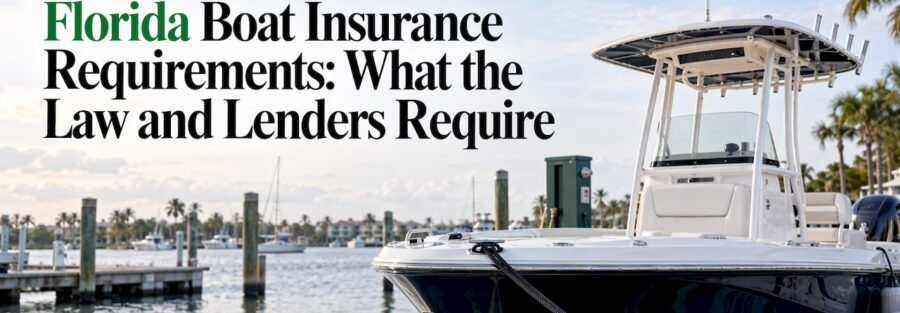
Florida does not impose a general law requiring insurance on a privately owned recreational boat, but that is only part of the answer. Your lender, your marina and, if you rent boats to others, the state itself can all require coverage with specific limits. Below you will find who requires what, the numbers behind it, and how to quote and bind a policy online with Diamondback Insurance once you know what you need.
TL;DR
- Florida has no blanket insurance mandate for private recreational boats, regardless of size or horsepower. The state does require insurance for boat rental businesses (liveries).
- Lenders and marinas commonly make coverage a condition. One Florida city marina, for example, asks for $500,000 bodily injury and $500,000 property damage, or $1,000,000 combined single limit.
- Florida’s boating safety ID card rules are about operator education, not insurance, and apply to anyone born on or after January 1, 1988 who runs a boat of 10 horsepower or more.
- Comprehensive boat insurance in Florida averages about $600 to $1,200 a year, and many policies carry a separate named-storm deductible.
Table of Contents
- Is boat insurance required by law in Florida?
- What Florida does require of boat operators
- When a lender, marina or storage facility requires coverage
- Insurance rules for rental boats and commercial use
- What coverage a Florida boat owner should carry
- What boat insurance costs in Florida
- How to meet every requirement in one pass
- Get a Florida boat insurance quote with Diamondback
- Our perspective on Florida boat insurance
- FAQ
- Sources
Is boat insurance required by law in Florida?
For an ordinary recreational boat, no. Florida does not require you to carry liability or hull insurance to register, trailer or operate your own boat, and the rule does not change with the size of the vessel or its engine. The insurance rules in Florida’s boating statute, Chapter 327, are aimed at businesses that rent boats, which we cover below.
That is why so many readers get a confusing answer. They hear “not required” and stop reading. In practice, the people who stand between you and the water often have their own requirements, and those are enforceable through your loan agreement or your dockage contract.
What about size, horsepower and registration? None of these set an insurance minimum for a private owner. They do trigger other obligations, and it helps to keep them separate from insurance.
What Florida does require of boat operators
The state’s main operator rule is educational. Under Section 327.395, Florida Statutes, a person born on or after January 1, 1988 may not operate a vessel powered by a motor of 10 horsepower or greater unless they have a Florida boating safety identification card issued by the Fish and Wildlife Conservation Commission (FWC), a state-issued ID indicating they hold that card, or a temporary certificate valid for 90 days.
The FWC boating and navigation page adds that the person must pass an approved boater safety course and carry the card along with photo identification. The Florida Highway Safety and Motor Vehicles department clarifies that Florida has no boating license as such: the card is proof that you completed the education requirement, and it is valid for life.
Age limits matter too. According to the same department, you must be at least 14 to operate a personal watercraft in Florida and at least 18 to rent one.
None of this involves insurance, but it shapes your coverage in practice. Carriers ask who will operate the boat, and an operator who has not completed the course may not be legally able to drive it at all. Name every regular operator when you quote, and make sure each one meets the card rule.
When a lender, marina or storage facility requires coverage
This is where “not required” most often turns into “required.” Three situations come up again and again.
Financed boats. If you borrowed to buy the boat, the lender holds a financial interest in it and will normally write insurance into the loan terms. Expect to show proof of a policy, and expect the lender to be listed on it. Read the loan agreement before closing so you know which coverages it names.
Marinas and dockage. Slip agreements frequently ask for liability limits and for the marina to be named on your policy. A concrete Florida example: the City of Hallandale Beach’s 2026 dockage application requires liability insurance with at least $500,000 bodily injury and $500,000 property damage, or $1,000,000 combined single limit. It will also accept protection and indemnity coverage of $500,000 that includes hull protection of not less than $300,000 per occurrence. In every case the City must be named as an additional insured.
Those three terms deserve a plain explanation. Bodily injury and property damage limits are what your liability coverage pays when your boat hurts someone or damages someone else’s property. A combined single limit merges the two into one pool. An additional insured endorsement gives the marina its own protection under your policy for claims arising from your boat’s presence at its dock. Your policy has to show all of that before the marina will assign you a slip.
Boats kept in salt water also face hull upkeep that insurance does not replace, and a guide on saltwater protection for your boat covers that side of dockside ownership.
Storage facilities and events. Dry-stack storage, boatyards and some organized events set their own conditions. Ask each one for its written insurance requirement before you sign, then match your quote to it.

Insurance rules for rental boats and commercial use
Here Florida law does set numbers. Section 327.54 requires a livery, meaning a business that rents boats, to carry insurance of at least $500,000 per person and $1 million per event, with proof available for inspection at the rental location.
The FWC livery regulations page describes the permit paperwork. A livery has to document valid coverage in those amounts, plus either a statement from the insurer that the renter is covered at the same level or a statement that the renter can buy additional insurance. Operating without a valid Livery Operator Permit violates section 327.54(2) and is a first degree misdemeanor with a $1,000 fine.
If you carry paying passengers on charters, a recreational policy is not the right product. Charter operations need a purpose-built commercial marine policy, and the limits depend on the vessel and the operation. Tell us what you do with the boat and the quote can start from the right category.
What coverage a Florida boat owner should carry
Since the state sets no floor for private owners, you set your own. A sensible Florida policy usually combines several pieces.
Hull and equipment coverage pays to repair or replace the boat, motor and gear after a covered loss such as collision, fire or theft. Decide whether you want agreed value or actual cash value, and make sure the insured amount reflects what it would cost to replace your boat today.

Liability coverage pays when you are responsible for injuring someone or damaging their boat, dock or property. If a marina or lender sets minimum limits, treat those as your starting point, not your target. A serious injury claim can exceed $500,000 quickly.
Medical payments and uninsured boater coverage help with injuries to passengers and with losses caused by someone who has no insurance. Since Florida does not require private boaters to insure, other boaters on the water may be uninsured.
Towing and on-water assistance matters for owners who run far from the dock in the Gulf, the Keys or the Intracoastal Waterway.
Storm coverage. Hurricanes are the defining Florida risk. During Hurricane Ian in 2022, more than 7,000 boats were destroyed in Florida, with more than $112 million in insured losses, which the cited insurance expert called the largest marine loss on record for a hurricane. Review the storm terms in your policy before you need them. Many Florida marine policies carry a separate named-storm deductible, typically 2% to 10% of the insured hull value, that applies whenever a hurricane or tropical storm warning is in effect. On a $400,000 hull, a 5% deductible means you absorb the first $20,000 of storm damage. Knowing that number in advance lets you budget for it and choose the deductible that fits.
For more on this, our guide to hurricane coverage questions at renewal walks through what to review each season.
What boat insurance costs in Florida
According to the insurance expert quoted by MySunCoast in June 2026, comprehensive boat insurance in Florida averages about $600 to $1,200 a year. High-value yachts and performance boats can run from $3,000 to more than $10,000 a year, and premiums often fall between 1% and 5% of a boat’s replacement cost.
Several factors push the figure up or down:
Where the boat lives and travels. Coastal boating and storage raise rates in Florida.
Performance. High-performance vessels and boats with three or more engines cost more to insure.
Value and use. A higher replacement value means a higher premium, and a boat used for rentals or charters belongs in a commercial category altogether.
Deductibles and limits. Higher deductibles lower the premium; higher liability limits raise it. The named-storm deductible is a separate lever worth discussing at quote time.
Our cost guides, such as boat insurance costs in Florida and yacht insurance cost by state, go deeper on how these factors combine.
How to meet every requirement in one pass
The cleanest way to handle Florida’s mix of rules is to collect the requirements first and quote once.
Step 1: List who requires what. Check your loan agreement, your slip or storage contract and, for any rental use, the livery rules above. Write down each required limit and each party that must be named.
Step 2: Gather boat details. Have the make, model, year, length, engine horsepower, hull value, home port and typical cruising area ready, along with the names and boating education status of regular operators.
Step 3: Quote with the highest requirement in mind. If your marina asks for $1,000,000 combined single limit, request at least that, then compare how premiums change at other limits and deductibles.
Step 4: Compare offers and bind. We compare quotes from multiple insurers in one place, so you can see options side by side and buy online in minutes. Ask for the additional insured and lienholder certificates at the same time, so your marina and lender have proof the day your policy starts.
Step 5: Review each year. Hull values, storm deductibles and marina terms change. Review your policy before each hurricane season.
Get a Florida boat insurance quote with Diamondback
We built Diamondback Insurance to take the paperwork out of buying coverage. You enter your boat’s details, receive instant online quotes from multiple insurers, compare them and purchase directly through the platform. When your lender or marina has set minimum limits, you can compare policies against those limits in one session instead of calling around. Start your boat insurance quote and see what is available for your boat.
If you also own a home in Florida, our home and auto page shows the other personal coverages we offer, and flood insurance for homeowners is available from the Diamondback home page.
Our perspective on Florida boat insurance
Most owners ask us whether insurance is required, and the honest first answer is that the state does not require it for private boats. We think that is the wrong question to stop on. The right one is what happens to you financially after a hurricane, a collision or a dockside injury claim.
Florida’s conditions arrive through contracts: the lender, the marina, the storage yard. Each sets a number, and those numbers rarely match each other. Gathering them before you shop saves time and prevents a last-minute scramble on the day you want to launch.
That is why we compare multiple insurers online. Different carriers price the same boat differently, and being able to see offers side by side, adjust limits and deductibles, and bind coverage in minutes gives you control over a decision that used to take days of phone calls. Our platform is designed to make that process fast and transparent.
Our advice: choose liability limits at or above your marina’s minimum, understand your named-storm deductible before June, and review your policy every year.
Vladimir
FAQ
Is boat insurance required in Florida?
Not by a general state law for privately owned recreational boats. Lenders, marinas and storage facilities often require it by contract, and Florida does require rental liveries to carry at least $500,000 per person and $1 million per event.
Do I need a license to drive a boat in Florida?
Florida has no boating license, but anyone born on or after January 1, 1988 who operates a boat powered by 10 horsepower or more needs a boating safety education identification card. The card is valid for life and must be carried with photo ID.
How much does boat insurance cost in Florida?
Comprehensive coverage averages about $600 to $1,200 a year according to a 2026 report. High-value yachts and performance boats can cost $3,000 to more than $10,000 a year. Your boat’s value, location and use decide the actual premium.
What is a named-storm deductible?
It is a separate deductible, commonly 2% to 10% of the insured hull value, that applies when a hurricane or tropical storm warning is in effect. On a $400,000 hull, a 5% deductible means the first $20,000 of storm damage is yours.
Can a marina require specific insurance limits?
Yes. Marinas set their own conditions in the dockage agreement. One Florida city marina asks for $500,000 bodily injury and $500,000 property damage, or $1,000,000 combined single limit, with the marina named as an additional insured.
Sources
- Section 327.395, Florida Statutes (2026)
- FWC Boating & Navigation
- Florida DHSMV Vessels FAQ
- Chapter 327, Florida Statutes (2025)
- FWC Livery Regulations and Safety Information
- MySunCoast: Insurance expert urges Florida boaters to check coverage
- Real Cost of Owning a Yacht in Florida, Ward Yacht Sales
- Saltwater Protection for Your Boat