
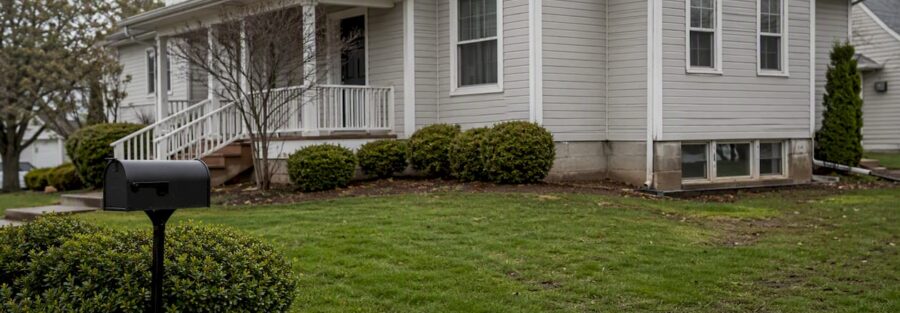
Yes, you can buy flood insurance outside a FEMA-designated high-risk flood zone. The National Flood Insurance Program makes coverage available to eligible property owners in any NFIP-participating community, regardless of whether their home sits inside a Special Flood Hazard Area (SFHA). Mandatory purchase requirements apply only to federally backed mortgages on properties within SFHAs, but that does not mean you are off the hook for flood risk if your home is outside one.
Your two most urgent checks right now:
- Confirm your community participates in the NFIP (most do, but not all), and factor in the standard 30-day waiting period before coverage takes effect.
- Contact an agent or use an online quote platform to start a quote, especially if you are within 45 days of a closing or the start of storm season.
Key Takeaways
Flood insurance is available to homeowners outside FEMA high-risk zones through the NFIP or private carriers, but the 30-day waiting period means you must act before a storm or closing, not after.
| Point | Details |
|---|---|
| Coverage is available outside SFHAs | NFIP policies are open to eligible owners in participating communities, not just high-risk zones. |
| Over 20% of NFIP claims come from outside SFHAs | Properties in lower-risk zones file a significant share of claims, making coverage a real risk-management need. |
| Request a PRP eligibility check | Zone X does not automatically mean the lowest rate; loss history and program rules affect eligibility. |
| Buy 45–60 days before closing or storm season | The standard 30-day waiting period leaves no room for last-minute purchases; loan and map exceptions exist but are narrow. |
| Diamondbackins for fast comparison | Diamondbackins aggregates NFIP and private flood quotes online so you can compare and bind coverage in one session. |
Table of Contents
- Do homeowners outside a mapped flood zone need flood insurance?
- What policy options are available for properties outside the SFHA?
- How are flood insurance premiums calculated for properties outside high-risk zones?
- How do you check your property’s flood risk and confirm its map status?
- How do you buy flood insurance step by step?
- What does flood insurance actually cover, and what does it exclude?
- When should you buy, and how does the 30-day waiting period work?
- Questions to ask your agent and red flags to watch for
- Sample premium guidance and ways to lower your flood insurance cost
- What I recommend every homeowner outside an SFHA do next
- Compare flood insurance quotes faster with Diamondbackins
- Official resources to verify your flood zone and get NFIP information
- Sources
Do homeowners outside a mapped flood zone need flood insurance?
Your mortgage lender may not require it, but that is a different question from whether you need it. Over 20% of NFIP claims come from properties outside mapped high-risk flood areas. That figure alone should reframe how you think about your exposure.
Standard homeowners insurance does not cover flood damage. FEMA and FloodSmart are explicit on this point: flood coverage is a separate policy, provided either through the NFIP or a private flood insurer. If a flash flood, storm surge, or overland water event damages your home and you have no flood policy, your homeowners carrier will deny the claim.
Several practical triggers make flood coverage worth buying even when it is not required:
- Your property sits in a low-lying area or near a drainage channel, creek, or retention pond.
- Your community has experienced flash flooding or localized street flooding in the past decade.
- Your elevation is close to the Base Flood Elevation (BFE) shown on the FIRM, even if the map places you just outside the SFHA boundary.
- Your lender imposes flood-insurance requirements beyond the federal mandate, which some do during purchase or refinance transactions.
- You recently purchased in an area where development upstream has altered drainage patterns.
Maps define regulatory requirements. They do not define your actual flood risk, and FEMA’s own guidance makes that distinction clearly.
What policy options are available for properties outside the SFHA?
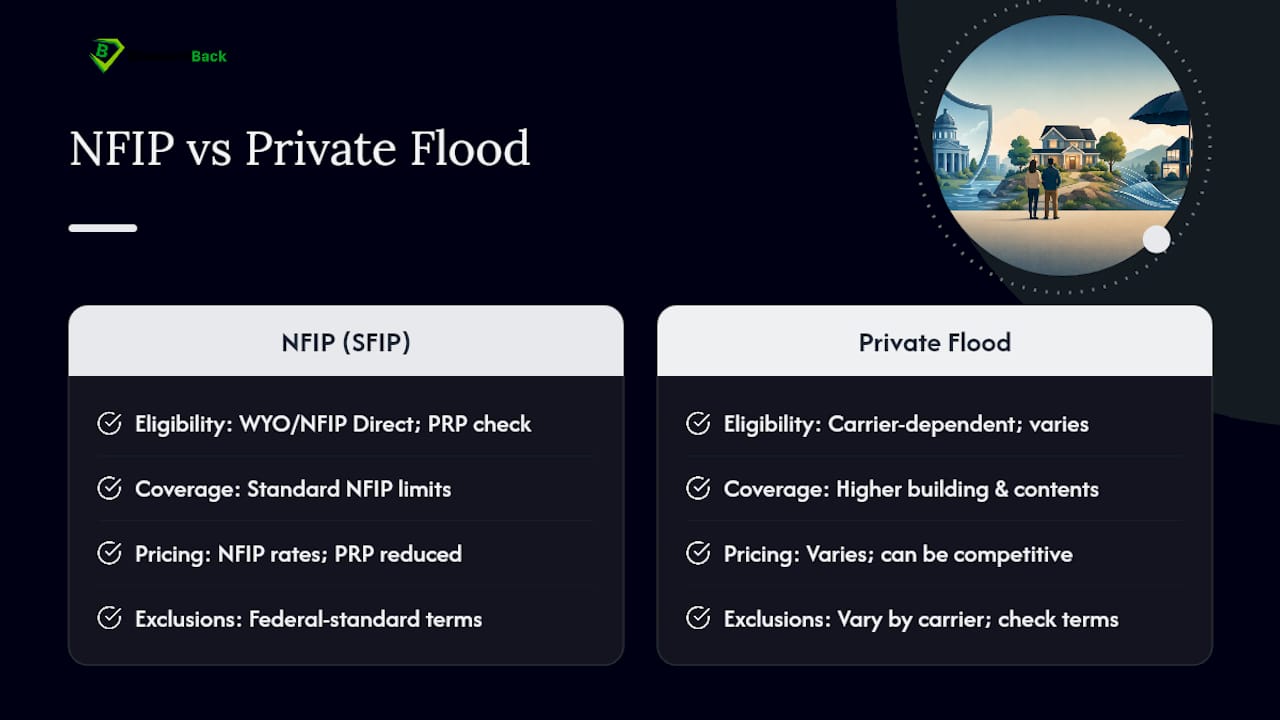
Two main paths exist: an NFIP policy (sold through Write Your Own companies or NFIP Direct) and a private flood insurance policy. Each has different eligibility rules, coverage limits, and pricing structures.
NFIP Standard Flood Insurance Policy (SFIP)
The NFIP sells its Standard Flood Insurance Policy through two channels. Write Your Own (WYO) companies are private insurers authorized by FEMA to issue and service NFIP policies under their own names, but the coverage terms are federally standardized. NFIP Direct is FEMA’s own servicing arm, available when a WYO company is not an option. Either channel gives you the same underlying NFIP coverage.
Preferred Risk Policy (PRP)
The Preferred Risk Policy is a lower-cost NFIP rate structure historically available to eligible buildings in B, C, and X zones, which are the zones outside the SFHA. Eligibility is not automatic. Loss history matters: a property with prior flood claims may not qualify. Always ask your agent to run a formal PRP eligibility check rather than assuming your Zone X label means you qualify for the lowest available rate.
Private flood insurance
Private flood policies can offer higher building and contents limits than the NFIP, different exclusion structures, and sometimes more competitive premiums for lower-risk properties. They are worth comparing, particularly if your replacement cost exceeds NFIP maximums or if you want additional living expense coverage that NFIP does not provide. The trade-off is that private policies vary significantly by carrier, so reading the exclusions carefully is non-negotiable.
Pro Tip: Always request a PRP eligibility check from your agent before accepting a standard-rate NFIP quote. The difference in annual premium can be meaningful, and agents do not always run the check automatically.
For commercial property owners and fleet operators, flood insurance coverage options for your business and fleet follow a similar NFIP-versus-private framework but with different limit structures.
How are flood insurance premiums calculated for properties outside high-risk zones?
Your flood zone label is the starting point for underwriting, not the finish line. NFIP underwriting manuals confirm that two homes in the same Zone X can carry materially different premiums because rating uses building-specific inputs, not just map labels.
The core factors that drive your premium:
- Flood zone and community participation. Zone X properties generally receive more favorable base rates than Zone AE, but the community’s participation level and Community Rating System (CRS) discount class also affect the final number.
- Building characteristics. Foundation type (slab, crawlspace, basement, or elevated) and the lowest floor elevation relative to the BFE are among the most influential inputs.
- Replacement cost. Higher replacement cost means higher building coverage limits, which raises the premium.
- Coverage limits and deductible. Choosing a higher deductible lowers your annual premium. Choosing contents coverage adds to it.
- Loss history. Prior flood claims on the property can disqualify a PRP application and push the policy into a higher rate tier.
A practical example: a Zone X home with a finished basement and a low-elevation crawlspace will typically rate higher than a neighboring Zone X home built on a slab at a higher elevation, even though both carry the same map label. Elevating mechanical systems (HVAC, water heater, electrical panel) above the first floor and removing finished basement space are two mitigation steps that FEMA guidance identifies as influencing premium calculations.
Pro Tip: *Ask your local floodplain administrator whether your community participates in the CRS.
How do you check your property’s flood risk and confirm its map status?
The fastest authoritative source is the FEMA Map Service Center, which publishes Flood Insurance Rate Maps (FIRMs) for every NFIP-participating community. Being outside an SFHA does not mean zero flood risk, and the map itself will tell you exactly which zone applies to your parcel.
Follow these steps to pull your property’s official flood-zone information:
- Go to msc.fema.gov and enter your property address.
- Identify the FIRM panel number and effective date shown for your address.
- Note your flood zone label (B, C, X, AE, AH, AO, or other) and whether a BFE is shown.
- Download or save the relevant FIRM panel as a PDF for your records.
- Cross-reference with FloodSmart’s flood-zone pages for plain-language zone definitions.
For additional context beyond the official FIRM, tools like Flood Factor (operated by First Street Foundation) provide a property-level risk score that accounts for projected changes in flood frequency. Treat these as supplemental information. For insurance eligibility and lender compliance, the FEMA FIRM is the authoritative document.
What to record from your check:
- Exact FIRM panel number and effective date
- Your flood zone designation
- BFE (if shown on the map)
- Whether your community is NFIP-participating
Those four data points matter for PRP eligibility, lender verification, and accurate premium quotes. If the map shows a recent revision or a Letter of Map Amendment (LOMA) on your parcel, bring that document to your agent, as it can directly affect your rating.
When the online tools leave you uncertain, contact your county or municipal floodplain administrator. They can interpret the FIRM for your specific parcel and confirm whether any local amendments apply.
How do you buy flood insurance step by step?
The fastest path to coverage is to contact a licensed agent or go through NFIP Direct, get a quote, confirm PRP eligibility if you are in a B, C, or X zone, and submit payment before the 30-day waiting period becomes a problem. FEMA’s flood insurance guidance is clear that most new policies and endorsements carry a 30-day wait before coverage takes effect, so timing matters.
Step-by-step purchase flow:
- Find a licensed agent who writes NFIP policies through a WYO company, or go directly to NFIP Direct at floodsmart.gov.
- Provide your property address, flood map panel number, and basic building details (foundation type, number of floors, year built).
- Ask the agent to run a PRP eligibility check if your property is in a B, C, or X zone.
- Choose your building and contents coverage limits and your deductible.
- Review the quote, confirm the effective date, and ask the agent to explain any exclusions.
- Submit payment and receive your policy declarations page.
Documents to have ready:
- Property address and legal description
- Mortgage lender name and loan number (if applicable)
- Building replacement cost estimate or recent appraisal
- FIRM panel number and effective date
- Prior flood loss history for the property
Timeline callout: The standard 30-day waiting period applies to new NFIP policies and most endorsements. Three exceptions exist. The loan exception applies when flood insurance is required as a condition of a loan closing, refinance, or loan review, and coverage can take effect the day of closing. The map revision exception applies when a property is newly mapped into an SFHA following a FIRM revision, with a narrow window for coverage to take effect quickly. The post-wildfire exception applies in certain federally declared wildfire disaster areas where the risk of flooding has increased.
Pro Tip: If you are closing on a home, coordinate with your lender and agent at least two weeks before the closing date. Use the loan exception window to avoid any gap in coverage, and confirm the effective date on your declarations page matches the closing date.
What does flood insurance actually cover, and what does it exclude?
NFIP policies cover two separate categories: building property and personal contents. You purchase them independently, and the limits are set separately.

Building coverage under the NFIP pays for structural elements: foundation, electrical and plumbing systems, HVAC equipment, water heaters, built-in appliances, flooring, and permanently installed cabinets. Contents coverage pays for personal property such as furniture, clothing, electronics, and portable appliances.
Common exclusions and limitations to know:
- Landscaping, trees, shrubs, fences, patios, and swimming pools are not covered.
- Detached structures (garages, sheds) require separate coverage and have their own limits.
- Vehicles are not covered under flood policies; your auto policy handles those.
- Temporary housing and additional living expenses are not covered under standard NFIP policies, though many private flood policies include this.
- Basement contents (furniture, electronics stored below grade) are excluded under NFIP; only structural elements in a basement are covered.
- Mold and mildew damage that could have been avoided after the flood event is typically excluded.
If your replacement cost exceeds $250,000 or you want additional living expense coverage, a gap coverage flood insurance policy can supplement your NFIP limits.
After a flood event, follow these steps:
- Document all damage with photos and video before moving anything.
- Take reasonable steps to mitigate further damage (move contents to higher ground, use fans, etc.).
- Contact your agent or WYO company to report the claim and get a claim number.
- Cooperate with the assigned adjuster and provide your documentation.
- Review the adjuster’s proof of loss carefully before signing.
When should you buy, and how does the 30-day waiting period work?
Buy early. The default NFIP waiting period is 30 days for new policies and most endorsements, which means a policy purchased today does not cover a flood event that happens tomorrow. FEMA’s operational guidance and the NFIP manual both confirm this rule applies broadly.
The three exceptions that shorten or remove the wait:
- Loan exception. When a lender requires flood insurance as a condition of a new loan, refinance, or loan review, coverage can take effect the day of the transaction. This is the most commonly used exception and the one most relevant to homebuyers.
- Map revision exception. When FEMA revises a flood map and a property is newly placed inside an SFHA, the NFIP provides a narrow window during which a policy can take effect with a shortened wait. Timing must be coordinated precisely with the map’s effective date. NFIP operational manuals describe the specific conditions that apply.
- Post-wildfire exception. In certain federally declared wildfire disaster areas, the NFIP recognizes that flood risk increases significantly after vegetation loss. Policies in these areas may qualify for a shortened waiting period.
The practical scheduling recommendation: get quotes 45–60 days before a closing or before the start of your region’s primary storm season. That buffer gives you time to compare NFIP and private options, confirm PRP eligibility, and bind coverage without relying on an exception.
Questions to ask your agent and red flags to watch for
Before you sign anything, ask your agent these questions directly:
- Is this policy NFIP (through a WYO company or NFIP Direct) or a private flood policy, and why are you recommending one over the other?
- Has a PRP eligibility check been run for my property, and what was the result?
- What is the exact FIRM panel number and effective date used to rate this policy?
- Does my elevation affect the rating, and would an elevation certificate change the premium?
- What does this policy specifically exclude, and how does it handle basement contents?
- What replacement cost assumption is built into the building coverage limit?
- What is the claims process, and who handles claims under this policy?
Red flags that warrant a second opinion:
- The agent cannot tell you whether the policy is NFIP or private.
- PRP eligibility was never mentioned or checked.
- The agent cannot provide the FIRM panel number or effective date used for rating.
- The quoted premium comes with no clear explanation of the coverage limits or deductible.
- The agent discourages you from getting a second quote.
An agent who cannot answer the FIRM panel question or the PRP eligibility question is not equipped to rate your property accurately. That is not a minor gap; it can mean you are paying the wrong premium or holding coverage with unexpected exclusions.
Sample premium guidance and ways to lower your flood insurance cost
Premiums for flood insurance outside a high-risk zone vary widely based on the building-specific factors covered earlier. Because the NFIP rates properties using individual inputs, two Zone X homes on the same street can carry meaningfully different premiums. Any number you see in a general article is illustrative; a personalized quote is the only reliable figure.
What the research does confirm:
Mitigation steps that FEMA and NFIP guidance identify as influencing premiums:
- Elevating mechanical systems (HVAC, water heater, electrical panel) above the first floor.
- Removing finished space from below-grade areas, which affects the building’s rating classification.
- Obtaining an elevation certificate from a licensed surveyor, which can document that your lowest floor is above the BFE and support a lower rate.
- Participating in the Community Rating System (CRS): if your community has a CRS class, NFIP policyholders receive a discount that scales with the class level.
The disclaimer here is straightforward: these factors influence premiums directionally, but the actual dollar impact depends on your specific building, zone, and coverage selections. Get a personalized quote from a licensed agent or through an online comparison platform before making coverage decisions.
What I recommend every homeowner outside an SFHA do next
If I owned a home outside a mapped high-risk flood zone, my first three moves would be to confirm my community’s NFIP participation, pull the FIRM panel for my address, and request a PRP eligibility check before assuming the cheapest rate applies. The 30-day waiting period is the detail most homeowners miss until it is too late. A flood event during that window means no coverage, regardless of how long you have owned the home.
FEMA’s own guidance makes the case plainly: maps define regulatory requirements, not actual flood risk. A Zone X designation means your lender probably will not require a policy. It does not mean your property cannot flood. Buying before storm season or before a closing, rather than after a near-miss, is the decision that protects your investment.
Compare flood insurance quotes faster with Diamondbackins
Sorting through NFIP eligibility rules, PRP checks, and private flood options takes time most homeowners do not have, especially when a closing date is approaching or storm season is weeks away. Diamondbackins gives you instant, side-by-side flood insurance quotes from multiple carriers in one place, so you can compare coverage limits, deductibles, and premiums without calling five different agents.

The platform aggregates quotes from top insurers and lets you customize coverage limits, review exclusions, and bind a policy entirely online. For homeowners outside an SFHA who want to confirm PRP eligibility and compare it against private flood options in a single session, that workflow saves significant time. Commercial property owners and fleet operators can also review flood coverage options for their business and fleet through the same platform.
Start your flood insurance quote at Diamondbackins today. Enter your address, answer a few building questions, and get quotes you can compare and purchase without waiting for a callback.
Official resources to verify your flood zone and get NFIP information
These are the authoritative sources to visit before you buy or renew a flood policy:
- FEMA Map Service Center (msc.fema.gov): The official source for Flood Insurance Rate Maps. Enter your address to pull the FIRM panel, effective date, and flood zone designation for your property.
- FloodSmart.gov: FEMA’s consumer-facing NFIP site. Use it to find a WYO agent, understand zone definitions, check PRP eligibility basics, and confirm what your flood risk looks like before you buy.
- FEMA.gov/flood-insurance: The primary FEMA page for flood insurance program rules, waiting-period guidance, and links to the NFIP manual.
- NFIP Flood Insurance Manual (agents.floodsmart.gov): The full underwriting and operational manual used by agents and WYO companies. Useful if you want to verify how a specific rating factor or waiting-period exception applies to your situation.
- Your county or municipal floodplain administrator: When online tools leave you uncertain about a map boundary or a recent FIRM revision, a local floodplain administrator can interpret the FIRM for your specific parcel and confirm whether any Letters of Map Amendment or Revision apply.
For web-based risk context beyond the official FIRM, Flood Factor (floodfactor.com) provides a property-level risk score. Use it for general awareness, not for insurance eligibility decisions. The FEMA FIRM governs those.
This article is general information, not a substitute for advice from a qualified financial advisor. Consult a qualified financial professional about your own circumstances before acting on anything here.
Sources
- Eligibility | National Flood Insurance Program
- Fema
- Flood | North Dakota Insurance Department
- fema_nfip_flood-insurance-manual_042024.pdf