

Insured property is defined as any tangible asset or structure explicitly listed in an insurance policy, forming the legal basis for coverage, premium calculation, and claims. This is not a broad, catch-all category. Specific listings determine coverage scope, meaning an asset that is not named or scheduled in your policy may be excluded from a claim even if you own it outright. The definition of insured property applies differently in personal and commercial contexts, and understanding that distinction protects you from costly gaps. Whether you own a home, a business, or a fleet of trucks, knowing exactly what qualifies as covered property is the first step toward real financial protection.
What is the definition of insured property?
Insured property is any tangible asset described in an insurance policy that the insurer agrees to cover against specified perils. The term “insured property” is the standard industry phrase, though you may also encounter “covered property” in policy documents. Both terms refer to the same concept: physical assets that qualify for a claim payout when a covered loss occurs.
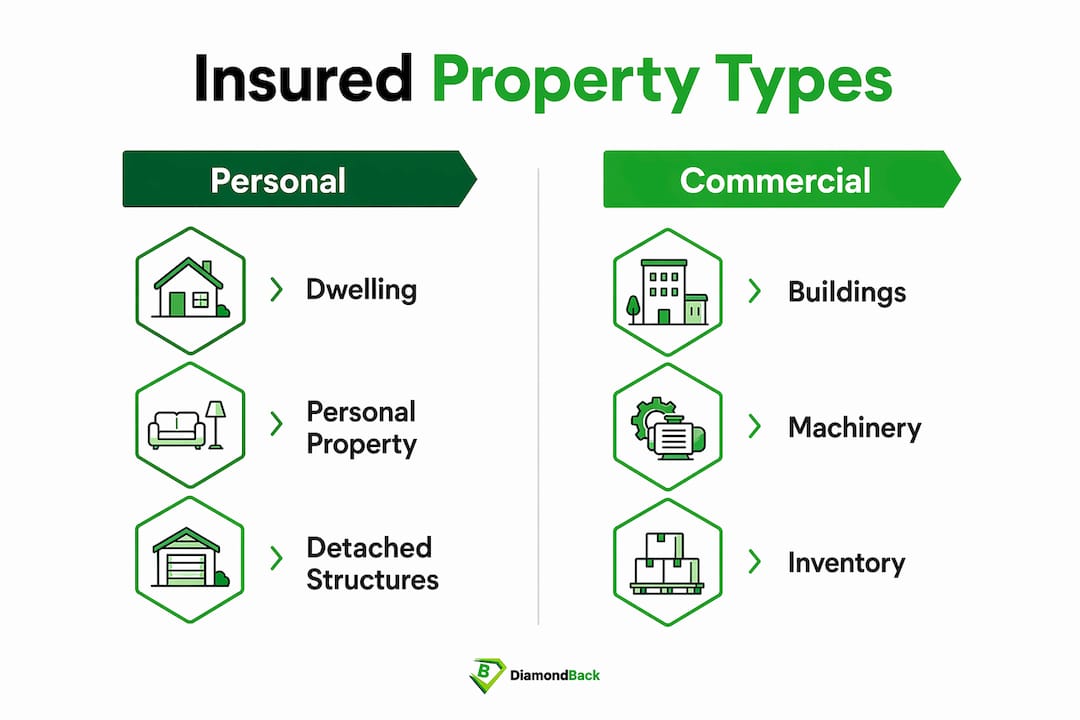
The distinction between personal and commercial insured property matters from day one. In a personal policy, insured property typically includes your home structure, attached structures like garages, and personal belongings inside. In a commercial policy, the definition expands to include buildings, inventory, machinery, and business personal property such as computers, furniture, and tools.

Your declarations page is the document that makes this concrete. It lists the specific property the insurer has agreed to cover, along with the coverage limits assigned to each category. If an asset does not appear on that page or in an attached schedule, the insurer has no contractual obligation to pay for its loss.
What types of insured property exist in personal and commercial insurance?
Coverage categories differ significantly between personal and commercial policies. The table below shows the main types and their typical scope.
| Category | Examples | Typical Coverage Scope |
|---|---|---|
| Personal dwelling | Home structure, attached garage | Rebuilding costs up to policy limit |
| Personal property | Furniture, clothing, electronics | 50–70% of dwelling limit per standard policy |
| Renters’ possessions | Belongings in a rented unit | Covers possessions regardless of building ownership |
| Commercial building | Office, warehouse, retail space | Structure and permanent fixtures |
| Business personal property | Inventory, equipment, computers | Requires explicit scheduling to be covered |
| Specialized extensions | Business interruption, equipment breakdown | Separate endorsements or riders required |
Homeowners policies typically cover personal property at 50–70% of the dwelling limit. That means a home insured for $400,000 may cover personal belongings up to $280,000, but only if those items are described or categorized within the policy.
Commercial property insurance uses three main coverage forms: Basic, Broad, and Special Form. Special Form policies provide the widest coverage, protecting against all perils except those explicitly excluded, such as floods or acts of war. Basic Form covers only named perils, which is a much narrower list. Broad Form falls in between. Choosing the right form determines which events trigger a valid claim.
For trucking and transportation businesses, specialized extensions matter just as much as the base policy. Business interruption insurance covers income loss when a covered event halts operations, while equipment breakdown coverage addresses mechanical failures not caused by an external peril. Neither extension is automatic. You must add them explicitly.
How do insurance policies define insured property precisely?
Precision in policy language is not a formality. Assets not scheduled or described may be excluded from coverage despite belonging to the insured. Claims adjusters use the declarations page and the Statement of Values (SOV) as checkpoints to verify whether damaged assets qualify as insured property. An inaccurate or incomplete SOV can result in a claim denial or a reduced payout.
Several asset types require explicit listing to be covered:
- High-value jewelry, art, or collectibles above standard sublimits
- Vehicles, trailers, and specialized equipment in commercial fleets
- Newly acquired property added after the policy’s effective date
- Leased equipment for which the business carries insurance responsibility
- Tenant improvements made to a rented commercial space
Coverage disputes most often arise when a policyholder assumes an asset is covered because it is on the premises. Strict interpretation of insured property definitions causes many of these disputes, and the insurer’s position is almost always supported by the policy language. The burden falls on you to verify that every asset you want protected appears in the policy.
For trucking operators, this applies directly to trailers, cargo containers, and specialized loading equipment. A trucking insurance questionnaire helps you identify every asset that needs to be scheduled before a loss occurs.
Pro Tip: Review your declarations page and SOV at every renewal. Add any new equipment, vehicles, or property acquired during the policy year before the renewal date, not after a loss.
What coverage forms and valuation methods affect insured property protection?
The coverage form you select determines which perils trigger a claim. The valuation method determines how much you actually receive when a claim is approved. Both decisions shape your real financial recovery after a loss.
The three commercial coverage forms work as follows. Basic Form covers a short list of named perils: fire, lightning, explosion, windstorm, hail, smoke, aircraft damage, vehicle damage, riot, and vandalism. Broad Form adds perils like water damage from plumbing failures and falling objects. Special Form covers everything except named exclusions, making it the most protective option for businesses with significant physical assets.
Valuation is where many policyholders are surprised at claim time. Replacement Cost coverage pays to rebuild or replace assets at current market prices, with no deduction for age or wear. Actual Cash Value (ACV) subtracts depreciation, so a five-year-old piece of equipment worth $50,000 new may only pay out $20,000 under an ACV policy. Selecting Replacement Cost coverage prevents significant out-of-pocket expenses compared to ACV policies, particularly for businesses with aging equipment or older structures.
| Valuation Method | How It Works | Best For |
|---|---|---|
| Replacement Cost | Pays current cost to replace with like kind and quality | Businesses needing full recovery |
| Actual Cash Value | Pays replacement cost minus depreciation | Lower-premium situations with newer assets |
| Agreed Value | Insurer and insured agree on value upfront | High-value or unique assets |
High-value or unique assets, such as custom-built machinery or specialty vehicles, benefit from Agreed Value coverage. The insurer and policyholder agree on the asset’s value before the policy is issued, eliminating depreciation disputes at claim time. For yacht owners and other high-value property holders, specialized insurance planning follows similar principles of scheduled valuation.
Pro Tip: Choose Replacement Cost valuation for any asset you would need to replace at full current cost after a loss. Reserve ACV only for assets you could afford to replace partially or plan to retire soon.
What are common insured property examples and misconceptions?
Real-world examples clarify where coverage applies and where it stops. A homeowner’s policy covers the house structure and personal belongings inside, but a detached workshop filled with power tools may require a separate endorsement to be fully covered. A retail business policy covers the store building and inventory, but the owner’s personal laptop brought from home is not automatically included as business personal property.
Business personal property requires explicit scheduling. Merely insuring the building does not automatically cover inventory or equipment. A trucking company that insures its terminal building but fails to schedule its fleet of trailers separately may find those trailers unprotected after a fire or theft. The same logic applies to tools, computers, and any movable asset used in operations.
Several misconceptions lead to real financial harm:
- Myth: Liability insurance covers physical damage to your own property. Fact: Commercial property insurance covers owned physical assets; liability covers third-party claims only.
- Myth: All assets on your premises are automatically insured. Fact: Only assets listed or scheduled in the policy qualify.
- Myth: Business interruption is part of standard property coverage. Fact: It requires a separate endorsement.
- Myth: Renters have no property coverage. Fact: Renters insurance covers possessions regardless of who owns the building.
- Myth: One policy covers both personal and commercial property. Fact: Personal and commercial policies are separate contracts with different definitions and limits.
Business owners often conflate commercial property insurance with liability insurance, which leads to gaps in coverage that only become visible after a loss. Reviewing your fleet and asset coverage before a claim is the only reliable way to confirm protection is in place.
Key Takeaways
Insured property is defined as tangible assets explicitly listed in a policy, and only those listed assets qualify for coverage, making accurate scheduling the single most important step in property insurance management.
| Point | Details |
|---|---|
| Definition of insured property | Only assets explicitly listed in a policy qualify for coverage and claims. |
| Personal vs. commercial coverage | Personal policies cover dwellings and belongings; commercial policies require separate scheduling of equipment and inventory. |
| Coverage form selection | Special Form provides the broadest protection; Basic Form covers only named perils. |
| Valuation method matters | Replacement Cost pays full current value; Actual Cash Value deducts depreciation and reduces payouts. |
| Active policy management | Review and update your declarations page and SOV at every renewal to prevent coverage gaps. |
What I’ve learned from watching coverage gaps happen in real time
After years of reviewing commercial insurance policies, the pattern I see most often is not fraud or bad faith. It is simple neglect of the declarations page. A business owner buys a policy, files it away, and never updates it. Two years later, they have added $200,000 in equipment, hired more drivers, and expanded their facility. None of that appears in the policy. When a loss hits, the claim reflects the original, outdated schedule.
The second pattern I see is the liability-versus-property confusion. Owners assume their general liability policy protects their physical assets. It does not. Liability coverage responds when your operations cause harm to someone else. Your own trucks, trailers, and equipment need property coverage, and each asset needs to be named.
My practical advice is to treat your declarations page like a living document. Set a calendar reminder 60 days before renewal. Walk through your facility or fleet, list every asset acquired since the last review, and send that list to your broker before the renewal date. That single habit prevents the majority of coverage disputes I have seen. The insurers are not the problem. The gap between what you own and what you have scheduled is the problem.
— Vladimir
How Diamondbackins helps you protect what you own
Knowing the definition of insured property is only useful if your policy actually reflects it. Diamondbackins makes it straightforward to get commercial trucking insurance quotes that account for your specific assets, from trucks and trailers to cargo and equipment.
The platform aggregates quotes from multiple top insurers, so you can compare coverage options side by side without calling multiple brokers. You see exactly what is covered, at what limit, and at what cost. For fleet managers and small business owners who need accurate, up-to-date property coverage, Diamondbackins provides the transparency and speed to get it done right. Visit Diamondbackins to review your coverage options and make sure every asset you own is properly scheduled.
FAQ
What is the definition of insured property?
Insured property is any tangible asset or structure explicitly listed in an insurance policy that the insurer agrees to cover. Only assets named or scheduled in the policy qualify for a claim payout.
What are examples of insured property in a commercial policy?
Commercial insured property examples include buildings, inventory, machinery, computers, furniture, and vehicles. Each category typically requires explicit scheduling on the declarations page or a Statement of Values.
Does insuring a building automatically cover the equipment inside?
No. Business personal property such as inventory, tools, and equipment requires separate scheduling. Insuring the building alone does not extend coverage to movable assets inside it.
What is the difference between Replacement Cost and Actual Cash Value?
Replacement Cost pays the current cost to replace an asset with no depreciation deduction. Actual Cash Value subtracts depreciation, which often results in a significantly lower claim payment.
Why do coverage disputes arise over insured property?
Disputes arise because insurers apply strict interpretation to policy language. Assets that are not described or scheduled in the policy are typically excluded, even if the policyholder assumed they were covered.