

Box truck commercial coverage is the set of insurance protections that safeguards your straight truck, your cargo, and your business against liability, physical damage, and financial loss during operations. If you run a box truck for last-mile delivery, household moving, food distribution, or freight hauling, this coverage is not optional. Federal regulations, freight brokers, and most commercial contracts all require proof of specific policy limits before you can legally operate or secure loads. The core coverages you need include:
- Primary Auto Liability covering third-party bodily injury and property damage
- Physical Damage (collision and comprehensive) protecting the truck and permanently mounted cargo box
- Motor Truck Cargo Insurance covering goods you haul against loss or damage in transit
- General Liability protecting against injuries or property damage at customer locations during loading and unloading
- Non-Trucking Liability covering personal use of the truck outside active dispatch
- Workers Compensation or Occupational Accident insurance for employee or owner-operator injuries
- Liftgate and Equipment Coverage for hydraulic platforms, pallet jacks, and other mounted tools
Getting any one of these wrong can mean a rejected load, a voided contract, or a loss your business absorbs entirely out of pocket.
Table of Contents
- What does box truck commercial coverage actually include?
- What insurance requirements apply to box trucks in the US?
- How much does box truck insurance typically cost?
- How do you get the right box truck insurance for your operation?
- Key Takeaways
- Diamondbackins makes box truck coverage faster and clearer
What does box truck commercial coverage actually include?
Box truck commercial auto coverage is built from several distinct policies that work together. Understanding each one helps you avoid gaps that only surface at claim time.
Auto Liability Insurance is the foundation of any commercial vehicle policy. It covers bodily injury and property damage you cause to third parties in an at-fault accident. The standard market limit is $1 million Combined Single Limit (CSL), and most freight brokers will not assign loads without it.
Physical damage coverage must be purchased separately from liability. It includes collision (accidents and rollovers) and comprehensive (theft, fire, vandalism, hail, and natural disasters). Because the cargo box is permanently mounted on the chassis, it is rated as part of the truck rather than as separate equipment. If your truck is financed or leased, your lender requires this coverage as a loan condition. Without it, a totaled truck becomes a self-funded loss.
Motor Truck Cargo Insurance protects the freight you haul. General freight policies typically carry $100,000–$250,000 in limits. Household goods movers operate under a different framework entirely: FMCSA 49 CFR 375 mandates coverage ranging from Released Value Protection at $0.60 per pound up to Full Value Protection at $6 or more per pound. Standard delivery cargo policies often exclude household goods, so movers need a specialized form with higher limits and different policy language.

General Liability covers third-party injuries and property damage that occur away from the road, specifically at customer locations during loading and unloading. A slip-and-fall at a delivery dock, damage to a customer’s property during unloading, or a loading-dock incident all fall under GL rather than auto liability. Amazon DSP delivery service partners must carry $1 million GL as a non-negotiable program requirement.
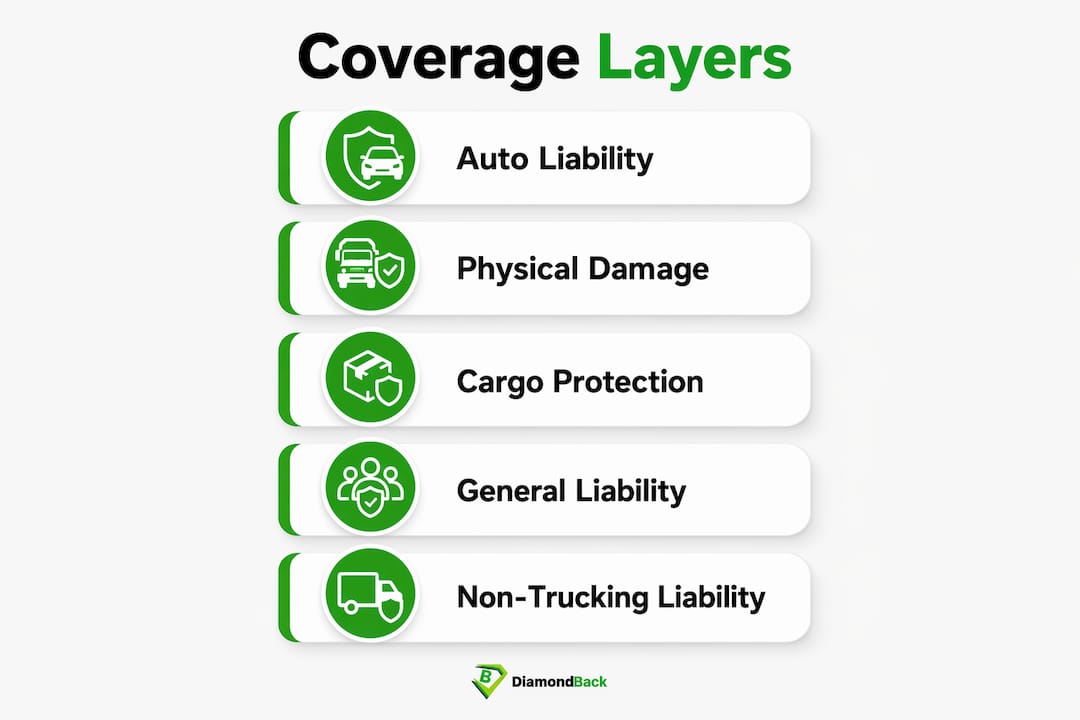
Non-Trucking Liability covers the truck when it is not under active dispatch. This is most relevant for owner-operators leased to a motor carrier and for Amazon DSP partners whose primary policy does not extend to personal trips. Liftgate and equipment coverage addresses the $5,000–$25,000 worth of hydraulic platforms, dollies, and pallet jacks that most physical damage policies do not automatically schedule. Liftgate failures and equipment theft are routine claims that catch operators off guard.
Pro Tip: If you use your box truck for both household moving and general freight, confirm with your broker that your cargo policy covers both. A single generic policy almost never does.
What insurance requirements apply to box trucks in the US?
Federal and state requirements set the floor for box truck insurance, but brokers and contracts often push you well above that floor.

The FMCSA mandates a $750,000 minimum auto liability for non-hazardous interstate freight under 49 CFR 387. Hazardous materials loads require higher minimums. That federal floor, however, is rarely sufficient for working in the brokered freight market. Most freight brokers require $1 million CSL and proof of cargo coverage before assigning any load. Failing to meet those limits means rejected freight, regardless of your FMCSA compliance.
The 26,001 lbs Gross Vehicle Weight Rating (GVWR) threshold is the most consequential number in box truck classification. Vehicles at or above that weight require a Class B CDL and trigger higher insurance premiums due to increased liability exposure. Many 16-foot, 20-foot, and 24-foot configurations stay under the threshold, but a 26-foot truck with a liftgate frequently crosses it. The liftgate alone adds 800–1,500 lbs to GVWR, which can push a borderline truck into CDL territory and a higher insurance tier.
State-level requirements vary by jurisdiction. Most states set their own minimum liability limits for commercial vehicles, and some states impose additional requirements based on cargo type or operating radius. You need to verify your specific state’s rules, particularly if you operate across state lines.
Certificate of insurance (COI) disputes are the most common pitfall fleet managers face. Brokers require proof of specific policy limits, named additional insured parties, and endorsements that match contract language exactly. A COI that lists the wrong limit or omits a required endorsement can cost you a contract. COI documentation errors are especially common among new fleet managers who have not yet coordinated their policy language with broker requirements. Review every COI against the contract before accepting a load assignment.
For household goods movers operating under FMCSA MC-MX authority, the regulatory framework is distinct from general freight. Interstate movers must comply with 49 CFR 375, which sets specific cargo coverage standards tied to declared value and released value protection levels. If you hold or plan to obtain mover authority, your insurance coverage needs are materially different from a standard delivery operator.
How much does box truck insurance typically cost?
Annual premiums for box truck commercial insurance vary considerably based on operation type, truck size, and coverage requirements. Solo owner-operators running a 24-foot or 26-foot box truck with $1 million auto liability pay a range of annual premiums depending on various factors. Solo household-goods movers with MC-MX authority pay higher premiums due to added cargo and customer-property exposure. Small mover fleets and beverage and food distributor fleets incur progressively larger insurance costs based on fleet size and cargo type.
Amazon DSP delivery service partners face some of the highest per-truck costs in the box truck segment due to program requirements such as $1 million auto liability, $1 million general liability, workers compensation, and named additional insured mandates, resulting in significant total annual premiums for fleet operations.
Several factors drive your specific premium. Driver history, truck age, cargo type, coverage limits, and business location all influence what you pay. A driver with violations or prior claims pays more. Older trucks with higher mileage cost more to insure for physical damage. Operating in dense urban markets like New York or Los Angeles carries higher liability exposure than rural routes. Operators who add a hazmat endorsement can expect premiums to increase by 25–40%.
Telematics and safe driving programs offer a real path to lower costs. Some carriers integrate GPS and driving-behavior data directly into their rating models, rewarding clean records with meaningful discounts. Bundling your commercial auto policy with general liability and workers compensation under one carrier often produces additional savings. Choosing a higher deductible on physical damage coverage reduces your annual premium, though you absorb more out-of-pocket cost at claim time. The right balance depends on your cash reserves and how frequently your trucks are in the shop.
How do you get the right box truck insurance for your operation?
Getting properly covered starts with an honest assessment of your business. Before you request a single quote, document your truck specifications (year, make, model, GVWR, body length), your driver roster and their records, the cargo types you haul, your operating radius, and any contracts or broker relationships that impose specific coverage requirements. That information determines which coverages you need and at what limits.
Working with an agent or platform that specializes in commercial trucking gives you a significant advantage over going to a generalist. Specialists understand the difference between a standard cargo policy and a household-goods form, know which carriers write box truck business in your state, and can identify endorsements your contracts require before a broker rejects your COI. An independent agent or digital platform can compare policies across multiple carriers and surface options a single-carrier approach would miss.
When comparing quotes, hold the coverage limits and deductibles constant across every quote you receive. A lower premium that comes with a lower liability limit or a missing cargo endorsement is not a better deal. Verify that each quote includes the specific endorsements your contracts require, that the COI language matches your broker’s requirements, and that the carrier is licensed in your operating states.
Once you have coverage in place, keep it current. Adding a truck, hiring a new driver, changing cargo types, or taking on a new contract can all create coverage gaps if your policy is not updated. Fleet managers who treat insurance as a once-a-year renewal task rather than an ongoing operational function are the ones who discover gaps at the worst possible moment. A digital platform that allows mid-term policy updates and instant COI generation makes that ongoing management far less burdensome.
For moving companies specifically, understanding the distinct insurance needs for movers is worth reviewing before you finalize your cargo coverage limits. The liability framework for household goods is genuinely different from standard freight, and the consequences of underinsuring a customer’s belongings are both financial and reputational.
Key Takeaways
Box truck commercial coverage requires a layered policy stack, and the FMCSA’s $750,000 minimum is rarely enough to satisfy broker contracts or protect your business assets.
| Point | Details |
|---|---|
| Coverage is multi-layered | Auto liability, physical damage, cargo, GL, and workers comp all serve distinct functions and must be purchased separately. |
| Broker limits exceed federal minimums | Most freight brokers require $1 million CSL; FMCSA mandates only $750,000 for non-hazmat interstate freight. |
| GVWR threshold matters | Trucks at or above 26,001 lbs GVWR require a Class B CDL and trigger higher insurance premiums. |
| Solo operators with a 24-foot or 26-foot box truck typically pay $5,500–$11,000 per year for full commercial coverage, depending on factors like truck size, coverage limits, and operation specifics. | |
| Diamondbackins simplifies the process | Diamondbackins aggregates quotes from multiple top carriers so you can compare options and get covered in minutes online. |
Diamondbackins makes box truck coverage faster and clearer
Getting the right commercial vehicle insurance for your box truck operation used to mean phone calls, paperwork, and waiting days for a quote. Diamondbackins changes that. The platform aggregates quotes from multiple top-rated carriers in real time, so you can compare coverage options side by side and purchase a policy in minutes, entirely online.
Diamondbackins is built specifically for fleet managers and small business owners who need accurate, contract-ready coverage without the back-and-forth of a traditional broker. Whether you run a single 26-foot truck on local delivery routes or manage a growing fleet with varied cargo types, the platform surfaces policies matched to your actual operation, not a generic commercial auto template. Every quote comes with clear coverage details, so you know exactly what you are buying before you commit.
Compliance documentation is handled the same day. COIs that meet broker and contract requirements are available immediately after purchase, which means no delays between signing a contract and accepting your first load. For fleet managers who need to update coverage mid-term or add a driver quickly, the platform handles those changes without requiring a call to an agent.
Ready to compare box truck insurance quotes and get covered today? Visit Diamondbackins and get your quote in minutes.