

Hurricane damage to your boat gets covered only when you carry hull or physical-damage coverage, often called comprehensive coverage, and your policy does not carry a named-storm exclusion. The National Hurricane Center sets the official criteria for what counts as a named storm, and Diamondback Insurance’s own review of carrier policies confirms that clause is what separates a paid claim from a denied one. Named-storm deductibles and your preparation duties decide what you actually collect.
TL;DR:
- Named-storm deductibles can significantly increase your out-of-pocket costs, especially in high-exposure states where percentages can reach several thousand dollars.
- Coverage for wind, storm surge, and debris impacts is generally included under comprehensive policies, but only if your policy has no storm exclusion and is activated when a storm watch or warning is issued.
- Navigational limits like hurricane zones or “hurricane boxes” are critical; staying within designated safe zones during a storm can void coverage entirely.
- Having a documented hurricane plan with scheduled haul-out, relocation, and photography reduces the risk of claim denial after storm damage.
- Comparing multiple carrier quotes before season start helps clarify deductible structures, endorsements, and coverage limits, saving time during critical pre-storm preparations.
Table of Contents
- Does Boat Insurance Hurricane Coverage Include Wind and Flood Damage?
- Named-Storm Deductibles and Navigational Limits: What Changes During Season
- What Should Be In Your Hurricane Preparedness Plan?
- How Do You File a Hurricane Boat Insurance Claim?
- What Questions Should You Ask Before Renewing Hurricane Coverage?
- Publisher Resources for Comparing Hurricane Coverage
- Balancing Cost and Risk in Hurricane Zones
- Get Hurricane-Ready Coverage Before the Next Named Storm
- Where to Verify Storm Status and Insurer Guidance
- Sources
Does Boat Insurance Hurricane Coverage Include Wind and Flood Damage?
Whether your policy pays after a hurricane comes down to which type of boat insurance you bought. Comprehensive coverage, sometimes labeled physical-damage or hull coverage, pays to repair or replace your vessel when wind, storm surge, or flying debris tears it apart. Liability-only policies never cover your own boat. They exist to pay for damage you cause to other people or their property, so a liability-only owner facing hurricane wreckage is on their own financially, according to Progressive’s coverage explanation.
Most comprehensive policies treat wind damage, storm surge flooding, debris impact, and sinking as covered perils. Insurers typically deny claims tied to pre-existing hull rot, deferred maintenance, or a boat left improperly secured against known guidance. An adjuster who finds algae-caked bilge pumps or a snapped dock line that was never replaced after a prior warning will use that against you.
Coverage often hinges on timing, not just wording. Many policies activate named-storm provisions the moment the National Hurricane Center issues a watch or warning for your boat’s location, and where your vessel sits when that happens, marina, open water, or a hauled-out trailer, can change what applies. This is why the declarations page matters more than the marketing brochure. It lists your actual endorsements, exclusions, and named-storm language in plain terms, and reading it before June 1 costs you nothing. Reading it in October, after a system has already formed, is far too late.
Named-Storm Deductibles and Navigational Limits: What Changes During Season
The deductible structure is where hurricane coverage quietly becomes expensive. Standard deductibles are usually flat dollar amounts, but named-storm deductibles run as a percentage of your insured value instead. Common ranges span from low to higher percentages, with higher deductibles common in Florida and other high-exposure states, according to LegalClarity’s breakdown of named-storm terms.
Statistic Callout: On a moderately insured boat, a named-storm deductible means you absorb a significant portion of any hurricane claim yourself, compared to a flat deductible on non-named storm damage.
Navigational limits add a second layer of risk. Many policies define a “hurricane box,” a geographic zone you must exit or haul out from once a storm approaches, and staying inside that box during an active watch can void coverage entirely. This detail trips up boaters who assume any marina slip counts as safe harbor.
Wreck removal and salvage costs deserve separate attention too. Some policies fold that expense into your overall hull limit, which shrinks what’s left for actual repairs. Others carry a distinct wreck-removal limit that doesn’t eat into your repair budget. Diamondback Insurance’s guide to hurricane-box coverage rules walks through how these zones are drawn state by state.
What Should Be In Your Hurricane Preparedness Plan?
Insurers ask for a written hurricane plan for a practical reason: a documented plan proves you took reasonable precautions, and that documentation protects your claim later. Underwriters commonly require the plan to name a haul-out yard, a relocation route, and a person responsible for executing it if you’re out of town when a storm forms.
A workable, insurer-approved timeline looks like this:
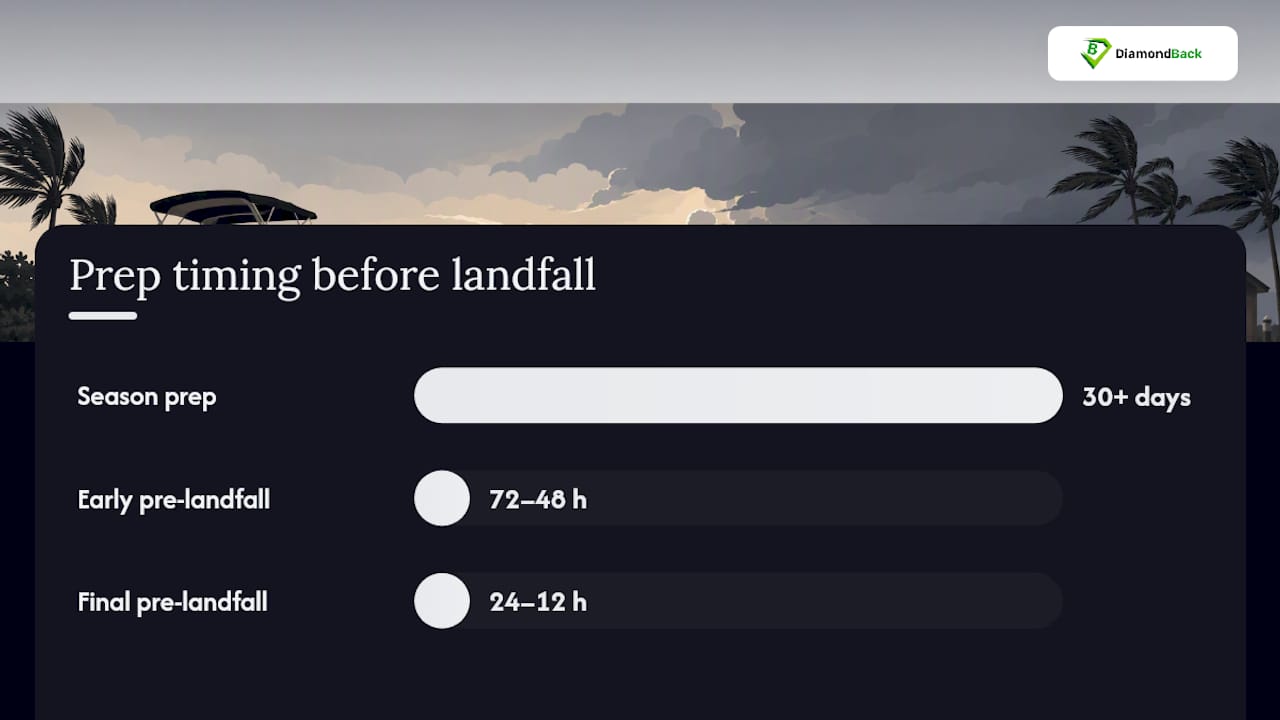
- 30+ days before hurricane season (well ahead of June 1): confirm your marina’s storm policy, reserve a haul-out slot with your yard, and review your declarations page for named-storm language.
- 72 to 48 hours before landfall: begin hauling out or relocating per your plan, double bilge pump checks, and fully charge batteries.
- 24 to 12 hours before landfall: strip canvas and electronics, add extra dock lines or straps if staying in water, and photograph the boat from every angle.
Storage options range from a dry-stack rack to a trailer stored inland; the earlier you book, the more choices you have, since yards fill fast once a storm is named.
Pro Tip: Photograph your boat’s condition, engine hours, and serial numbers every spring before hurricane season starts, then save copies to cloud storage. That single habit resolves more claim disputes than any other prep step.
Many hurricane endorsements reimburse haul-out and relocation costs, but only when you followed your filed plan and the storm was officially named, per Chubb’s guidance on hurricane readiness.
How Do You File a Hurricane Boat Insurance Claim?
Once the storm passes, your first job is safety, not paperwork. Once it’s safe to approach your boat, document everything before touching a single repair.
- Photograph all damage from multiple angles, including hull, engine, and interior.
- Record serial numbers and compare them against your pre-storm documentation.
- Collect haul-out invoices, marina emails confirming relocation, and receipts for any preparation expenses.
- Get written repair estimates from a licensed marine repair shop.
- Report the claim to your insurer promptly; most policies specify a notification window, and delays invite denial.
Adjusters expect prompt notice and a paper trail connecting your prep work to the plan on file. Common denial reasons include missing haul-out records, undocumented pre-storm condition, or evidence of neglect. You can perform temporary mitigation, like tarping a breach to stop further water intrusion, but hold off on permanent repairs until the adjuster inspects the boat. ORNER’s overview of insurance option categories offers useful background on how coverage types differ across asset classes, including marine risk.
What Questions Should You Ask Before Renewing Hurricane Coverage?
A renewal call is the cheapest insurance review you’ll ever do, and most owners skip it. Ask your carrier or agent these questions directly, and get every answer in writing on your declarations page or as a signed endorsement:
- Is my named-storm deductible a flat amount or a percentage, and what percentage applies in my county?
- Is named-storm coverage included automatically, or does it require a separate endorsement?
- Does my policy reimburse haul-out or relocation costs, and what triggers that reimbursement?
- What is my wreck-removal and salvage limit, and is it separate from my hull limit?
- What navigational limits or hurricane-box boundaries apply to my vessel?
- Is there a waiting period before newly purchased hurricane coverage takes effect?
Replacement cost coverage pays to replace your boat with a comparable new model, while actual cash value factors in depreciation, meaning an older vessel gets a smaller check under a total loss. Owners with boats under five years old often benefit most from full replacement cost; older boats sometimes see lower premiums under actual cash value in exchange for that reduced payout ceiling. Diamondback Insurance’s boat insurance calculator helps you model both scenarios against your actual insured value before you commit.
Publisher Resources for Comparing Hurricane Coverage
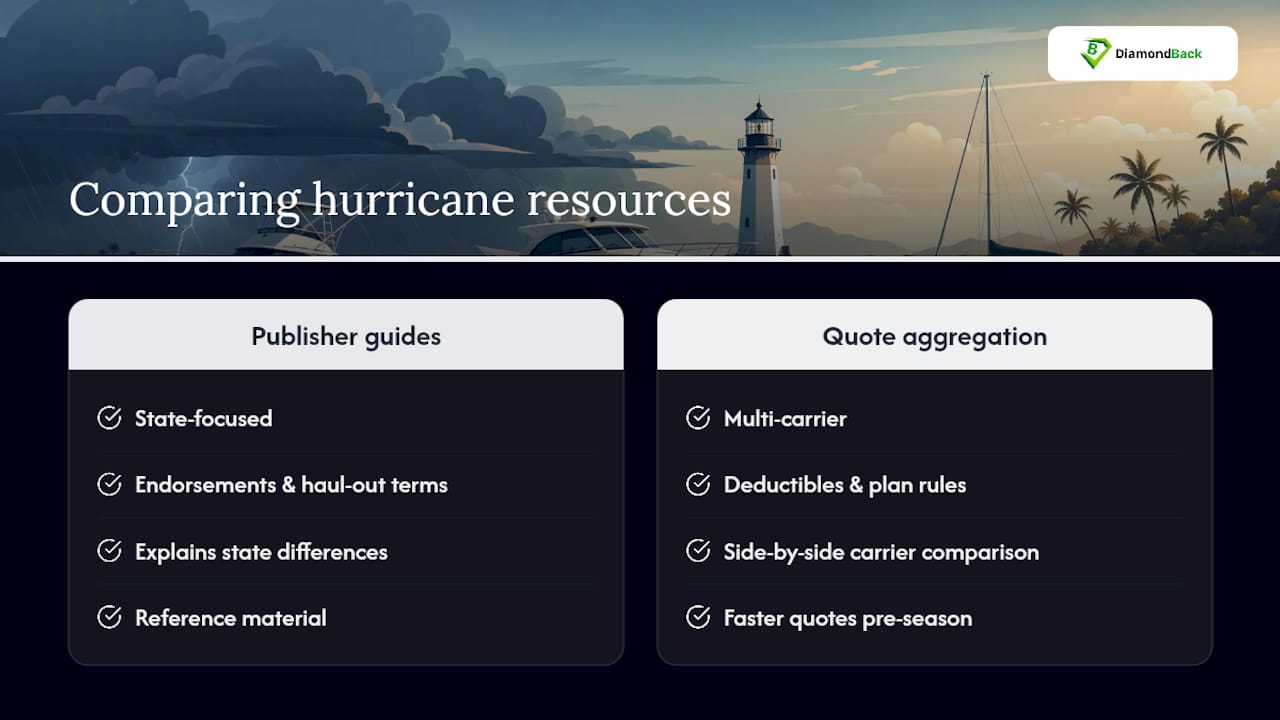
Diamondback Insurance’s guides, including its breakdown of Florida boat insurance requirements, walk through how named-storm endorsements and haul-out reimbursement terms differ by state. Because instant quote aggregation pulls multiple carriers into one comparison, you can see deductible structures and hurricane-plan requirements side by side instead of calling five agents individually. That speed matters most in the weeks before season opens, when carriers still have room to write new hurricane endorsements.
Balancing Cost and Risk in Hurricane Zones
Paying more for a lower named-storm deductible feels unnecessary until the year it isn’t. A percentage deductible on a total loss can run into the thousands, while the extra premium for tighter terms is usually a fraction of that. Review your policy every spring, document your boat’s condition, and lock in named-storm protection before the season opens, not after a storm gets a name.
— Vladimir
Get Hurricane-Ready Coverage Before the Next Named Storm
Comparing carriers one phone call at a time during hurricane season wastes the exact time you need for haul-outs and prep, not paperwork. Diamondback Insurance pulls named-storm endorsements, deductible structures, haul-out reimbursement terms, and wreck-removal limits from multiple carriers into a single instant quote, so you can see the real differences in minutes instead of days.

Request a written copy of any endorsement language before you sign; a carrier’s verbal assurance about named-storm coverage means nothing if it’s not on the declarations page. Diamondback Insurance can’t override what a carrier ultimately puts in writing, but it can get you comparable quotes fast enough to schedule a proper policy review before June 1. Start by comparing boat insurance quotes today and lock in hurricane protection while carriers are still writing new policies.
Where to Verify Storm Status and Insurer Guidance
Check the National Hurricane Center for official storm naming and forecasts, and review Roamly’s hurricane prep guide for owner-focused readiness steps.
This article is general information, not a substitute for advice from a qualified financial advisor. Consult a qualified financial professional about your own circumstances before acting on anything here.
Sources
- National Hurricane Center (NOAA)
- Hurricane Boat Insurance: Prep guide | Roamly
- Protecting your boat from hurricanes and other major storms | Chubb