
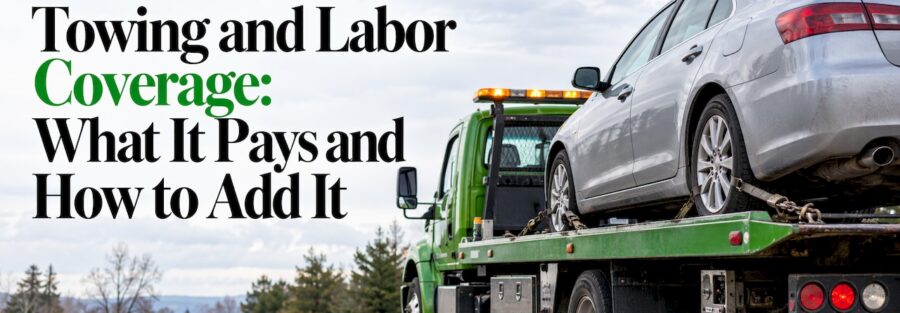
Towing and labor coverage is an optional add-on to an auto policy that pays, up to a stated limit, for a tow or for roadside labor when a covered vehicle is disabled. It does not pay for repairs or parts. If your trucks or personal vehicles run on thin margins and tight schedules, the question is not whether you can afford the endorsement. It is whether the limit on your policy matches what a breakdown really costs. You can compare policies side by side and see which quotes include it on our instant online quote platform.
TL;DR
- Towing and labor is an optional endorsement, so it only applies if it appears on your declarations page with a limit.
- It typically pays for a tow, a jump-start, a tire change, a lockout or a fuel delivery. It does not pay for parts or shop repairs.
- Limits are often small and are counted per disablement, so a long tow can exceed them quickly.
- A tow after a covered collision or storm loss is usually handled under collision or comprehensive, not this endorsement.
- For commercial trucks, towing is handled through the trucking policy itself, so compare it when you compare quotes.
Table of Contents
- What towing and labor coverage actually is
- What it can pay for
- How the limits work
- Towing after a breakdown versus towing after a crash
- Towing and labor versus roadside assistance
- What towing and labor does not cover
- What this means for trucking companies
- How to add towing and labor or compare it
- Our perspective
- Compare coverage before the next breakdown
- FAQ
- Sources
What towing and labor coverage actually is
The name sounds broader than it is. Towing and labor is an endorsement, meaning an add-on that changes the base policy. The North Carolina Department of Insurance describes it as optional coverage that can pay towing and labor each time a covered automobile is disabled, and also when keys are lost, broken or locked inside the vehicle.
Two words in the definition matter most. “Disabled” means the vehicle cannot be driven safely, usually because of a breakdown. “Labor” does not mean a mechanic’s time at a shop. A Nevada personal auto policy form states that it pays only for labor performed at the place of disablement, with the limit shown for that vehicle on the declarations page. If the work happens in a garage, it is a repair and not roadside labor.
That single distinction explains most of the surprises drivers report. They expect a flat tire to be fixed and a part to be replaced. The endorsement covers the first and not the second.
What it can pay for
The typical services are the ones you can complete on the roadside in a short time: towing to a repair location, changing a flat, jump-starting a dead battery, getting you back into a locked vehicle, and delivering gas or oil. Fuel and fluids are usually paid for as a delivery service only. You still pay for the fuel itself.
The terms are spelled out in policy forms filed with state regulators. An Oklahoma auto policy form on file with that state’s insurance department describes up to one hour of mechanical labor at the breakdown location, plus towing to the nearest place where necessary repairs can be made during regular business hours. It applies when the vehicle will not run or is stranded on or immediately beside a public road.
Read that sentence twice, because every clause is a condition:
Does it have to be the nearest shop? Often, yes. The benefit is built around getting the vehicle to the closest place that can fix it, not to the shop you prefer. If you want the truck taken to your own mechanic across town, you may owe the difference in towing charges.
Does it have to be during business hours? In that form, the destination is a place open for repairs during regular business hours. A tow at 2 a.m. may be covered; the destination logic still follows the policy wording.
Does the vehicle have to be on the road? In that form, the vehicle must be stranded on or right beside a public road. A vehicle that will not start in a private lot or driveway can fall outside the definition, depending on the wording of your policy.
None of these conditions is unusual. They are the reason the endorsement should be read like a contract and not like a feature list.
How the limits work
The endorsement does not promise unlimited help. It pays up to a stated amount, and that amount is printed on the declarations page, the summary page of your policy that lists your coverages and limits. The Nevada form quoted above ties the payment to the amount shown for that vehicle.
Three numbers are worth finding before you ever need a tow.
The dollar limit per disablement. Some policies set it low enough that a single flatbed call in a rural area uses all of it. Others offer tiers, so you can pay a little more for a higher limit.
The number of claims per year. Some forms cap the occurrences per vehicle in a policy period. A vehicle that breaks down often can run out of benefit before the term ends.
Any mileage or distance condition. A tow of five miles and a tow of sixty miles are priced very differently. If your routes run through low-population areas, the nearest repair facility may be far away.
A worked example makes this concrete. Suppose your policy shows a limit of $100 per disablement. Your pickup dies on a county road, the flatbed charges a hook-up fee plus a per-mile rate, and the shop is 25 miles away. The bill is easily above the limit, and you pay the rest. The same event on a policy with a higher limit may be fully covered. The figures here are illustrative, not quotes. What matters is that the limit, not the endorsement’s name, decides what you pay.
Availability, limits and deductibles vary by state and by insurer, so use your own declarations page and your own state’s rules as the reference.
Towing after a breakdown versus towing after a crash
Many drivers assume one coverage handles every tow. It does not. The cause of the disablement decides which part of the policy responds.
If the vehicle simply fails (dead battery, mechanical problem, flat tire), towing and labor or a roadside assistance benefit is what pays. Liability-only coverage does not pay to move your own vehicle, because liability covers damage you cause to others.
If the vehicle is disabled by a covered accident, the tow is generally part of the collision claim, since it is a cost of the damaged vehicle. If it is disabled by a covered non-collision event such as fire, vandalism, falling objects or severe weather, comprehensive coverage is the part of the policy that typically applies. In both cases, the deductible you chose for that coverage can apply.

This is the reason some drivers find that towing and labor “often has no deductible” while a tow tied to a claim does. They are different parts of the policy with different rules. If you are weighing whether to add the endorsement, the main value is for the plain breakdown, the event that no other coverage touches.
Homeowners should note that flooding of a vehicle follows the same logic as other non-collision losses: it belongs to the vehicle’s own coverage, not to a home or flood policy. A flood policy protects the building and, if you choose, its contents. If you own property in a flood-prone area, a separate flood insurance quote covers the home itself.
Towing and labor versus roadside assistance
The two terms overlap, and insurers do not use them consistently. In practice, towing and labor is a reimbursement-style benefit written into the auto policy: you pay the provider, then claim back up to the limit. Roadside assistance is often a dispatched service: you call a number and a provider is sent. Some insurers use one label for either arrangement.
Because the labels vary, compare the contents and not the name. Look for:
Who arranges the service. Do you call a number, or do you find a tow yourself and submit a receipt?
What is included. Tow, tire change, jump-start, lockout, fuel delivery. Not every policy lists all five.
Whose vehicle is covered. The benefit typically attaches to the vehicle on the policy, not to a friend’s car you happen to be driving. Some forms extend it to non-owned vehicles, which is why the Nevada form mentions both a covered auto and a non-owned auto. Read your own wording.
What paperwork is needed. Reimbursement benefits usually need itemized receipts and a prompt claim, so keep every invoice and photograph the scene.
What towing and labor does not cover
Exclusions are where most disappointment comes from, so they deserve a plain list in paragraph form.
Parts are not covered. If the tow truck driver replaces a battery, the battery is yours to pay for. Repairs at a shop are not covered either, because the benefit stops at the place of disablement. Labor beyond the policy’s time cap (some forms use one hour) is excluded. Towing farther than the nearest suitable repair facility, because you prefer a particular mechanic, is generally not paid beyond what the nearest tow would have cost.
Costs covered elsewhere in the policy are also not paid twice. If your collision coverage already pays for a tow, towing and labor will not pay for the same tow on top of it.
If the vehicle needs a rental while the repair is under way, that is a separate matter from towing and labor. Rental reimbursement is its own coverage, and a shop that handles claims can often coordinate it: see how one rental cars while yours is repaired arrangement works for drivers in Florida’s Escambia County.
The North Carolina Department of Insurance advises reviewing the policy or contacting an agent about coverage limitations and exclusions. That is sound advice, and it is easier when you can see several policies’ terms at once.
What this means for trucking companies
The endorsement described above is written for personal auto policies. A trucking company has a different problem. A disabled tractor-trailer cannot be moved by a standard flatbed. Heavy-duty recovery and towing cost far more than a car tow, and downtime on a load costs more still. So for fleets, the question is not “do I add towing and labor?” but “how does my commercial policy treat a breakdown, a tow and the trailer behind it?”

The answer depends on the structure of your coverage: the primary liability, physical damage, any trailer interchange agreement and the add-ons you select. Our own guides go through these pieces, including what a trucking policy covers when a truck is towed, the top policy add-ons for trucking and the difference between cargo coverage and trailer interchange. If you operate service or tow trucks, the guide to service truck coverage applies too.
A few questions are worth asking about every commercial quote:
Does the policy respond to a breakdown, or only to a covered accident? These are different triggers, and the wording should say which applies.
What happens to the trailer? A tow that moves the tractor but leaves a loaded trailer on the shoulder is a partial solution. Check how the policy handles a trailer you pull, whether it is yours or interchanged from someone else.
How is cargo treated during the incident? Cargo coverage is separate from the truck’s own coverage, and a recovery operation can affect it.
What limit applies per incident, and how many incidents are allowed? The same two numbers that matter on a personal policy matter here, at much higher amounts.
Because a trailer-pulling question has no single answer across insurers, the declarations page and the endorsement wording are the only reliable guide. Put the question to the quote itself and do not assume.
How to add towing and labor or compare it
The process is short, and most of the value is in the comparison.
Step 1: Pull your current declarations page. Check whether towing and labor or roadside assistance is listed, and note the limit and any claim count.
Step 2: Decide what a bad day costs you. For a personal vehicle, price a typical tow in your area. For a fleet, add the cost of lost revenue per day of downtime. The gap between that figure and your limit is your exposure.
Step 3: Compare quotes with the endorsement included. Premium for this coverage is usually modest relative to the rest of the policy, but the limits differ across insurers, so compare like with like. On our platform you can get quotes from multiple insurers and compare the options in one place instead of repeating the same application at each company.
Step 4: Read the wording on the exclusions. Confirm the labor location rule, the nearest-facility rule, any claim cap and the receipt requirements.
Step 5: Buy and keep the paperwork handy. Save the declarations page and the insurer’s claim instructions where the driver can reach them from the roadside.
Our perspective
Most of the coverage questions we see start the same way: someone assumed that “insurance” and “covered” were the same word. Towing and labor is a good example. It is a small, inexpensive piece of a policy, and it is easy to overlook until a truck or a car is sitting on a shoulder.
We built our platform around one idea: you should see your options before you commit. Comparing quotes from multiple insurers lets you look at limits and terms next to each other, and for trucking operators it means you can match the coverage to how the fleet actually runs, rather than accepting whatever a single quote includes.
Our advice is practical. Know your limit, know your exclusions, and revisit both at renewal. Staying ahead of that review is far cheaper than finding out at the roadside.
Vladimir
Compare coverage before the next breakdown
Whether you manage a fleet, run a small trucking business or are protecting a family vehicle and a home, the same habit helps: put the terms side by side. Our platform offers instant quotes from multiple insurers for trucking insurance, home and auto and flood coverage, and you can buy a policy online once you have chosen.
Start at diamondbackins.com and review the limits on each quote before you decide.
FAQ
Is towing and labor coverage the same as roadside assistance?
Not always. Insurers use the names differently, and some use one label for both. Compare the covered services, limits and exclusions in the policy instead of relying on the name, because those details decide what you receive.
Does car insurance cover towing after a breakdown?
Only if the policy includes towing and labor or roadside assistance. Liability-only coverage does not pay to tow your own vehicle. A tow after a covered accident or storm loss is generally handled under collision or comprehensive, and your deductible can apply.
Does towing and labor pay for repairs or parts?
No. State policy forms describe it as paying for towing and for labor at the place of disablement. For example, the Nevada form pays only for labor performed where the vehicle broke down. Parts and shop repairs fall outside it.
Does it cover a friend’s car that I am driving?
Usually it attaches to the vehicle on your policy. Some forms extend to a non-owned auto, so check the wording of your own endorsement before relying on it.
Is it enough for a trucking company?
A personal-style endorsement is not designed around heavy-duty recovery. Review how your commercial trucking policy handles breakdowns, towing and the trailer, and compare those terms across quotes.
Sources
- Basic and Miscellaneous Auto Coverages, North Carolina Department of Insurance
- Personal Auto Policy Cover Sheet, Nevada Division of Insurance
- Oklahoma Auto Policy form, Oklahoma Insurance Department
- Rental Cars While Yours Is Repaired, Pensacola