

Occupational accident insurance (OAI) is a voluntary policy that pays medical bills, wage replacement, and accidental death and dismemberment (AD&D) benefits to independent contractors, owner-operators, and 1099 workers who get hurt on the job. It exists mainly because this group typically falls outside a traditional workers’ compensation plan.
Core benefits usually include:
- Medical expense coverage for hospital bills, surgery, and rehabilitation tied to a job-related accident
- Disability benefits that replace a portion of lost income during recovery, temporary or permanent
- AD&D benefits paid to you or your beneficiaries in the event of death or serious permanent injury
One caution up front: OAI is not a lawful substitute for workers’ compensation in states where comp is legally required for your workers. If you’re unsure which applies to you, that distinction matters more than almost anything else in this guide, and we’ll walk through it below.
Key Takeaways
Occupational accident insurance replaces medical and wage-loss risk for contractors who fall outside workers’ compensation, but it never legally substitutes for comp where state law requires it.
| Point | Details |
|---|---|
| OAI serves contractors, not employees | It’s built for 1099 owner-operators and leased drivers who don’t qualify for workers’ comp. |
| Coverage has real caps | Medical, disability, and AD&D benefits pay up to scheduled limits, not unlimited amounts. |
| Comp exclusivity doesn’t transfer | OAI doesn’t block lawsuits or replace a state’s mandated workers’ comp requirements. |
| Classification comes first | Confirm contractor status in writing before assuming OAI fits your situation. |
| Diamondbackins speeds up comparison | The platform aggregates instant quotes from multiple insurers for owner-operators and small fleets. |
Table of Contents
- What Does Occupational Accident Insurance Cover?
- How Is Occupational Accident Insurance Different From Workers’ Comp?
- What Drives the Cost of Occupational Accident Insurance?
- How Do You Arrange Occupational Accident Insurance?
- Getting an Occupational Accident Quote Without the Runaround
- What Should Owner-Operators Prioritize First?
- Compare Occupational Accident Coverage Through Diamondbackins
- Frequently Asked Questions
- Sources
What Does Occupational Accident Insurance Cover?
OAI policies build their protection around three benefit categories, and each one works differently than you might expect from the phrase “accident insurance.”
Medical expense benefits pay for the direct costs of treating a covered injury: ER visits, imaging, surgery, physical therapy, and sometimes prescribed medical equipment. Most policies pay this benefit up to a scheduled limit set by the policy, which can vary widely depending on the plan you choose. That’s a policy-defined ceiling, not a guarantee of full reimbursement.
Disability benefits replace part of your income while you can’t work. Here’s typically how they break down:
- Temporary total disability pays a weekly benefit, commonly in the range of $500 to $1,500, for a defined period while you recover.
- Permanent total or partial disability pays a lump sum or extended weekly benefit if the injury results in lasting impairment.
- Survivor and AD&D benefits pay a scheduled lump sum to your family if an accident causes death or specific losses like limb amputation or loss of sight, with amounts depending on the policy terms.
Workplace injuries carry real financial weight beyond the obvious. The National Safety Council’s Injury Facts tracks the direct and indirect costs of work injuries nationwide, a dataset that helps explain why medical and wage-replacement benefits matter as much as the headline coverage amounts.
Pro Tip: Read the exclusions page before the benefits page. Most OAI policies exclude occupational disease, cumulative trauma (like repetitive strain injuries), and any injury that isn’t tied to a specific, sudden accident. If your risk looks more like slow wear than a sudden event, ask about endorsements before you sign.
How Is Occupational Accident Insurance Different From Workers’ Comp?
Workers’ compensation is a state-mandated program for employees; occupational accident insurance is a voluntary contract you or a hiring company chooses to buy. That single distinction drives almost every practical difference between them.
Here’s what separates the two in practice:
- Legal mandate: Workers’ comp is required by state law for eligible employees. OAI is optional and contract-based, and Usa confirms that eligibility and requirements vary by state, so check your state’s bureau before assuming either option applies to you.
- Exclusive remedy: Workers’ comp generally bars an injured employee from suing their employer in exchange for guaranteed benefits. OAI carries no such exclusivity. It pays a claim, but it doesn’t shield the hiring company from a lawsuit the way comp does.
- Occupational disease and cumulative trauma: Comp typically covers disease and repetitive injury tied to the job. Standard OAI policies usually don’t, unless specifically endorsed, according to III’s guidance on workers’ compensation insurance.
- Who’s covered: Comp covers classified employees. OAI is built for people who fall outside that system, most often 1099 contractors.
A leased owner-operator hauling freight under another company’s authority is the textbook OAI candidate. A gig platform driver without employee status often is too. A properly classified W-2 employee, on the other hand, should already have comp coverage, and layering OAI on top doesn’t change your employer’s legal obligations.
What Drives the Cost of Occupational Accident Insurance?
Premiums move with risk, and risk in this category comes from a handful of predictable levers. Industry classification carries the most weight. OSHA’s trucking-industry guidance documents the physical hazards common to commercial driving, which is exactly why trucking and transportation account for a large share of OAI policies sold.
Other factors that shift your premium:
- Job risk category, since a long-haul driver and a dispatcher don’t price the same way even under one company’s plan
- Benefit limits chosen, where higher medical caps and higher weekly disability amounts raise the premium proportionally
- Waiting period length, since a shorter wait before benefits start typically costs more
- Number of covered individuals, relevant for small fleets buying coverage across several owner-operators at once
As a rough illustration, OAI premiums for a single owner-operator often run lower than comparable workers’ comp premiums for a W-2 driver in the same seat, largely because OAI’s benefit schedule is capped rather than open-ended. Treat that as a general pattern, not a quote.
Claim timelines follow a predictable rhythm too; for insights on incident reporting and claims processes, see our freight damage claim guide. Most policies apply a waiting period, often a matter of days, before disability payments begin, and insurers typically require medical documentation and an incident report before processing the claim. Simple medical-only claims tend to move faster than disability claims, which need ongoing proof of lost work capacity.
How Do You Arrange Occupational Accident Insurance?
Two models dominate how OAI actually gets purchased. In the first, the contractor buys their own policy directly, which is common among independent owner-operators who want control over their own limits. In the second, the hiring company arranges a group OAI policy covering all its leased or contracted drivers, often as a contractual requirement before someone can haul under that authority.
Whichever side you’re on, walk through this before signing anything:
- Confirm who’s the named insured. A policy naming the hiring company as sole beneficiary of certain payments may leave you underprotected, so ask directly who receives what.
- Ask about exclusions in plain language. Get a straight answer on occupational disease, pre-existing conditions, and off-duty injuries, not just a policy number reference.
- Verify the waiting period and benefit caps in writing. A verbal quote means nothing if the bound policy differs.
- Request proof-of-coverage documentation you can hand to a broker, a state agency, or a hiring company that requires it contractually.
- Check the carrier’s track record. NAIC’s consumer complaint database lets you see how a specific insurer handles claims disputes before you commit.
If there’s any ambiguity about whether you’re classified correctly as a contractor versus an employee, that’s a legal question, not an insurance one. The IRS’s guidance on Form W-2 filing is a useful starting reference, but misclassification disputes usually need a state labor agency or an attorney, not a policy adjustment. For a deeper look at how coverage needs scale once you’re managing more than one driver, our guide to independent contractor trucking coverage walks through the practical purchasing options.
Getting an Occupational Accident Quote Without the Runaround
Comparing OAI options usually means calling several brokers and waiting on callbacks, which slows down a decision that shouldn’t take days. Diamondbackins built its platform to shortcut that process for exactly this audience.
- Instant, side-by-side quotes pulled from multiple insurers instead of one broker’s limited book
- Built specifically with trucking, transportation, and owner-operator risk profiles in mind
- A fully online purchase path, from quote to bound policy, without waiting on phone tag
For small fleets weighing OAI alongside other required coverage, tools like our owner-operator cost guide help you see where OAI fits into your total budget before you buy anything.
What Should Owner-Operators Prioritize First?
Most advice on occupational accident insurance treats it as a simple add-on, a box to check after liability and cargo coverage. That undersells how much it actually determines whether an injured contractor stays financially solvent during recovery. The real gap isn’t awareness of OAI, it’s misclassification. Too many drivers assume they’re covered by someone else’s comp policy when they’re actually operating as 1099 contractors with no statutory protection at all.

If you take one thing from this guide, make it this: confirm your classification before you shop for coverage, not after. A hiring company telling you “you’re covered” is not the same as seeing it in writing. Ask for the certificate, read the exclusions, and don’t assume a scheduled AD&D benefit means the same thing as full wage replacement, because it usually doesn’t. The contractors who get burned aren’t the ones who skip insurance entirely; they’re the ones who bought the wrong kind and found out during a claim.
Compare Occupational Accident Coverage Through Diamondbackins
Diamondbackins gives owner-operators and small fleets a way to see real occupational accident and commercial coverage options side by side, without spending a week on the phone with brokers. The platform pulls quotes from multiple top insurers at once, so you can compare benefit limits, weekly disability amounts, and premiums in one place instead of piecing together separate calls.
If you’re a leased driver, an owner-operator, or a small fleet manager trying to figure out where OAI fits alongside your other required coverage, this is built for exactly that situation. Get an instant online quote for your truck insurance today and see what a properly structured occupational accident policy actually costs for your specific setup, or check current online insurance rates for fleet coverage if you’re managing more than one covered driver.
Frequently Asked Questions
Is occupational accident insurance necessary if I’m an independent contractor?
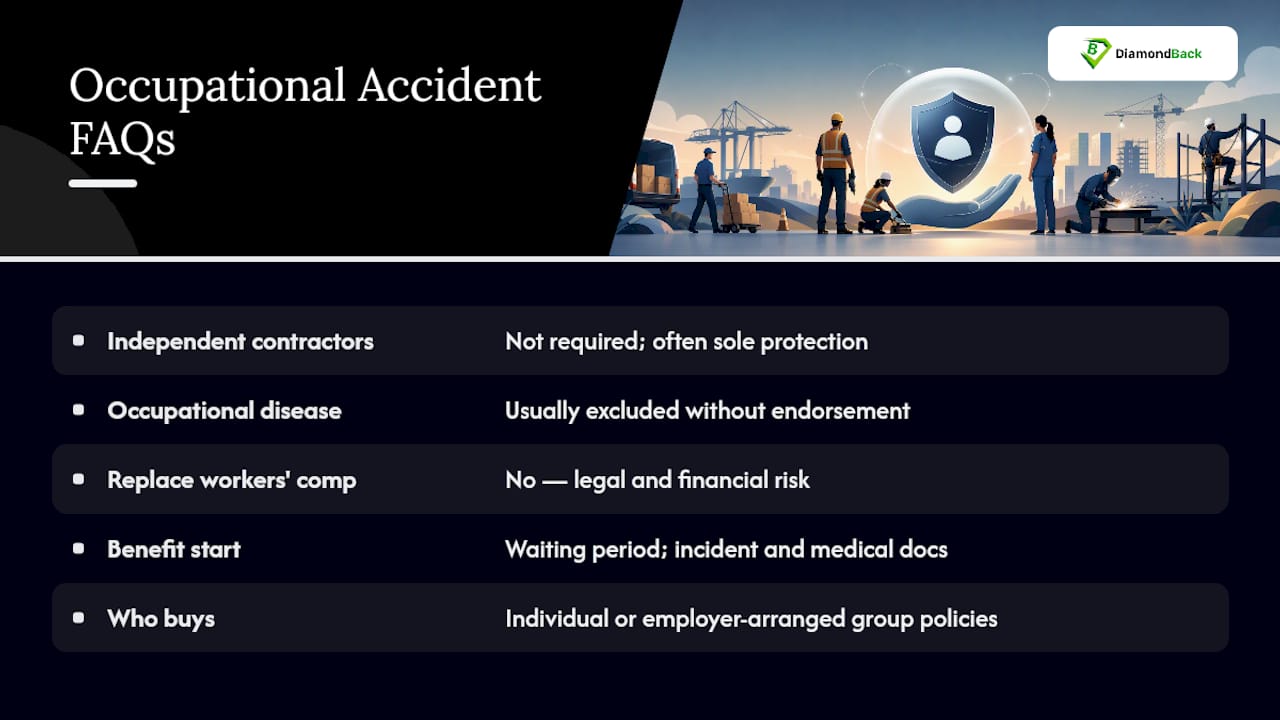
It’s not legally required, but it’s often the only protection a 1099 contractor has against medical bills and lost income after a job-related injury, since workers’ comp typically doesn’t apply to non-employees.
Does occupational accident insurance cover occupational disease?
Usually not by default. Standard OAI policies are built around sudden accidents, and conditions like repetitive strain injuries or long-term illness typically need a specific endorsement to be covered.
Can a company use OAI instead of workers’ comp to save money?
No. Where state law requires workers’ compensation for eligible employees, substituting OAI exposes the employer to legal and financial risk, since OAI doesn’t create the exclusive-remedy protection comp provides.
How fast do OAI benefits start after a claim?
Most policies apply a waiting period of several days before disability payments begin, and insurers typically require an incident report and medical documentation before processing begins.
Who usually buys the OAI policy, the contractor or the company?
Both models exist. Some owner-operators buy individual coverage directly, while other hiring companies arrange group OAI policies covering all their leased or contracted drivers as a condition of the work agreement.
Sources
- Usa
- Trucking industry | Occupational Safety and Health Administration (OSHA)
- Work injury costs | Injury Facts (NSC)
- Workers compensation insurance | Insurance Information Institute (III)
Recommended
- Workers’ Compensation Insurance in Oklahoma What You Need to Know – Diamondback Insurance – Solutions with Instant Online Quotes
- Workers’ Compensation Insurance: Is It Mandatory, and How to Get Covered Instantly – Diamondback Insurance – Solutions with Instant Online Quotes
- Understanding Workers’ Compensation Insurance: What It Covers and How to Secure It Instantly – Diamondback Insurance – Solutions with Instant Online Quotes
- Determining Your Coverage Needs: How Much Workers’ Compensation Insurance Do You Need – Diamondback Insurance – Solutions with Instant Online Quotes