

Secondary liability, in the insurance sense, is coverage that pays only after a specified primary policy has paid its full limit or a defined condition triggers it. It usually shows up as excess liability or umbrella coverage sitting above your primary auto liability policy. The verdict for fleet operators is simple: primary pays first, dollar for dollar, up to its limit; secondary picks up what’s left, but only if the loss is one your policy wording actually covers.
That order of payment isn’t automatic in every case. Wording, exclusions, and proof of exhaustion all decide whether your excess or umbrella layer actually responds.
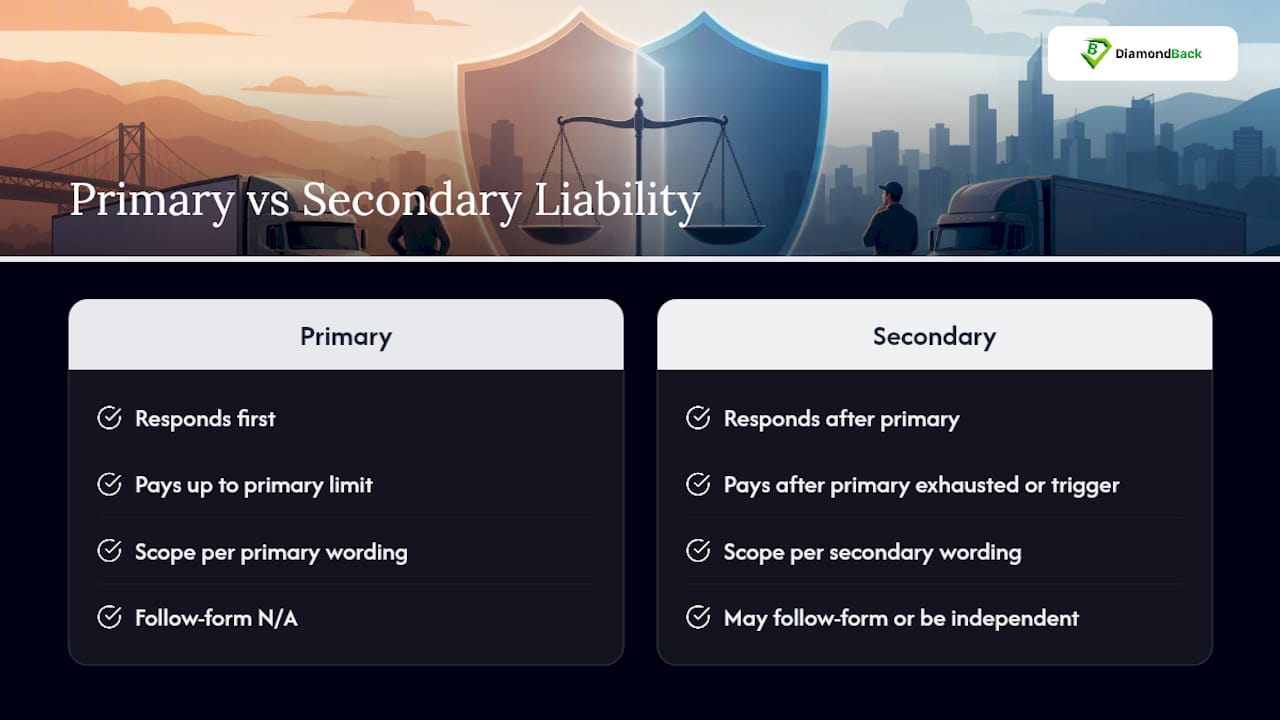
- Primary liability pays first, up to its stated limit, for a covered loss.
- Secondary (excess/umbrella) pays after that, but only within the scope its own policy language allows.
- Gaps happen when the primary policy excludes a loss the secondary layer was never written to pick up.
Pro Tip: Before you assume your umbrella “has your back” on a catastrophic crash, pull the declarations page and check what it’s actually built to sit above. A quick review with Diamondback Insurance can flag mismatches before a claim does.
Key Takeaways
Secondary liability coverage pays only after your primary policy’s limits are exhausted, and whether it actually responds depends entirely on attachment points, follow-form wording, and exclusions matching your primary policy.
| Point | Details |
|---|---|
| Payment order is fixed | Primary pays first to its limit; secondary/excess pays only above that point when wording allows. |
| Follow-form wording matters most | A follow-form excess policy mirrors your primary’s exclusions; non-follow-form policies write their own. |
| Attachment points must match | Confirm your excess policy’s attachment point equals your actual primary liability limit, not an estimate. |
| Exhaustion documentation drives timing | Excess carriers typically require proof the primary limit was paid before they accept a claim. |
| Compare towers before renewal | Diamondbackins lets fleet operators pull multiple excess and umbrella quotes side by side to spot wording gaps early. |
Table of Contents
- How Does Secondary Liability Work?
- When Does Secondary Coverage Actually Pay for Fleets?
- What Should You Check Before You Rely on Secondary Coverage?
- How Do Layered Excess Towers Work for Larger Fleets?
- What Happens After a Secondary Insurer Pays a Claim?
- What Should You Ask Your Broker About Excess Coverage?
- What Underwriters Wish Fleet Operators Understood About Excess Layers
- How Diamondback Insurance Helps You Build the Right Coverage Tower
- Frequently Asked Questions
- Sources
How Does Secondary Liability Work?
Payment priority is the whole game. Your primary policy responds first, paying defense costs and damages up to its limit. Once that limit is exhausted, either through settlement or judgment, the secondary layer starts paying for amounts above it, assuming the loss falls within its terms.
The attachment point is where secondary coverage kicks in. It’s written into the declarations or in a schedule endorsement, and it should match your primary limit exactly. A mismatch, even a small one, can create a coverage gap nobody notices until a claim exposes it.
Whether your excess or umbrella policy is “follow-form” matters just as much as the dollar figures. Follow-form wording means the secondary policy mirrors the primary policy’s terms and exclusions. Non-follow-form policies write their own definitions and exclusions, which can be broader or narrower than what sits underneath them. Excess liability generally increases limits without broadening coverage, while umbrella wording sometimes allows the policy to “drop down” and cover a gap the primary policy excluded.
Before you sign anything, check these clauses:
- Other insurance clause (how coverage coordinates with other applicable policies)
- Follow-form vs. non-follow-form language
- Stated limits and attachment point
- Self-insured retention (SIR) amount and what it applies to
- Drop-down language, if any
Say your primary auto liability caps at $1 million and a jury awards $3.5 million after a multi-vehicle pileup. Primary pays its $1 million. Your excess layer, if properly attached and worded to cover the loss, pays the remaining $2.5 million. If the excess policy excludes that type of loss, though, none of that math matters. Excess liability generally follows the underlying policy and pays after underlying limits are exhausted, which is exactly why the wording review comes before the premium comparison.
When Does Secondary Coverage Actually Pay for Fleets?
Real-world trucking losses make the abstract rules concrete. Secondary coverage tends to pay in a few recognizable situations.
- A catastrophic multi-fatality crash pushes damages well past your primary auto liability limit, and the excess layer responds for the overage.
- A shared-fault pileup involving several carriers triggers your primary policy first; once it pays its limit, your excess layer covers your portion above that threshold.
- A cargo-related injury claim falls within both the primary and excess policy’s defined terms, letting the layers work in sequence as designed.
Secondary coverage often doesn’t pay in situations that look similar on the surface but aren’t:
- The primary policy specifically excludes the loss (say, certain non-trucking use), and the excess layer follows that exclusion because it’s written on follow-form terms.
- The primary policy lapsed or was canceled for nonpayment rather than exhausted by a covered loss. Most excess and umbrella policies require an active, in-force primary at the time of the incident.
- Contractual exposures, like broker liability tied to a shipper agreement, sit outside both the primary and secondary scope entirely.
Underwriters see this pattern constantly with fleets: a policy looks airtight until the type of loss falls into a gap nobody flagged at renewal.
What Should You Check Before You Rely on Secondary Coverage?
Run through this before you assume your excess or umbrella layer will respond:
- Locate the named underlying policy on the declarations page, and confirm it matches your actual primary auto liability policy.
- Confirm the attachment point equals your primary’s stated limit, not an estimate from last year’s renewal.
- Check whether the excess or umbrella policy is follow-form, and if not, read its own exclusions line by line.
- Look for SIR (self-insured retention) language, and note whether it applies per occurrence or in aggregate.
- Search for Additional Insured and Primary Noncontributory endorsements if shippers or brokers require them contractually.
If any of that language isn’t obvious from the documents you have, call your broker and ask for the actual endorsement forms, not a summary. Verbal assurances that “you’re covered” mean nothing against policy language in a dispute.
Watch for red flags: a secondary policy that doesn’t name your specific primary carrier, an attachment point that’s vague or “to be determined,” or SIR language that could leave you paying a large gap out of pocket before excess responds.

Pro Tip: Keep a copy of every endorsement in one file, not just the declarations page. Adjusters and underwriters will ask for the full form language during a large claim, and scrambling to find it costs you time you don’t have.
How Do Layered Excess Towers Work for Larger Fleets?
Once your fleet’s exposure outgrows a single umbrella, you build a tower: primary auto liability at the base, a first excess or umbrella layer above it, then additional excess layers stacked on top, each attaching where the layer below leaves off.
Underwriters treat trucking losses as high-severity exposures, and tower design becomes critical once total program limits climb into eight figures. At that scale, mismatched attachment points or inconsistent form language between layers create gaps that dollar amounts alone don’t reveal.
A few triggers typically push fleets toward layered towers rather than a single umbrella:
- Shipper or broker contracts demanding limits beyond what one umbrella carrier will write.
- Fleet growth that increases total vehicle count and mileage exposure.
- High-value cargo or hazardous freight that raises severity, not just frequency.
Before accepting a proposed tower, confirm each layer’s attachment point lines up with the layer below, request sample claim scenarios from your broker, and verify that form language is consistent across every carrier in the stack.
What Happens After a Secondary Insurer Pays a Claim?
The claims sequence follows a predictable order once a loss exceeds your primary limit.
- You report the loss to both your primary and excess carriers as soon as it happens, not after primary exhaustion becomes obvious.
- The primary insurer sets reserves, defends the claim, and pays toward its limit.
- Once primary limits are exhausted, the excess carrier typically requires documentation proving that exhaustion before it accepts payment responsibility.
- The excess insurer pays the remaining covered amount and may pursue subrogation against a responsible third party to recover costs.
Late notice to the excess carrier is one of the most common pitfalls fleets run into, along with waiver-of-subrogation language buried in a shipper contract that quietly limits recovery rights.
Pro Tip: Ask your primary carrier for a written exhaustion letter the moment a claim approaches its limit. It speeds up excess claim handling and avoids disputes over timing later.
What Should You Ask Your Broker About Excess Coverage?
A short list of direct questions saves you from surprises after a loss:
- Is this excess policy follow-form, and if not, what exclusions differ from my primary?
- What’s the exact attachment point, and which primary policy is scheduled underneath it?
- Does the umbrella include drop-down language for gaps in the primary?
- Is my SIR per occurrence or aggregate, and are defense costs inside or outside the limit?
- Will this policy satisfy a shipper’s Additional Insured and Primary Noncontributory requirements as written?
Get the answers in writing, ideally in the endorsement language itself rather than a broker’s paraphrase.
What Underwriters Wish Fleet Operators Understood About Excess Layers
Most fleet operators shop excess and umbrella coverage on price and total limit, and skip the wording comparison entirely. That’s backwards. Two policies offering identical $5 million limits can behave completely differently in a real loss if one follows form and the other writes its own exclusions.
The choice between umbrella-first and straight excess isn’t just cost. An umbrella’s drop-down potential is worth more to a fleet running mixed operations, non-trucking use, or leased owner-operators, where primary exclusions are more likely to surface. A straight excess layer works fine for a fleet with clean, uniform exposure and a well-matched primary. Kelly Insurance Group’s underwriting perspective reinforces this: attachment points and form alignment matter as much as the limit you’re buying.
How Diamondback Insurance Helps You Build the Right Coverage Tower
Comparing excess and umbrella quotes on your own means chasing multiple carriers, reading form language line by line, and hoping the attachment points actually match. Diamondbackins pulls quotes from multiple top insurers into one place, so you can compare limits, retentions, and form language side by side instead of juggling separate broker calls.

For fleet operators, that means:
- Instant quotes on primary, excess, and umbrella options without waiting on callback after callback.
- Access to transport-specialist markets that understand trucking-specific exposures, not generic commercial auto risk.
- A side-by-side comparison that makes attachment-point mismatches and exclusion gaps easier to spot before you buy.
If you’re reviewing your program before a renewal or building out a tower for the first time, start with a look at trucking insurance coverage options built specifically for fleet operators, and get instant quotes to see how your current limits stack up.
Frequently Asked Questions
What is secondary liability in insurance terms?
Secondary liability is coverage, typically excess or umbrella, that pays only after a primary policy’s limits are exhausted or a specific policy condition is met. It’s not automatic coverage; the trigger and scope depend entirely on the policy’s own wording.
How does secondary liability differ from primary liability?
Primary liability responds first for a covered loss, up to its stated limit. Secondary liability responds afterward, and only within whatever scope its follow-form or independent wording defines.
Is secondary liability coverage enforceable if my primary policy lapses?
Generally, no. Most excess and umbrella policies require the primary policy to be active and in force at the time of loss. If it lapsed for nonpayment rather than exhaustion by a covered claim, secondary coverage typically won’t respond.
Can an umbrella policy cover something my primary policy excludes?
Sometimes. Umbrella policies with drop-down language can cover gaps the primary excludes, but this depends entirely on the specific wording. Straight excess policies usually follow the primary’s exclusions exactly.
When should a fleet consider a layered excess tower instead of a single umbrella?
Once total required limits exceed what one umbrella carrier will write, or when shipper contracts demand higher totals than a single layer provides, a layered tower with carefully matched attachment points becomes the practical option.
This article is general information, not a substitute for advice from a qualified financial advisor. Consult a qualified financial professional about your own circumstances before acting on anything here.
Sources
- Umbrella vs Excess Liability: Which Option Best Supplements Your Trucking Insurance Limits? – Insurance Curator
- Trucking Umbrella & Excess Liability Insurance for Fleets – Kelly Insurance Group
- When Primary Insurance Ends: Does Secondary Coverage Automatically Take Over? | ShunIns