

Multi-state insurance compliance is the practice of meeting each state’s licensing, filing, and tax rules for every jurisdiction where your business has exposure, anchored by the “Home State” concept that determines which state has primary authority over a given risk. The National Association of Insurance Commissioners (NAIC) and the Nonadmitted and Reinsurance Reform Act (NRRA) shape most of the framework, but individual state departments of insurance still enforce their own rules on top of it.
Here’s the verdict: multi-state compliance isn’t just a licensing issue, or just a tax issue. It’s all four at once. Licensing and appointments, surplus lines taxes and allocation, policy filings, and recordkeeping all move together, and a failure in one usually triggers a failure in another.
The pieces you’ll need to manage include:
- Producer licenses and carrier appointments in every active state
- Surplus lines diligent-search documentation and premium tax allocation
- Policy form filings and financial reporting obligations
- Data privacy, cybersecurity, and recordkeeping standards
Key Takeaways
Multi-state insurance compliance succeeds when licensing, surplus lines tax allocation, filings, and recordkeeping are managed as one interconnected system rather than four separate tasks.
| Point | Details |
|---|---|
| Home State drives tax | Under the NRRA, surplus lines premium tax is collected based on the insured’s home state, not each risk’s location. |
| Compacts centralize filings | The IIPRC serves 41 jurisdictions covering roughly two-thirds of national premium volume for product filings. |
| Licensing failures cascade | A single lapsed appointment can suspend sales authority and trigger audit scrutiny across every active state. |
| Documentation prevents disputes | Keep diligent-search records, allocation inputs, and remittance receipts on file before regulators ask for them. |
| Automation reduces risk | Pre-bind license checks through NIPR or Sircon catch most compliance gaps before a policy ever binds. |
Table of Contents
- What Does Multi-State Insurance Compliance Actually Cover?
- Which Laws and Compacts Govern Multi-State Compliance?
- A Step-by-Step Checklist for Multi-Jurisdictional Compliance
- How Do Premium Tax Allocation and Surplus Lines Clearinghouses Work?
- What Happens When Multi-State Compliance Fails?
- When Should You Bring In Outside Help?
- What DiamondBack Insurance Recommends First
- Where to Learn More About Multi-State Insurance Rules
- Frequently Asked Questions
- Sources
What Does Multi-State Insurance Compliance Actually Cover?
Multi-state compliance is not one rule; it’s a stack of interlocking obligations. Each piece has its own paperwork, deadline, and enforcement mechanism, and skipping one usually breaks another.
Producer licensing and appointments sit at the base. Every state where you solicit or sell insurance generally requires its own producer license and carrier appointment, separate from your home state credential. Policy form and rate filings determine whether the coverage you’re selling is even legal to issue in a given state. Surplus lines rules apply when standard-market carriers won’t write a risk, requiring a documented diligent search and a licensed surplus lines broker. Premium tax allocation follows the Home State rule, meaning taxes are usually collected and remitted based on where the insured is headquartered, not where each individual risk sits.
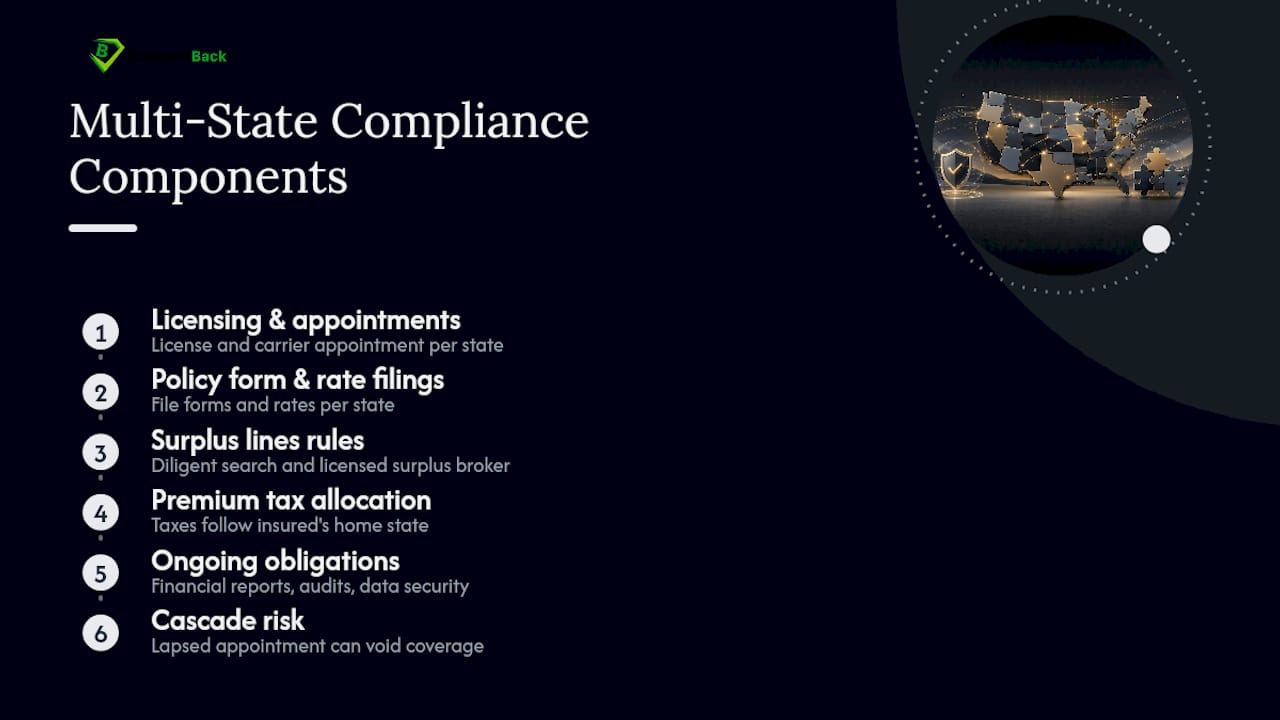
Add financial reporting and audit requirements, data privacy and cybersecurity standards, and ongoing carrier appointment maintenance, and you have a system where a single lapsed appointment can cascade. A missed renewal doesn’t just create a paperwork gap; it can void the underlying coverage the moment a claim is filed.
Which Laws and Compacts Govern Multi-State Compliance?
Federal law sets the outer boundary; individual states fill in the details. The NRRA established that surplus lines premium tax gets collected by the insured’s home state, replacing what used to be a chaotic multi-state remittance process. That single rule eliminated most of the double-taxation disputes that plagued non-admitted insurance before 2010.
Building on that foundation, the Surplus Lines Multi-State Compliance Compact proposes exclusive Home State authority for non-admitted insurance on multi-state risks, along with a clearinghouse and uniform allocation formulas to split premium tax among participating states.
The NAIC drives standardization through model laws, including the Model Audit Rule and the Producer Licensing Model Act, but adoption varies by state. The Interstate Insurance Product Regulation Compact (IIPRC) centralizes life, annuity, and related product filings for participating jurisdictions.
The IIPRC now serves 41 participating jurisdictions, representing roughly two-thirds of national premium volume, which shows both the scale of coordination already achieved and how much still runs state by state.
State DOIs remain the actual enforcers. They can adopt, modify, or ignore model language, so a rule that applies cleanly in one state may look different in the next.
A Step-by-Step Checklist for Multi-Jurisdictional Compliance
Building a defensible compliance program means working through exposures methodically rather than reacting state by state as problems surface.
- Map your exposures and identify each risk’s Home State. For a Multi-State Risk, the home state is typically where the insured maintains its principal place of business, not where the vehicle, property, or activity is located.
- Inventory every license, appointment, and carrier authorization by state, and assign a named owner for tracking renewals.
- Document diligent-search procedures for any surplus lines placement, keeping the declination records that prove you tried the standard market first.
- Build premium-allocation procedures and automate the tax math wherever your volume justifies it, recording the allocation method and every input you used.
- Tie filings and recordkeeping to your renewal calendar so policy forms, audited financials, and appointment records stay current together instead of drifting apart.
- Run quarterly mock audits and keep a remediation log that shows regulators you catch and fix problems before they escalate.
Practical controls matter as much as the steps themselves: validate every license before you bind coverage, use NIPR or Sircon gateway checks to confirm appointment status in real time, reconcile your appointment matrix against active states monthly, and track continuing education deadlines centrally rather than state by state.
Pro Tip: Set up automated pre-bind license validation through NIPR before you expand into a new state, not after your first policy in that state gets flagged. Retroactive fixes cost far more than upfront checks.
How Do Premium Tax Allocation and Surplus Lines Clearinghouses Work?
The NRRA’s home-state rule sounds simple: one state collects the tax. In practice, allocating that tax correctly across the risk’s full footprint is where most surplus lines licensees stumble.
The Surplus Lines Multi-State Compliance Compact proposes a clearinghouse specifically to solve this. Under the model, Compacting States would submit transaction data to the clearinghouse, which applies uniform allocation formulas to distribute the collected premium tax proportionally among the states where the underlying exposure actually sits.
Timing matters here. Clearinghouse operations, reporting start dates, and notice periods to licensees are all tied to compact enactment thresholds, meaning the mechanism only activates once enough states sign on.
Regardless of whether your home state has joined a compact, keep these on file:
- Complete transaction data for every surplus lines placement
- The specific allocation formula and inputs you used
- Tax remittance receipts and confirmation records
- Diligent-search documentation supporting the surplus lines placement itself
What Happens When Multi-State Compliance Fails?
The most common failures are mundane: a license lapses, an appointment gets missed during a renewal cycle, diligent-search paperwork goes unfiled, or premium tax gets allocated to the wrong state entirely.

The consequences rarely stay contained. Regulators can impose fines, demand back taxes with interest, suspend a producer’s appointment, or challenge a claim on the grounds that the underlying policy was never properly authorized. One state’s finding often triggers scrutiny in every other state where you operate, since regulatory changes and license events accumulate quickly at enterprise scale and few organizations track all of them manually with any reliability.
When Should You Bring In Outside Help?
Some situations call for a specialist rather than an internal fix. Get counsel involved for novel Multi-State Risk allocation disputes, active enforcement actions, or decisions about opting out of a compact standard.
Use a surplus lines specialist, not a general broker, for complex non-admitted placements spanning several jurisdictions. Bring in a tax advisor when premium allocation disputes surface or retroactive exposure looks likely. And if your license count or appointment matrix has outgrown a spreadsheet, a dedicated compliance platform with NIPR or Sircon integration usually pays for itself within the first audit cycle.
What DiamondBack Insurance Recommends First
Start by mapping your operating footprint before you touch anything else. Validate every license and appointment before you bind a policy, not after a claim exposes the gap. Automate surplus lines allocation as soon as your placement volume justifies it.
Most fleet operators we work with start with an inventory of active states, then layer automation on top once the manual process shows where the friction actually lives.
Where to Learn More About Multi-State Insurance Rules
For legal text and statutory background, review the NAIC’s regulatory history white paper and the Surplus Lines Multi-State Compliance Compact model text. For financial reporting standards, consult the NAIC’s audited financial reports guide. For operational implementation, see how DOT compliance connects to insurance obligations and check your fleet’s state-specific requirements.
Frequently Asked Questions
What is multi-state insurance compliance in simple terms?
It means meeting each state’s licensing, tax, filing, and recordkeeping rules everywhere your business operates, coordinated through a “Home State” that holds primary authority over multi-state risks.
Does the NRRA apply to all commercial insurance, or just surplus lines?
The NRRA specifically governs non-admitted, or surplus lines, insurance. Standard admitted coverage still follows each state’s individual licensing and filing rules.
Do I need a separate producer license in every state where I sell insurance?
Generally yes, unless a specific commercial lines exemption applies, and those exemptions vary by state and shouldn’t be assumed without verification.
What triggers a multi-state insurance audit?
Common triggers include license lapses, inconsistent premium tax filings, complaints, or routine cyclical review by a state department of insurance.
How does DiamondBack Insurance help with multi-state compliance?
DiamondBack Insurance helps fleet operators compare coverage across insurers and states, making it easier to align policies with the requirements each jurisdiction demands.
This article is general information, not a substitute for advice from a qualified lawyer. Consult a qualified legal professional about your own circumstances before acting on anything here.
Sources
- NAIC: History and role of insurance regulatory frameworks (white paper)
- Surplus Lines Insurance Multi-State Compliance Compact (model text)
Recommended
- Understanding Workers Compensation Insurance Requirements by State A Guide from DiamondBack Insurance – Diamondback Insurance – Solutions with Instant Online Quotes
- Meeting California’s Workers’ Compensation Insurance Requirements A Guide for Businesses – Diamondback Insurance – Solutions with Instant Online Quotes
- DOT Compliance and Insurance: What Trucking Fleets Must Know
- Streamlining Workers Compensation Insurance in Maryland with DiamondBack Insurance – Diamondback Insurance – Solutions with Instant Online Quotes