

For most U.S. owner-operators and small fleets searching for issamins.com alternatives, Diamondbackins is the recommended starting point: it delivers instant, multi-carrier quotes online and lets you bind coverage without a phone call. Other viable channels include independent agents and brokers for mid-size or specialty fleets, and MGA/wholesale specialists for hard-to-place risks.
Two signals worth checking before you commit to any provider:
- Carrier financial strength: Confirm the underlying carrier holds an AM Best rating of A- or better. A platform or agency is only as reliable as the carrier behind the policy.
- Claims advocacy: Digital platforms issue certificates fast and automate renewals, but independent agents typically provide direct advocacy during disputed or denied claims, which matters for high-value cargo or complex accidents.
If your operation takes more than a single sentence to describe — multiple commodity types, oversized loads, or limits above $1 million — a human broker or MGA will serve you better than any instant-quote tool.
Table of Contents
- What are the best issamins.com alternatives for trucking?
- How each provider channel actually performs
- How do you pick the right alternative for your fleet?
- How to get fast quotes and switch providers without a coverage gap
- What drives trucking insurance prices and what coverages you need
- Required coverages for commercial trucking in the U.S.
- What issamins.com offers and where it falls short
- Discounts and bundling options for trucking insurance
- How state-specific rules affect your provider choice
- Financial stability and claims payout speed beyond AM Best ratings
- What customer service channels and digital tools should you expect?
- Legal compliance and regulatory requirements for commercial trucking
- Key Takeaways
- Why the “digital vs. broker” debate misses the real question
- Diamondbackins: instant trucking quotes without the wait
- Useful sources and further reading
What are the best issamins.com alternatives for trucking?
| Provider category | Best for | Quote speed / online buy | Coverage types | Pricing & discounts | Claims / agent access | State availability | Underwriting flexibility |
|---|---|---|---|---|---|---|---|
| Digital-first instant platforms (e.g., Diamondbackins) | Owner-operators, 1–10 unit fleets, standard dry van/flatbed | Minutes; fully online bind | Primary auto liability, physical damage, cargo, bobtail, NTL | Competitive; telematics and multi-policy discounts common | Automated portal; limited human advocacy | Broad; varies by carrier panel | Low to moderate complexity only |
| Independent agents / brokers | Mid-size fleets, specialty cargo, complex loss history | Hours to days; phone/email | Full tower including umbrella, excess, workers’ comp | Negotiated; volume and loyalty discounts | Direct agent advocacy; claims negotiation | Nationwide via surplus lines if needed | High; manual underwriting available |
| MGAs / wholesale specialists | Hard-to-place risks, telematics-driven fleets, non-standard cargo | Days; broker-submitted | Specialty endorsements, surplus lines, program business | Program pricing; limited standard discounts | Broker-mediated; strong for complex claims | Varies by program; surplus lines in most states | Very high; bespoke wording possible |
| Large national direct writers | Standard fleets preferring brand recognition | Hours to days; online or agent | Standard commercial auto, cargo, general liability | Advertised discounts; advertising costs can affect rates | Mixed; national toll-free or local agent | Nationwide | Moderate; appetite varies by state |
Fast online buy: If your fleet is 10 units or fewer with standard cargo and a clean loss history, a digital-first platform can quote and bind same-day.
Complex placement required: Fleets with specialty cargo, adverse loss runs, or limits above $1 million should route submissions to an independent broker or MGA for manual underwriting.
Digital-first platforms and traditional brokers serve different complexity thresholds — standard risks bind in minutes, while complex broker placements can take days or weeks.
How each provider channel actually performs
Digital-first instant-quote platforms excel at speed and price transparency. You get certificates within minutes, renewals are automated, and comparing multiple carriers side by side requires no phone tag. The trade-off is real: policy forms tend to be productized, bespoke endorsements are limited, and claims support is largely portal-driven with minimal human intervention. Best for standard dry van, flatbed, and refrigerated fleets under 10 units with clean MVRs.
Independent agents and brokers bring genuine market access. They can approach admitted carriers, surplus lines markets, and specialty programs when a standard market declines your risk. Their strongest advantage is claims advocacy: when a carrier disputes a loss, an agent who knows the adjuster and the policy language is worth considerably more than an automated portal. The downside is time. Submissions require back-and-forth, and binding can stretch to several days.
MGAs and wholesale specialists occupy a distinct niche. An MGA like HDVI, for example, uses telematics-first underwriting with capacity from rated reinsurers, targeting fleets that can demonstrate safety data but may not fit standard admitted markets. MGAs can satisfy DOT and shipper certificate requirements while offering program pricing unavailable through retail channels. They are not the right channel for a single-truck owner-operator who needs coverage today.
Large national direct writers offer brand familiarity and broad geographic reach. Their underwriting appetite for trucking varies significantly by state, and their advertising spend can influence rate structures. They work well for fleets that want a single point of contact and standard coverage, but they rarely compete on price for specialty or high-risk accounts.
How do you pick the right alternative for your fleet?
Start with these selection criteria before you request a single quote:
- Fleet size and unit count
- Cargo type and commodity value
- Liability limits required by shippers or brokers (many require $1 million minimum)
- Interstate vs. intrastate operations and applicable FMCSA filings
- Loss history for the past three to five years
- State-specific filing requirements (MCS-90, Form E, BOC-3)
Questions to ask any prospective provider: Which carriers are on your panel, and what are their AM Best ratings? Do you write surplus lines if admitted markets decline? What is your average claims response time, and who handles disputed losses? Is there a licensed producer of record on this policy, and in which states are they appointed?
Red flags to watch for: No carrier ratings displayed anywhere on the platform or quote documents. Generic policy forms with no endorsement options. Claims handled entirely by a third-party administrator with no agent escalation path. No licensed producer name or NPN number on the binder.
Pro Tip: Apply the one-sentence complexity test before choosing a channel. If you cannot summarize your fleet’s operations, cargo, and key exposures in a single sentence, route your submission to an independent broker or MGA for manual underwriting rather than an instant-quote platform.
How to get fast quotes and switch providers without a coverage gap
Follow these steps in order to move efficiently from shopping to binding:
- Gather your documents first. You need current MVRs for all drivers, VINs for every unit, a driver roster with license numbers, three to five years of loss runs, your current declarations page, and your MCS-90 or other FMCSA filings if applicable.
- Build one consolidated submission. Fill a single application with complete information rather than starting multiple partial quotes. Incomplete submissions are the primary cause of delayed quotes.
- Request carrier panel names. Ask each platform or agent which specific carriers will see your submission and confirm their AM Best ratings before comparing prices.
- Compare effective dates carefully. Your new policy must be effective before your current policy cancels. A one-day gap can trigger an FMCSA out-of-service order.
- Send a written cancellation notice. Most commercial policies require 30 days’ written notice to cancel. Send it only after your new binder is in hand.
Timeline expectations: standard primary-layer quotes from a digital platform can arrive in minutes. An independent broker working a mid-size fleet submission typically returns quotes within 24–48 hours. Surplus lines or excess tower placements can take one to two weeks.
Comparing quotes across carriers efficiently requires having all documents ready before you start, not after.
What drives trucking insurance prices and what coverages you need
Every trucking policy should include these core coverages: primary auto liability (federally required at $750,000 minimum for most for-hire carriers), motor truck cargo, physical damage (comprehensive and collision on your units), bobtail/non-trucking liability, trailer interchange if you pull nonowned trailers, and workers’ compensation where state law requires it. Umbrella or excess layers become necessary once shipper contracts push required limits above $1 million.
| Underwriting factor | Effect on premium |
|---|---|
| Adverse loss runs (3+ years) | Significant surcharge or market declination |
| Driver MVR violations (DUI, reckless) | Surcharge per driver; some markets non-renew |
| High-value or hazmat cargo | Specialty market required; higher cargo rates |
| California operations | State-mandated minimums and filing fees add cost |
| Telematics / ELD data available | Potential discount with telematics-first programs |
| Fleet size (1 vs. 10+ units) | Per-unit rates typically decrease with scale |
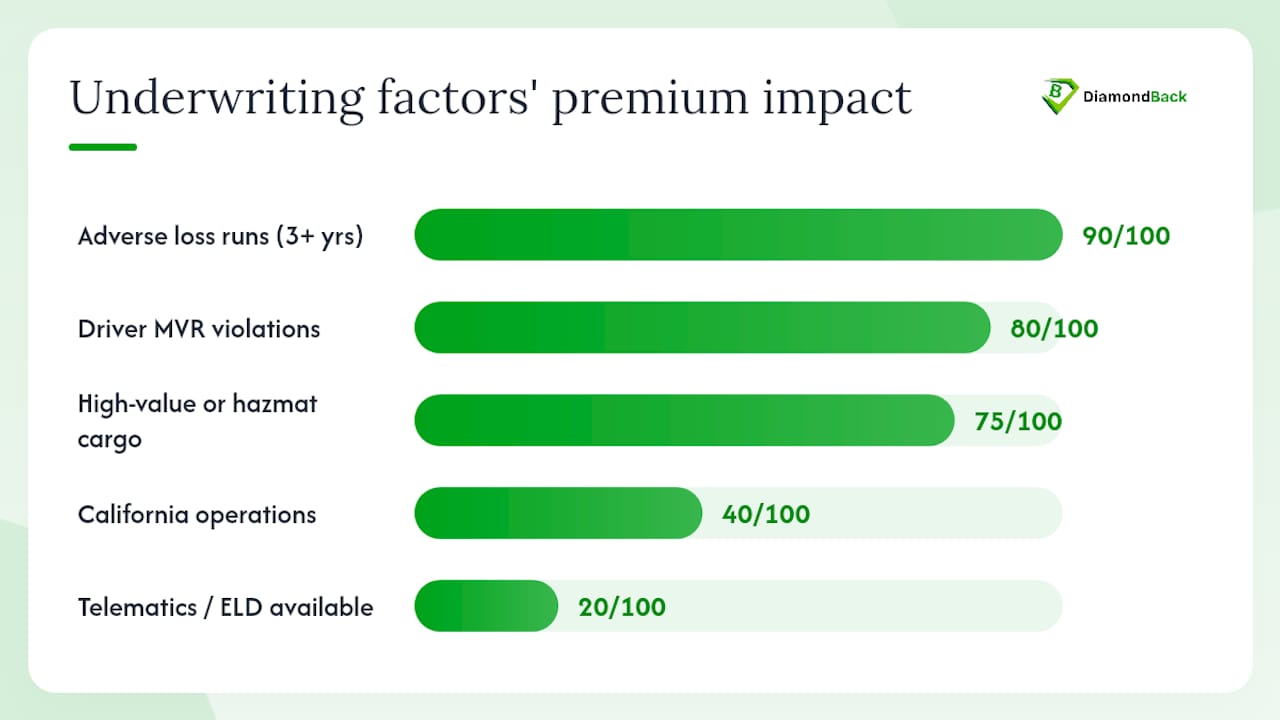
Understanding why truck insurance costs more than standard commercial auto starts with gross vehicle weight, cargo liability exposure, and interstate mileage, all of which amplify the severity of potential claims.
Independent agencies placed roughly 39.5% of all personal lines premium in the U.S. according to a 2025 report, reflecting the continued strength of multi-carrier access for buyers who need negotiated terms.
Required coverages for commercial trucking in the U.S.
Federal law sets the floor. The FMCSA requires for-hire carriers transporting non-hazardous freight to carry a minimum of $750,000 in primary auto liability. Carriers hauling hazardous materials face minimums ranging from $1 million to $5 million depending on commodity. Most shipper contracts and freight brokers require $1 million regardless of federal minimums, so that figure is the practical standard.
Beyond liability, physical damage coverage protects your equipment investment. Bobtail coverage applies when a driver operates a tractor without a trailer and outside of dispatch, a gap that primary auto liability does not fill. Non-trucking liability (NTL) is similar but broader, covering personal use of the tractor. Motor truck cargo covers the freight itself against loss or damage in transit. Trailer interchange covers non-owned trailers under a written interchange agreement.
For a complete picture of service truck and fleet coverage types, the specific endorsements you need depend on your operating authority, cargo type, and contractual obligations with shippers.
What issamins.com offers and where it falls short
Issam Insurance Agency (issamins.com) operates as a traditional independent insurance agency based in the United States, offering commercial auto and trucking coverage alongside personal lines. As an independent agency, it can access multiple carriers and provide personalized service, which suits clients who prefer a relationship-based approach.
The limitations that lead trucking operators to search for issamins.com alternatives are common to smaller independent agencies: limited online self-service, no instant-quote capability for most commercial lines, and geographic concentration that may restrict carrier panel depth in certain states. If you need a certificate at 6 AM before a load dispatch, or you want to compare five carriers simultaneously without a phone call, a digital-first platform fills that gap directly.
Discounts and bundling options for trucking insurance
Trucking-specific discounts vary by carrier but follow consistent patterns. Telematics and ELD integration is the fastest-growing discount category: carriers that use driving data in underwriting, including some MGA programs, can offer meaningful premium reductions for fleets with clean telematics records. Multi-policy bundling, combining primary auto liability with cargo, physical damage, and general liability under one carrier or program, typically produces a lower total premium than placing each coverage separately.

Other common discount triggers include: continuous coverage history with no lapses, driver safety training certifications (such as Smith System or NSC courses), low annual mileage for seasonal operators, and fleet size thresholds where per-unit rates decrease as you add vehicles. Some carriers also offer paid-in-full discounts when you pay the annual premium upfront rather than monthly.
How state-specific rules affect your provider choice
State law shapes both your minimum required coverages and the carriers willing to write your risk. California imposes its own minimum liability requirements for certain commercial vehicles and requires specific state filings beyond the federal MCS-90. New York mandates higher minimums for livery and for-hire vehicles. Texas requires the Texas Liability Insurance Card (Form E) for intrastate carriers.
Surplus lines regulations also vary. If your risk is declined by admitted carriers in your state, a broker must file a surplus lines affidavit and the policy may not carry state guaranty fund protection. Knowing whether your policy is admitted or non-admitted matters if the carrier becomes insolvent. Always ask which state the policy is filed in and whether the carrier is admitted in your operating states.
For fleets operating across multiple states, finding carriers licensed in every state you operate is a non-negotiable step in the quoting process.
Financial stability and claims payout speed beyond AM Best ratings
An AM Best rating of A- or better tells you a carrier can pay claims. It does not tell you how fast or how fairly. Two additional signals matter: the carrier’s loss ratio trend and its claims-handling reputation in trucking-specific forums and industry associations.
A carrier with a deteriorating loss ratio may be tightening reserves, which can slow claim payments. Carriers that specialize in trucking, rather than writing it as a small slice of a large commercial book, tend to have adjusters who understand cargo claims, subrogation against shippers, and the nuances of bobtail vs. primary liability disputes. Ask any prospective carrier or platform how many trucking claims they handle annually and what their average time-to-close is for cargo claims specifically.
Hybrid models that combine digital automation with human expert oversight increase client satisfaction and efficiency, particularly when exceptions arise during the claims process.
What customer service channels and digital tools should you expect?
A modern trucking insurance provider should offer at minimum: online certificate issuance available 24/7, a digital claims portal with status tracking, and a direct phone line to a licensed agent during business hours. Platforms that route all service through chatbots or generic email queues create real operational problems when a load is on the road and a shipper needs a certificate amendment at midnight.
The strongest providers combine automated tools for routine tasks with accessible human support for exceptions. Certificate automation and renewal reminders are table stakes. What differentiates providers is response time when something goes wrong: a disputed claim, a mid-term endorsement for a new unit, or an urgent state filing. Before binding, test the service channel yourself. Call the number on the quote, ask a specific question about your coverage, and note how long it takes to reach someone who can actually answer.
Legal compliance and regulatory requirements for commercial trucking
Commercial trucking insurance in the U.S. operates under a dual regulatory framework: federal oversight by the FMCSA and state-level regulation by each state’s department of insurance. For-hire carriers must file proof of financial responsibility with the FMCSA, typically via the MCS-90 endorsement attached to the primary auto liability policy. The MCS-90 is not a separate policy; it is an endorsement that makes the insurer a guarantor of last resort for public liability.
Brokers and freight brokers (not insurance brokers) must carry a $75,000 surety bond or trust fund under FMCSA rules. Owner-operators leased to a motor carrier may be covered under the carrier’s policy while under dispatch, but need bobtail or NTL coverage for off-dispatch operations. Operating without the correct FMCSA filings can result in out-of-service orders and civil penalties.
The importance of proper transportation insurance coverage extends beyond compliance: it protects your operating authority, your assets, and your ability to secure shipper contracts.
This article provides general information about commercial trucking insurance options and is not legal or professional insurance advice. Confirm current FMCSA requirements, state minimums, and policy terms with a licensed insurance professional or your state’s department of insurance.
Key Takeaways
Diamondbackins is the recommended instant-quote alternative for standard U.S. trucking fleets, with independent brokers and MGAs serving complex or high-limit accounts that digital platforms cannot underwrite.
| Point | Details |
|---|---|
| Digital platforms for standard risks | Owner-operators and fleets under 10 units with clean records can quote and bind same-day online. |
| Brokers for complex accounts | Specialty cargo, adverse loss history, or limits above $1 million require manual underwriting and broker access. |
| Verify carrier AM Best ratings | Always confirm the underlying carrier holds an AM Best rating of A- or better before binding. |
| State filings are non-negotiable | MCS-90, Form E, and state-specific filings must be in place before your first load moves. |
| Diamondbackins for instant quotes | Diamondbackins aggregates multi-carrier quotes online, letting small fleets compare and bind coverage without a phone call. |
Why the “digital vs. broker” debate misses the real question
The conventional framing treats digital platforms and independent agents as competing philosophies. They are not. They are tools calibrated for different risk profiles, and the mistake most fleet operators make is choosing a channel based on habit rather than complexity.
A single-truck owner-operator running standard dry van freight on established lanes has no practical reason to spend three days in a broker submission process when a digital platform can bind equivalent coverage in 20 minutes. Conversely, a 15-unit fleet hauling temperature-sensitive pharmaceuticals with a loss run showing two cargo claims in three years has no business expecting an instant-quote tool to find them competitive admitted-market pricing.
The real question is not “digital or human?” It is “how complex is my risk?” Answer that honestly, and the right channel becomes obvious. The hybrid model, where digital tools handle routine tasks and licensed professionals handle exceptions, is what the best providers now offer. That combination reduces friction for standard accounts while preserving the advocacy that complex claims genuinely require.
Diamondbackins: instant trucking quotes without the wait
Owner-operators and small fleets that need coverage fast have a direct path: Diamondbackins aggregates quotes from multiple rated carriers, lets you compare options side by side, and allows you to bind a policy entirely online. No broker submission delays, no waiting for a callback.
The platform is built for fleets that need primary auto liability, physical damage, cargo, and bobtail coverage on a standard risk profile. State filing support is available, and the carrier panels include financially rated insurers so you are not trading speed for stability. When a question comes up mid-process, licensed support is accessible rather than buried behind a chatbot queue.
Have your VINs, driver roster, and current declarations page ready, then get your instant truck insurance quote today and compare live rates from multiple carriers in minutes.
Useful sources and further reading
| Source | What it covers |
|---|---|
| Marketplace vs. Traditional Broker: Speed, Coverage Depth and When to Use Each | Channel selection framework; quote-to-bind timelines for standard vs. complex risks |
| Independent Agent vs. Buying Insurance Online (Legacy Group) | Market share data and pricing dynamics for independent agents vs. direct writers |
| Independent Agent vs. Buying Online (Insurance Pro Agencies) | Claims advocacy differences between digital platforms and independent agents |
| How Commercial Carriers Are Turning Digital Distribution into a Retention Advantage | Hybrid digital-plus-human model; client satisfaction and efficiency data |
| HDVI Trucking Insurance Review (Small Fleet HQ) | MGA model for telematics-driven trucking fleets; capacity and appetite details |
| Commercial Trucking Insurance Quotes (Dispatched) | Producer-of-record disclosure and platform distribution model explained |
| Trucking Insurance Explained (Diamondbackins) | Core coverage types and instant-quote platform overview |
| The Importance of Insurance in Transportation (Ridescouts) | Industry primer on transportation insurance requirements and compliance |
| Insurtech vs. Traditional Insurance (Brokerage Audit) | Practical comparison of insurtech and traditional distribution models for agencies |