

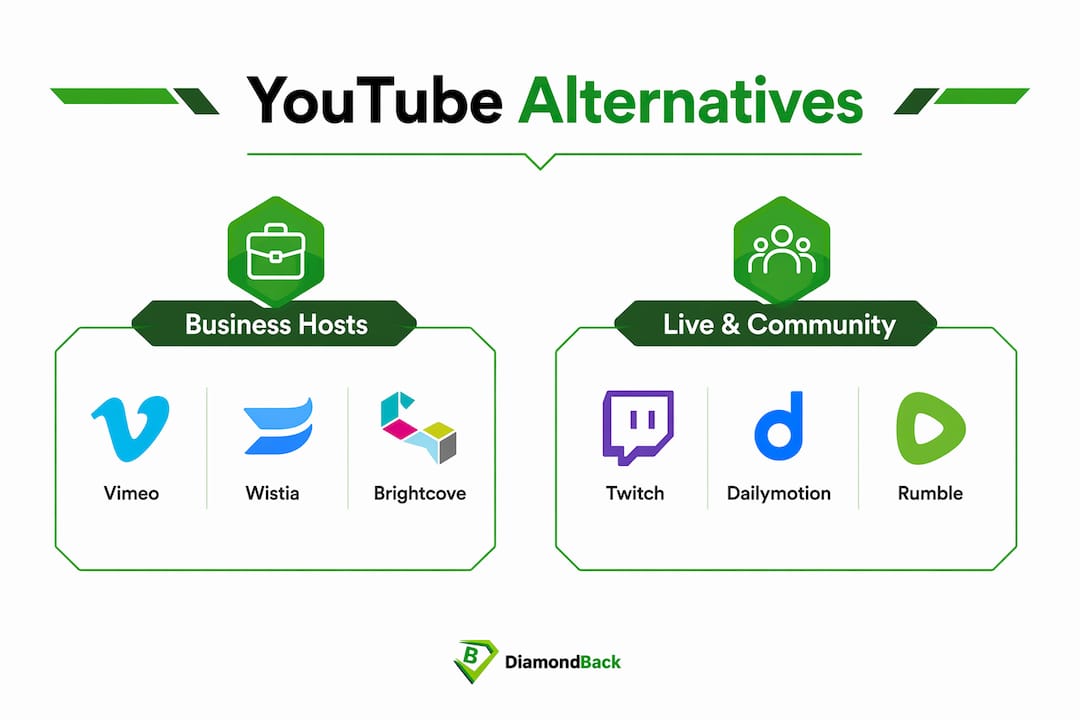
For insurance businesses and fleet operators, the best YouTube.com alternatives fall into five categories: business-hosted platforms (Vimeo, Wistia, Brightcove, Vidyard), live and community platforms (Twitch), social video platforms (Dailymotion, Rumble), decentralized networks (Odysee/LBRY, PeerTube), and privacy-focused aggregators. Your choice depends on whether you need CRM-connected lead capture, secure onboarding video, internal training, or broad discovery reach.
Here is a fast-action shortlist by job-to-be-done:
- Business-hosted video (Vimeo, Wistia, Vidyard): Best for customer-facing product demos, secure embeds, and CRM-integrated lead capture. These platforms remove competitor ads and track viewer behavior down to the second.
- Live and community (Twitch): Best for real-time Q&A sessions, claims support webinars, and community engagement where audience interaction drives trust.
- Social video (Dailymotion, Rumble): Best for broad reach and supplemental discovery when you want algorithmic exposure without full YouTube dependency.
- Decentralized networks (Odysee, PeerTube): Best for content ownership, censorship resilience, and audiences who prioritize platform independence.
- Privacy-focused aggregators: Best for internal training distribution where tracking cookies and recommendation algorithms must be removed entirely.
Three signals that tell you your next step: if you have high-value onboarding or policy-explainer videos, pilot a business host with a free tier first. If you run live Q&A for fleet managers, test a live platform alongside your existing setup. If you share sensitive claims or training content, move those assets behind passworded links on a business host before anything else.
Table of Contents
- What types of YouTube alternatives should you consider?
- How do you choose the right platform for your business?
- Top YouTube.com alternatives compared by business use case
- How do you migrate away from single-platform dependency?
- What does it cost, and how long does setup take?
- Which platform should you pick for each insurance job?
- Key Takeaways
- Why platform loyalty is a liability, not a strategy
- Useful sources and further reading
What types of YouTube alternatives should you consider?
Platform selection depends on your business intent, and each category serves a distinct function.
Business-hosted platforms (Vimeo, Wistia, Brightcove, Vidyard) operate on subscription or tiered-fee models. They remove ads, block competitor recommendations, and provide analytics tied to your CRM and marketing stack. For insurance businesses, this category is the primary workhorse for customer-facing and internal content.
Live and community platforms (Twitch) prioritize real-time interaction. They suit live claims Q&A, agent training sessions, and community-building events where audience participation matters more than polished production.
Social video platforms (Dailymotion, Rumble) offer algorithmic discovery and broad reach. They are best used as secondary distribution channels, not primary repositories, because you own none of the audience data.
Decentralized networks (Odysee/LBRY, PeerTube) give you content ownership and resilience against policy changes or deplatforming. Trade-offs include smaller audiences and less polished analytics.
Privacy-focused aggregators proxy video playback, strip tracking cookies, and suppress recommendation algorithms. They work well for internal training distribution where employee privacy or regulatory compliance is a concern.
How do you choose the right platform for your business?
The best starting point is a mixed strategy: own your primary video repository on a business host, then use one or two external platforms for reach and community. B2B platforms shift the KPI from views to conversions, which is exactly the right frame for insurance marketing.
Evaluate every platform against these seven criteria:
- Discoverability and algorithmic reach: Does the platform surface your content to new audiences, or does it require you to drive all traffic yourself? Social platforms win here; business hosts do not.
- Monetization and revenue model: Can you gate content, run direct subscriptions, or capture leads? Business hosts and some decentralized platforms support this; ad-based platforms do not.
- Data ownership and export: Can you export your video files, viewer logs, and analytics at any time? Confirm this before committing to any platform.
- Analytics and CRM integrations: Does the platform support embed tracking, UTM parameters, and direct integrations with HubSpot, Salesforce, or your marketing automation tool? For insurance lead funnels, this is non-negotiable.
- Privacy and sharing controls: Does the platform support password protection, private links, and SSO? These features are required for onboarding and claims-related content.
- Content moderation and policy risk: Review the platform’s terms of service carefully. Understand what triggers demonetization or removal, and whether appeals are available.
- Live streaming and community features: Does the platform support scheduled live events, chat moderation, and replay hosting?
On pricing and contracts: ask enterprise vendors about SLA uptime guarantees, support response times, and whether bandwidth overages are billed separately. Many business hosts offer annual discounts compared to monthly billing.
Top YouTube.com alternatives compared by business use case
The primary pick for business-hosted video is Vimeo or Wistia. For live and community, Twitch leads. For decentralized ownership, Odysee and PeerTube are the main options.
| Platform | Best For | Pricing Shape | Monetization | Discoverability | Moderation Risk | Analytics & Integrations | Data Portability | Live Streaming |
|---|---|---|---|---|---|---|---|---|
| Vimeo | Business hosting, secure embeds | Freemium to enterprise | Subscriptions, paywalls, lead capture | Low (owned traffic) | Low | Advanced, CRM-ready | Full export | Yes |
| Wistia | B2B lead capture, CRM funnels | Freemium to SaaS tiers | Lead forms, email gates | Very low | Very low | Deep, HubSpot/Salesforce | Full export | Yes (Channels) |
| Brightcove | Enterprise broadcast, LMS | Enterprise licensing | Ad monetization, paywalls | Low | Low | Enterprise-grade | Full export | Yes |
| Vidyard | Sales and marketing video | Freemium to SaaS tiers | Lead capture, CRM triggers | Very low | Very low | Sales-stack integrations | Full export | Limited |
| Twitch | Live Q&A, community events | Free (revenue share) | Subscriptions, bits, ads | High (live) | Moderate | Basic | Limited | Yes (core feature) |
| Rumble | Broad reach, free-speech content | Free to revenue share | Ad revenue share | Moderate | Low | Basic | Limited | Yes |
| Odysee (LBRY) | Decentralized ownership | Free to tipping | Crypto tips, memberships | Low-moderate | Very low | Basic | Full (blockchain) | Yes |
| Dailymotion | Supplemental discovery | Free to partner | Ad revenue, partner program | Moderate | Moderate | Basic | Limited | Limited |
| PeerTube | Self-hosted, privacy-first | Free (self-hosted) | None native | Very low | Self-governed | Basic | Full (self-hosted) | Yes (with plugins) |
Vimeo offers ad-free playback, SSO, granular privacy controls, and embeddable player customization. For insurance businesses, the ability to password-protect policy-explainer videos and track viewer drop-off by chapter is a direct revenue tool. The main limitation is that Vimeo does not drive organic discovery.

Wistia is purpose-built for B2B lead capture. Its Turnstile email gate and HubSpot integration mean a fleet manager watching your onboarding video can be pushed directly into a nurture sequence. Pricing starts free with limits, scaling to paid tiers for advanced analytics.
Brightcove targets enterprise broadcasters and LMS operators. It handles high-volume video delivery with enterprise SLAs. The cost is higher than Vimeo or Wistia, but the uptime guarantees and support response times justify it for large fleets or national carriers.
Vidyard frames every video as a sales and marketing asset with CRM triggers and conversion analytics. It is the strongest choice when your sales team sends personalized video messages to prospects.
Twitch is the right call for live, interactive sessions. A weekly live Q&A for trucking clients builds community loyalty that recorded video cannot replicate. Moderation is moderate, so review content policies before going live with insurance-specific claims.
Rumble provides broad reach with lighter moderation. It suits supplemental distribution of general educational content, though analytics are basic and data portability is limited.
Odysee (LBRY) runs on a blockchain-based protocol, giving you genuine content ownership. Monetization via crypto tips and memberships is growing, but the audience is still niche. Use it as a resilience layer, not a primary channel.
Dailymotion ranks globally and supports a Publishing Partner program for ad revenue. It is the closest structural analog to YouTube among the social video options, with a Similarweb global traffic rank of 200.
PeerTube is self-hosted, open-source, and fully under your control. There are no platform fees, no algorithmic interference, and no third-party data collection. The trade-off is that setup requires technical resources and ongoing server maintenance.
How do you migrate away from single-platform dependency?
Industry experts recommend running YouTube as a discovery channel while moving high-value assets to an owned business host. Keep YouTube for reach; protect your best content elsewhere.
Follow this migration sequence:
- Audit your existing video library (Week 1–2): Categorize assets by sensitivity and business value. Flag onboarding, claims training, and policy-explainer videos for immediate migration.
- Export and back up all assets (Week 2–3): Download original files from YouTube. Store backups in cloud storage independent of any video platform.
- Set up your business host with tracking (Week 3–4): Configure embed codes with UTM parameters, connect your CRM, and test viewer analytics before going live.
- Migrate high-value assets first (Weeks 4–12): Move sensitive and conversion-critical videos to the business host. Update all embed codes on your website and landing pages.
- Build a repurposing schedule (Ongoing): Publish short clips from long-form content to social and live platforms to drive traffic back to your owned assets.
- Update moderation playbooks (Week 6): Define comment policies and response protocols for each platform where you maintain a presence.
Pro Tip: When you update embed codes on existing pages, add 301 redirects from any old YouTube-linked landing pages and apply canonical tags where the same video content lives on multiple platforms. This preserves your inbound SEO value during the transition.
What does it cost, and how long does setup take?
Costs vary significantly by platform type. Social platforms are free to start; business hosts run on subscription models; enterprise platforms require custom licensing.
| Platform Type | Approximate Monthly Cost | Setup Time | Key Cost Drivers |
|---|---|---|---|
| Social / free video (Rumble, Dailymotion, Odysee) | — | 1–3 days | None; revenue share on ads |
| Small-business SaaS host (Vimeo, Wistia, Vidyard) | — | 1–2 weeks | Storage, bandwidth, seat count |
| Enterprise host (Brightcove) | — | 4–8 weeks | SLA, SSO integration, support tier |
| Self-hosted (PeerTube) | Server costs only | 2–6 weeks | Technical staff, server maintenance |
Recurring cost drivers to budget for include bandwidth overages, additional storage tiers, SSO integration fees, and premium support response SLAs. CRM integration setup typically adds one to two weeks of developer time on top of the platform’s own onboarding.
Which platform should you pick for each insurance job?
Use an owned business host as your primary video repository, then add one external platform for reach or community. Here is how that maps to common insurance jobs:
- Customer onboarding: Business-hosted video with passworded links and SSO (Vimeo or Wistia). Privacy controls protect sensitive policy information, and analytics track completion rates for conversion attribution.
- Lead capture from educational content: Wistia with a Turnstile email gate connected to your CRM. Every view becomes a trackable lead event. Pair this with your online quote funnel for maximum conversion.
- Fleet manager training: Business host with private links and viewer-log export for compliance records. Brightcove or Vimeo Enterprise handles high-volume internal distribution.
- Live claims Q&A: Twitch or a live-capable business host. Real-time interaction builds trust faster than recorded content.
- Community and brand awareness: Dailymotion or Rumble for supplemental reach. Publish repurposed short clips and link back to your owned assets.
- Decentralized content backup: Odysee or PeerTube as a resilience layer. If your primary platform changes its policies, your content and audience data remain intact.
Key Takeaways
A mixed strategy combining an owned business host with one or two external platforms gives insurance businesses the best balance of privacy, analytics, and reach.
| Point | Details |
|---|---|
| Own your primary repository | Host high-value and sensitive videos on a business platform with SSO and analytics, not on a social platform. |
| Match platform to job | Use Wistia or Vimeo for lead capture and onboarding; use Twitch or Dailymotion for live Q&A and discovery. |
| Migrate incrementally | Audit and export assets first, then migrate high-value content over 6–12 weeks while keeping YouTube for reach. |
| Budget realistically | Small-business SaaS hosts typically run on a moderate monthly subscription basis; enterprise platforms require custom or higher pricing. |
| Diversify for resilience | Running two or three platforms concurrently protects your content and audience if one platform changes its policies. |
If your priority is high-intent lead conversion for trucking or fleet insurance, Diamondbackins offers instant commercial truck insurance quotes that pair directly with a video-driven lead funnel. Review the fleet manager’s coverage guide to see how explainer video content maps to real buyer decisions.
Why platform loyalty is a liability, not a strategy
The conventional wisdom says “go where your audience is.” That is sound advice for discovery, but it becomes a liability the moment you treat a single platform as your video infrastructure. Every algorithm change, policy update, or account suspension on a platform you do not own is a direct threat to your marketing funnel and your customer relationships.
The businesses I see getting the most measurable ROI from video are not the ones with the biggest YouTube channels. They are the ones who host their best content on a platform they control, use CRM integrations to tie every view to a pipeline stage, and treat social and live platforms as traffic drivers rather than destinations. Creators and businesses that use multiple platforms concurrently build resilience that single-platform operators simply cannot match.
For insurance businesses specifically, the stakes are higher than for most. Onboarding videos, claims walkthroughs, and policy explainers contain sensitive information. Hosting that content on a platform that can serve competitor ads alongside your video, or remove your content without warning, is an operational risk. Owned hosting is not a premium feature. It is a basic requirement for any business that takes its customer relationships seriously.
Useful sources and further reading
- Vimeo: Full-featured business video host with ad-free playback, SSO, privacy controls, and CRM-ready analytics.
- Vidyard blog: best video hosting platforms: Comparison of top video hosting options with a B2B and sales-stack focus.
- Mediacube: beyond YouTube: Practical guide to multi-platform strategies for creators and businesses scaling beyond a single channel.
- Flozic: YouTube alternatives ranked: Ranked comparison of alternatives by business intent, monetization, and ownership.
- Fourthwall: 13 best YouTube alternatives: Platform-by-platform breakdown covering decentralized, niche, and live-streaming options.
- Indeed: video sharing sites and their benefits: Overview of major video platforms with monetization and audience notes.
- Wikipedia: list of online video platforms: Comprehensive reference covering traffic rankings, language support, and platform categories.
- SimpleerTube: Privacy-focused video aggregator that proxies playback, removes tracking cookies, and strips recommendation algorithms.
- Diamondbackins: trucking insurance explained: Core educational resource for fleet managers evaluating coverage options.
- Diamondbackins: freight insurance online: Explains how instant online quotes and digital workflows speed up commercial insurance purchases.
Recommended
- Top 3 Sources for onebluerealestateschool.com Alternatives 2026
- Where to Get Workers’ Compensation Insurance A Guide for Business Owners – Diamondback Insurance – Solutions with Instant Online Quotes
- Top 3 Sites for myfullcoverage.com Alternatives 2026
- CoverageDiamond.com Alternatives: Faster, Transparent Quotes