

If your fleet operates terminals, maintenance shops, or vehicle storage in any flood-prone region, the single most important step you can take today is to buy a private excess flood policy sized to your full reconstruction and replacement costs. Standard NFIP commercial policies cap building and contents at $500,000 each, a threshold many fleet facilities exceed before you even count parked vehicle value and specialized shop tooling. Moody’s analysis puts the U.S. flood insurance protection gap at 65%, with potential uninsured losses exceeding $375 billion from a 1-in-100-year event. That exposure is not hypothetical for trucking operations concentrated at a single terminal.
Your immediate next steps: gather replacement-cost figures for every facility, compile a site inventory of vehicles and equipment values, then request tailored excess flood quotes through Diamondbackins. Do not wait for a storm forecast to start this process.
-
NFIP commercial limits are $500,000 per building and $500,000 per contents, often far below a fleet terminal’s true exposure.
-
Moody’s finds the national flood insurance protection gap now stands at 65%.
-
Private excess flood policies fill the shortfall above NFIP or primary property limits and can run continuously even during NFIP lapses.
-
Diamondbackins aggregates quotes from multiple carriers so you can compare excess flood options in minutes.
Table of Contents
- What is gap coverage flood insurance for commercial fleets?
- Why does the flood insurance gap persist for fleet operators?
- What do fleet-oriented excess flood policies typically cover?
- How do you size excess flood limits and what drives the premium?
- What documents and questions do you need to get quotes and bind coverage?
- Diamondbackins makes closing your fleet’s flood gap faster
- Key Takeaways
- The flood risk most fleet managers underestimate
- Authoritative sources to verify flood coverage facts
What is gap coverage flood insurance for commercial fleets?
Gap coverage flood insurance, more precisely called excess flood insurance in commercial settings, is a private policy that sits above your NFIP policy or primary property policy to cover losses that exceed those base limits. For fleet operators, it addresses the shortfall between what your foundational coverage pays and what it actually costs to rebuild a terminal, replace shop equipment, and account for stored vehicle losses.
How the layers work:
- NFIP commercial policy pays first, up to $500,000 for the building and $500,000 for contents. Most standard business property policies exclude flood entirely, so the NFIP is often the only first-layer protection.
- Primary private flood policy (if purchased instead of or alongside NFIP) pays up to its stated limit for direct flood damage to the building and contents.
- Excess/gap flood policy activates once the underlying limit is exhausted, covering rebuilding costs, contents, specialized equipment, and optional extensions up to the agreed excess limit.
Policy trigger distinctions matter for fleets. Most excess flood policies trigger on a “flood event,” defined as surface water overflowing onto normally dry land. Sewer backup is a separate peril and requires its own endorsement. If your terminal sits near a drainage system, confirm whether your policy covers backup-driven flooding or only direct inundation.
Short policy glossary:
- Per-location building limit: the maximum the excess policy pays for structural damage at a single site.
- Per-vehicle storage extension: a sub-limit covering vehicles physically stored at the insured location during a flood event.
- Sub-limits vs. aggregate limits: sub-limits cap individual categories (e.g., electronics, inventory); aggregate limits cap total payout across all categories for one event.
- Waiting period: the delay between policy purchase and when coverage becomes active.
Private excess policies also offer a continuity advantage: they can write new and renewal business even during NFIP lapses, which matters if your NFIP policy lapses during a government funding gap.
Why does the flood insurance gap persist for fleet operators?
The structural causes are well-documented, and fleet managers are among the most exposed because of how they concentrate high-value assets at fixed locations.
FEMA’s Special Flood Hazard Area (SFHA) maps are the primary tool mortgage lenders and many risk managers use to assess flood exposure. The problem, as Moody’s analysts conclude, is that these maps are backward-looking and binary. They do not account for storm surge, sea-level rise, or extreme short-duration rainfall events. A terminal located just outside a mapped SFHA is not necessarily safe; it simply has not been mapped as high-risk yet.
“Uninsured losses arise not from isolated outliers, but from persistent gaps between expanding flood hazards — particularly beyond regulatory flood maps that dictate mortgage requirements — and insurance take-up.” — Moody’s whitepaper on the U.S. flood insurance gap
Congressional analysis confirms that NFIP’s mandatory-purchase rules concentrate coverage in mapped zones, leaving inland and peri-urban fleet facilities systematically underinsured. Neptune Flood research estimates that approximately two-thirds of expected annual flood losses to single-family structures are uninsured, and commercial properties outside SFHAs face comparable exposure rates.
Three myths fleet managers rely on at their peril:
“We’re outside the SFHA, so we’re covered.” Being outside a mapped flood zone means the NFIP does not require you to carry flood insurance. It does not mean you face no flood risk. Hurricane Helene’s 2024 flooding in Asheville, North Carolina, a 1-in-1,000-year rainfall event, hit a county with an 88% flood insurance protection gap.

“Our commercial property policy covers flood losses.” Standard commercial property policies exclude flood as a named peril. Without a separate flood policy, a flood loss to your building and contents is uninsured regardless of your property coverage limits.
“The NFIP is enough for our terminal.” At $500,000 per building and $500,000 per contents, the NFIP cap is frequently insufficient for a fleet maintenance facility with specialized lifts, diagnostic equipment, parts inventory, and parked vehicles.
What do fleet-oriented excess flood policies typically cover?
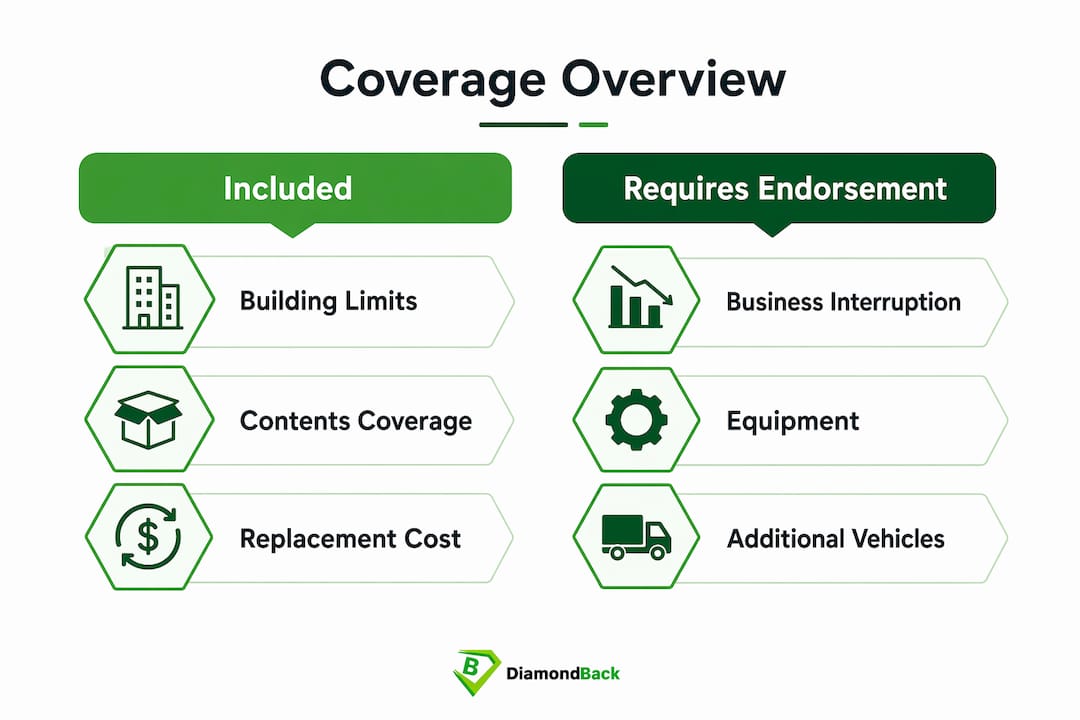
The coverage matrix below gives you a working reference when reviewing quotes. Use it to identify what a policy includes by default versus what requires an endorsement.
| Coverage Category | Typically Included | Usually Requires Endorsement |
|---|---|---|
| Increased building limits (above NFIP) | Yes | No |
| Contents and inventory | Yes | No |
| Specialized shop equipment | Yes (check sub-limits) | Sometimes |
| Vehicle storage extension | No | Yes |
| Business interruption / extra expense | No | Yes |
| Debris removal | Yes (sub-limit applies) | No |
| Outdoor equipment / landscaping | No | Rarely available |
| Sewer backup | No | Yes |
Business interruption is excluded from standard NFIP policies and is not automatic in private excess policies either. You must request it as an add-on and confirm the waiting period and indemnity period in the policy language.
Pro Tip: Always insist on replacement-cost valuation, not actual cash value (ACV). ACV deducts depreciation, which can leave a 10-year-old maintenance building significantly underinsured. Confirm how valuation is defined in the policy language before binding.
Advances in catastrophe modeling, including tools like Moody’s RMS US Inland Flood HD model, now allow private insurers to price risk outside SFHAs with greater precision, which means more tailored excess products are available for fleet facilities in moderate-risk areas than were accessible five years ago.
How do you size excess flood limits and what drives the premium?
The sizing rule is straightforward: use current total reconstruction cost, not market value or purchase price. Latent Insurance guidance is explicit that basing excess limits on reconstruction costs is the only way to prevent recreating the gap the excess layer is meant to close.
Sample calculation for a single terminal:
| Asset Category | Example Value |
|---|---|
| Building reconstruction cost | $1,580,000 |
| Shop equipment and lifts | $500,000 |
| Peak stored vehicle value (10 units × $75,000) | $500,000 |
In this example, the NFIP pays the first $500,000 on building and $500,000 on contents. The excess policy needs to cover the remaining $1,580,000 plus the vehicle storage extension. Copying your primary property limit into the excess layer without this recalculation is the most common and costly mistake fleet managers make, per industry sizing guidance.
Pricing drivers underwriters weigh for fleet facilities include flood hazard zone (beyond FEMA classification), site elevation, historical claims at the location, concentration of assets at a single site, whether business interruption is included, deductible structure, and mitigation features such as flood barriers or elevated electrical systems. Understanding how insurers price transportation risk helps you present your facility in the best light when requesting quotes.
What documents and questions do you need to get quotes and bind coverage?
Documents to prepare before requesting quotes:
- Site inventory: list of vehicles with individual values, keyed to each storage location.
- Replacement-cost estimates for each building (appraisal or contractor estimate preferred).
- Elevation certificates, if available for your sites.
- Prior loss history for all locations (five years minimum).
- Current AOP/commercial property schedule showing existing limits.
- NFIP policy declarations page, if a policy is currently in force.
Questions to ask every insurer or broker:
- How is valuation defined: replacement cost or ACV?
- What event triggers the policy, and is sewer backup included or excluded?
- Is vehicle storage covered, and what is the per-vehicle sub-limit?
- What is the waiting period before coverage activates?
- How are aggregation and concentration treated if multiple sites flood simultaneously?
Timeline to bind excess flood coverage:
| Step | Typical Duration |
|---|---|
| Quote request and document submission | 1–2 business days |
| Underwriting review and questions | 3–5 business days |
| Revised quote and negotiation | 1–3 business days |
| Binder issuance | Same day to 1 business day |
| Total (private market) | 10–15 business days |
The NFIP enforces a 30-day waiting period for new policies. Private-market excess policies commonly reduce that wait to 10–15 days, but neither is instantaneous. Plan ahead of peak hurricane and heavy-rain seasons rather than reacting to a forecast. For fleets operating in hurricane-prone regions, reviewing your hurricane season preparedness alongside your flood coverage timeline is a practical step many operators overlook.
Diamondbackins makes closing your fleet’s flood gap faster
Fleet operators dealing with multiple sites, specialized equipment schedules, and vehicle storage exposure need tailored quotes, not generic online forms. Diamondbackins aggregates excess flood options from multiple carriers so you can compare policy terms, endorsements, and limits side by side without calling five brokers.

The platform guides you through replacement-cost inputs and site inventory uploads, then surfaces quotes that reflect your actual exposure rather than a generic commercial property profile. For fleet managers who need flood coverage options built around trucking and terminal operations specifically, that specificity matters at claim time. You can also review service truck coverage options alongside your flood gap policy to build a complete protection program in one session. Start your tailored excess flood quote at Diamondbackins today and have a binder in hand before the next storm season.
Key Takeaways
Private excess flood insurance is the only reliable way for commercial fleets to close the gap between NFIP limits and actual reconstruction costs.
| Point | Details |
|---|---|
| NFIP caps create real exposure | NFIP commercial policies top out at $500,000 each for building and contents, far below most terminal values. |
| Size to reconstruction cost | Base excess limits on full rebuild cost plus peak stored vehicle value, not market value or purchase price. |
| Private policies run during NFIP lapses | Excess private flood coverage stays active even when NFIP funding gaps interrupt federal program renewals. |
| Buy before storm season | NFIP requires a 30-day wait; private markets often reduce that to 10–15 days, but neither covers a storm already forming. |
| Diamondbackins for tailored quotes | Diamondbackins aggregates excess flood quotes from multiple carriers for fleet-specific coverage comparison and fast binding. |
The flood risk most fleet managers underestimate
Most fleet managers think about flood insurance the way they think about earthquake coverage: a specialized add-on for operators in obviously high-risk zones. That framing is the problem. The Moody’s data show a significant national protection gap and large potential uninsured losses from a 1-in-100-year event, driven by operators in flood-prone areas beyond mapped zones. It is driven by operators who trusted a FEMA map that was never designed to capture the full range of modern flood hazards.
For fleet operations specifically, the concentration risk is acute. A single terminal with 20 vehicles, a maintenance shop, and a parts warehouse can represent $3 million or more in replacement exposure at one address. When to escalate beyond a standard quote request: if your aggregate exposure at one site exceeds $2 million, if you carry specialized equipment not listed on standard commercial property schedules, if you have had prior flood claims, or if a business-interruption analysis shows material revenue at risk from a multi-week shutdown. In those cases, involve your risk manager, a specialist broker familiar with excess flood markets, and potentially a structural engineer who can document mitigation features that reduce your premium. Have your site inventory, replacement-cost appraisals, and five-year loss history ready before that conversation.
Authoritative sources to verify flood coverage facts
Use these primary sources to validate policy language, NFIP limits, and market analysis when reviewing quotes:
- FEMA Flood Insurance overview: official program details, community participation requirements, and NFIP policy structure.
- FloodSmart / NFIP policy limits: confirms the $500,000 commercial building and contents caps and how to buy a policy.
- Moody’s U.S. flood insurance gap analysis: SFHA mapping limitations, the 65% protection gap, and private-market modeling advances.
- Neptune Flood underinsurance research: macro data on uninsured flood losses and the scale of the coverage shortfall.
- Latent Insurance excess sizing guidance: reconstruction-cost methodology for sizing excess flood limits correctly.
- RedlineApp on NFIP waiting periods and private alternatives: waiting period comparisons and red flags to watch for in flood policy terms.
- Congress.gov CRS analysis on closing the flood insurance gap: regulatory context for NFIP participation rules and inland coverage gaps.