

An insurance underwriter is the professional responsible for assessing risk and deciding the terms under which an insurance policy is issued. The role of underwriters in insurance sits at the center of every coverage decision you receive, from the premium you pay to the exclusions buried in your policy. Underwriters evaluate applications, apply company guidelines, and weigh regulatory requirements to protect both the insurer and the policyholder. The Bureau of Labor Statistics reports a median annual pay of $79,880 for insurance underwriters, reflecting the technical skill and judgment the work demands.
What are the main responsibilities of insurance underwriters?
Underwriters are the final decision-makers in the insurance process. While brokers and agents gather your information and present options, underwriters hold final authority over whether coverage is actually accepted. That distinction matters more than most applicants realize.
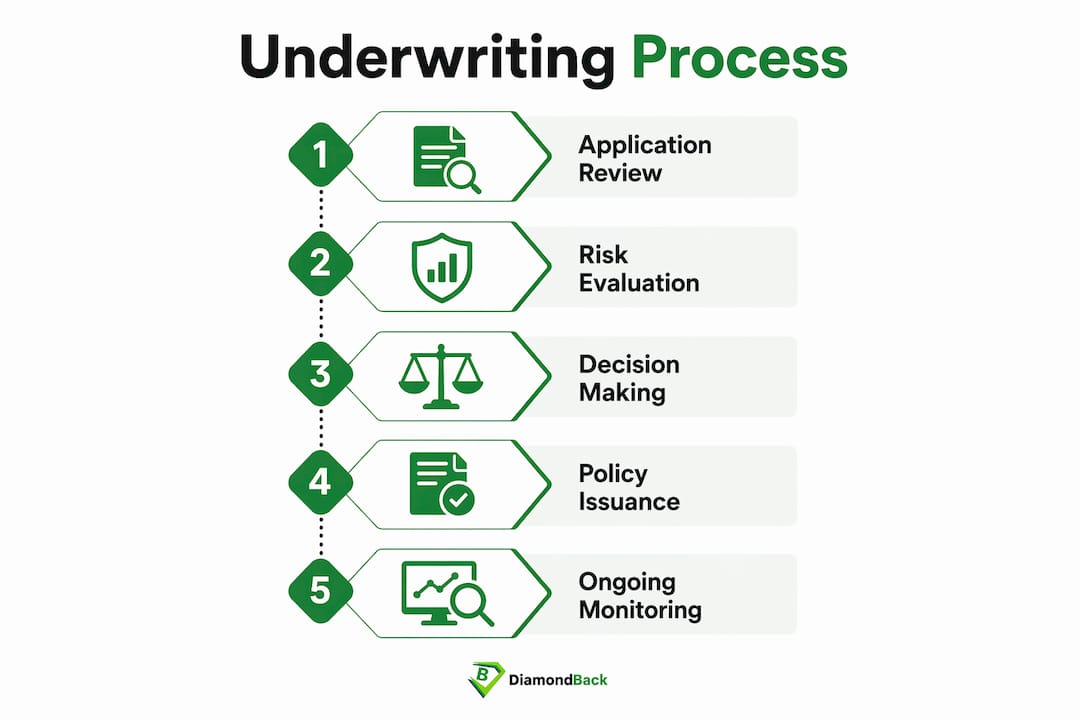
The core of the underwriting process in insurance involves reviewing submitted documentation, applying risk guidelines, and reaching one of three outcomes. After completing their review, underwriters either approve at standard rates, approve with modified terms, or decline coverage based on how the applicant’s risk profile compares to company guidelines. Each outcome carries real consequences for your premium, your deductibles, and the scope of your protection.

Beyond the decision itself, underwriters manage submission prioritization, handle exceptions, and collaborate with distribution teams. Strong logical reasoning and operational discipline separate effective underwriters from average ones. They are not simply rule-followers. They synthesize company policy, state law, broker input, and raw risk data into a single defensible decision.
Technology plays a growing part in this workflow. Automated systems now handle routine, lower-risk submissions, freeing underwriters to focus on complex cases. That shift is one reason the Bureau of Labor Statistics projects a 3% employment decline in underwriting through 2034. Fewer people will process more policies, but the judgment calls on difficult risks will still require human expertise.
Pro Tip: When you submit an insurance application, treat it like a job interview. Incomplete or disorganized submissions slow the validation stage and can result in modified terms or outright declines. Organized, complete documentation is your best tool for a favorable outcome.
How do underwriters assess risk across different insurance types?
Risk assessment looks different depending on the type of insurance involved. Property and casualty underwriters focus heavily on physical exposure, location data, and loss history. Commercial insurance adds another layer of complexity, pulling in financial statements, industry classification, and operational details that a personal lines underwriter would never need.
For property coverage, standard documentation requirements include a site map, a statement of values per structure, prior loss history, and current replacement cost estimates. Each document answers a specific question about exposure. The site map shows proximity to flood zones or fire hazards. The loss history reveals patterns that raw property data cannot.
The role of underwriters in flood insurance deserves specific attention. Flood risk assessment requires underwriters to analyze Federal Emergency Management Agency flood zone maps, elevation certificates, and historical claims data for the surrounding area. A property sitting in a Zone AE carries a fundamentally different risk profile than one in Zone X, and the underwriter’s job is to price that difference accurately.
Health and life insurance underwriting shifts the focus to the individual. Medical history, prescription records, and behavioral data all factor into the assessment. Commercial underwriting for trucking and transportation adds yet another dimension, requiring review of driver records, vehicle maintenance logs, cargo types, and operating radius.
| Insurance type | Primary risk factors reviewed |
|---|---|
| Property and casualty | Location, loss history, replacement cost, flood zone |
| Health and life | Medical history, age, behavioral data, prescriptions |
| Commercial trucking | Driver records, cargo type, operating radius, vehicle condition |
| General commercial | Financial statements, industry classification, claims history |
Actuarial models support the underwriter’s judgment but do not replace it. Models generate probability estimates. Underwriters apply those estimates to the specific facts of each submission and make the call.
What regulatory and legal limits shape the underwriting role?
Underwriting does not happen in a legal vacuum. Federal and state laws define what information underwriters can use, how they must communicate decisions, and what protections applicants hold throughout the process.
The Fair Credit Reporting Act is one of the most significant federal constraints on underwriting decisions. When an underwriter takes an adverse action based on a consumer report, such as denying coverage or increasing a premium, applicants must receive formal notification under FCRA requirements. That notification must identify the consumer reporting agency used and explain the applicant’s right to request a free copy of the report.
State regulations add another layer of complexity. Each state maintains its own rules on permissible rating factors, required disclosures, and prohibited underwriting criteria. An underwriter working across multiple states must track and apply different rule sets for each jurisdiction. That multi-state complexity is one reason underwriting governance relies on documented referral processes and exception handling protocols.
Anti-discrimination rules restrict the use of certain personal characteristics in underwriting decisions. Race, religion, national origin, and gender are prohibited factors in most lines of coverage. Some states extend those protections further, limiting the use of credit scores or zip codes as rating inputs. Underwriters must stay current on these restrictions because violations carry regulatory penalties and can expose the insurer to litigation.
Pro Tip: If you receive an adverse action notice after an insurance application, request your consumer report immediately. Errors in credit or claims history reports are more common than most people expect, and correcting them can reverse an unfavorable underwriting decision.
How do underwriters affect pricing, policy terms, and risk management?
Underwriting is the engine behind insurance pricing. Every premium you pay reflects an underwriter’s judgment about the likelihood and cost of a future claim. Get that judgment wrong in either direction and the consequences ripple through the entire portfolio.
Underwriters set premiums, deductibles, limits, and exclusions to align new business with the insurer’s risk appetite. They also manage accumulation risk, which is the danger that too many policies in a single geographic area or industry segment create concentrated exposure. A commercial trucking insurer that writes too many long-haul carriers in hurricane-prone coastal routes faces accumulation risk that no single policy’s premium can offset.
Effective underwriting reduces policy corrections, coverage disputes, and portfolio volatility. Poor underwriting does the opposite. When terms are set incorrectly at the point of sale, the problems surface at claim time. That is when coverage gaps, ambiguous exclusions, and mispriced deductibles become expensive disputes. The underwriter’s accuracy at the front end determines the quality of the claims experience at the back end. For trucking businesses, this connection is direct. You can learn more about how insurers shape transportation risk and what that means for your fleet’s coverage costs.
Tiered authority levels govern how decisions get made on complex submissions. Junior underwriters or automated systems handle straightforward cases. Risks that fall outside standard guidelines move up to senior underwriters or underwriting committees. That escalation process adds time, which is why submission quality matters so much. A clean, complete submission moves through the standard track. A disorganized one triggers referrals and delays.
Providing high-quality, organized data upfront helps underwriters move submissions through the validation stage faster. Validation, the process of verifying that submitted information is complete and consistent, is the most common bottleneck in the underwriting workflow. Businesses that understand this submit better packages and get faster, more accurate quotes as a result. Reviewing your trucking insurance underwriting guidelines before you apply is one of the most practical steps you can take.
Key Takeaways
Underwriters are the central decision-makers in insurance, and the quality of their work directly determines your premium, your coverage terms, and your claims experience.
| Point | Details |
|---|---|
| Underwriters hold final authority | Brokers present options, but underwriters approve, modify, or decline coverage. |
| Three possible outcomes | Every application results in standard approval, modified approval, or a decline. |
| Documentation quality matters | Complete, organized submissions move faster and produce more accurate quotes. |
| Regulations protect applicants | FCRA and state laws require adverse action notices and restrict discriminatory rating factors. |
| Underwriting accuracy drives stability | Poor underwriting creates coverage disputes and portfolio volatility that surface at claim time. |
Why underwriters matter more than most people think
Most people assume their broker controls their coverage. That assumption costs them. I have seen businesses spend months negotiating with brokers over premium increases, only to discover that the underwriter flagged a loss history issue that no amount of broker advocacy could override. The underwriter’s decision was final, and it was final from the start.
The practical lesson is straightforward. Treat the underwriting submission as seriously as you treat the policy itself. Every document you provide, every loss narrative you include, and every piece of supporting data you attach shapes how the underwriter reads your risk. Incomplete submissions do not just slow the process. They invite assumptions, and underwriters fill information gaps conservatively.
Automation is changing the workflow, but it is not changing the fundamentals. Automated systems handle routine risks faster than any human could. Complex risks still require experienced judgment. For trucking and transportation businesses, that means your driver history, your cargo types, and your safety record all land on a real underwriter’s desk. Understanding what they look for gives you a genuine advantage when you go to market for coverage.
The future of underwriting will involve more data, faster decisions, and tighter integration between actuarial models and underwriter judgment. What will not change is the core function: someone has to decide whether your risk is worth taking, and at what price. That decision shapes everything else in your insurance relationship.
— Vladimir
Diamondbackins and commercial trucking coverage
Commercial trucking insurance involves some of the most detailed underwriting in the industry. Driver records, cargo classifications, operating territories, and vehicle maintenance histories all feed into the underwriter’s assessment. Getting that assessment right means submitting the right information from the start.

Diamondbackins works with multiple top-rated insurers to generate instant, tailored quotes for trucking and transportation businesses. The platform gives you access to competitive options without the back-and-forth of traditional broker submissions. Whether you operate a single truck or a full fleet, you can review commercial trucking insurance in Georgia or get instant trucking quotes that reflect real underwriting criteria. Knowing how underwriters evaluate your risk puts you in a stronger position to secure the right coverage at the right price.
FAQ
What does an insurance underwriter actually do?
An insurance underwriter reviews applications, evaluates risk factors, and decides whether to approve, modify, or decline coverage. They also set the premium, deductibles, and policy limits that reflect the insurer’s assessment of your risk.
Do underwriters make the final coverage decision?
Yes. Underwriters or authorized carrier officials hold final acceptance authority, not brokers or agents. Brokers present your submission, but the underwriter controls the outcome.
How do underwriters assess risk for commercial trucking?
Commercial trucking underwriters review driver records, vehicle condition, cargo types, operating radius, and loss history. Each factor influences the premium and the specific terms attached to the policy.
What is the role of underwriters in flood insurance?
Flood insurance underwriters analyze FEMA flood zone designations, elevation certificates, and historical loss data to price flood risk accurately. Properties in high-risk zones like Zone AE receive different terms than those in lower-risk areas.
What happens if an underwriter denies my application?
If an underwriter takes an adverse action based on a consumer report, federal law under the Fair Credit Reporting Act requires the insurer to notify you, identify the reporting agency used, and explain your right to request a free copy of that report.