

Policy underwriting is the process insurers use to evaluate risk, determine coverage eligibility, and set premium pricing before issuing a policy. Every insurance contract you receive, whether for a commercial truck, a warehouse, or a cargo shipment, exists because an underwriter reviewed your application and decided the insurer would accept that risk. Understanding how this process works puts you in a stronger position when applying for coverage, negotiating terms, or managing a fleet’s insurance costs. This guide breaks down the underwriting workflow, the main types, the risk factors that shape decisions, and what happens to your policy after it is issued.
What is policy underwriting and why does it matter?
Policy underwriting is defined as the systematic evaluation of an applicant’s risk profile to decide whether an insurer will provide coverage and at what price. The word “underwriting” traces back to Lloyd’s of London, where early insurers would literally write their names under a risk description to signal acceptance. Today, the process is far more structured, but the core function remains the same: align risk with price so the insurer stays financially stable and the policyholder pays a fair premium.
The importance of underwriting extends beyond pricing. Underwriters also determine coverage limits, exclusions, and any special conditions attached to a policy. For a trucking business, this means the underwriter’s decision directly affects your liability limits, cargo coverage, and whether certain routes or cargo types are excluded. Underwriting assigns each applicant to a risk tier using actuarial data, statistical modeling, and detailed risk evaluation. That tier determines everything from your deductible to whether coverage is offered at all.

For most applicants, underwriting happens invisibly after submission but before final quotes arrive. It is the mechanism that connects your specific risk profile to a premium that reflects it accurately.
How does the policy underwriting process work?
The standard underwriting workflow follows five core steps: application review, data verification, information follow-up, risk classification, and a final coverage decision. Each step builds on the last, and skipping or rushing any one of them increases the insurer’s exposure to unexpected losses.
Step 1: Application review. The underwriter reads your submitted application and flags any gaps, inconsistencies, or high-risk indicators. For commercial vehicle coverage, this includes driver records, vehicle types, and operating radius.
Step 2: Data verification. The insurer cross-checks your application against third-party databases. Common sources include the Comprehensive Loss Underwriting Exchange (CLUE), Motor Vehicle Records (MVRs), and federal safety databases like the FMCSA’s Safety Measurement System. Discrepancies between your application and these records trigger additional scrutiny.
Step 3: Information follow-up. If data is missing or contradictory, the underwriter contacts you or your broker for clarification. Delays at this stage are the most common reason underwriting takes longer than expected.
Step 4: Risk classification. The underwriter assigns your application to a risk category. This classification drives premium pricing, coverage terms, and any conditions attached to the policy.
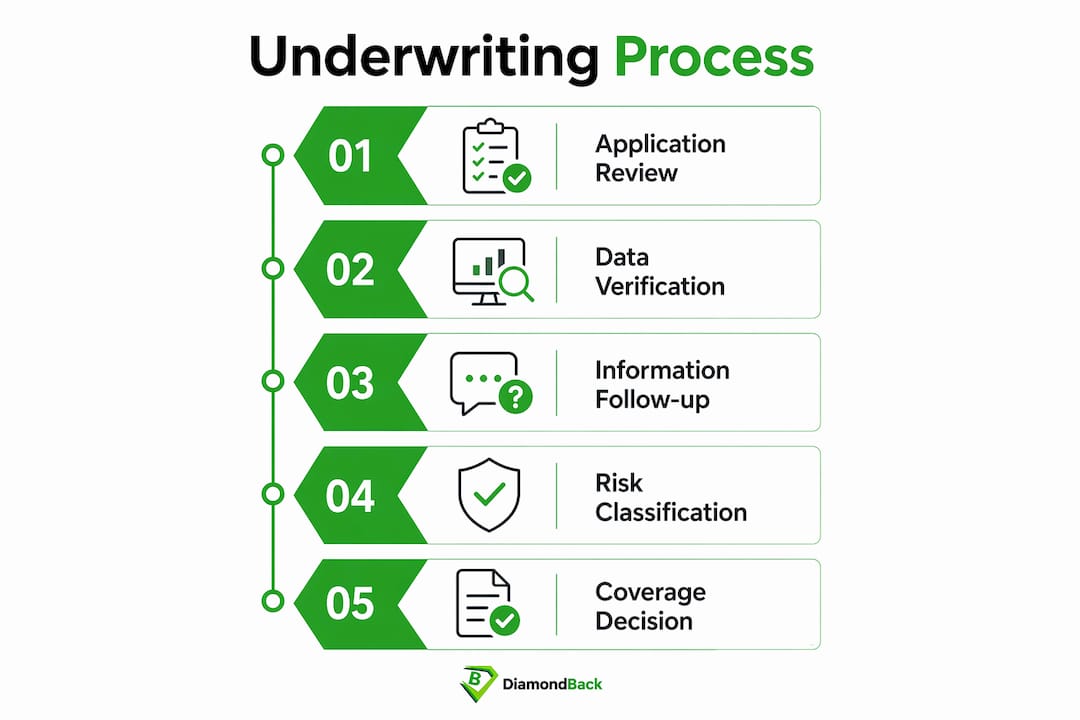
Step 5: Coverage decision. The insurer issues one of three outcomes: an offer at standard or modified terms, a counteroffer with adjusted premiums or exclusions, or a decline. Automated lines can produce decisions within days. Traditional commercial underwriting can take several weeks.
Pro Tip: Gather your MVR reports, loss runs from the past three to five years, and vehicle schedules before submitting any commercial insurance application. Complete submissions move through underwriting faster and reduce the chance of a counteroffer.
What are the types of policy underwriting?
The four main underwriting approaches differ in depth, speed, cost, and who qualifies. Knowing which type applies to your situation helps you set realistic expectations for premiums and processing time.
| Underwriting Type | Coverage Limits | Premium Level | Application Requirements |
|---|---|---|---|
| Full (traditional) | Highest available | Lowest | Full medical or operational review, extensive documentation |
| Simplified issue | Moderate | Moderate | Short questionnaire, no medical exam |
| Guaranteed issue | Lowest | Highest | No questions, acceptance guaranteed |
| Accelerated/automated | Varies | Competitive | Algorithm-driven, near-instant decision |
Full underwriting is the most thorough approach. Insurers collect complete health records, operational histories, or financial data depending on the line. The process takes the longest but produces the most accurate risk picture, which is why it typically yields the lowest premiums for well-qualified applicants.
Simplified issue underwriting removes the medical exam or detailed operational audit. Applicants answer a shorter set of questions, and the insurer accepts some additional uncertainty in exchange for faster processing. Premiums run higher than full underwriting to offset that uncertainty.
Guaranteed issue underwriting accepts all applicants regardless of risk profile. Coverage limits are low, benefits may be graded during an initial period, and premiums are the highest of any type. This approach is common in certain life insurance products and some high-risk commercial lines where standard underwriting would result in a decline.
Accelerated underwriting uses algorithms and real-time data feeds to reach decisions in minutes rather than weeks. It is particularly well-suited for younger, healthier applicants or businesses with clean safety records. Technology-driven accelerated underwriting is growing in popularity because it delivers faster decisions with acceptable accuracy for many applicants.
Pro Tip: If you operate a commercial fleet with a strong safety record and clean driver histories, push for full underwriting rather than accepting a simplified issue policy. The lower premiums over a multi-year period will outweigh any short-term convenience.
How do risk factors shape underwriting decisions?
Risk factors vary significantly by insurance line, and underwriters weigh them differently depending on the type of coverage being evaluated. These assessments directly influence premium cost, coverage terms, and exclusions.
For life insurance, underwriters focus on age, current health status, medical history, lifestyle habits like smoking, and occupation. A long-haul truck driver applying for life insurance faces different scrutiny than an office worker because the occupational hazard profile differs substantially.
For property insurance, the key factors are location, construction materials, proximity to fire stations, and prior claims history. A warehouse located in a flood zone with a history of water damage claims will face higher premiums and potentially a flood exclusion.
For commercial insurance, including trucking and fleet coverage, underwriters examine operational safety records, industry-specific liability exposure, driver qualification files, vehicle maintenance logs, and cargo types. A fleet hauling hazardous materials carries a fundamentally different risk profile than one delivering retail goods. Understanding how insurers shape transportation risk helps fleet managers anticipate where underwriters will focus their attention.
The underwriter integrates actuarial data and statistical modeling to translate these factors into a risk tier. That tier then determines the premium, any coverage exclusions, and the deductible structure. A single adverse factor, such as a driver with multiple at-fault accidents, can move an entire fleet into a higher risk tier and raise premiums across the board.
What role does underwriting play after a policy is issued?
Most people assume underwriting ends the moment a policy is issued. It does not. Insurers reserve the right to conduct post-issuance underwriting research for up to 60 days after a policy takes effect. During that window, they can cancel coverage or adjust premiums based on new information discovered after the original decision. If a cancellation is triggered, the insurer must provide at least 10 days’ notice.
This ongoing authority matters for fleet operators. If an insurer discovers during the 60-day review that a driver’s MVR contained unreported violations, or that the fleet’s actual operating radius is wider than stated, the policy terms can change. That is not a technicality. It is a contractual right the insurer holds to protect against material misrepresentation.
Underwriters can also add endorsements, exclude specific coverage types, or require loss-control measures as conditions of continued coverage. A fleet with a high accident frequency might be required to install dashcams or complete a driver safety program before the insurer will renew at standard rates. These adjustments shape the contract well beyond the initial approval decision.
It is also worth clarifying what underwriting is not. Underwriting and claims handling are separate processes. Underwriters decide whether the insurer accepts the risk and issues the policy. Claims adjusters evaluate individual incidents after the policy is in force. Confusing the two leads to misplaced frustration when a claim is disputed. The underwriter set the terms; the adjuster applies them.
Underwriting is not a one-time gate. It is a continuing risk management tool that shapes your policy from application through renewal.
Key takeaways
Policy underwriting is the foundation of every insurance contract, determining not just price but the full structure of your coverage.
| Point | Details |
|---|---|
| Underwriting defines coverage terms | Underwriters set premiums, exclusions, limits, and conditions, not just whether coverage is approved. |
| Five-step workflow drives decisions | Application review, data verification, follow-up, risk classification, and a final decision form the standard process. |
| Four underwriting types exist | Full, simplified issue, guaranteed issue, and accelerated underwriting each trade off speed, cost, and coverage depth. |
| Risk factors vary by insurance line | Life, property, and commercial lines each weigh different factors, from health history to fleet safety records. |
| Post-issuance review is real | Insurers can adjust or cancel policies within 60 days of issuance based on newly discovered information. |
Why transparency is the most underrated underwriting strategy
I have reviewed enough commercial insurance applications to say this plainly: the single biggest mistake applicants make is treating the underwriting process like a negotiation rather than a disclosure. They omit a driver’s prior violation, understate the operating radius, or fail to mention a prior policy cancellation. Every one of those omissions gets caught during data verification against CLUE, MVRs, or FMCSA records.
Total transparency during application speeds underwriting and reduces the risk of cancellation. That is not just good advice. It is the most cost-effective strategy available to any fleet operator. Discrepancies trigger manual review, which delays decisions and signals to the underwriter that the application warrants closer scrutiny.
The second thing I have seen consistently underestimated is the impact of technology on this process. Accelerated underwriting algorithms now pull real-time data from sources that did not exist five years ago. For fleets with clean records, this is genuinely good news. Decisions that once took three weeks now take three days. For fleets with mixed records, the same technology surfaces problems faster and more completely than a manual reviewer ever could.
My practical advice: before you submit any commercial insurance application, review your own data first. Pull your loss runs, check your drivers’ MVRs, and confirm your vehicle schedule is accurate. Arrive at underwriting with a complete, verified package, and you will move through the process faster, with fewer surprises, and at better terms.
— Vladimir
How Diamondbackins simplifies commercial underwriting for fleets
Understanding underwriting is the first step. Getting through it efficiently is the next one. Diamondbackins connects fleet operators and trucking businesses directly with top-rated insurers, aggregating quotes so you can compare underwriting outcomes across multiple carriers in minutes rather than weeks.

Whether you operate a single commercial truck or a multi-vehicle fleet, Diamondbackins gives you instant access to tailored coverage options built around your specific risk profile. The platform handles the complexity of the underwriting process on your behalf, so you spend less time on paperwork and more time on the road. Get your commercial trucking insurance quote today and see what your fleet qualifies for. You can also explore Diamondbackins’s trucking underwriting guidelines to understand exactly what insurers look for before you apply.
FAQ
What is the policy underwriting definition in simple terms?
Policy underwriting is the process an insurer uses to evaluate an applicant’s risk, decide whether to offer coverage, and set the premium and terms. It is the step between application submission and receiving a final policy offer.
How long does the underwriting process take?
Automated underwriting decisions can arrive within days, while traditional commercial underwriting can take several weeks depending on the complexity of the application and how quickly missing information is provided.
What are the main types of policy underwriting?
The four main types are full underwriting, simplified issue, guaranteed issue, and accelerated underwriting. Each differs in the depth of review required, the speed of the decision, and the resulting premium level.
Can an insurer cancel my policy after it is issued?
Yes. Insurers can conduct post-issuance underwriting research for up to 60 days and may cancel or adjust a policy based on new findings, provided they give at least 10 days’ notice before cancellation takes effect.
What is the difference between underwriting and claims handling?
Underwriting determines whether an insurer accepts a risk and issues a policy before any loss occurs. Claims handling evaluates specific incidents after the policy is in force. The two functions are separate and handled by different teams within an insurance company.