

Hired auto coverage is defined as commercial auto liability insurance that protects your business when you rent, lease, or borrow a vehicle for business use. This coverage fills a critical gap that standard commercial general liability (CGL) policies leave open. CGL policies contain an absolute auto exclusion, meaning any auto-related accident involving a rented or borrowed vehicle leaves your business fully exposed. Hired auto coverage steps in to cover bodily injury, property damage, and legal defense costs arising from those incidents. For fleet operators and business owners who rely on rentals or short-term leases, this protection is not optional.
What is hired auto coverage and what does it protect?
Hired auto coverage is the industry-recognized term for what insurers formally classify under hired and non-owned auto (HNOA) liability insurance. The “hired” portion applies specifically to vehicles your business rents, leases, or borrows temporarily. It does not cover vehicles your business owns outright. Those fall under a standard commercial auto policy.
Hired autos include vehicles rented from major rental agencies for deliveries, leased trucks used during peak season, or borrowed cargo vans from a partner business. This differs from non-owned autos, which are personally owned by employees but used for work errands. The distinction matters because each category requires a separate coverage designation in your policy.

The protection hired auto coverage provides is liability-focused. It covers bodily injury and property damage claims made against your business after an accident involving a hired vehicle. It also includes legal defense costs if a third party sues your company. What it does not cover is physical damage to the hired vehicle itself or injuries sustained by your own employees.
Pro Tip: If you rent vehicles frequently, ask your insurer about adding physical damage coverage for hired autos as a separate endorsement. Liability alone will not pay to repair or replace the rental unit.
Which vehicles and situations does hired auto coverage apply to?
Business owners often assume their general liability policy covers any vehicle-related incident. That assumption creates serious financial exposure. Hired auto coverage applies in a specific and well-defined set of circumstances.
Vehicles that qualify as hired autos include:
- Cargo vans rented from national agencies for short-term deliveries
- Box trucks leased for a week or month during seasonal demand spikes
- Passenger cars rented by employees for business travel or client visits
- Flatbed trucks borrowed from a vendor or partner company for a single job
- Refrigerated units leased temporarily to fulfill a contract
The key qualifier is temporary business use. The vehicle must be rented, leased, or borrowed. It cannot be owned by your business or personally owned by an employee. That second category, employee-owned vehicles used for work, falls under non-owned auto coverage, which is a separate but related protection.
Hired auto coverage does not extend named insured status to the employee driving the vehicle. Hired auto coverage protects the named insured business, not the individual driver. This distinction causes frequent misunderstandings when claims arise. Your employee may believe they are covered personally. They are not. Your business is covered for the liability it faces as a result of their actions behind the wheel.
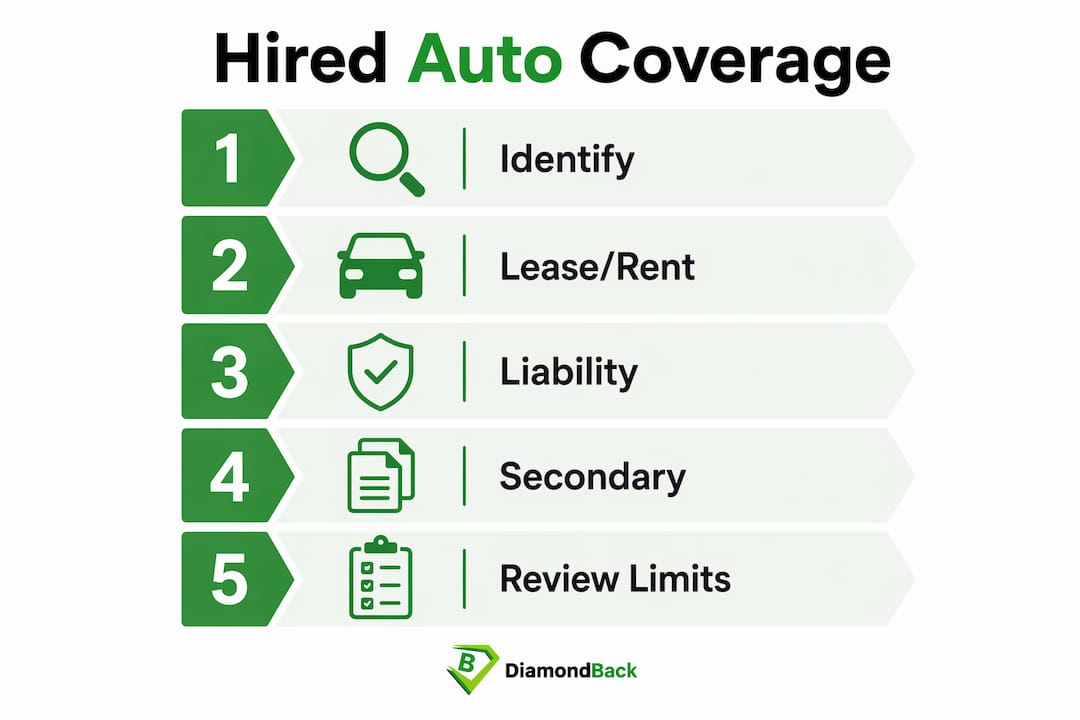
Understanding logistics contract obligations also matters here. Many vendor and delivery contracts require the hiring party to carry hired auto liability. Reviewing those contract terms before signing protects you from being in breach before a vehicle ever leaves the lot.
How does hired auto coverage work within a commercial policy?
Hired auto coverage operates as a liability shield, not a physical damage policy. When an accident occurs involving a rented vehicle, the claims process follows a specific order of priority.
The rental company’s insurance responds first. Hired auto coverage typically acts as secondary insurance, filling in after the rental company’s primary coverage is exhausted. This layered structure means your policy absorbs excess liability once the rental agency’s limits are depleted. That sequence matters when damages exceed what the rental company’s policy can pay.
The technical designation for hired auto coverage in ISO commercial auto forms is Symbol 8. Symbol 8 covers hired autos only and excludes employee personal vehicles. Businesses that need full protection typically carry Symbol 8 for hired autos alongside Symbol 9 for non-owned autos. Reviewing your policy declarations page for these symbols confirms whether your coverage is complete.
Standard liability limits for hired auto coverage follow a structured approach:
- Base limit: $1 million per occurrence is the recommended standard limit for most businesses.
- BOP sublimits: Many business owner policies (BOPs) include HNOA coverage but cap it at $100,000–$300,000. That range is insufficient for serious accidents involving commercial vehicles.
- Umbrella or excess coverage: Businesses with frequent vehicle use should layer an umbrella policy above the base limit to reach $2 million or more in total protection.
- Endorsement upgrades: If your BOP’s HNOA sublimit is below $1 million, a separate endorsement can raise it. Verify this with your broker before renewing.
Pro Tip: Request a copy of your policy’s declarations page and search for Symbol 8. If it is absent, your hired auto exposure is uninsured regardless of what your broker told you verbally.
Why do businesses need hired auto coverage?
The liability gap created by CGL auto exclusions is the core reason hired auto coverage exists. Without it, your business absorbs full financial responsibility for any accident involving a rented or borrowed vehicle.
“HNOA bridges the vicarious liability gap, protecting employers when employees cause vehicle accidents while on business but driving non-owned vehicles. Without this coverage, a single serious accident can expose a business to six-figure or seven-figure judgments that no general liability policy will touch.”
Consider a practical scenario. Your operations manager rents a cargo van to deliver equipment to a client. She runs a red light and injures two pedestrians. The rental company’s insurance pays its limit. The remaining damages, legal fees, and settlement costs fall to your business. Without hired vehicle liability coverage, you pay those costs out of pocket or face a judgment that threatens your company’s solvency.
The risks businesses face without this coverage include:
- Uncovered bodily injury claims from third parties injured in accidents
- Property damage liability when a rented vehicle damages another vehicle or structure
- Legal defense costs that accumulate even when your business is not ultimately found liable
- Vicarious liability exposure when employees act within the scope of their employment
Hired auto coverage works alongside your existing commercial fleet insurance to close these gaps. It does not replace your commercial auto policy. It extends protection to vehicles outside your owned fleet. Businesses that rely on rentals during peak periods, use leased trucks for contract work, or send employees on business trips in rental cars all carry meaningful hired auto exposure.
Businesses frequently misunderstand the distinction between hired and non-owned auto exposure. That confusion leads to gaps that only surface when a claim is filed. Reviewing your policy annually with a qualified broker prevents that outcome.
How to evaluate and purchase hired auto insurance
Assessing your hired auto exposure starts with understanding how often your business uses vehicles it does not own. The frequency, vehicle type, and geographic range of that use all influence the coverage structure you need.
Key factors that affect your hired auto policy and premium include:
- Vehicle usage frequency: Businesses that rent vehicles weekly pay more than those that rent occasionally.
- Type of vehicle: Commercial trucks and vans carry higher liability exposure than passenger cars.
- Driver records: Insurers review the driving histories of employees who regularly operate hired vehicles.
- Geographic range: Multi-state operations or interstate deliveries increase exposure and may require higher limits.
- Industry type: Staffing firms, professional services companies, and logistics operators face elevated HNOA risk due to frequent employee travel.
Hired auto insurance averages about $147 per month for standalone policies, though adding it as an endorsement to an existing commercial policy often costs only $100–$300 annually. That cost difference makes the endorsement route the most practical starting point for most small and mid-size businesses.
The table below outlines the primary coverage structures and their typical use cases:
| Coverage structure | Best for | Typical limit |
|---|---|---|
| BOP endorsement | Small businesses with occasional rentals | $100,000–$300,000 |
| Standalone HNOA policy | Businesses with frequent hired vehicle use | $1 million per occurrence |
| Commercial auto with Symbol 8 | Fleet operators using leased or rented units | $1 million+ per occurrence |
| Umbrella over HNOA | High-exposure industries, frequent travel | $2 million–$5 million total |
When speaking with your broker, ask specifically whether your policy includes Symbol 8 coverage, what the per-occurrence limit is, and whether physical damage to hired vehicles requires a separate endorsement. Knowing how much coverage your fleet needs before that conversation puts you in a stronger position to select the right structure.
Pro Tip: Review your hired auto limits every year, especially if your business has grown, added new contracts, or increased rental frequency. Coverage that was adequate two years ago may leave you underinsured today.
Key Takeaways
Hired auto coverage is the single most effective tool for closing the liability gap that CGL policies create when your business uses rented, leased, or borrowed vehicles for commercial purposes.
| Point | Details |
|---|---|
| CGL policies exclude auto liability | Standard general liability does not cover accidents involving rented or borrowed vehicles. |
| Symbol 8 designates hired auto coverage | Verify your commercial auto policy includes Symbol 8 to confirm hired vehicle protection. |
| Secondary coverage structure | Hired auto responds after the rental company’s primary insurance is exhausted. |
| BOP sublimits are often too low | Many BOPs cap HNOA at $100,000–$300,000; a separate endorsement raises limits to $1 million. |
| Annual review is non-negotiable | Coverage needs change as your fleet usage, contracts, and employee travel patterns evolve. |
What I’ve learned about hired auto gaps after years in commercial insurance
The most expensive mistake I see business owners make is assuming their general liability policy covers everything vehicle-related. It does not. The auto exclusion in CGL policies is absolute, and insurers enforce it without exception. By the time a claim surfaces, it is too late to add coverage retroactively.
The second mistake is treating hired and non-owned auto as interchangeable terms. They are not. A business that carries only non-owned auto coverage has no protection when an employee rents a van for a delivery. A business with only hired auto coverage has no protection when that same employee uses their personal car for a work errand. You need both, and you need to verify both are in your policy with adequate limits.
What I find most telling is how often the Symbol 8 designation is missing from policies that brokers describe as “complete.” Verbal assurances mean nothing when a claim is denied. Pull your declarations page, find the coverage symbols, and confirm the limits in writing. That five-minute review has saved businesses from six-figure exposures more times than I can count.
The regulatory environment for commercial vehicles is also tightening. Fleet operators who review their insurance requirements annually are better positioned to stay compliant and avoid coverage gaps as contract terms and state regulations evolve. Hired auto coverage is not a set-it-and-forget-it line item. It requires the same proactive attention as any other part of your commercial insurance program.
— Vladimir
Diamondbackins can protect your fleet with the right hired auto coverage
Hired auto liability is one of the most overlooked gaps in commercial fleet insurance, and it is one of the most straightforward to fix when you work with the right partner.
Diamondbackins specializes in commercial trucking and fleet insurance across Georgia, Virginia, and beyond. The platform aggregates quotes from multiple top-rated insurers, so you can compare hired auto coverage options side by side in minutes. Whether you need a standalone HNOA policy or want to add hired auto protection as an endorsement to your existing commercial policy, Diamondbackins makes the process direct and transparent. Business owners in Georgia can explore tailored fleet coverage options built for commercial operations, while Virginia fleet operators can access instant online coverage without the delays of traditional brokers.
FAQ
What is hired auto coverage in simple terms?
Hired auto coverage is commercial liability insurance that protects your business when you rent, lease, or borrow a vehicle for business use. It covers bodily injury, property damage, and legal defense costs if an accident occurs with that vehicle.
Does hired auto coverage pay for damage to the rental vehicle?
No. Hired auto coverage is a liability policy and does not pay for physical damage to the rented vehicle itself. You need a separate physical damage endorsement or the rental company’s collision damage waiver for that protection.
What is the difference between hired auto and non-owned auto insurance?
Hired auto covers vehicles your business rents, leases, or borrows. Non-owned auto covers employee-owned vehicles used for work. Most businesses need both, designated as Symbol 8 and Symbol 9 respectively in commercial auto forms.
How much does hired auto insurance cost?
Hired auto insurance averages about $147 per month as a standalone policy. Adding it as an endorsement to an existing commercial policy typically costs $100–$300 per year, making the endorsement the most cost-effective option for most businesses.
Is hired auto coverage required by law?
Hired auto coverage is not universally mandated by law, but many vendor contracts and client agreements require it. Businesses operating commercial vehicles must also meet state minimum liability requirements, which hired auto coverage helps satisfy for rented or leased units.