

The policy selection process for trucking insurance is defined as the structured evaluation of coverage types, liability limits, and insurer qualifications that meet FMCSA financial responsibility requirements while protecting your fleet’s specific operational risks. Every trucking company operating in interstate commerce must complete this process before receiving operating authority, and the stakes are significant. Insurance filing requirements from FMCSA confirm that no operating authority registration is granted until minimum financial responsibility levels under 49 CFR Part 387 are in place. Getting this right from the start protects your authority, your assets, and your revenue.
The trucking insurance market has also grown considerably more expensive. Insurance costs rose 18.6% from 2021 through 2024, even as crash rates fell by 2.6%. That gap between cost and risk frequency signals a litigation and claims severity problem that directly shapes how you should approach selecting coverage limits and policy layers. Understanding both the regulatory and market dimensions of this process is what separates fleets that stay protected from those that face gaps at the worst possible moment.
What is the policy selection process for trucking insurance?
The policy selection process for trucking is the formal workflow of identifying, comparing, and committing to commercial insurance coverage that satisfies federal compliance mandates and aligns with your fleet’s actual exposure. It is not simply choosing the lowest premium. It involves mapping your operations, understanding what regulators require, evaluating what your assets and cargo demand, and then vetting insurers on their ability to deliver when a claim occurs.
Fleet managers who treat this as a one-time administrative task tend to encounter the most costly surprises. Policy selection is better understood as a recurring discipline tied to renewal cycles, operational changes, and market conditions. When your routes expand, your cargo type shifts, or your driver roster changes, your coverage needs change with them. Building a repeatable selection process protects you from coverage gaps that emerge silently between renewals.
What federal insurance requirements must trucking companies meet?
FMCSA sets minimum financial responsibility levels based on freight type and operating weight. For interstate general freight carriers, the federal minimum is $750,000 in liability coverage, while carriers transporting hazardous materials face minimums reaching $5 million. These are floors, not recommendations. Operating below these thresholds is not a compliance gray area. It results in revoked authority.
Proof of financial responsibility must be filed directly with FMCSA through an approved insurer or surety. Your insurer submits Form MCS-90 or the equivalent BMC filing on your behalf. This filing is what activates your operating authority, and it must remain continuously active. Filing lapses can result in loss of operating authorization even when your underlying policy is technically still in force. The filing and the policy are two separate things, and both must be maintained.
Timing matters as well. FMCSA requires applicants to comply with filing requirements within 20 days of authority publication, or within 60 days if separately notified. Missing these windows risks dismissal of your application. Many fleet managers are surprised to learn that their insurer’s internal processing timelines can consume a significant portion of that window, which is why initiating the policy selection process well before you need authority activation is the only reliable approach.
Pro Tip: Set a calendar reminder 90 days before your policy renewal date and verify your FMCSA filing status directly on the FMCSA portal. Do not assume your insurer has filed on time. Confirm it yourself.
How do you evaluate your fleet’s risk and coverage needs?
Accurate risk evaluation starts with your operations. The cargo you carry, the routes you run, the drivers you employ, and the equipment you operate all create distinct exposures that generic coverage minimums will not fully address. A refrigerated food carrier running Southeast corridors faces different risks than a flatbed hauling construction materials across mountain routes. Your coverage selection must reflect that specificity.
The core coverage types you will evaluate include primary liability, physical damage, motor truck cargo, uninsured and underinsured motorist coverage, and general liability. Each serves a different exposure. Physical damage covers your tractors and trailers. Cargo coverage protects the freight you are responsible for. Primary liability is what pays when your driver causes an accident that injures others or damages property. Understanding how insurers shape transportation risk helps you align each coverage type to your actual operational profile rather than defaulting to minimum limits.
Your FMCSA safety rating and BASIC percentile scores also factor directly into what coverage options are available to you and at what price. Underwriters check FMCSA safety data to assess risk and set pricing. A fleet with elevated BASIC scores in categories like unsafe driving or vehicle maintenance will face restricted options and higher premiums. Improving those scores before entering the market for new coverage is one of the most effective ways to expand your policy options.
| Coverage type | What it protects | Who needs it |
|---|---|---|
| Primary liability | Third-party bodily injury and property damage | All interstate carriers (federally required) |
| Physical damage | Your trucks and trailers | Any fleet with financed or high-value equipment |
| Motor truck cargo | Freight in your care, custody, and control | All carriers transporting customer goods |
| Uninsured motorist | Injuries caused by uninsured drivers | Recommended for all fleets regardless of size |
| General liability | Non-driving incidents at terminals or loading docks | Fleets with owned facilities or drop-yard operations |
Pro Tip: Request your CSA BASIC scores from the FMCSA Safety Measurement System before approaching insurers. Knowing your scores in advance lets you address weak areas and negotiate from a stronger position.
How do you shop, compare quotes, and select the best policy?
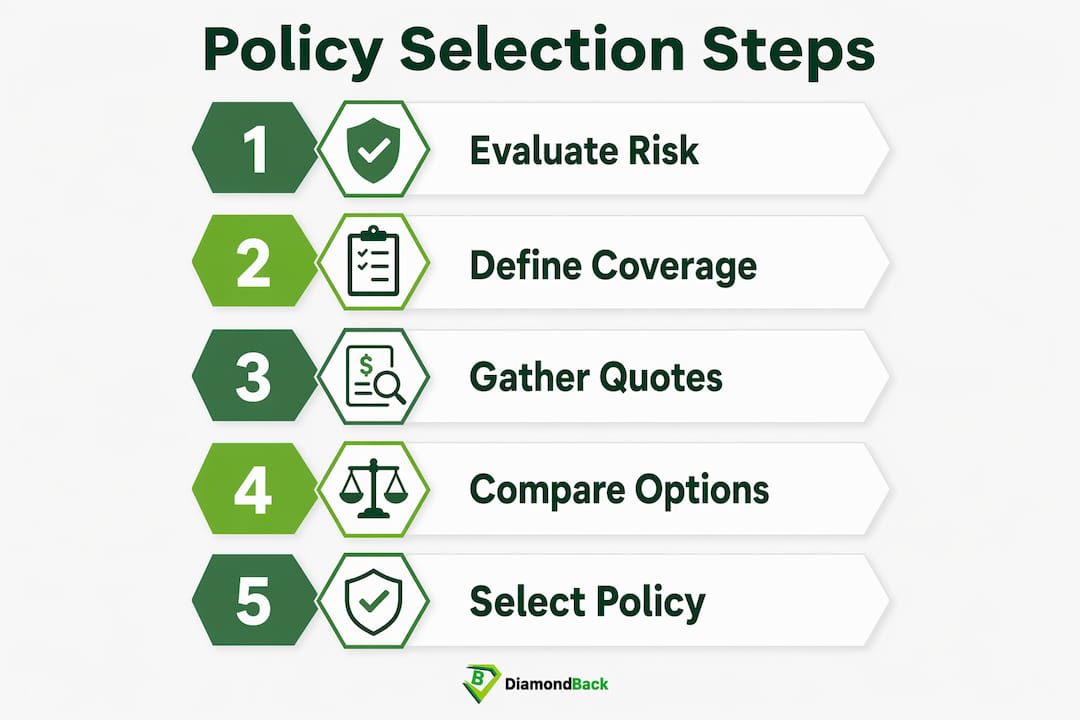
Effective policy selection follows a defined sequence: determine your coverage needs, set your deductible tolerance, gather quotes, compare terms, evaluate claims service, and document your decision. Skipping any step creates risk, either in coverage gaps or in choosing an insurer who cannot perform when you need them most.

Start by gathering at least three quotes from carriers who specialize in commercial trucking. General commercial auto insurers often lack the underwriting depth to price trucking risk accurately, which means their quotes may look attractive but carry restrictive exclusions. When comparing quotes for trucking fleets, verify that each quote reflects identical coverage limits, deductibles, and endorsements before treating the premium numbers as comparable.
Claims service quality is a factor most fleet managers underweight until they experience a bad claim. A policy that pays slowly or disputes coverage on technical grounds can leave a truck off the road for weeks, costing far more than any premium savings. FreightWaves emphasizes that checking insurer claims workflows before committing to a policy is a standard part of responsible selection. Ask each insurer for their average claim resolution time and whether they use in-house adjusters or third-party administrators.
Review policy exclusions carefully. Common exclusions in trucking policies include coverage gaps for owner-operators leased to your authority, specific cargo types, or operations in certain states. An endorsement can often close these gaps, but only if you identify them before binding coverage. Document your selection rationale in writing, noting which coverage options you considered, why you chose specific limits, and how you verified the insurer’s financial strength rating through AM Best or a similar rating agency.
How do insurance market trends affect your policy decisions?
Trucking insurance pricing is driven more by claims severity and litigation trends than by actual crash frequency. Liability insurance premiums reached 10.2 cents per mile by 2024, with claims costs climbing 33.1% over the same period. That cost-per-mile figure is a practical benchmark. If your current policy cost exceeds it significantly, you have either a risk profile problem or a pricing problem worth investigating.
Excess layer pricing has moved sharply upward. Excess layer premiums rose 34% for the $5 million to $10 million coverage band and 45% for the $10 million to $15 million band between 2021 and 2024. This matters for larger fleets that rely on layered policy structures to reach adequate total limits. The cost of building a $15 million tower of coverage is now substantially higher than it was three years ago, and that reality must be factored into your budget planning.
“Premiums are rising primarily due to increased claim severity and litigation, not crash frequency, influencing how fleets approach policy layering and retention.” — ATRI Research
Social inflation, meaning the tendency of juries to award larger verdicts in trucking accident cases, is the primary driver behind these trends. Understanding why trucking insurance rates are increasing gives you the context to make informed decisions about how much primary limit to carry versus how much to push into excess layers. Some fleets are also exploring higher self-insured retentions to reduce premium exposure, though that strategy requires sufficient cash reserves to absorb retained losses.
What are the most common pitfalls in trucking policy selection?
The most damaging mistake fleet managers make is treating the FMCSA filing as an automatic byproduct of purchasing a policy. It is not. Filing status must be actively monitored throughout the policy lifecycle. An insurer who cancels your policy for non-payment is required to notify FMCSA, which then initiates authority revocation. If you are unaware of the cancellation, you may continue operating under revoked authority, which creates compounding legal exposure.
Selecting the cheapest available policy without vetting the insurer’s claims performance is the second most common error. A low premium from an insurer with poor claims handling translates directly into operational downtime and out-of-pocket costs during disputes. The Montgomery v. Caribe Transport II decision reinforced that carriers and brokers must document their safety and insurance vetting processes to defend against negligence claims. That documentation obligation extends to your insurer selection decisions as well.
Ongoing policy review is not optional for fleets that want to stay protected. Your coverage should be reviewed whenever you add equipment, change cargo types, hire new drivers, or expand into new states. Each of those changes can alter your risk profile in ways your current policy does not address. Integrating policy review into your quarterly compliance calendar, alongside driver qualification file audits and vehicle inspection records, keeps your coverage aligned with your actual operations.
Pro Tip: Keep a written policy selection log that records the quotes you received, the coverage terms you compared, and the reasons you chose your final policy. This documentation protects you in litigation and simplifies your next renewal cycle.
Key takeaways
A disciplined policy selection process for trucking is the single most reliable way to protect your operating authority, your assets, and your revenue against the compounding risks of regulatory non-compliance and claims exposure.
| Point | Details |
|---|---|
| FMCSA filing is non-negotiable | Operating authority requires active financial responsibility filings, not just an active policy. |
| Coverage limits must exceed minimums | Federal minimums start at $750,000 but litigation trends make higher limits a practical necessity. |
| Claims service quality matters | Slow claims resolution costs more in downtime than premium savings are worth. |
| Market costs are rising sharply | Excess layer premiums rose up to 45% from 2021 to 2024, requiring proactive budget planning. |
| Documentation protects you | Written records of your selection process defend against negligence claims and simplify renewals. |
Why the cheapest policy is often the most expensive decision
I have reviewed hundreds of trucking insurance situations over the years, and the pattern that causes the most damage is almost always the same. A fleet manager, under pressure to cut costs, selects the lowest-quoted policy without verifying the insurer’s claims track record or reading the exclusions carefully. The policy looks fine on paper. Then a significant accident occurs, and the claims process reveals coverage gaps or delays that leave the fleet absorbing costs it believed were covered.
The other issue I see consistently is the FMCSA filing gap. Fleet managers assume their insurer handles it automatically and completely. Sometimes they do. Sometimes there is a processing delay, a data entry error, or a billing dispute that triggers a cancellation notice to FMCSA without the fleet manager knowing. By the time the authority revocation notice arrives, the fleet has been operating out of compliance for weeks. The regulatory and legal exposure from that scenario far exceeds the cost of a 90-day monitoring calendar.
My honest recommendation is to treat your trucking coverage choices as a risk management decision, not a procurement exercise. The right policy pays quickly, covers your actual operations, and keeps your authority intact. Those three criteria should rank above premium cost in your evaluation. Price matters, but it should be the final filter, not the first.
— Vladimir
How Diamondbackins helps you select the right trucking policy
Diamondbackins is built specifically for trucking professionals who need accurate, tailored quotes without the delays of traditional broker processes. The platform aggregates quotes from multiple top-rated commercial trucking insurers, giving you side-by-side comparisons of coverage terms, limits, and premiums in minutes.
Whether you operate a single-truck owner-operator setup or manage a regional fleet, Diamondbackins provides access to commercial trucking insurance options designed to meet FMCSA filing requirements and your specific operational profile. The platform supports FMCSA compliance documentation and connects you with insurers experienced in commercial trucking underwriting. Get your instant trucking insurance quote today and compare your options without the wait.
FAQ
What is the minimum insurance required for interstate trucking?
FMCSA requires a minimum of $750,000 in liability coverage for interstate general freight carriers, with limits reaching $5 million for hazardous materials operations. These minimums must be filed directly with FMCSA before operating authority is granted.
How does FMCSA filing differ from having an active policy?
An active insurance policy and an active FMCSA filing are separate requirements. Your insurer must submit the appropriate filing form to FMCSA on your behalf, and that filing must remain continuously active. A policy cancellation triggers a filing withdrawal, which can result in authority revocation even if you purchase replacement coverage immediately.
Why are trucking insurance premiums rising if crashes are declining?
Trucking insurance costs rose 18.6% from 2021 to 2024 despite a 2.6% drop in crash rates, driven primarily by increased claims severity and larger jury verdicts rather than higher accident frequency. Social inflation and litigation trends are the primary cost drivers.
What should I check when comparing trucking insurance quotes?
Verify that each quote reflects identical coverage limits, deductibles, and endorsements before comparing premiums. Also evaluate each insurer’s claims resolution time, financial strength rating from AM Best, and experience with commercial trucking underwriting specifically.
How often should I review my trucking insurance policy?
Review your policy whenever you add equipment, change cargo types, hire new drivers, or expand operations into new states. At minimum, conduct a formal review 90 days before each renewal to allow time for market comparison and FMCSA filing coordination.