

Most fleet managers assume their commercial auto insurance is working as long as the trucks keep moving and no claims get denied. That assumption is quietly expensive. Skipping routine insurance reviews means you could be overpaying on premiums that no longer reflect your actual risk profile, or worse, operating with coverage gaps that leave your business exposed after a serious accident. This guide walks you through the real financial and legal consequences of neglecting your policy, and gives you a clear path to reviewing, adjusting, and optimizing your fleet insurance to protect your operation and reduce unnecessary spending.
Table of Contents
- The risks of outdated commercial auto insurance
- How operational changes impact insurance needs
- Cost savings and value: reviewing insurance unlocks discounts
- Meeting regulatory requirements and avoiding violations
- Why reviewing insurance coverage is the smartest move most fleet managers skip
- Effortless insurance reviews and quotes: next steps for your fleet
- Frequently asked questions
Key Takeaways
| Point | Details |
|---|---|
| Review insurance annually | A yearly review ensures your coverage matches current fleet risks and avoids unnecessary costs. |
| Update for operational changes | Any expansion, new routes, or driver changes require insurance updates to prevent gaps or overpayment. |
| Unlock discounts | Regular reviews help access telematics and safety discounts, potentially saving thousands each year. |
| Stay compliant | Routine audits protect your fleet from expensive FMCSA violations and help maintain regulatory requirements. |
The risks of outdated commercial auto insurance
Outdated insurance coverage is one of the most common and most avoidable financial risks fleet managers face. Many operators renew their policies automatically year after year without asking whether the coverage still matches how the business actually operates. The result is either overpayment on coverage your fleet no longer needs, or underinsurance that leaves you exposed when a claim hits.
What happens when coverage doesn’t match your operation?
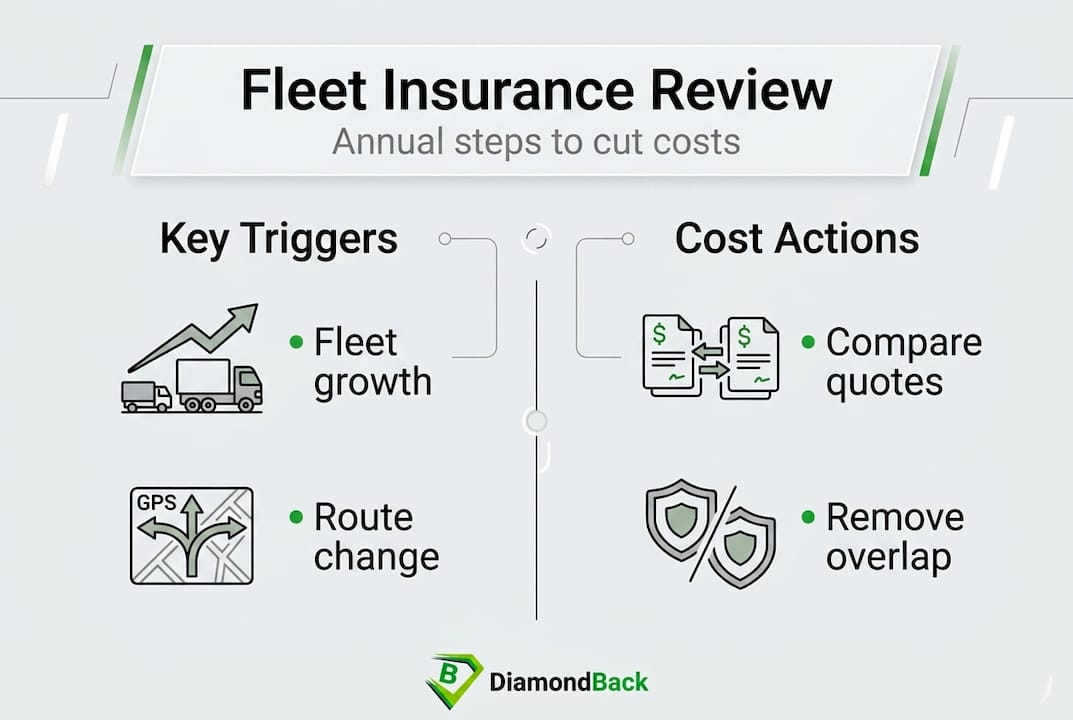
Your fleet is not static. Vehicles get added, routes change, drivers turn over, and cargo types shift. Each of those changes affects your risk profile, and your insurance policy needs to reflect that reality. According to coverage update requirements, operational changes like fleet expansion, new routes, and vehicle additions or removals require corresponding coverage updates. Failure to make those updates leads directly to overpayment or underinsurance, both of which cost you money.
Underinsurance is the more dangerous outcome. If a vehicle involved in an accident is not properly listed on your policy, or if a new route crosses into a jurisdiction with different liability requirements, your insurer may deny the claim. That leaves you personally absorbing the cost of repairs, medical expenses, or legal settlements. Those figures can run well into six or seven figures in serious commercial trucking incidents.
Overpaying is less dramatic but just as damaging over time. Carrying coverage on vehicles that have been removed from your fleet, or paying for endorsements you no longer need, wastes budget every single month.
Why annual audits are non-negotiable.
The most structured way to catch these problems is through a formal fleet audit. A fleet safety audit is an annual review of your driver qualification files, maintenance records, and insurance certificates. The purpose is to verify that your coverage actually matches your active vehicles and licensed drivers. Fleets that maintain a 90% or higher pass rate on these audits significantly reduce their exposure to FMCSA violations, which carry penalties of up to $16,000 per incident.
Understanding the full scope of fleet insurance coverages is your starting point for knowing where gaps might exist. Equally important is knowing why trucking policy differences exist between operators, because a policy that works for a regional carrier may be entirely wrong for a fleet running long-haul interstate routes.
Staying proactive about your policy review is not about being cautious for the sake of caution. It is about protecting the financial foundation your business runs on.
How operational changes impact insurance needs
Fleet insurance is not a one-time decision. It is a living document that needs to evolve as your business evolves. Every time your operation changes in a meaningful way, your coverage needs to be reassessed. The challenge is that most fleet managers do not have a formal trigger system for that reassessment, so changes slip by unnoticed until a claim surfaces the gap.
What counts as a meaningful operational change?
Major business milestones that should immediately prompt an insurance review include adding vehicles to your fleet, retiring older units, hiring new drivers, expanding into new geographic territories, changing the type of freight you haul, and taking on new contracts with specific insurance requirements. Any one of these events can shift your risk profile enough to make your current policy either inadequate or more expensive than it needs to be.

The relationship between operational changes and coverage adjustments is direct. As noted in the commercial auto insurance guidance for 2026, fleet expansion and route changes require coverage updates to match the current risk profile. Ignoring those updates means your premiums are calculated on outdated information, which never works in your favor when a claim is filed.
Consider a practical example. A small fleet that hauls regional freight and adds three new long-haul trucks to serve a national client now operates in multiple states with different minimum liability requirements. If the policy isn’t updated to reflect those interstate routes, the fleet could be operating out of compliance in certain jurisdictions without even knowing it.
How to build a practical review process.
The most reliable approach is to assign a specific internal trigger to each type of operational change. When a new vehicle is purchased, that purchase order prompts an insurance call. When a new driver is hired, their onboarding paperwork includes an insurance update step. This removes the review from being an annual calendar event and makes it a standard part of your operational workflow.
Understanding the factors affecting insurance rates helps you approach those conversations with insurers from a position of knowledge. Rates are influenced by vehicle type, driver history, route risk, cargo class, and claims history. Knowing which factors apply to your changes lets you ask the right questions and negotiate from a stronger position.
Pro Tip: Keep a simple change log for your fleet. Any time a vehicle, driver, or route is added or removed, record the date and details. Bring that log to every insurance review so nothing gets missed.
The table below illustrates how common operational changes map to coverage adjustments:
| Operational change | Coverage adjustment needed |
|---|---|
| Adding a new vehicle | Update vehicle schedule, verify liability limits |
| Hiring a new driver | Add to driver list, review MVR requirements |
| Expanding to new states | Verify state-specific liability minimums |
| Changing cargo type | Review cargo coverage class and limits |
| Removing a retired truck | Remove from schedule to eliminate overpayment |
| New client contract | Confirm contract-required liability limits are met |
Each of these adjustments is straightforward when done promptly. When left unaddressed, they accumulate into coverage mismatches that either cost you money or leave you unprotected.
Cost savings and value: reviewing insurance unlocks discounts
Most fleet managers think about insurance reviews in terms of risk management. The financial upside is just as significant. A structured review of your policy is one of the most effective ways to reduce your operating costs, and it often surfaces savings opportunities that would otherwise remain invisible.
Why premiums keep rising without intervention.
Commercial trucking insurance premiums rise 10 to 30% annually due to factors like nuclear verdicts, rising vehicle repair costs, and increased litigation in the transportation sector. That means if you are not actively reviewing your coverage and shopping your rates, you are almost certainly paying more this year than you need to. The increase happens automatically at renewal unless you push back with data and alternatives.
The good news is that the same review process that helps you stay compliant also creates opportunities to capture discounts. Telematics programs, which use GPS and driver behavior monitoring to track speed, braking, and route efficiency, can reduce your premiums by 15 to 30%. Fleet safety programs that document driver training and vehicle maintenance can deliver an additional 5 to 15% reduction. These discounts are real and available, but many fleet managers never claim them because they don’t ask during the renewal process.
Comparing your savings options.
The table below shows how different savings strategies compare in terms of typical discount range and what’s required to qualify:
| Savings strategy | Typical discount range | What you need to qualify |
|---|---|---|
| Telematics monitoring | 15 to 30% | GPS devices installed, clean data history |
| Fleet safety program | 5 to 15% | Documented training and maintenance records |
| Multi-vehicle policy | 5 to 10% | Two or more vehicles on same policy |
| Claims-free history | 5 to 20% | No at-fault claims in prior policy period |
| Competitive shopping | Variable | Access to multiple insurer quotes |
The most underused savings tool is competitive comparison. Many fleet operators stay with the same insurer year after year out of convenience. Comparing insurance quotes across multiple providers is the single fastest way to determine whether your current rates are competitive or inflated. The market for insurance companies for truckers is broad, and rates for the same coverage can vary significantly between providers.
Reviewing your policy also helps you eliminate redundant coverage. Endorsements added years ago may no longer apply to your current operation. Dropping unnecessary add-ons while retaining the coverage that matters can reduce your annual spend without reducing your actual protection.
Meeting regulatory requirements and avoiding violations
Beyond cost savings and coverage quality, there is a compliance dimension to insurance reviews that carries serious financial consequences if neglected. The FMCSA (Federal Motor Carrier Safety Administration) sets minimum insurance requirements for commercial carriers, and those requirements are not static. Contracts with freight brokers and shippers often impose their own minimums on top of federal requirements.
What are the current benchmarks for 2026?
Current trucking insurance benchmarks for 2026 show that owner-operators typically pay between $8,000 and $14,000 per year, while small fleets of two to five trucks pay between $15,000 and $40,000 annually. General freight operations are required to carry a minimum of $750,000 in liability coverage, though many contracts now require $1 million to $2 million. Knowing where your coverage sits relative to these benchmarks tells you immediately whether you are adequately protected for the contracts you are pursuing.
Regulatory compliance is not a background concern. Operating with insufficient liability limits can result in FMCSA violations carrying penalties of up to $16,000 per incident, as noted in fleet audit standards. A single violation can exceed the entire annual cost savings from skipping a coverage review.
How to structure a compliance-focused review.
A compliance-oriented insurance review should follow a clear sequence. First, verify that every active vehicle in your fleet appears on your current policy’s vehicle schedule. Second, confirm that each listed driver has a valid commercial license and that their records have been checked against your insurer’s requirements. Third, review your liability limits against both federal minimums and the specific requirements in your active contracts. Fourth, ensure your insurance certificates are current and available for inspection at any time. Fifth, document the review date and findings so you can demonstrate a consistent compliance process to auditors or regulators.
Understanding how much insurance a trucking company needs is foundational to this process. The requirements vary by cargo type, vehicle class, and operating radius. Equally important is maintaining essential insurance documents in an accessible format so that any roadside inspection or audit request can be satisfied immediately.
Fleet audits that achieve a 90% or higher pass rate, as referenced in fleet safety audit standards, are the most reliable indicator that your coverage and compliance documentation are aligned. Building that audit standard into your annual review cycle protects your operating authority and keeps your business eligible for the contracts that require clean compliance records.
Why reviewing insurance coverage is the smartest move most fleet managers skip
Here is the uncomfortable reality. Most fleet managers treat insurance as a fixed line item, budgeted once and revisited only when something goes wrong. That mindset is understandable because it feels like efficiency. In practice, it is the exact opposite.
The fleets that consistently operate at lower cost and higher resilience are the ones that treat insurance as an active management function, not a background expense. They review annually, they update at every operational milestone, and they shop the market regularly. The result is not just lower premiums. It is better coverage aligned to actual risk, fewer denied claims, and a business that can absorb the unexpected without a financial crisis.
There is also a less obvious benefit that rarely gets discussed. When your drivers know that your fleet carries current, well-matched coverage, it signals that you take operational integrity seriously. That builds internal trust and reduces turnover, both of which have real cost implications. And when shippers and brokers see that your compliance documentation is clean and current, they are more willing to offer you better contracts.
The fleet coverage tips that make the biggest difference are not complicated. The barrier is not knowledge. It is the habit of treating insurance as active rather than static. Build that habit, and the returns compound over time.
Effortless insurance reviews and quotes: next steps for your fleet
Reviewing your fleet insurance doesn’t have to be a slow or complicated process. The strategies covered in this article give you a clear framework for what to look for, when to act, and how to negotiate better terms.
Diamondback Insurance makes the practical side of this process straightforward. You can get instant insurance quotes from multiple top-rated insurers in minutes, compare them side by side, and identify whether your current coverage is competitive or overpriced. Whether you are conducting your annual review, responding to an operational change, or simply checking whether better rates are available, the platform gives you the information you need without the delays of traditional brokerage. Take a few minutes to review fleet coverages and see how your current policy stacks up.
Frequently asked questions
How often should a fleet manager review insurance coverage?
A fleet manager should review insurance coverage at least once a year and after any significant operational changes, such as adding vehicles or entering new routes. Annual fleet safety audits confirm that coverage aligns with active vehicles and drivers.
What triggers a need to adjust fleet insurance?
Fleet expansion, new routes, adding or removing vehicles, and hiring new drivers all trigger a need to review and adjust coverage. Operational changes that shift your risk profile require corresponding updates to avoid overpayment or coverage gaps.
What are the typical commercial trucking insurance benchmarks in 2026?
2026 benchmarks show owner-operators pay $8,000 to $14,000 per year, small fleets of two to five trucks pay $15,000 to $40,000 annually, and general freight operations require a minimum of $750,000 in liability coverage, with many contracts requiring $1 million to $2 million.
What are the consequences of not reviewing and updating insurance coverage?
Not reviewing insurance may lead to overpayment, coverage gaps, and costly compliance violations. Fleet audit standards show that FMCSA violations alone can reach $16,000 per incident, which far exceeds the cost of a routine annual policy review.