

Missing an insurance filing or carrying the wrong coverage limits can cost your fleet thousands in fines, shut down your operating authority, or disqualify you from landing a shipper contract. For fleet managers and small business owners in trucking, these are not hypothetical risks. They happen to experienced operators who assumed their coverage was in order without actually confirming it. This guide walks you through every critical step: understanding federal and state requirements, verifying your filings through the FMCSA SAFER system, building an airtight recordkeeping process, and resolving compliance gaps before they become serious problems.
Table of Contents
- What are the core insurance requirements for commercial truck fleets?
- Step-by-step: How to check your insurance filings and compliance status
- Organizing your check: Compliance checklists and recordkeeping best practices
- Troubleshooting and common mistakes: What to do if requirements aren’t met
- A fleet management perspective: What actually keeps you compliant
- Stay compliant and protect your fleet with the right insurance solutions
- Frequently asked questions
Key Takeaways
| Point | Details |
|---|---|
| Check requirements for your operation | Federal and state insurance minimums vary by fleet type, cargo, and operation territory. |
| Verify with official sources | Use the FMCSA SAFER system and direct insurer confirmation to ensure active, correct filings. |
| Maintain compliance proactively | Quarterly checklist reviews and consistent recordkeeping ensure your fleet is always audit-ready. |
| Resolve gaps immediately | Address coverage lapses or missing filings right away to avoid fines or loss of authority. |
What are the core insurance requirements for commercial truck fleets?
With the risks in mind, start with understanding exactly what requirements your fleet must meet. Federal regulations establish the baseline, but your actual obligations depend on the type of freight you haul, whether you operate interstate or intrastate, and what your brokers and shippers require.
The Federal Motor Carrier Safety Administration (FMCSA) sets the minimum liability insurance thresholds that most for-hire carriers must carry. For general non-hazmat freight over 10,001 lbs GVWR, the FMCSA minimum liability is $750,000. If you haul oil, that number rises to $1 million. Transporting hazardous materials or passengers pushes the requirement to $5 million. These are hard federal floors, not suggestions.
| Freight type | Minimum liability required |
|---|---|
| General non-hazmat freight (over 10,001 lbs GVWR) | $750,000 |
| Oil (non-hazmat) | $1,000,000 |
| Hazmat / Passengers | $5,000,000 |
The interstate versus intrastate distinction matters significantly. Intrastate operations follow state DOT minimums, which can be lower or higher than the federal standard. For example, Texas intrastate minimum is $500,000, compared to the federal $750,000 threshold for interstate hauls. If your trucks cross state lines at any point, federal rules apply and you must meet the higher requirement. Understanding why truck insurance policies differ across carriers and states helps you avoid accidental gaps.
Beyond minimum thresholds, you need to know which insurance forms apply to your operation. The BMC-91 or BMC-91X form is the standard liability filing for for-hire interstate carriers. The MCS-90 endorsement is a mandatory addition to any liability policy, ensuring payment even when a policy exclusion might otherwise apply. For intrastate carriers, state-specific forms like Form E or Form H are common. Private carriers (those hauling their own goods, not operating for hire) are generally exempt from FMCSA filing requirements, but should still confirm their state obligations.
One fact that surprises many operators: brokers and shippers routinely require coverage that exceeds the FMCSA minimum. A shipper moving high-value cargo may demand $1 million in limited liability coverage even for non-hazmat freight. Review your broker contracts carefully and treat their requirements as equally binding as federal rules. Knowing your types of liability coverage helps you match the right policy to the right contract.
Step-by-step: How to check your insurance filings and compliance status
Once you know your requirements, the next step is to actually verify your current compliance status. The FMCSA SAFER (Safety and Fitness Electronic Records) system is your primary tool for this, and it is free and publicly accessible.

Here is how to verify your filings step by step.
Step 1: Access the SAFER system. Go to the FMCSA SAFER website and search using your USDOT number, MC number, or company name. This pulls up your carrier profile with registration details, safety ratings, and insurance status.
Step 2: Check your insurance status. Look for the insurance section within your carrier profile. You want to see the label Insurance: Properly Filed alongside active policy details. If you see a gap, a pending status, or an incorrect policy number, that is a red flag requiring immediate action.
Step 3: Verify the correct forms are on file. Confirm that the right form type is listed, whether BMC-91X for interstate liability or the relevant state form for intrastate operations. The FMCSA SAFER system lets you verify active filings like the BMC-91X directly within the carrier profile.
Step 4: Account for system update delays. SAFER data is not always real-time. Updates from insurers can lag by one to five business days. If you recently renewed or changed carriers, the portal may not reflect the change yet. This is normal, but it means you should not rely solely on SAFER during urgent situations.
Step 5: Request a Certificate of Insurance (COI). For time-sensitive or high-stakes situations, contact your insurer directly and request a current COI. This document confirms your active coverage and policy limits in real time. Insurers must file proofs with FMCSA, but you can verify via COI immediately without waiting for portal updates.
Pro Tip: If you are about to sign a new broker or shipper agreement, always cross-verify your coverage details directly with your insurer rather than relying on SAFER alone. Portal lag can create a false sense of security at exactly the wrong moment.
For a complete breakdown of what documents belong in your compliance file, review this insurance documents guide. If your filings are managed through a third party, insurance brokers for trucking can help verify and correct filings on your behalf.
Organizing your check: Compliance checklists and recordkeeping best practices
With the verification steps outlined, organization and recordkeeping are equally important for ongoing compliance. A one-time check is not sufficient. You need a repeatable system that keeps every truck in your fleet audit-ready at all times.
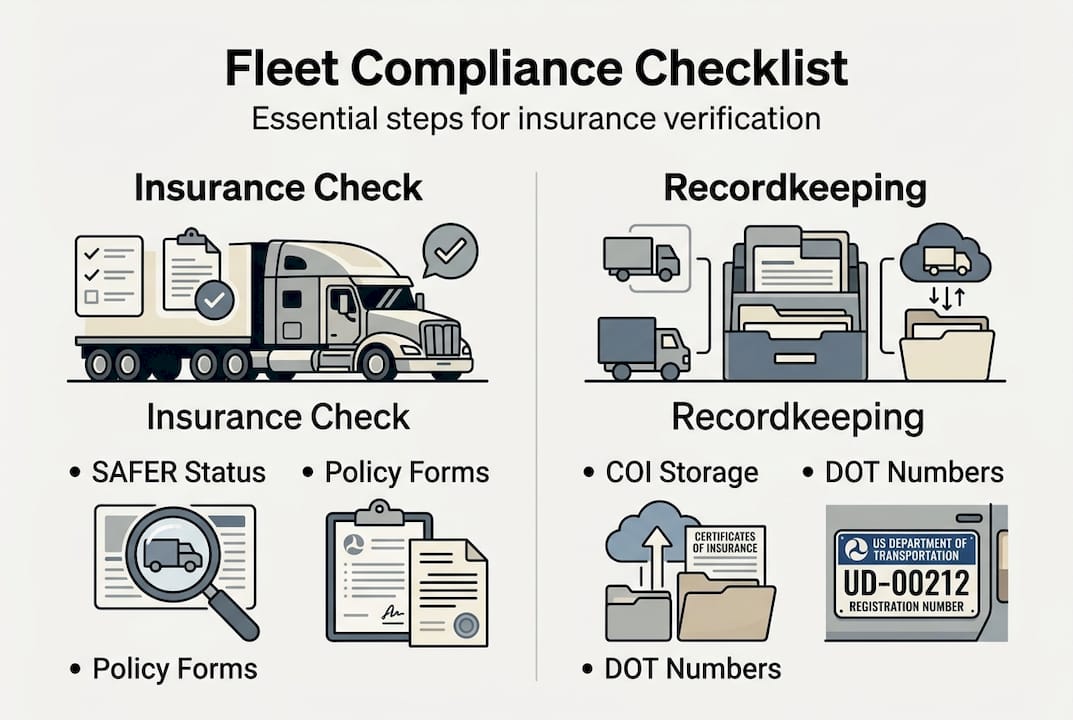
Fleet managers use quarterly checklists to verify USDOT/MC numbers, insurance filings, registration documents, and policy expiration dates on a consistent schedule. The quarterly rhythm is deliberate: it catches policy lapses before they become violations and ensures all documents remain current between annual renewals.
| Task | When to check | Responsible party |
|---|---|---|
| Verify SAFER insurance status | Quarterly | Fleet manager |
| Confirm policy expiration dates | Quarterly and at renewal | Fleet manager / Broker |
| Update FMCSA Portal filings | After any policy change | Insurance broker |
| Review broker/shipper coverage requirements | Before each new contract | Fleet manager |
| Audit vehicle registration documents | Annually | Fleet manager |
| Monitor SMS (Safety Measurement System) scores | Quarterly | Safety officer |
Your essential compliance documents should always be current and accessible. These include your Certificate of Insurance, FMCSA insurance filings confirmation, vehicle registration for each unit, your operating authority certificate, and any broker-specific certificates of coverage. Keeping digital copies stored in a cloud-based system gives you instant access during roadside inspections or contract negotiations.
Compliance checklists integrated with the FMCSA Portal also allow you to monitor your SMS scores, which reflect your safety performance and can directly affect your insurance premiums. Staying ahead of SMS score changes lets you address issues before they raise your rates.
Pro Tip: Link your insurance verification calendar to your vehicle maintenance and inspection schedule. When a truck comes in for a quarterly safety check, it is also a natural trigger to verify that truck’s registration, coverage limits, and filing status. This integrated approach reduces the chance of anything slipping through.
For tools that help you streamline online insurance management or compare quotes for truck fleets efficiently, online insurance platforms for fleets offer built-in reminders and document storage that simplify this process significantly.
Troubleshooting and common mistakes: What to do if requirements aren’t met
Even the best systems can encounter errors or lapses. Knowing how to respond quickly is what separates compliant fleets from those that face enforcement action.
If you discover a missing filing or lapsed policy, follow these steps immediately.
Step 1: Contact your insurance provider directly. Do not wait for SAFER to flag the issue. Call or email your broker or insurer and confirm whether the lapse is real or a system delay.
Step 2: Request emergency filing if the lapse is confirmed. Insurers can submit updated filings to the FMCSA, but it takes one to five business days to appear in SAFER. For proof in the interim, request a written COI or a filing confirmation letter.
Step 3: Halt operations if required. If your operating authority is suspended due to a genuine lapse, do not dispatch trucks. Operating without valid insurance exposes you to severe federal penalties and personal liability.
Step 4: Resolve any state versus federal mismatches. If your state filing shows active but your federal filing does not, or vice versa, work with your broker to file the correct forms for each jurisdiction separately.
Step 5: Confirm restoration in both SAFER and with your insurer. Once resolved, verify via SAFER and request a COI from your insurer to confirm that all filings are current and accurate.
Federal regulations are unambiguous on one point: continuous coverage is required with no lapses permitted under 49 CFR 387. Even a single day without valid coverage can result in fines, suspension of operating authority, or disqualification from shipper contracts.
Remember that SAFER data lags one to five days, so a portal showing a lapsed status does not always mean your coverage is actually gone. Real-time confirmation from your insurer is always the most reliable source during an active issue. Review your liability coverage safeguards to ensure your policy is structured to prevent these gaps from occurring in the first place.
A fleet management perspective: What actually keeps you compliant
Here is something most compliance guides will not tell you: checking your FMCSA status once a quarter is not the same as being truly compliant. It is a starting point, not a finish line.
In practice, many fleet managers who believe they are compliant are actually operating on outdated assumptions. They filed their insurance correctly two years ago, their SAFER profile still shows active status, and they assume everything is fine. But broker requirements have evolved, shipper contracts have tightened, and minimum limits that satisfied contracts in 2024 may not satisfy them in 2026. Trusting a single online status check to carry the weight of your entire compliance posture is a risk that experienced operators have learned to avoid.
The fleets that stay genuinely audit-ready treat compliance as a living process, not a one-time task. They use fleet insurance platform tools to automate reminders and centralize documents, and they maintain an open relationship with working with insurance brokers who proactively flag coverage gaps before they become problems. The real edge is combining digital efficiency with human accountability.
Stay compliant and protect your fleet with the right insurance solutions
Compliance is easier and less stressful with the right partner in your corner. At Diamondback Insurance, we specialize in helping fleet managers and trucking business owners get the right coverage quickly and without the typical complexity.
Our platform lets you review your fleet liability options, compare multiple insurer quotes side by side, and complete the entire online insurance buying process in minutes. Whether you are closing a coverage gap, preparing for a new broker contract, or simply ready to compare trucking fleet quotes and find better rates, we make it simple, transparent, and fast. Take control of your compliance today and get a quote that actually fits your fleet.
Frequently asked questions
How do I know if my truck insurance meets federal requirements?
Use SAFER to verify that your insurance filings are active and confirm the listed limits match the minimums required for your specific cargo type and operating classification.
Is state insurance enough for intrastate operations?
Intrastate fleets must meet state DOT minimums, which can differ from or exceed federal rules, so always verify both sets of requirements before assuming your current coverage is sufficient.
What should I do if the SAFER system says my insurance is not properly filed?
Contact your insurance provider immediately to confirm whether it is a real lapse or a reporting delay, and request a current COI as real-time proof of your active coverage.
How often should I check my insurance compliance records?
Fleet managers use quarterly checklists to verify insurance status, and you should also confirm all filings are current immediately after any policy renewal or carrier change.
Recommended
- How to compare insurance quotes for trucking fleets efficiently
- Essential insurance documents for truckers: complete guide
- Why Trucking Policies Differ: A Guide for Fleet Managers
- Protect your trucks: gap insurance explained for fleet owners
- How to Get the Best Truck Insurance Quotes for Your Business