

Trucking claims have never been more expensive. Claims costs rose 166% between 2015 and 2023 in some regions, with nuclear verdicts exceeding $10 million becoming increasingly common. Yet many fleet managers and owner-operators still rely on bare-minimum policies that leave serious gaps in protection. Basic trucking insurance may keep you legally operational on paper, but it rarely satisfies broker requirements, shields you from catastrophic claims, or keeps your business moving when something goes wrong. This article walks you through the legal requirements, the real-world coverage differences, and the financial stakes so you can make a smarter, more informed decision about protecting your fleet.
Table of Contents
- Legal requirements and industry compliance
- What specialized trucking insurance covers
- Financial impact: risk, claims, and cost control
- Choosing the right provider: Specialized vs. general insurance
- The hidden pitfalls of generic trucking insurance: An industry insider’s view
- Safeguard your fleet with the right trucking insurance partner
- Frequently asked questions
Key Takeaways
| Point | Details |
|---|---|
| Compliance matters | Only specialized policies ensure you meet all FMCSA and broker requirements. |
| Protects against the unexpected | Specialized coverage guards your business against costly edge-case losses not covered by basic policies. |
| Reduce financial risk | Modern risk management and telematics lower claim costs and premium expenses. |
| Choose specialists | Specialized providers prevent costly delays, offer better claims handling, and support business growth. |
Legal requirements and industry compliance
Knowing why the basics fall short sets the stage for understanding what compliance actually demands. The Federal Motor Carrier Safety Administration, commonly known as the FMCSA, sets the federal floor for trucking liability coverage. For general freight operations, that minimum is $750,000. Carriers hauling oil must carry at least $1,000,000, and those transporting hazardous materials are required to hold $5,000,000 in liability coverage. These figures are not suggestions. FMCSA minimum liability requirements are federal law, and operating below them puts your authority at immediate risk.
Here is the part that surprises many new fleet operators: meeting the federal minimum is rarely enough to actually work. Brokers and shippers in the real market typically require $1,000,000 in liability coverage regardless of cargo type. If your policy only hits the federal floor for general freight at $750,000, you may find yourself turned away from load opportunities before your truck ever leaves the yard. Understanding the general liability insurance landscape helps you see where your current policy may already be underperforming.
| Cargo type | FMCSA minimum | Common broker requirement |
|---|---|---|
| General freight | $750,000 | $1,000,000 |
| Oil transport | $1,000,000 | $1,000,000 or more |
| Hazardous materials | $5,000,000 | $5,000,000 or more |
| Household goods | $300,000 | $1,000,000 |
The consequences of missing these thresholds go beyond a rejected load. Carriers who cannot document proper coverage risk losing their operating authority entirely. Specialized trucking insurance is designed to meet and exceed both federal thresholds and market-driven expectations, giving you consistent access to loads and keeping your authority intact. Even if you operate in a niche area like relocation services, industry-standard liability expectations follow the same pattern: the market almost always demands more than the legal minimum.
What specialized trucking insurance covers
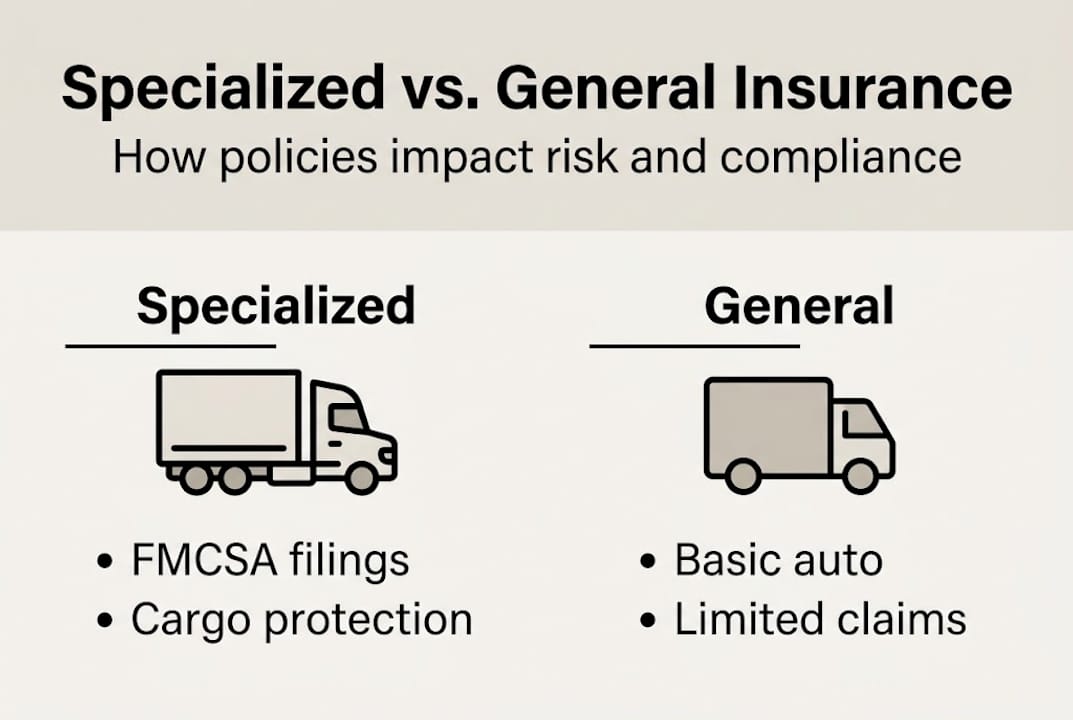
Once compliance is established, it is crucial to know the practical protections specialized policies deliver. A basic commercial auto policy covers bodily injury and property damage in an accident. That is where it stops for most generalist policies. A specialized trucking policy covers a much wider range of real-world scenarios that basic coverage simply ignores.
Specialized policies typically include cargo insurance, physical damage coverage, reefer breakdown protection for refrigerated loads, hazmat liability, and loss-of-income or downtime coverage. For owner-operators specifically, coverage gaps like non-trucking liability, high-value cargo theft, and pollution cleanup costs are some of the most financially damaging exclusions found in standard policies. These are not edge cases. They are the kinds of losses that happen regularly on real routes.
| Claim scenario | Basic policy outcome | Specialized policy outcome |
|---|---|---|
| Refrigerated cargo spoils due to breakdown | Not covered | Covered under reefer breakdown endorsement |
| Truck stolen while off-duty between hauls | Likely excluded | Covered under non-trucking liability |
| Hazmat spill requires roadside cleanup | Not covered | Covered under hazmat/pollution endorsement |
| Accident causes 3-week downtime | No income replacement | Covered under downtime or rental reimbursement |
Reviewing your current policy for exclusions and endorsements is something every fleet manager should do at least once a year. Start by pulling your declarations page and listing every covered peril. Then compare that list against the most common claim types in your cargo category. Next, ask your agent directly which endorsements are available and what they cost. Finally, request a sample claim scenario walkthrough so you understand exactly how your policy responds before you need it.
Understanding how specialized insurance for business risks applies to trucking operations helps you identify where your insurance safety net has holes before a claim reveals them.
Pro Tip: Always ask your insurer about rental reimbursement and broad form endorsements. Rental reimbursement pays for a substitute vehicle while yours is being repaired, and broad form endorsements expand physical damage coverage beyond the standard terms. These additions are often inexpensive relative to the protection they provide.
Financial impact: risk, claims, and cost control
Coverage details are only part of the equation. The financial impact of underinsurance can be devastating if not fully understood. Claims severity rose 166% between 2015 and 2023 in some regions, and nuclear verdicts exceeding $10 million have become a real threat to small and mid-sized fleets. A single catastrophic accident can generate legal fees, settlement costs, and cargo claims that exceed the value of your entire operation.
The financial threats from underinsurance are not limited to accidents alone. A single serious accident can trigger a lawsuit that exceeds your policy limits, leaving your business assets exposed. Downtime from an uninsured breakdown can mean days or weeks without revenue. A denied load due to insufficient coverage directly costs you income while your truck sits idle. Repeat compliance issues can result in elevated premiums that compound over time, making it harder to stay competitive.

Specialized trucking carriers address these risks through more than just better coverage. Many integrate telematics data, proactive risk management programs, and dedicated claims support that generalist carriers simply do not offer. Telematics, which refers to GPS and vehicle performance monitoring technology, has become one of the most effective tools for both reducing accidents and lowering premiums. Understanding box truck insurance costs gives you a concrete starting point for budgeting these protections into your operation.
Stat callout: Telematics integration can reduce trucking insurance premiums by 15 to 40 percent, while also generating documented driving data that strengthens your defense in the event of a disputed claim.
Pro Tip: Investing in a telematics system pays off in two ways. It lowers your upfront premium costs through demonstrated safe driving behavior, and it gives you timestamped, GPS-verified data that can counter exaggerated or fraudulent claims against your drivers.
Choosing the right provider: Specialized vs. general insurance
Financial risks make it clear that the provider you choose can make or break your trucking business. Not all insurance companies that sell commercial auto coverage actually understand the trucking industry. The difference between a specialist and a generalist goes far beyond marketing language.
Specialized trucking insurance providers operate using trucking-only carrier programs and maintain deep familiarity with FMCSA filings including the MCS-90 endorsement and BMC-91 bond, which are federal documents required for operating authority. Generalist agents often lack experience with these filings, and a single error in an MCS-90 submission can delay or block your operating certificate.
| Factor | Generalist provider | Specialized provider |
|---|---|---|
| FMCSA filing knowledge | Limited or inconsistent | Deep, ongoing expertise |
| MCS-90 and BMC-91 handling | Prone to errors | Standard practice |
| Claims processing speed | Slower, less trucking-specific | Faster, industry-informed |
| Fleet scaling capability | Often restricted | Built for growth |
| Cargo-specific endorsements | Rarely available | Offered as standard options |
Signs that you need a specialized provider include being turned down for loads due to coverage gaps, experiencing claim delays caused by adjuster unfamiliarity with trucking regulations, or receiving FMCSA compliance notices after your agent submitted incorrect filings. Minimum compliance limits market access to a significant degree, and a specialized provider who exceeds those limits by default gives you a meaningful operational advantage.
Working with a team that has genuine expertise in navigating insurance with specialists means fewer surprises at renewal and stronger support when claims arise. Understanding the full coverage spectrum comparison between policy types equips you to ask better questions and make a decision grounded in real operational needs. Even adjacent industries like commercial moving operations demonstrate how specialized coverage structures consistently outperform generic alternatives when claims become complex.
“The most expensive insurance mistake a fleet owner can make is assuming their agent understands trucking. Incorrect FMCSA filings and missed endorsements don’t just cause paperwork delays. They stop loads, trigger audits, and in serious cases, result in suspended authority.”
The hidden pitfalls of generic trucking insurance: An industry insider’s view
Comparing providers naturally leads to one of the most important questions: what do experienced fleet managers wish they had known sooner? The conventional wisdom in fleet management says to control costs by keeping premiums low. That logic is sound until it is not. The problem with generic trucking insurance is not what it covers. It is what it excludes, and how slowly it responds when you actually need it.
We have seen fleets lose six-figure contracts because a non-specialist agent submitted an inaccurate MCS-90 filing. The carrier assumed coverage was in place. The broker ran a compliance check and found a documentation error. The load went to a competitor. That kind of loss never shows up in a premium comparison spreadsheet, but it is very real.
The harder lesson is this: the insurer who processes your box truck insurance the fastest during a claim is worth more than the one who offered the lowest quote at binding. Always verify your insurer’s filing history and ask for references from trucking-specific clients before you sign. The quality of your coverage is only revealed when a claim is filed.
Safeguard your fleet with the right trucking insurance partner
You now have a clear picture of what specialized trucking insurance covers, what compliance actually requires, and why the provider you choose matters as much as the policy itself. The next step is putting that knowledge into action.
At Diamondback Insurance, you can get a fast custom insurance quote in minutes, with access to multiple top-rated carriers competing for your business. Our platform is built specifically for trucking professionals who need accurate, compliant, and tailored coverage solutions without the back-and-forth of traditional brokers. Whether you run a single truck or manage a growing fleet, our online quoting process is fast, transparent, and designed to get you covered without delay. Secure your operation today.
Frequently asked questions
Is basic trucking insurance enough for my fleet?
Basic insurance often meets state minimums but falls short of what brokers and shippers actually require. Brokers demand $1M+ for general freight, meaning a minimum-only policy can block you from the loads your business depends on.
How does specialized insurance lower my costs?
Specialized policies reduce costs through targeted discounts and stronger claims outcomes. Telematics can yield 15 to 40 percent premium reductions while also providing documented driving data that improves your defense in disputed claims.
What risks does specialized trucking insurance cover?
Specialized policies go well beyond standard commercial auto. Tailored coverage protects against cargo exclusions, non-trucking liability gaps, reefer breakdown, hazmat incidents, and income loss during downtime.
Why do general insurance agents cause delays or downtime?
Generalist agents often lack experience with trucking-specific federal documents. Specialized providers understand FMCSA filings including the MCS-90 and BMC-91, reducing the risk of errors that can block loads or delay your operating authority.
Recommended
- Q&A Blog Post: Box Truck Insurance Near Me
- Q&A Blog Post: Box Truck Insurance Quotes
- Navigating Workers’ Compensation Insurance for Travelers with DiamondBack Insurance: Instant, Efficient, and Comprehensive – Diamondback Insurance – Solutions with Instant Online Quotes
- Securing Success: General Liability Insurance for Contractors with DiamondBack Insurance – Diamondback Insurance – Solutions with Instant Online Quotes