

Managing insurance for a commercial fleet is one of the most expensive and time-consuming responsibilities you face as a trucking business owner. Commercial truck premiums average $8,000 to $14,000 per vehicle annually for small fleets, and that number keeps climbing. Traditional insurance processes make it worse, burying you in paperwork, slow quotes, and limited options. Online insurance platforms are changing that reality. This guide walks you through how these platforms reduce costs, simplify administration, and give you real leverage when it matters most, including how telematics integration can turn your fleet’s safety record into measurable savings.
Table of Contents
- Traditional insurance headaches: Why change is needed
- What online insurance platforms really offer
- Telematics integration: Unlocking usage-based savings
- The trade-offs: Transparency, upfront costs, and edge cases
- What most insurance guides miss: Leveraging data for negotiation
- Discover streamlined fleet insurance solutions
- Frequently asked questions
Key Takeaways
| Point | Details |
|---|---|
| Online insurance unlocks savings | Digital platforms help fleets save up to 25% through telematics and bundling options. |
| Improved efficiency and faster claims | Fleets using online platforms process claims 92% quicker, reducing admin burden. |
| Balanced view on trade-offs | Managers should weigh upfront telematics costs and privacy concerns against long-term benefits. |
| Leverage data for negotiation | Using safety and maintenance metrics on platforms empowers fleets to secure below-market rates. |
Traditional insurance headaches: Why change is needed
If you’ve spent any time managing fleet coverage through a traditional broker, you already know the frustration. Getting a quote takes days. Comparing policies means juggling multiple phone calls and PDF documents that all look slightly different. When you finally get a number, there’s little room to push back because you have no benchmark to compare it against.
The administrative burden alone is significant. Renewing coverage for even a five-truck fleet can require hours of documentation, driver records, and back-and-forth with agents who may not specialize in commercial trucking. You’re often assigned a generalist broker who handles everything from homeowner policies to commercial auto, which means the advice you receive isn’t always calibrated to the specific risks and regulations of the trucking industry.
Transparency is another persistent problem. Traditional insurance models are not designed to show you what factors are driving your premium. You receive a number, and unless you know the right questions to ask, you accept it. This lack of visibility makes it nearly impossible to identify where you can optimize coverage or reduce costs.
The pricing environment has only made things harder. Fleet insurance premiums have risen 47% since 2020, putting real pressure on small trucking businesses that are already managing tight margins. That kind of increase isn’t just a line item on a spreadsheet. It affects hiring decisions, equipment upgrades, and your ability to stay competitive on freight rates.
For fleet managers looking to understand the full scope of their coverage obligations, reviewing box truck insurance near me options can reveal how dramatically costs and coverage terms vary by vehicle type and region. The traditional model simply doesn’t make it easy to see those differences side by side.
“A 47% premium increase since 2020 isn’t an industry footnote. For a small fleet owner running five vehicles, that could mean $35,000 or more in additional annual costs. That’s a driver’s salary. That’s a truck payment. It demands a smarter approach to how you shop for and manage coverage.”
Having outlined the challenge, it’s time to look at how online platforms are different.
What online insurance platforms really offer
Online insurance platforms are built around one core idea: give you the information and tools to make better decisions faster. Instead of waiting days for a quote, you enter your fleet details and receive multiple competitive offers within minutes. Instead of relying on a single broker’s relationships, you access a network of insurers competing for your business.
The transparency difference is real. Online platforms increase transparency, offer discounts, and support bundling for fleets in ways that traditional brokers rarely match. You can see exactly what each policy covers, compare deductibles and liability limits side by side, and filter options based on your specific operational needs.
Here’s a direct comparison of what you can expect from each model:
| Feature | Traditional insurance | Online platform |
|---|---|---|
| Quote turnaround | 1 to 5 business days | Minutes |
| Policy comparison | Limited, single broker | Multiple insurers, side by side |
| Bundling options | Varies by broker | Standardized, easy to apply |
| Pricing transparency | Low | High |
| Digital document access | Often paper-based | Fully digital |
| Discount visibility | Minimal | Clearly listed |
Beyond speed and transparency, online platforms offer features specifically useful for fleet operations. You can manage certificates of insurance digitally, update driver records without calling an agent, and set renewal reminders so you’re never caught off guard. Bundling commercial auto with general liability or workers’ compensation is straightforward, and the savings are visible before you commit.
Understanding your full coverage picture is important. Reviewing a solid liability insurance guide can help you identify gaps before they become costly claims. For businesses in Texas or other high-activity states, platforms that offer instant online workers comp coverage make it easier to stay compliant without the usual administrative delays.
Pro Tip: When comparing bundled policies on an online platform, always calculate the total cost of all coverages together, not just the commercial auto line. Bundling discounts of 10 to 25% can make a significant difference in your annual spend.
As online platforms simplify insurance, they also unlock savings and unique opportunities. Next, let’s see how telematics amplify these benefits.
Telematics integration: Unlocking usage-based savings
Telematics refers to technology that collects real-time data from your vehicles, including location, speed, braking patterns, idle time, and hours of service. When this data is connected to your insurance platform, it enables usage-based insurance, commonly called UBI, where your premiums reflect your fleet’s actual behavior rather than industry-wide averages.

This matters because most small fleets are being priced based on the risk profile of the entire trucking industry, including operators with poor safety records and high claim histories. If your drivers are safe and your maintenance is current, you’re subsidizing someone else’s risk. Telematics lets you prove your fleet is different.
Telematics on online platforms supports UBI, offering 12 to 25% premium reductions. For a fleet vehicle with a $12,000 annual premium, that’s a potential savings of $1,440 to $3,000 per vehicle, per year. Across a ten-truck fleet, that number becomes transformative. The average savings benchmark sits at $2,840 per vehicle annually for fleets that actively use telematics data.
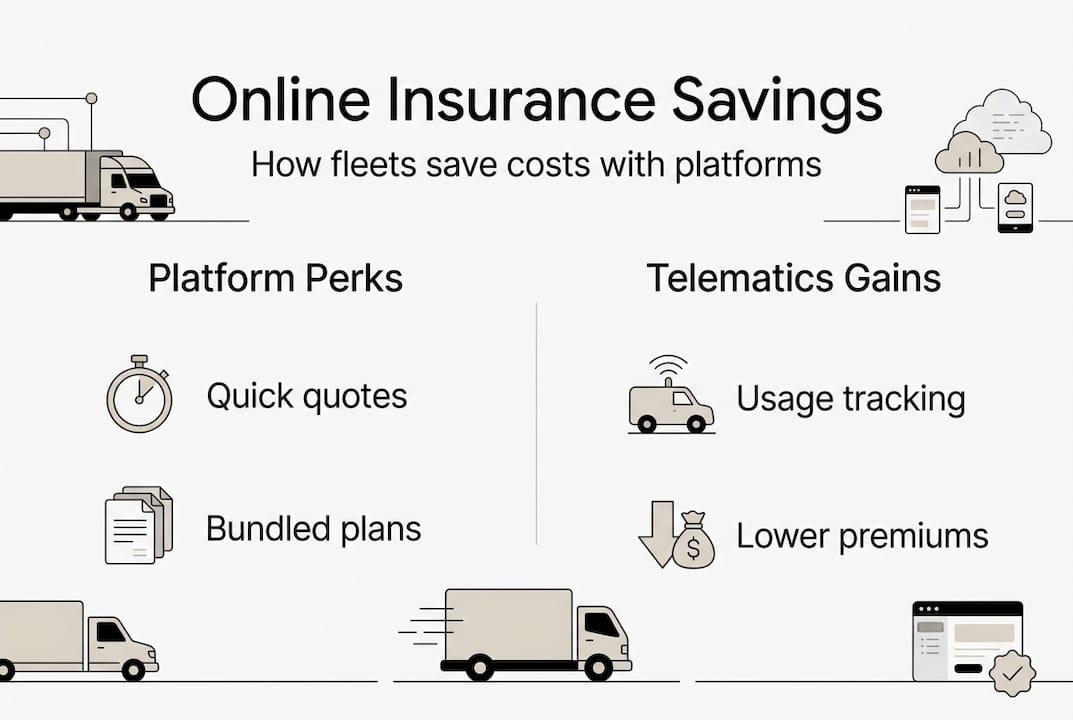
Here’s how the numbers typically break down:
| Metric | Industry average | Telematics-enabled fleet |
|---|---|---|
| Premium reduction | 0% | 12 to 25% |
| Claims processing time | Standard | 92% faster |
| Fraudulent claim rate | Baseline | 67% lower |
| Annual savings per vehicle | None | Up to $2,840 |
Activating telematics-powered discounts is a straightforward process. First, install approved telematics devices on your fleet vehicles, either through a third-party provider or a system integrated with your platform. Second, connect the device data feed to your online insurance account. Third, allow a monitoring period, typically 60 to 90 days, so the insurer can establish your baseline risk profile. Fourth, review the adjusted premium offer and compare it against your current rate. For additional insights on how this technology shapes coverage decisions, telematics insurance insights from industry sources can help you evaluate providers.
For fleets ready to explore specific vehicle coverage options, reviewing insurance quotes for box trucks alongside telematics-adjusted rates gives you a clearer picture of total cost. Platforms that support UBI-supported cost reduction make it easier to tie safety performance directly to premium outcomes.
Pro Tip: Share your CSA (Compliance, Safety, Accountability) score proactively with underwriters when applying through an online platform. A strong score is documented evidence of low risk, and some insurers will factor it into your initial quote rather than waiting for telematics data to accumulate.
While telematics turbocharge savings, there are important nuances and trade-offs to consider before diving in.
The trade-offs: Transparency, upfront costs, and edge cases
Telematics and online platforms offer real advantages, but they aren’t without limitations. Before you commit, it’s worth understanding where the friction points are so you can plan accordingly.
The most common challenges fleet managers encounter include upfront hardware costs for telematics devices, which can range from $100 to $500 per vehicle depending on the provider. Not all insurers participate in telematics programs, which can limit your options if you’re working with a specialized carrier. Data privacy is also a legitimate concern. When you share driving behavior and location data with an insurer, you need to understand exactly how that data is stored, who has access to it, and whether it can be used against you in a claim dispute.
Equipment costs and privacy concerns exist with telematics sharing, and some insurers limit access to their programs based on fleet size or vehicle type. Reviewing data usage and privacy policies before signing up is a step many fleet managers skip, and it’s one that can cause problems later.
For high-risk fleets or new authorities, the picture is actually more encouraging than many expect. Online platforms give brokers access to a broader network of specialized carriers that traditional agents may not work with. If your fleet has a poor CSA score, recent violations, or you’re operating under a new authority, a platform’s aggregated marketplace increases your chances of finding coverage that fits. The online claims efficiency tools available through digital platforms also make it easier to document and resolve incidents quickly, which matters a great deal when you’re rebuilding a safety record.
“The real question isn’t whether telematics is worth it. It’s whether you’ve done the work to understand your data before your insurer does. Fleets that review their own telematics reports before renewal are in a far stronger negotiating position than those who let the insurer interpret the numbers alone.”
Having weighed the pros and cons, let’s bring these insights together and share what most industry guides overlook.
What most insurance guides miss: Leveraging data for negotiation
Most articles about online insurance platforms focus on the convenience angle: faster quotes, easier comparisons, digital documents. That’s all true, but it misses the most powerful use case for fleet managers who are serious about controlling costs.
The real opportunity is using your platform’s data as negotiation leverage at renewal time. Platforms excel for standard operations but pair best with telematics and CMMS (Computerized Maintenance Management System) data for renewal negotiations. When you walk into a renewal conversation with 12 months of clean telematics data, documented maintenance records, and a strong CSA score, you’re not just hoping for a better rate. You’re proving you deserve one.
Most underwriters respond to documented evidence. Sharing your CSA scores, driver safety metrics, and maintenance logs through your platform gives insurers a concrete reason to price your fleet below industry averages. This is leverage that most small fleet owners never use because they don’t know it exists. Reviewing renewal negotiation tips well before your policy expires gives you time to compile the right data and present it effectively.
Pro Tip: Start building your renewal dataset at least 90 days before your policy expires. Compile telematics reports, maintenance records, and any safety certifications your drivers have completed. The earlier you prepare, the stronger your position when it’s time to negotiate.
Now that you’re ready to apply these strategies, explore solutions designed for fleets and learn how to get a quote.
Discover streamlined fleet insurance solutions
Managing fleet insurance doesn’t have to mean hours of phone calls, stacks of paperwork, and premiums that feel impossible to control. Diamondback Insurance is built for fleet managers and small trucking business owners who want a faster, more transparent way to secure the coverage they need.
Through our platform, you can access online insurance quotes from multiple top-rated carriers in minutes, compare options side by side, and purchase coverage directly without the back-and-forth of traditional brokers. Whether you’re protecting a single box truck or a growing fleet, we make it straightforward to find the right coverage at a competitive rate. Explore liability insurance essentials and get your instant quote today.
Frequently asked questions
How much can fleets save using telematics on online insurance platforms?
Safe fleets using telematics-enabled platforms often see 12 to 25% reductions in premiums, translating to savings of up to $2,840 per vehicle per year based on industry benchmarks.
Can new or high-risk trucking authorities benefit from online insurance platforms?
Yes, online platforms give brokers access to specialized carriers, making it easier to find coverage for new businesses or fleets with poor CSA scores, as new authorities and high-risk profiles are better served through aggregated marketplace options.
What should fleet managers watch out for when sharing telematics data?
Managers should review upfront hardware costs, confirm limited insurer availability won’t restrict their options, and ensure data privacy agreements are clearly defined before sharing any telematics information with insurers.
How do online platforms speed up insurance claims?
Fleets using digital platforms report claims processed 92% faster than traditional methods, with significantly less paperwork and a 67% reduction in fraudulent claim disputes.
Are bundling options available on online insurance platforms for trucking fleets?
Yes, most online platforms offer bundling discounts for commercial auto, liability, and workers’ compensation, with fleet bundling policies saving 10 to 25% compared to purchasing individual coverages separately.
Recommended
- Simplifying Your Boat Insurance Estimate with DiamondBack Insurance – Diamondback Insurance – Solutions with Instant Online Quotes
- Chart Your Course with Confidence: The Marine Insurance Policy at DiamondBack Insurance – Diamondback Insurance – Solutions with Instant Online Quotes
- Navigating the Seas with Confidence: Marine Insurance for Your Cargo – Diamondback Insurance – Solutions with Instant Online Quotes
- Understanding Yacht Insurance Cost A Comprehensive Guide by DiamondBack Insurance – Diamondback Insurance – Solutions with Instant Online Quotes
- How to optimise corporate taxi costs for Cyprus businesses