

Most small businesses pay a monthly amount per employee within a range reflecting the type of work, with desk-based or beauty and wellness work at the lower end and heavier-risk trades at the higher end. On an annual basis, this results in a moderate yearly cost per employee for small firms, while transportation and logistics operations can cost significantly more.
The number that moves your premium more than any other single factor is your class code, the classification tied to what your employees actually do. Payroll size and your experience modification rate (EMR) come next. A few benchmarks worth anchoring on before you get quotes:
- MoneyGeek’s 2026 cost analysis puts small-business monthly costs around $113 per employee for firms with one to four workers, with industry-level ranges spanning $16 to $343 per employee monthly.
- GetBusinessCoverage reports a typical small-business median near $54 per month.
- Investopedia cites a lower average of about $45 per month, drawn from a different carrier sample, which shows how much published averages shift depending on who is doing the counting.
The fastest way to get a number that actually applies to you is to run a cost calculator with your real payroll and class code, or request quotes from a few carriers that specialize in your industry.
Key Takeaways
Workers’ comp premiums are driven primarily by class code and payroll, calculated as (payroll ÷ 100) × class rate × EMR, with state rules and carrier expense loads layered on top.
| Point | Details |
|---|---|
| Typical monthly range | Small businesses generally pay $45 to $113 per employee monthly, with industry extremes from $16 to $343. |
| Core formula | Estimate premium as (annual payroll ÷ 100) × class rate × experience modification. |
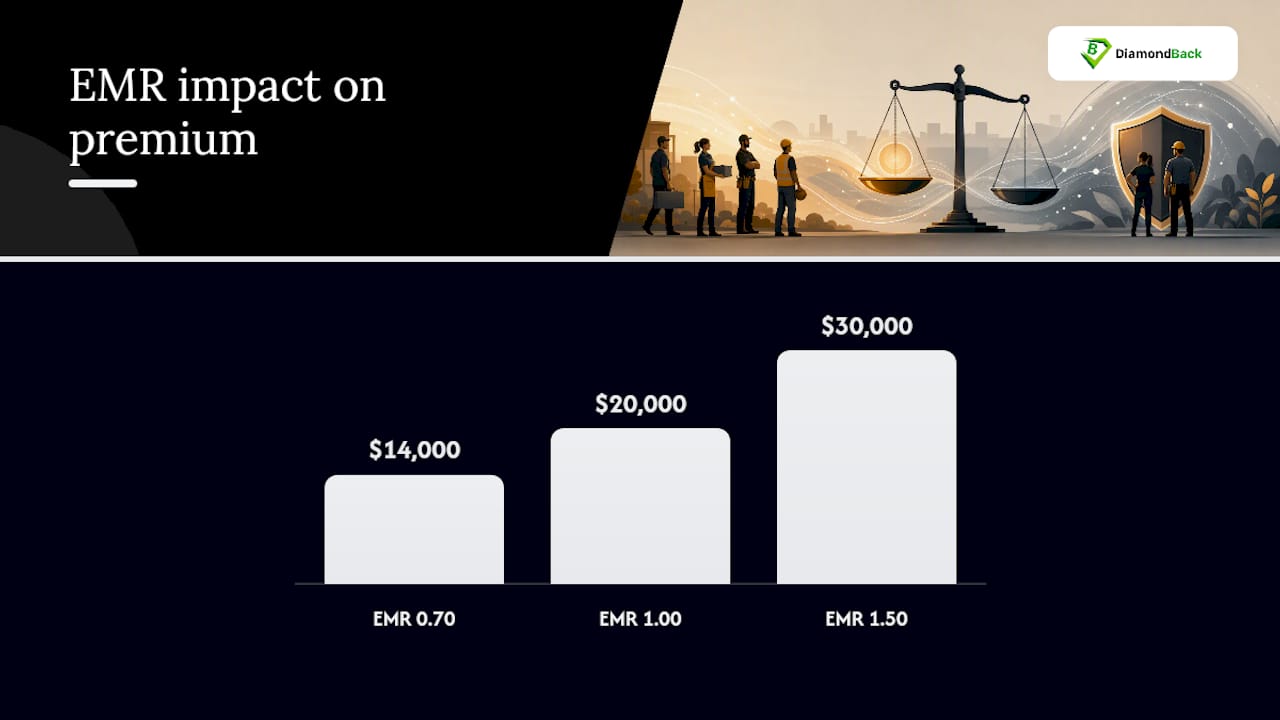
| EMR is your biggest lever | A 0.70 EMR can cut premium roughly 30% versus a 1.50 EMR adding about 50%. |
| State rules vary sharply | Four states (North Dakota, Ohio, Washington, Wyoming) require buying through a monopolistic state fund. |
| Verify before you bind | Confirm class codes, payroll accuracy, and state mandates before accepting any quote. |
| Compare instantly | Diamondbackins aggregates tailored quotes from multiple carriers so you can compare pricing without repeating paperwork for each one. |
Table of Contents
- How Much Is Workers Comp Insurance for a Small Business?
- What Factors Determine Your Workers’ Comp Premium?
- How Do You Calculate Your Workers’ Comp Premium?
- How Much Does Workers’ Comp Cost by State?
- How Can You Lower Your Workers’ Comp Costs?
- How Do You Get Accurate Workers’ Comp Quotes?
- How Accurate Is a Workers’ Comp Cost Calculator?
- Is Workers’ Comp Insurance Mandatory for Your Business?
- What Should You Ask Before Choosing a Carrier?
- What’s the Smartest Way to Approach Workers’ Comp Costs?
- How Diamondbackins Helps You Estimate and Compare Workers’ Comp Costs
- Where Can You Verify These Workers’ Comp Numbers Yourself?
- Frequently Asked Questions
- Sources
How Much Is Workers Comp Insurance for a Small Business?
The honest answer is: it depends heavily on what your employees do, not just how many of them you have. A bookkeeping firm and a roofing crew with the same headcount can post premiums that differ by a factor of ten or more.
Industry-wide, per-employee monthly costs range from about $16 to $343, with beauty and wellness businesses at the low end and transportation and logistics operations at the high end. Firms with one to four employees average close to $113 per employee monthly under that same analysis, and per-employee cost tends to fall as headcount grows, since fixed underwriting and administrative costs spread across more payroll and businesses become eligible for experience rating that rewards a clean claims history.
Three quick profiles show how differently this plays out in practice:
- Clerical work sits near the bottom of the NCCI risk scale, which is why office-based businesses pay the least.
- Food service blends lower-risk front-of-house roles with higher-risk kitchen work, landing it in the middle.
- Construction trades carry burn, fall, and strain risk that pushes rates toward the top of the range, a pattern the National Safety Council’s injury cost data backs up with actual claims frequency and severity figures.
Everything else in this article exists to help you find your own number instead of leaning on someone else’s average.
What Factors Determine Your Workers’ Comp Premium?
Seven levers set your premium, and you control some of them far more than others.
- Class code. This is the single biggest driver. NCCI (the National Council on Compensation Insurance) assigns advisory loss costs per $100 of payroll for each job classification, and the spread is enormous. GetBusinessCoverage cites a Colorado filing example where clerical work rates near $0.05 per $100 of payroll while roofing rates near $5.40, a spread of more than 100 times.
- Payroll. Premiums are priced per $100 of payroll within each class code, so a business with $500,000 in payroll in a given class pays five times what a business with $100,000 in the same class pays, all else equal.
- Experience modification rate (EMR). This factor, usually built after three years of claims history, adjusts your premium up or down based on how your actual losses compare to what is expected for your class.
- State rating bureau and loss costs. Most states use NCCI-filed advisory rates as a baseline; some states run their own independent rating bureaus with different loss-cost assumptions.
- Claims history. Frequent or severe past claims raise your EMR and can also trigger tighter underwriting scrutiny even before the math kicks in.
- Business size and payroll mix. A business that blends office staff with field crews under one policy needs accurate job-by-job payroll allocation, since misclassifying warehouse workers as clerical (or vice versa) skews the whole premium.
- Carrier expense loads. Beyond the state’s base loss cost, each carrier layers on its own loss-cost multiplier to cover overhead, profit margin, and claims administration, which is why quotes for the same risk can still vary between insurers.
NCCI states versus monopolistic funds. Most states let you shop workers’ comp among competing private carriers, using NCCI-filed loss costs as the pricing floor. A handful of states, including North Dakota, Ohio, Washington, and Wyoming, run monopolistic state funds, meaning employers there cannot buy from the private market at all and must purchase directly through the state system.
Here’s how much EMR alone can swing your bill: CostPrism’s rate tables show that an EMR of 0.70 can cut your premium by roughly 30% against the class baseline, while an EMR of 1.50 can add about 50%. On a $20,000 baseline premium, that is the difference between paying around $14,000 and paying $30,000, for otherwise identical payroll and class code.
Pro Tip: Pull your EMR worksheet from your current carrier every renewal, even if you’re not shopping. A single data-entry error in a claim reserve can inflate your mod for years before anyone catches it.
How Do You Calculate Your Workers’ Comp Premium?
The core formula carriers use to build a base premium is:
(Annual payroll ÷ 100) × class rate × experience modification = estimated premium
Your EMR only applies once you have enough claims history, usually after your third year in business or once you cross a state-specific premium threshold; new businesses typically start at a neutral 1.00 mod.
Here’s a worked example for a landscaping company with 10 employees and $450,000 in annual payroll, assigned a class rate of $8.50 per $100 of payroll (a realistic outdoor-labor rate) and an EMR of 0.95 for a clean claims history:
That $303 monthly figure lines up closely with the high end of MoneyGeek’s transportation and logistics range, which makes sense since outdoor manual labor carries comparable injury risk.
The quoted price you actually pay rarely stops at this formula. Carriers apply their own loss-cost multiplier on top of the state’s advisory rate to cover overhead and claims handling, and most states also tack on assessments for the state’s second-injury or uninsured-employer funds. Nearly every state enforces a minimum premium regardless of how small your payroll is, so a business with only one part-time employee may still owe a few hundred dollars a year even when the raw formula produces less. Break down your own numbers with a per-employee cost worksheet before you assume the sticker price on a quote is final.
How Much Does Workers’ Comp Cost by State?
Where you’re located changes your premium as much as what your employees do, sometimes more. Three forces drive that spread: medical treatment costs, statutory benefit levels, and how litigious the claims environment is in your state.
- States with higher medical costs and more generous wage-replacement benefits, often concentrated in the Northeast and parts of California, tend to sit at the higher end of the national rate spread.
- States with lower medical-cost baselines and less claims litigation, common across parts of the Midwest and South, often land toward the lower end.
- Rates within the same class code can differ by two or three times between the cheapest and most expensive states, largely because each state rating bureau files its own loss costs independent of neighboring states.
Four states run monopolistic funds: North Dakota, Ohio, Washington, and Wyoming. If your business operates in any of these, you cannot buy workers’ comp from a private carrier for work performed there; you buy directly from the state fund, and your rate options are limited to whatever that fund publishes. Everywhere else, you’re shopping the competitive private market, where NCCI-filed advisory loss costs set the baseline and carriers compete on their expense load and service.
To check your own state’s numbers, go to the source rather than a generic estimate. State rating bureaus and state fund pages, like Florida’s FWCJUA rates page, publish actual filed rates and assigned-risk pool information for employers who can’t find coverage in the standard market. If you operate across state lines, especially in trucking or logistics, rate differences by state are worth mapping out early, since payroll allocated to a higher-cost state raises your blended premium even if your home office sits somewhere cheaper. New York employers in particular deal with a distinct rate environment worth understanding on its own terms; Diamondbackins breaks down the specifics of New York’s system for businesses operating there.
How Can You Lower Your Workers’ Comp Costs?
Cost reduction here isn’t about finding a loophole. It’s about giving underwriters fewer reasons to price in risk they can’t verify.
- Build a real safety program, not a poster on the break room wall. Documented safety training, protective equipment protocols, and regular hazard walkthroughs reduce claim frequency, which is the input that eventually lowers your EMR.
- Run a return-to-work program. Getting injured employees back into modified light duty, rather than leaving them on full wage-replacement, shortens claim duration and cuts the total cost carriers attribute to that claim.
- Verify your class codes every renewal. Misclassified employees, office staff coded under a field-labor class, for instance, quietly inflate premiums for years if nobody checks.
- Keep payroll records accurate and current. Underreporting payroll to lower an estimated premium backfires hard at audit time, when carriers back-bill the difference plus interest.
- Consider pay-as-you-go billing. Instead of estimating annual payroll upfront and reconciling later, pay-as-you-go workers’ comp calculates premium from actual payroll each pay period, which smooths cash flow and reduces audit surprises.
- Shop carriers that specialize in your industry. A carrier with deep experience in your class code often prices risk more accurately, and sometimes more favorably, than a generalist.
- Manage claims actively once they happen. Prompt reporting, clear communication with the adjuster, and early return-to-work outreach all reduce the eventual reserve amount tied to your EMR.
Pro Tip: Your EMR is calculated from a rolling three-year claims window that excludes your most recent policy year, so a bad claim doesn’t hit your mod immediately. That gives you roughly a full year to improve safety practices before that claim starts affecting your rate, and the effect fully rotates out after about three years.
For businesses with larger payrolls, a deductible policy, where you agree to reimburse the carrier for a set dollar amount per claim in exchange for a lower base premium, can meaningfully cut costs if your claims frequency is genuinely low. A loss-prevention consultant, often available through your carrier or broker at no separate charge, can also identify hazard patterns specific to your operation that a generic safety checklist misses. Self-insurance, where a business sets aside reserves to pay its own claims instead of buying a policy, is rarely realistic below several hundred employees and heavy state approval requirements, so most small businesses should treat it as a distant option rather than a near-term strategy.

How Do You Get Accurate Workers’ Comp Quotes?
Getting quotes you can actually compare starts with giving every carrier the same clean set of information.
Before you request pricing, gather:
- Detailed payroll broken out by job duty, not just a single company-wide total.
- The class codes you believe apply to each role, plus job descriptions if the code is ambiguous.
- Three to five years of prior claims history, including your current EMR worksheet if you have one.
- Certificate-of-insurance requirements from any clients or general contractors who require proof of coverage.
How the audit process actually works. Nearly every workers’ comp policy is subject to an audit, either mid-term, at renewal, or both. The carrier compares the payroll you estimated at binding against your actual payroll records for the period, then adjusts your premium up or down to match reality. The most common pitfall is underreporting payroll early to keep the initial quote low; that gap simply gets billed back at audit, often with less time to plan for the expense. Pay-as-you-go arrangements reduce this risk substantially since premium tracks actual payroll in near real time instead of an annual estimate, which is one reason it has become common for staffing-heavy and seasonal businesses.
When you’re ready to compare offers, get quotes from at least three carriers, and judge them on more than the number at the bottom of the page. Ask how each one handles class-code disputes, what their claims service actually looks like when something goes wrong, and how appetite for your specific industry shapes their underwriting. A side-by-side quote comparison makes it much easier to see where carriers actually differ instead of guessing from premium alone.
How Accurate Is a Workers’ Comp Cost Calculator?
A cost calculator gives you a starting estimate, not a bound price, but it’s still the fastest way to move from “I have no idea” to a number worth acting on.
Most calculators, including the formula-based tools referenced earlier in this article, ask for three inputs: your state, your primary industry or class code, and either your estimated annual payroll or your employee count with average wages. From those three inputs, the tool applies the relevant advisory loss cost and a default experience modification (usually 1.00 for businesses without established claims history) to produce a per-employee monthly and annual estimate.
- Inputs needed: state, industry/class code, payroll or headcount plus average wage.
- Output: estimated per-employee monthly and annual premium range.
- Data behind the estimate: state advisory loss costs and industry benchmark averages drawn from sources like the ones cited throughout this article.
Take the landscaping example from earlier: A 10-employee crew with $450,000 in payroll and an $8.50 class rate produced a calculated premium near $303 per employee monthly before any carrier-specific adjustment. That’s the kind of output a calculator would hand you instantly, and it’s a genuinely useful planning number.
The limitation is real, though: a calculator can’t know your actual claims history, your carrier’s specific expense load, or state assessments that apply only to your situation. Treat the output as a planning range, then confirm the real number with actual quotes matched to your industry.
Is Workers’ Comp Insurance Mandatory for Your Business?
In nearly every state, if you have even one employee, you’re required to carry workers’ compensation coverage, though the exact threshold and exemptions vary by state.
To confirm your specific obligation:
- Check your state’s labor department or workers’ compensation bureau website directly. State rules on required headcount, waiting periods, and exempt categories change more often than generic guides reflect.
- Look for exemptions that commonly apply to sole proprietors with no employees, certain independent contractors, and in some states, seasonal or agricultural workers under specific hour thresholds.
- Confirm whether your state requires purchase through a state fund (the four monopolistic states listed earlier) or allows you to buy from the competitive private market.
Penalties for skipping required coverage are steep and often personal. Depending on the state, going without required coverage can trigger fines calculated per day of noncompliance, stop-work orders that shut down your operation, and in some states, personal liability for the business owner if an employee gets hurt while uninsured. If you discover you’ve been operating without required coverage, the right move is to bind a policy immediately and disclose the gap to your state bureau proactively rather than waiting for an audit or claim to expose it; voluntary disclosure is treated far more favorably than discovery through an incident.
This is general information about state requirements, not legal advice. Confirm your exact obligations with your state’s workers’ compensation bureau or a licensed insurance professional before making coverage decisions.
What Should You Ask Before Choosing a Carrier?
The cheapest quote on paper isn’t always the cheapest policy once claims start happening, so the questions you ask matter as much as the number you get back.
Ask every carrier or agent:
- How do you verify and assign class codes, and will you put the classification in writing before binding?
- How often do you audit, and what documentation will you require at audit time?
- How is my experience modification calculated, and will you walk me through the worksheet?
- Who handles claims once one is filed, and what’s the average response time?
- What loss-cost multiplier are you applying on top of the state’s base rate?
Watch for these red flags before you sign anything:
- Vague or generic class descriptions that don’t match your actual job duties.
- Reluctance to disclose the loss-cost multiplier or explain how your quote was built.
- A quote that’s dramatically lower than every competing bid with little underwriting review behind it; that usually means a surprise at audit, not a bargain.
- Slow or unclear answers about how claims get handled once filed.
Prioritize carriers that specialize in your industry, publish clear fee schedules, and can explain their audit process before you ever ask about price. Pro Tip: If an agent can’t explain your EMR calculation in plain language on the spot, that’s a sign they may not catch errors on your worksheet either.
What’s the Smartest Way to Approach Workers’ Comp Costs?
The mistake I see most small-business owners make isn’t shopping too little, it’s shopping too generically. They request a quote, get a number that feels roughly reasonable, and bind it without ever checking whether the class code matches their actual operation or whether their EMR reflects a fair read of their claims history.
The practical sequence that actually works is straightforward: estimate your likely range using a calculator built on real payroll and class-code math, request quotes from at least three carriers that specifically underwrite your industry, and then invest the savings from tighter pricing into safety and return-to-work programs that keep your EMR trending down year over year. That loop compounds. A business that improves its mod from 1.10 to 0.90 over three years isn’t just saving money this year, it’s locking in a lower baseline for every renewal after that.
Three things to do this week:
- Pull your current payroll broken out by job duty and confirm every class code against actual duties, not job titles.
- Request quotes from at least three carriers that specialize in your industry, using identical payroll and claims data for each.
- If you don’t already have one, start a documented return-to-work protocol before your next claim, not after.
How Diamondbackins Helps You Estimate and Compare Workers’ Comp Costs
Getting from “roughly how much will this cost” to an actual bound policy usually means filling out the same payroll and class-code information over and over for every carrier you contact. Diamondbackins cuts that step out by pulling instant, tailored workers’ comp quotes from multiple carriers off a single set of inputs, so you see comparable pricing without repeating paperwork for each one.

The platform matches your business to carriers with real experience underwriting your class codes, rather than generalists guessing at your risk profile, and supports pay-as-you-go billing options where available so your premium tracks actual payroll instead of a locked annual estimate that risks an audit surprise. A quote through the platform isn’t a bound policy, it’s a fast, transparent starting point for comparing your real options side by side. If you already know your industry runs on tighter margins, Diamondbackins also breaks down how the instant-quote process simplifies class-code mapping so you know exactly what you’re submitting before pricing comes back.
If your payroll spans trucking, transportation, or fleet operations specifically, start with a cost patterns unique to trucking and fleet operations analysis to understand expense tracking and payroll impacts for fleets. Get your instant, side-by-side quotes today and see where your real numbers land.
Where Can You Verify These Workers’ Comp Numbers Yourself?
- NCCI and state rating bureaus publish the advisory loss costs behind every class code; check your state bureau’s filings to see your specific rate before assuming a national average applies to you.
- National Safety Council’s Injury Facts breaks down workplace injury cost data that explains why certain industries carry structurally higher claims costs.
- NASI’s national workers’ comp report offers a broader trend view of how claims and costs move at the national level over time.
- State fund and assigned-risk pages, like Florida’s FWCJUA, show actual filed rates for employers who can’t find coverage in the standard market.
Use the class-code and rating-bureau sources to confirm your exact rate, and treat the industry-average figures throughout this article as a planning range rather than your final number.
Frequently Asked Questions
How much is workers comp insurance for a small business with five employees?
Based on small-business benchmarks, a five-employee business typically pays somewhere between $225 and $565 per month total, or roughly $2,700 to $6,800 annually, depending heavily on industry classification and location.
What’s the average workers comp cost per employee per month?
Published averages vary by data source: MoneyGeek’s small-business benchmark lands near $113, GetBusinessCoverage cites a median around $54, and Investopedia reports an average near $45, reflecting different carrier samples rather than one universal figure.
Does workers comp insurance cost depend on payroll or headcount?
Payroll, not headcount, drives the base premium calculation, since rates are priced per $100 of payroll within each class code; two businesses with the same number of employees can pay very differently if their wage levels or class codes differ.
Can I pay workers comp insurance monthly instead of annually?
Yes. Pay-as-you-go workers’ compensation lets you pay based on actual payroll each pay period instead of an estimated annual premium, which many small businesses prefer for cash flow and audit accuracy.
Is workers comp insurance required if I only have one employee?
In most states, yes, one employee is enough to trigger the requirement, though a handful of states carve out exceptions for certain business structures or part-time work. Confirm your state’s exact threshold with its labor department before assuming you’re exempt.
This article is general information, not a substitute for advice from a qualified financial advisor. Consult a qualified financial professional about your own circumstances before acting on anything here.
Sources
- Average Workers’ Comp Insurance Cost (2026 Report)
- Workers Comp Insurance Cost: Rates + Calculator
- Workers’ Comp Cost Guide 2026: Rates by Industry, Class Code & State | CostPrism
- How Much Is Workers’ Comp Insurance?
Recommended
- How Much Is Workers’ Compensation Insurance for a Small Business – Diamondback Insurance – Solutions with Instant Online Quotes
- Decoding Workers’ Comp Insurance Costs: How It’s Calculated and Simplified with Instant Online Solutions – Diamondback Insurance – Solutions with Instant Online Quotes
- Understanding Workers’ Compensation Insurance Costs: The DiamondBack Insurance Cost Calculator – Diamondback Insurance – Solutions with Instant Online Quotes
- Workers’ Compensation Insurance for Small Businesses