

Your experience mod is the multiplier that directly raises or lowers your workers’ comp premium, and 1.00 is the industry average. A mod above 1.00 means you pay a surcharge; below 1.00 means you get a discount. Whether you even receive a mod depends on state eligibility thresholds, and a single bad claim can inflate your premium for three renewal cycles because of how the lookback period works.
TL;DR:
- Businesses should aim for a mod below 1.00, as most general contractors require subcontractors to have an industry-grade mod of 0.90 or lower for bid eligibility.
- A claim exceeding the state’s split point results in a heavily discounted excess loss, making frequent small claims more damaging than fewer large ones to your mod.
- Errors in reserve amounts, misclassified payroll, or unchallenged outdated claims can artificially inflate your mod and should be reviewed annually.
- Your experience mod is calculated using a four-year window that includes a one-year lag, meaning recent claim improvements may take years to reflect in your premium.
- Reconciling your loss run data before renewal enables accurate quotes and prevents hidden errors from raising your insurance costs.
Table of Contents
- What Is a Workers Comp Experience Mod?
- How Is Your Experience Mod Calculated?
- How Does the Mod Actually Change Your Premium?
- Who Calculates Your Mod, and Does Your Business Even Get One?
- Where to Find Your Mod and How to Check It for Errors
- What Can You Actually Do to Lower Your Mod?
- What Mistakes Keep Your Mod Higher Than It Should Be?
- A Publisher’s Take on Managing Your Mod
- Compare Workers Comp Quotes After You Reconcile Your Data
- Where to Verify This Information Yourself
- Sources
- FAQ
What Is a Workers Comp Experience Mod?
You’ll hear this number called a few different things: experience mod, EMR, or e-mod. All three refer to the same figure, and all three measure one thing: how your actual claims history compares to what’s expected for a business your size, in your industry, doing your kind of work.
A mod of 1.00 means your losses match the average for your class code. Anything under 1.00 is a credit mod, meaning fewer or smaller claims than expected, and it lowers your premium. Anything over 1.00 is a debit mod, and it raises what you pay.
This number does more than affect your renewal invoice. General contractors and large project owners often screen subcontractors by mod rate before they’ll even accept a bid, so a debit mod can quietly cost you work you never knew you lost.
- A 0.90 mod signals better than average safety and claims history.
- A 1.00 mod is neutral, common for newer or smaller employers.
- A 1.10 or higher mod tells insurers and clients you’re a higher risk to insure or hire.
How Is Your Experience Mod Calculated?
The formula compares your actual losses to your expected losses, the payroll-driven baseline for your industry’s class codes. But not all losses count equally.
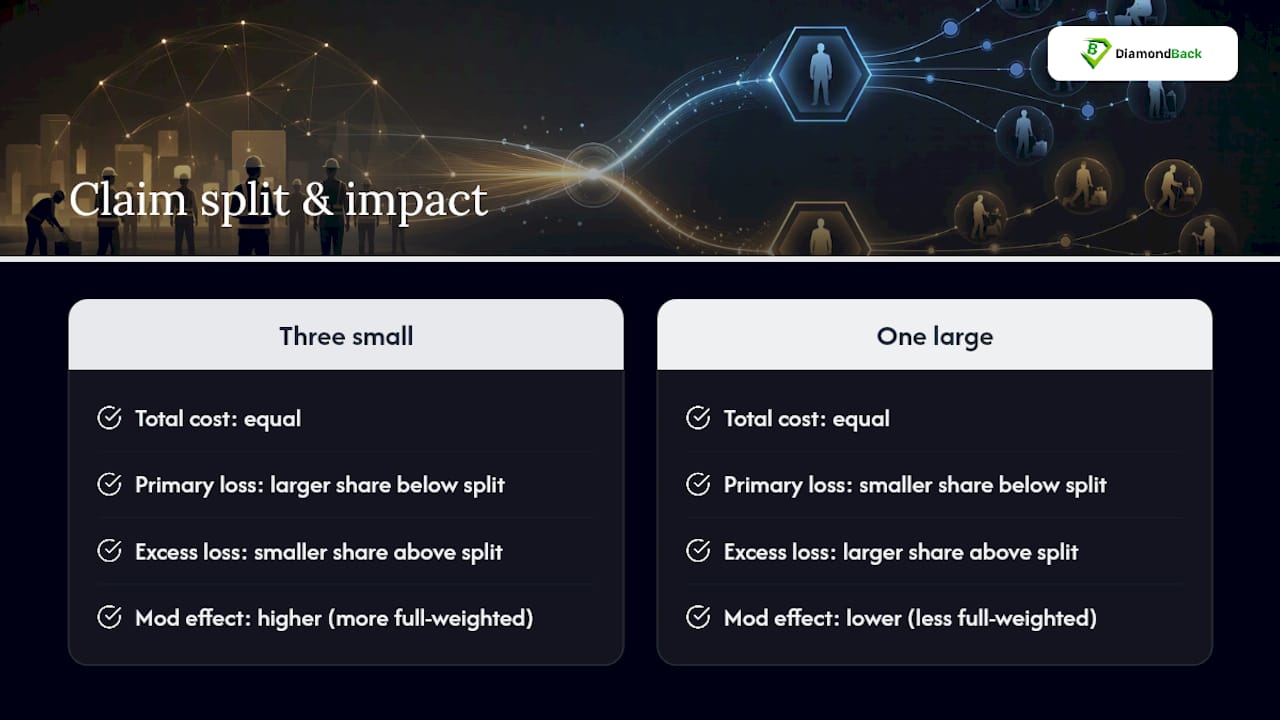
Every claim gets split at a split point, a dollar threshold that varies by state. The portion below that point is your primary loss, and it carries full weight in the formula because it reflects frequency, how often claims happen. The portion above the split point is excess loss, and it’s discounted heavily. This is why three small claims often hurt your mod worse than one large one of equal total cost, a detail that surprises a lot of owners who assume big claims are the only thing to fear.
A D-ratio and a ballast value (also called a stabilizer) keep the math from swinging wildly based on one unlucky year, smoothing results especially for smaller employers. And here’s the part that trips people up: open reserves count at full value, not the amount actually paid out. If your adjuster is sitting on an inflated reserve for a claim that’s mostly resolved, that number is dragging your mod up right now.
Most states use NCCI’s uniform experience rating formula, but a handful, including California, New York, Pennsylvania, Delaware, and New Jersey, run their own independent rating bureaus with slightly different formulas and split points.
Pro Tip: Ask your adjuster for a reserve review before your policy’s valuation date. Correcting an overstated reserve on an old claim can move your mod before it locks in for the year.
How Does the Mod Actually Change Your Premium?
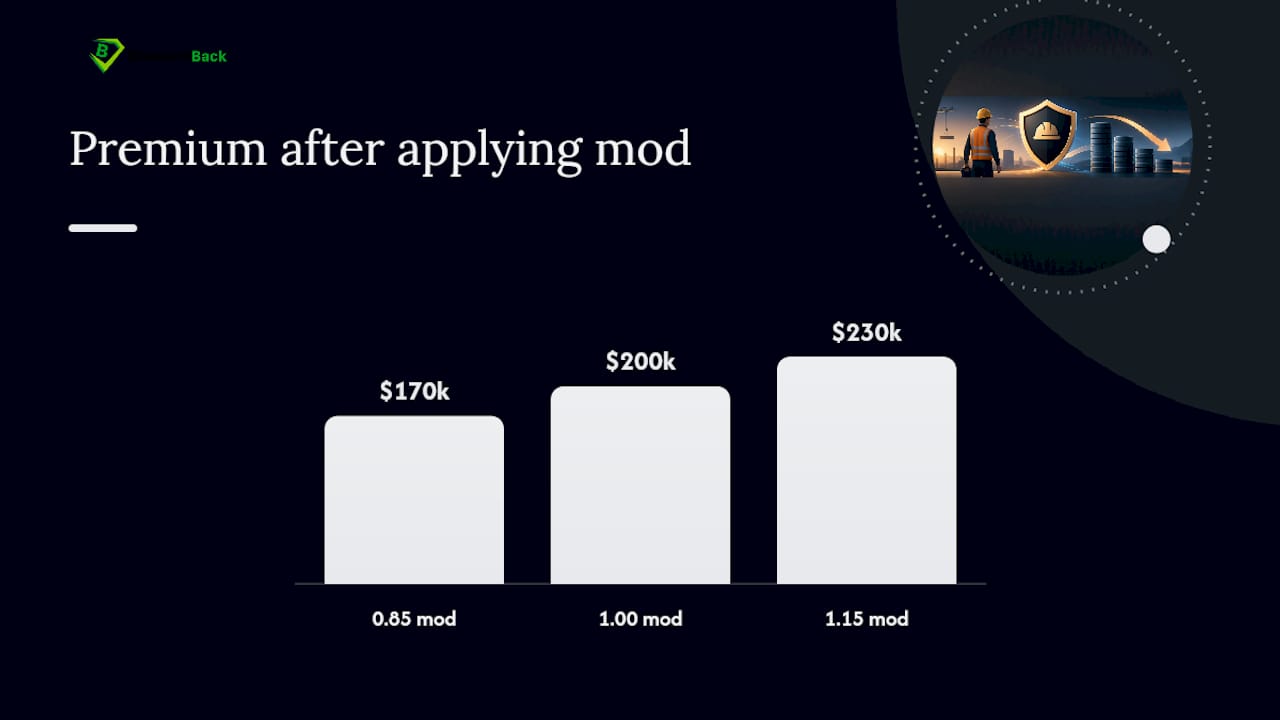
The math is straightforward: your manual premium (the base rate for your payroll and class codes) gets multiplied by your mod. That single number either shrinks your bill or inflates it.
The math is straightforward: your manual premium (the base rate for your payroll and class codes) gets multiplied by your mod. That single number either shrinks your bill or inflates it. NCCI confirms this multiplier effect directly: a 1.25 mod raises premium by 25%, while a 0.80 mod cuts it by 20%.
- 0.85 mod on $200,000 manual premium = $170,000
- 1.00 mod on $200,000 manual premium = $200,000 (no change)
- 1.15 mod on $200,000 manual premium = $230,000
The experience period pulls from the three oldest of your last four policy years, creating a one-year lag before a bad claim year even enters the calculation, and then it stays in the formula for three renewals after that. That’s a four-year window where one rough year follows you around. It’s also why a mod at or below 1.0 often becomes a hard requirement in bid specs, not just a nice-to-have.
Who Calculates Your Mod, and Does Your Business Even Get One?
Most employers get their mod from NCCI, but California, New York, New Jersey, Pennsylvania, Delaware, and Wisconsin, among others, use independent state rating bureaus with their own rules.
Not every business gets an experience mod at all. Employers below a state’s minimum premium threshold typically receive a flat unity mod of 1.0 because there isn’t enough claims history to rate them individually. As payroll grows and premium crosses that threshold, usually somewhere in the low thousands of dollars annually, you become eligible for full experience rating.
- Multi-state employers may see different treatment across NCCI states and independent bureau states.
- Newer businesses typically start at 1.0 until they build a qualifying premium history.
- Crossing a state’s threshold mid-year can trigger experience rating at your next renewal.
Where to Find Your Mod and How to Check It for Errors
Your current mod appears on your policy’s information page, usually labeled Item 4. To dig deeper, request your Experience Rating Worksheet (sometimes called the unit stat worksheet) from NCCI or your state’s rating bureau.
- Pull the worksheet and compare payroll by class code against your actual payroll records.
- Check each listed claim’s primary and excess split, and confirm the reserve amount matches what your carrier’s loss run shows today, not what it showed a year ago.
- Flag any claim missing a subrogation credit, misclassified payroll, or a reserve that looks stale.
- Submit correction requests through your broker, carrier, or the rating bureau directly, with documentation attached.
Reconciling your worksheet against your carrier’s loss run is the single most reliable way to catch errors before they cost you another renewal.
Pro Tip: Request your worksheet every year, even when your mod looks fine. Errors compound quietly, and a data mistake in year one often resurfaces in year three if nobody catches it.
What Can You Actually Do to Lower Your Mod?
Real improvement comes from a mix of claims discipline and prevention, not a single fix. Because primary losses drive the formula, preventing and quickly resolving minor injuries gives you more leverage over your mod than chasing one catastrophic claim.
- Report claims immediately and stay engaged with the adjuster through resolution.
- Pursue subrogation aggressively when a third party caused or contributed to an injury.
- Build a documented safety program using OSHA’s standards and training resources as your framework.
- Offer return-to-work or modified duty roles to cut lost-time claims short.
- Double-check payroll reporting and class code accuracy every audit cycle.
Fleet operators in particular benefit from structured risk management programs that pair driver training with faster incident response. Training resources like transport manager safety refreshers can reinforce those habits at the supervisor level.
Set realistic expectations: because of the three-year lookback, persistent improvements typically take one to three years to fully show up in your mod. Document everything along the way. That paper trail matters when you’re contesting an error later.
What Mistakes Keep Your Mod Higher Than It Should Be?
A handful of avoidable habits quietly lock businesses into worse mods year after year.
- Paying small medical bills out of pocket instead of filing them, which erases the discount medical-only claims are supposed to get.
- Misclassifying employees under the wrong class code or underreporting payroll during audits.
- Ignoring loss runs and letting outdated reserves sit unchallenged past the valuation date.
- Forgetting to pursue subrogation recoveries when another party was at fault.
A Publisher’s Take on Managing Your Mod
Most employers treat their mod as a mystery number that shows up at renewal. It shouldn’t be. Diamondback Insurance works with commercial and trucking clients who routinely find payroll or reserve errors sitting untouched on their worksheets, costing them real money for years. The businesses that improve fastest are the ones that reconcile their loss runs before shopping for new coverage, not after.
— Vladimir
Compare Workers Comp Quotes After You Reconcile Your Data
Instant online insurance quotes pulled from multiple carriers can provide a faster path to accurate pricing, reflecting your actual, corrected loss history instead of relying on stale worksheets.

A reconciled mod means every quote you receive is working from real numbers, not an inflated reserve or a misfiled class code. That’s the difference between a quote that looks good and one that actually holds up at binding. If you’ve just requested your Experience Rating Worksheet and cleaned up the errors, now is the right time to see what corrected data does to your premium. Compare workers’ compensation insurance quotes directly through Diamondback Insurance, or start with a broader look at your commercial coverage options if you’re reviewing multiple policies at once.
Where to Verify This Information Yourself
- NCCI’s ABCs of Experience Rating for the official calculation methodology.
- Your state’s independent rating bureau if you operate in California, New York, New Jersey, Pennsylvania, or Delaware.
- OSHA for safety program standards and training that support claim prevention.
This article is general information, not a substitute for advice from a qualified financial advisor. Consult a qualified financial professional about your own circumstances before acting on anything here.
Sources
- ABCs of Experience Rating — NCCI
- Experience modification rate: how it’s calculated — LegalClarity
- What Is an Experience Modification Rate? — Menlo Insurance Services
FAQ
What Is a Good Experience Mod for Workers’ Comp?
Anything below 1.00 is considered good, since it reflects fewer or smaller claims than expected for your industry. Many contractors aim for 0.90 or lower because general contractors often require subcontractor mods at or below set thresholds before awarding bids.
Where Can I Find My Workers’ Compensation Experience Modification Rate?
Your current mod appears on your policy’s information page, typically listed as Item 4. For the full calculation breakdown, request your Experience Rating Worksheet directly from NCCI or your state’s rating bureau.
What Is the Mod Rate in Workers Compensation?
The mod rate is a multiplier applied to your manual premium based on your claims history compared to the industry average. A mod of 1.25 increases your premium by 25%, while a 0.80 mod reduces it by 20%.
What Is a Mod in Workers Comp, and Does Every Business Get One?
A mod, short for experience modification factor, is the number insurers use to price your workers’ comp premium relative to similar businesses. Employers below their state’s minimum premium threshold typically don’t get individually rated and instead receive a flat 1.0 mod by default.
Does Diamondback Insurance Help With Workers’ Comp Quotes?
Yes, Diamondback Insurance provides instant online quotes for workers’ compensation coverage pulled from multiple carriers for comparison. Current pricing depends on your payroll, class codes, and experience mod, and is available directly through the quote platform.